why text messages?

As the Christmas decorations have been quickly swept away, Shenzhen has entered Chinese New Year mode. Rabbits are popping up everywhere and every type of text message from year in review to greetings are already circulating. On this blog, I have translated text messages because they provide insight into what my Chinese friends feel is worthwhile (funny, insightful, urgent) commentary on society. Indeed, text message culture (短信文化) has been an important factor in many recent social movements (2006, 2007, 2008, and 2009). Indeed, many speculated that the 2010 crackdown on text-porn was a not-so-subtle attempt to tighten censorship controls.

However, simply describing the effects of texting in Chinese cities overlooks an important question: why is texting so popular? Walk down a Shenzhen street and look into hair salons and dress shops, restaurants and convenience stores, any beautician, salesgirl, waiter, and clerk who is not serving a customer is reading or sending a text. On buses and the subway, in cars and yes, in classrooms and business meetings, movie theaters and restrooms, people are texting. Every Chinese New Year the country sets another world record for texts sent for a holiday.

I don’t understand the allure of texting. In part it’s generational; in high school, our thing were three-hour telephone calls. I still enjoy telephone conversations and really enjoy watching the antics of my nieces and nephews when we skype. In part, it’s skill; I do talk faster then I type in English or Chinese. But that’s not all of it. Chinese friends my age have readily adopted texting and regularly send me all sorts of messages. Indeed, setting up a date may involve a series of texts, rather than a phone call. And although part of the allure may be cost – it’s cheap cheap cheap to text – price doesn’t explain why many Chinese not only text, but also purchase services that allow them to text internationally. In other words, folks in Shenzhen are choosing to text more frequently and regularly than I would; indeed, they text in situations that I would either phone, or, frankly not bother. Indeed, in situations where I find texting intrusive, my friends cheerfully read and respond to a text.

And so here’s some cross-cultural speculation du jour: texting has enabled Chinese people to intensify a cultural preference to be in contact with people they care about and it is that moment of contact that is the true message. This desire to be together explains why it is socially necessary to apologize for not seeing a text message and responding immediately. Moreover, I suspect that text messages can grow into social movements precisely because they carry this underlying desire to be [stand] together. In this sense, text messages function as a constant assurance that a relationship is important. Chinese texters confirm this highly desired and desirable sense of solidarity by responding properly to a message. Sometimes that response is texting a smile, sometimes it is going to the restaurant, sometimes it is taking to the street to protest.

As with all speculation about how technology makes, unmakes, and restructures social relationships, the next question is how much quality time is necessary to keep the emotive message of texts resonant. What happens when relationships dissolve into nothing more than text messages? And how much text message-span really is enough to prompt some kind of counter apps? In the meantime, I’m reviewing lists of possible New Year’s messages to choose my contribution to the deluge.

新春佳节不送礼,发条短信祝福你,健康快乐常伴你,好运和你不分离,财神已经跟随你,财源滚滚进袋里,好处全都送给你!(I’m not sending a gift for Spring Festival, I’m sending a text to bless you. May you be healthy and happy. May luck stay with you. May the God of Wealth already accompany you and wealth roll into your pockets. May all good things be given to you!)

snide year’s greetings

it’s that time of year when the snide texts fly… this last one, summarizes thirty years of reform and opening not with a bang, but whimper whimper sigh…

新华社发布最新统计数据:三十年来,升值最快地是住房、墓地、乌纱、古玩和公务员;贬值最快地是职称、文凭、道德、诚信和人民币,惟有友情最保值。民族也日趋增多,新增了月光族、打工族、肯老组、蜗居族、蚁族、骗族、隐婚族、闪婚族、傍官族、小三族、还贷族等!奴隶制有复苏苗头,房奴、车奴、卡奴等已出现。

《最新幸福指数》
家里每人病;牢里没亲人;外头没仇人;圈里没小人;看似没情人!

Xinhua Press has released the latest statistics: these past thirty years, housing, graves, bureaucratic positions, antiques, and functionaries have seen the fastest rise in value; titles, diplomas, morality, trust, and the renminbi have seen the sharpest drop in value. The number of ethnicities has also increased daily. We now have people who spend their entire month’s salary, every month; manual laborers; college graduates who live off their parents, people who live like snails [in small, small houses], educated paupers, liars and cheats, married people who don’t tell anyone they’re married, people who suddenly marry, people who live off of functionaries, lovers, and people who live paying off debts. The slave system has begun to rebound and we have house payment slaves, car payment slaves, and credit card slaves.

“Latest indices of happiness”
No one in the family is sick; no one in jail is a relative; outside no one is an enemy; inside one’s circle no one is out to get you; and it appears that you don’t have a lover!

In the Name of Shenzhen Bay

The Shenzhen Bay Fringe Festival begins on Saturday, December 4 at 3 pm with a three-hour parade. The parade route spans from the Poly Theatre in the east to the Wenxin Park Plaza in the west (behind the Nanshan Book City). Should be fun. Also, please note that during workdays, most performances and screenings will take place from 7:30 on.

For Fat Birders, there will be two outdoor performances. The short playAnimals in Motion: Flashing Animals (动物在行动之”快闪动物”) shows on Sunday, December 5 at 4 p.m. on the Shenzhen Bay walk. The second is an ongoing performance piece (5-11 Dec) – Animals in Motion: One Cat, Six Days (动物在行动之”一猫六日”) that takes place throughout Coastal City.

In the meantime, in the spirit of the hopeful creativity, I’m posting a translation of Yang Qian’s thoughts on the Fringe; the Chinese original follows.

In the name of Shenzhen Bay
Yang Qian

During the Pliocene Epoch, over 5,300,000 years ago, black-faced spoonbills already took refuge in the mangrove forrest that grew in the deep and tranquil swamps of Shenzhen Bay. Over the past few decades, the ongoing reduction of the wetlands necessary to their survival, the increasing smog of their skies, the beautiful neighborhoods incesently clammering on their coast, towering glass skyscrapers and the shocking honks of traffic have made it nearly impossible for them to nest and breed here. Nevertheless, spoonbills continue – now as before – to take wing at sunrise and return to their nests at dusk. Like a group of society-forsaking hermits, their hidden but unhurried observation bears witness to and records each and every human action.

The nine days from December 4 to 12, 2010 may bring a sense of prosperity to the human residents of Shenzhen Bay because this is where the first Shenzhen Bay International Fringe Festival is being held. These days, it is more and more difficult to find situations which might be described as prosperous, nevertheless I feel that for this arts festival, we can boast a little.

The first Fringe Festival was held in Edinburg in 1947. It’s purpose was to celebrate and generate conversations about alternative theatre. Today, the Edinburg Fringe remains the world’s most famous and largest Fringe Festival. The word “fringe” refers to the decorative edge of a garment, consisting of hanging threads or cords. In the context of the arts it refers to art that is non-official, alternative, and non-commercial. Throughout the world, many countries and regions have their own Fringe, when residents get crazy happy and artists flaunt their brilliance and creativity.

During the first Shenzhen Bay International Fringe Festival, several tens of thousands of people will participate in the arts parade, independent films will be shown, cutting edge music and theatre will be performed, and performance artists and animal protection supporters will protest animal cruelty. The organizing principals of all this celebratory play are collective participation and individual creativity, equal dialogue and free expression.

In addition, I hope that people will be pleasently surprised to discover that the arts may change one’s habitual understanding of “ecological geography”. The first Shenzhen Bay International Fringe Festival takes place at Coastal City and the surrounding area. For the past three years, this luxury shopping mall has been the destination of upscale consumors. However, during the Fringe, the focus is not anxiously desired namebrand goods, even as the conversation is not about getting a good deal. In an era of ascending consumerism, securing a free space is a battle of life and death. In contrast, during the Fringe business defers to the people, and if even for a few days, this breathing space is the kind of prosperity worth lauding.

Finally, I cannot but comment that in practice the themes of this year’s Fringe – environmental conservation, low carbon life styles, and ecological safety – are but impotent and empty talk.

To understand the scale of Shenzhen’s environmental transformation, the most direct method is to visit the NASA website and download satelite photos of the Nantou Peninsula. From 1997 to 2002, in the short span of five years, the area of the peninsula doubled in size. What was the corresponding increase in population? How much arable land was eliminated? How many wild animals and plants were lost? Who knows the answers to these questions? More to the point, who can tell us what the short and long term cumulative effects of industrialization are and will be?

Presently, the phrases “environmental protection,” “low carbon lifestyle,” and “ecological safety” are on everyone’s lips. However, when we say one thing and do another, even putting the rights, safety, and protection of consumers above those of our world, then of course we become even more hypocritical and destructive.

A sense of prosperty flourishes when we face the world with dreams and hope and live with respect and freedom. It does not grow ignoring and fearing painful and lingering death – of ourselves or of the natural world. The most valuable aspect of the Shenzhen Bay Fringe is that it provides us with an opportunity to reflect on the true meaning of prosperity. Whether or not a fringe festival celebrated in the name of Shenzhen Bay will maintain its honor and sence of well-being is not simply dependent on Shenzhen’s GDP, but more importantly depends on the future condition of the Bay itself. If human beings act in the name of place and are to do so without shame, it must be done in such a way that also benefits black-faced spoonbills and painted snipes, spoiled and abandoned pets. May all that consitute the Shenzhen Bay prosper!

以深圳湾之名 杨阡

在深圳湾僻静幽深的泥沼里,530万年前的上新世也许就已经存在的黑脸琵鹭藏身红树林间。尽管最近的几十年里,它赖以生存的水面越来越小,尽管它鼓翼飞翔的天空越来越朦胧,尽管漂亮的邻居彩鹬一直抱怨岸边,高耸的镜子和震天的喇叭让它无法安心养育雏鸟。黑脸琵鹭还是一如既往地凌晨起飞,黄昏归巢。犹如离群索居的隐士,躲避着人群又从容不迫地观察着、记录着人类的一举一动。

2010年12月4日到12日这九天,对生活在深圳湾周围的人或许是幸福的日子,因为这里将举办首届“深圳湾国际艺穗节”。幸福这个词在今天越来越难得有用得上的地方了。但这个艺术节,我觉得多少值得这么自夸。

世界上首次“艺穗节”(Fringe Festival)是1947年在英国的爱丁堡举办的,主要是边缘戏剧表演和交流的艺术节。至今爱丁堡戏剧节仍是世界上最享有盛誉的也是规模最大的“艺穗节”。艺穗的“穗”(Fringe)原意是指我们穿的衣服,戴的围巾周围作为装饰的穗子。引申到艺术活动就有了非官方、非主流、非商业的含义。如今世界上已经有许多国家和地区拥有自己的艺穗节。这是个民众狂欢和艺术家自由展示才华与创造的节日。

在首届“深圳湾国际艺穗节”期间,将有几万人组成的艺术巡游,有独立电影的播放,有先锋音乐和戏剧的表演,有行为艺术家和动物保护主义者对环境破坏和动物虐待发出的抗议行动等等。公共参与和个体创造,平等对话和自由抒发是这个节日的游戏规则。

除此之外,我希望人们能惊喜地发现,艺术活动其实可以改变自己习惯的“生存地理学”概念。首届“深圳湾国际艺穗节”的主场地是深圳海岸城及其周边地区。这座奢华的shopping mall建成三年来一直用高档消费主导着大众周末和平日的消遣。但是由于艺术节,那些让人望而生畏的品牌将不再是焦点,压抑的标价也不再是谈话的核心。在消费主义盛行的时代,夺回自由空间是一场生死攸关的战斗。欢呼生意向民意低头,哪怕只有短短的几天时间,这也是值得夸耀的幸福。

最后我不得不说说这届艺术节的主题——“环保”、“低碳生活”和“生态安全”——在具体的现实面前是多么无力与苍白。

如果想了解深圳的环境发生了多大改变,最直观的办法就是上美国国家航天局(NASA)的网站,下载南头半岛的卫星照片。事实上从1997年2002年仅短短的五年里,南头半岛的面积几乎膨胀了一倍。那么同样的时间人口膨胀了多少?汽车增加了多少?耕地和湿地减少了多少?野生动植物损失了多少?谁能告诉我们?更进一步,这些改变加在一起产生的近期和远期后果,谁又能告诉我们?

现在“环保”、“低碳生活”和“生态安全”正在流于口号和做作。因为这些动听的字眼在不作为的时候,甚至比提保护消费者权益还要安全、保险,当然就更加犬儒和恶俗。

幸福感产生于我们朝向梦想与希望而生的尊严和自由中,而不在逃避与屈从恐惧的苟延残喘里。艺穗节最大的价值在于提供了这个对幸福反省的机会。以深圳湾得名的艺穗节是否会延续自己的荣誉和福祉,不光仰赖深圳市GDP指数,也仰赖于深圳湾这片水域有怎样的未来。如果我们人类用一个大地的名字荣耀自己而无愧疚的话,那么让黑脸琵鹭、彩鹬还有那些关在宠物店或流浪在路上的猫狗也能分享吧!

more global fun


125thst

Originally uploaded by maryannodonnell

have recently received the following message, both on phone and in email, so clearly it’s making the rounds. enjoy this take on national psychologies / international relations. note that the character “人” following a country (as in America people) signifies both people as individuals and people as a national group.

1、American power: I attack whoever I want (美國人的實力:想打誰,就打誰。)
2、Brittish power: I attack whoever America does (英國人的實力:美國打誰,我就打誰。)
3、French power: I attack whoever attacks me (法國人的實力:誰打我,我就打誰。)
4、Russian power: I attack whoever yells at me (俄羅斯的實力:誰罵我,我就打誰。)
5、Israeli power: I attack whoever might be thinking about attacking me (以色列的實力:誰心裡想打我,我就打誰。)
6、Japanese power: I have the US attack whoever is attacking me (日本人的實力:誰打我,我就讓美國打誰。)
7、Chinese power: I yell at whoever attacks me (中國人的實力:誰打我,我就罵誰.)
8、Taiwanese power: I have newspapers yell at whoever attacks me (台灣人的實力:誰打我,我就叫報紙罵誰。)
9、South Korean power: I join the US for military exercizes when I’m attacked (南韓人的實力:誰打我,我就和美國一塊演習。)
10、North Korean power: I attack South Korea whenever anyone displeases me (北朝鮮的實力:誰讓我心裡不痛快,我就打南韓。)

and yes, i am blogging by way of flickr. again.

and an fyi: the official schedule for the fringe festival will be available november 15.

shit


shit

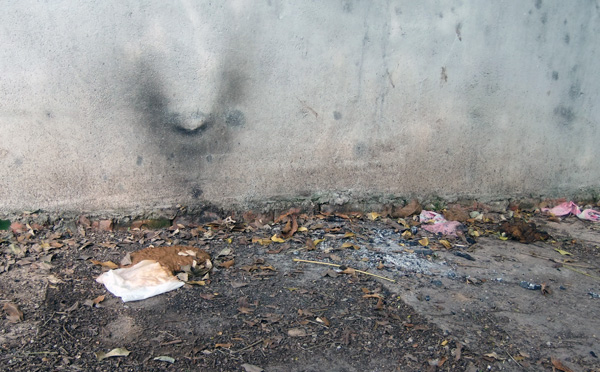
As I have wandered the edges of Shenzhen and as those edges have shrunk to the narrow spaces between the city’s elegant tree-lined boulevards and some kind of wall, I have noticed how easy it is to stumble into impromptu latrines.

Lines that redefine the territory: The road, a sidewalk, and a dirt footpath, which followed the river behind the row of bushes and trees that shaded the sidewalk. This particular latrine is located at the Sungang Bridge over the Buji River.

Once upon a time, maybe as many as ten years ago, this walk was part of Shenzhen’s official greenspace. Indeed, old tile walkways still connect the river path to the sidewalk. Consequently, I also stumbled upon chipped bits of walking path and several benches that provided a view of the Buji River.

The speed at which Shenzhen changes is the city’s identity. A popular saying has it that “To see thirty years of Chinese history, visit Shenzhen; to see one hundred years of Chinese history, visit Shanghai; to see 1,000 years of Chinese history, visit Beijing; to see 2,000 years of Chinese history, visit Xi’an (想看三十年的中国,到深圳;想看一百年的中国,去上海;想看一千年的中国,去北京;想看两千年的中国,去西安).”

A friend recently mentioned a twist on this theme, “Shenzhen took ten years to construct a new city; twenty years to construct an old city; and thirty years to construct a garbage city (深圳以十年建立一座新城市;以二十年建立一座旧城市;以三十年建立一座垃圾城市).”

Sigh.

“Years of Sadness”


coastline 2003

Originally uploaded by maryannodonnell

Wang Lingzhen and I collaborated to translate three pieces of autobiographical writing by Wang Anyi, one of contemporary China’s more important writers. The collection is called “Years of Sadness” and published by Cornell University.

Enjoy.

Am posting from flickr again. Sigh. I hope this is just a glitch and not a return wordpress being blocked. We had a brief period of relief…

shenzheners search for happiness…

happy endings?

The Shenzhen Civilization Office (文明办) is currently sponsoring the “Search for the Happy Person in My Life Video Contest (寻找身边快了幸福的人DV大赛)”.

At first, I was simply curious about how to interpret their posters – a canoe, floating on a dock, seperated from an idealized Shenzhen skyline by a vast expance of water. Am I supposed to understand the happy ones as those who have left the city or those who are heading toward the city? The image of Shenzhen rising fully formed from white fluffy clouds strikes me as oddly oz-like, and this has me wondering if perhaps those who don’t live in actually existing Shenzhen are the happy ones?

To assauge my curiosity, I googled 文明办 and, in addition to a national level office of civilization, I also discovered a provincial office. However, Shenzhen’s office was not online. A few more clicks and I found out that

中央文明办全名叫中央精神文明建设指导委员会办公室,是中央精神文明建设指导委员会的办事机构。而中央精神文明建设指导委员会最主要的职责就是督促检查各 地、各部门贯彻落实党的十四届六中全会精神和中央关于精神文明建设的一系列方针、政策的情况,协调解决精神文明建设主要是思想道德和文化建设方面的有关问 题。总结推广交流先进经验。深入调查研究,为中央决策提供建议。

(The full name of the Central Civilization Office is the Central Spiritual Civilization Establishment Oversight Committee Office, and is the managing agency of the Central government’s establishment of spiritual civilization. The main directive of the Central Spiritualization Establishment Oversight Committee is to  promote and supervise each region and bureau to implement the spiritual policies of the 14th meeting of the sixth plenary session and related questions of cultural construction.  In brief, to popularize and exchange avante guard experience. To conduct reseaerch into the process and provide suggestions for central policy making.)

Which begs the question: how do videos of happy people satisfy the Office’s mission?

A friend once told me that if you want to know what Chinese leaders think Chinese society lacks, all you have to do is find out what they’re currently promoting. For example, a “harmonious society” lacks harmony. By extension, a city searching for happy people would then lack happy people. Hmm…

Nevertheless, it seems wonderful to open the question of happiness to social debate. And to frame happiness as a question of spirituality? Again, yes! I’m all for making happiness part of national profiles and a condition for evaluating good government. However, instead of talking about what the conditions of happiness are and how we might extend them to more people, the videos by and large talk about how individuals are happy in their very private lives. Thus, in the videos I’ve seen, the definitions of happiness are so stereotypical (going to school, falling in love) and so individualized (family life, working hard) that its hard to see this competition as anything but more sugar-coating a decided lack of harmony chez Shenzhen.

And that’s the painfully irony: Shenzhen did begin in the dream of happiness or xiaokang, as it was once called.

More videos online at the official website.

History as Farce

As part of our book club discussion (see previous entry), Liu Jingwen handed out copies of a recent blog entry by Yang Hengjun (杨恒均) entitled “Ten Years of Cultural Revolution and Ten Years of the Internet: Where Do We Go From Here? (十年文革与十年互联网:我们向何处去?)” In the rest of this entry, I will translate some of the more interesting passages from Yang’s (much longer) essay. I hope this synopsis + citations will contribute to understanding about historic continuities between Maoism and what followed.

Yang Hengjun is interested in comparing the first thirty years (1949-1979) and second thirty years (1979-2009) of the People’s Republic because he believes there are startling similarities between these two eras. He is particularly interested in the comparing the ten years of the Cultural Revolution with the ten years of the internet in China.

十年文革是建国六十年甚至是中国历史上少有的几个“大鸣大放”、“大民主”的时期,当时是以青年学生(甚至很多高中生)为主,知识分子中大部分已经从1957年的反右中吸取了教训,少部分没有吸取教训的从一开始就被打倒在地了。

互 联网十年里,也是以清一色的青年人为主,在虚拟的空间进行独立思考和自由言说。这时期的知识分子们一边从文革和上个世纪八十年代末的事件中吸取了教训,打 骨子里认同了沉默是金的理念;一边从改革开放中收获真金白银,忙于改善自己的生活,从物质和精神上都向官员靠拢。结果,青年人主导思考和言论成为十年文革和十年互联网最大的共同之处,同时也彰显了我们民族的困境:急需知识分子们启蒙和引导青年的时候,思考国家前途和民族命运的担子竟然落在了涉世未深的青年人的肩膀上。

The ten years of the Cultural Revolution was a rare period of “free airing of views” and “democracy” in the 60 year history of the People’s Republic, indeed in the entire history of China. The key players were young people (even high school students) as a majority of intellectuals had already learned their lesson from the 1957 anti-rightism movement and the majority who hadn’t learned their lesson were beaten early on.

Young people again have been the key players during the ten years of the internet, conducting independent thought and free speech in virtual space. On the one hand, this era’s intellectuals have learned their lesson from the Cultural Revolution and the events of the late 80s, and believe in their bones that silence is golden. On the other hand, they have gotten rich during reform, keep busy improving their lives, and their material and spiritual interests overlap with those of officials. Thus, the primary importance of young people in leading thinking and debate is the greatest similarity between the ten years of the Cultural Revolution and the ten years of the internet. This also shows our people’s predicament: at the time when young people desperately need the enlightment and direction of intellectuals,  the responsibility for contemplating the country’s future and the people’s fate has been unexpectly thrust onto their inexperienced shoulders. Continue reading

three more text messages

Recent text messages on gaokao blues, the meaning of life, and lived common sense.

高考失意?前途渺茫?[出国通]帮你上加南大名校(免英语),更有机会拿绿卡!6月20日下午两点半招生面试,电话:XXXXX

Gaokao got you down? Future prospects uncertain? [Go abroad connections] will help you get into a famous Canadian University (no English necessary), and have a better chance for a green card! Student interviews on July 20 at 2:30, tel: XXXXX

中国汉子仅有三个,即可涵盖人生要领。尖字既是能大能小,斌字既是能文能武,卡字既是能上能下。真可谓:人生太复杂,三字既道明。

Only three Chinese characters gloss all the important points of a human life. The character for sharp (尖) can be both big (大)and small (小); the character for refinement (斌)can be both cultured (文)and martial (武); the character ka (卡) can go both up (上) and down(下): human life is complicated, three characters make it clear.

把简单是搞复杂是文化,把复杂石膏件大事科学。把明白事搞糊涂是哲学,把糊涂事搞明白是法律。稀里糊涂把人治好的是中医,明明白白把人医死的叫西医。把糊涂人搞明白叫老师,把明白人搞糊涂交领导。

To complicate simple matters is culture, to simplify complicated matters is science. To muddle obvious matters is philosophy, to clarify muddled matters is law. To brainlessly cure a patient is Chinese medicine, to wisely medicate a patient to death is Western medicine. A teacher is someone who straightens out the confused, a leader is someone who confuses those who know what’s what.

the shekou storm – translation

Throughout the 1980s, Beijing and Shenzhen were symbols in and locations of debates about the development of post-Mao society. In many ways, Beijing symbolized and produced theories of reform and opening, while Shenzhen symbolized and actualized these theories. However, as the saying goes, plans can’t keep up with change. Roughly a year and a half before the demonstrations in Tian’anmen, the Shekou Tempest demonstrated that the government was serious in its intention to reform and open all of society, including politics as usual.

In tribute to the efforts of young people in both cities, and the sincerity of the questioning, I have translated “Questions and Answers about the Shekou Tempest (蛇口风波问答录) by Zeng Xianbin (曾宪斌) because the article reminds us how important Shenzhen was (Shekou especially) to the hopes and dreams that characterized Chinese youth during the 1980s. The article also illustrates at what cost Shenzhen’s post Southern Tour (1992) development has come; once upon a time, Shenzhen residents had the rhetorical skills and ethical compulsion to debate the social implications of going capitalist.

Ironically, many of the early Shekou gold diggers, who once believed it was possible to make money and contribute to society, now sould like old leftists – too many people have come to Shenzhen only to make money without contributing anything to society. This emphasis on working for society, rather than oneself seems to be the important thread that links Old Shenzhen to the Chinese Revolution; New Shenzhen, post 1989 Shenzhen, is something else again.

Questions and Answers about the Shekou Tempest

by Zeng Xianbin

Reporter’s note: This is a small debate that took place half a year ago and was later reported in several newspapers. Today this newspaper [People’s Daily] introduces the event and some related opinions, as well as providing space for more comerades to participate in the discussion, together exploring the question of youth political thought work.

On January 13 this year [1988], Shekou, Shenzhen organized a “Youth Education Experts and Shekou Youth Symposium”. Participants included Comerades Li Yanjie, Qu Xiao, and Peng Qiyi, three political lecturers from the Chinese Youth Thought Work Research Center and seventy Shekou youths. The media has already introduced this symposium. Even if evaluations of this discussion were mixed, nevertheless there was concensus about one point: its meaning exceeded the actual tempest itself. During the first and middle parts of July, this reporter split his time between Beijing and Shenzhen, interviewing people involved such as Li Yanjie, Qu Xiao, Peng Qingyi and Yuan Geng, asking them to answer questions about which readers are concerned. In order to insure that the reader gets objective, verifiable facts, this reporter has recorded only the questions and answers. The reader must judge the rights and wrongs of the case for herself. Continue reading