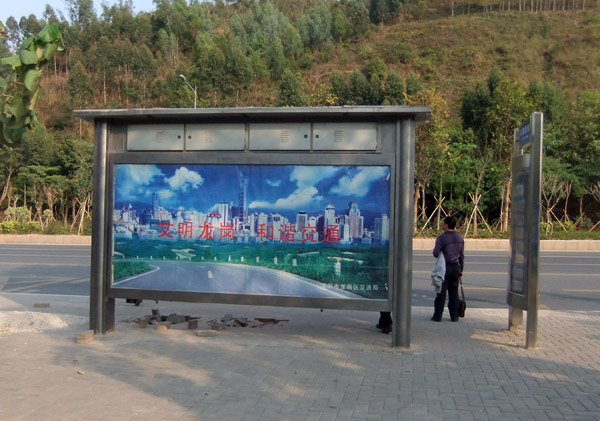
I have gotten somewhat inured to spiritual civilization campaigns like Longgang’s “Civilized Longgang, Harmonious Traffic” (above). After all, the offices have to do something with their budget and I actually support calls for more and better observation of traffic regulations, as well as teaching children to wait for others to get off a bus before charging on. However, this weekend YQ informed me that Shenzhen’s various Spiritual Civilization Bureaus (usually a division of the Ministry of Propaganda 精神文明办公室) have been asked to produce documentaries on “the happiest person I know (我身边最幸福的人)”. Nanshan is filming him because “we want to teach Shenzhen people that there’s more to life than making money.” Apparently, I was not selected because “foreigners do whatever they want, so there’s no educational value in [my] life.” — hee!
Tag Archives: shenzhen identity
cultural homogenization in shenzhen. and not.
Most discussions of Shenzhen emphasize that as an immigrant city, Shenzhen is a Mandarin speaking outpost of national culture in the midst of Guangdong Province. However, this description glosses over the historical division of Baoan County into Cantonese and Hakka cultural areas, and how urban development focused on the SEZ (rather than the entire Municipality).
The establishment of Baoan and Longgang Districts in 1992 institutionalized these historic divisions, with a Cantonese cultural-linguistic area (Baoan District) and a Hakka cultural-linguistic area (Longgang District). At the same time, the traditional SEZ (bounded by the second line) formed the core of Mandarin national culture in the city.
Thinking about Shenzhen as a tri-cultural city enables understanding of how cultural homogenization does and does not take place. Today, I’m thinking specifically about the creation of a recognizably “rural” local identity versus an “urbane” Shenzhen identity. In the area surrounding the Universiade Village, for example, these various trends are most visible in ongoing construction and demolition projects.
Construction wise, the planned Universiade Village boasts beautiful, glass stadiums and swimming areas, which reflect urbane aesthetics. Indeed, the nearby 5-star hotels and upscale residential areas lump Shenzheners (the Mandarin nationals) with cutting edge international taste and consumption. This aesthetics contradicts that of the mid-90s generation of handshake buildings that constitute much of the Longcheng Street residential area. Architecturally, it all seems a straight-forward contradiction between rural and urbane Shenzhen, which in turn is often misread as a contradiction between Cantonese and Mandarin spheres.
In fact, walking through a small Hakka Village, like Dawei indicates how recent handshake buildings as an architectural sign of the rural are in Shenzhen. In Dawei, the handshake buildings have been built into and on top of a traditional, small Hakka compound (similar to the one in Sungang). In other words, handshake buildings create a common “rural” or “Baoan local” identity for (once culturally and linguistically distinct) Cantonese and Hakka villages only in contradistinction to a Mandarin identity.
Visual evidence in slideshow, below.
choices, choices
I enjoy hanging with Daomei because he lives the unexpected life. To support his nascent acting career, he recently decided to become a lifeguard and is now completing a series of trainings, including Red Cross training to recognize and respond to heart attack symptoms and pulling dead weight through cold waves.
Daomei’s career swerves and occupational dabbling may seem familiar to Americans, but in Shenzhen, it sparkles. Moreover, it reveals a crack in what is often perceived (in China and abroad) as Shenzhener’s relentless pursuit of economic prosperity. Although it is true that many of Daomei’s classmates have settled for more mundane career tracks, nevertheless it is also true that for the tens of students who have taken paths opened by their parents or slipped into more cynical careers such as corporate drinking buddy, there is one who has left Shenzhen to roam Yunnan and another who pursued yoga. All this to say, Daomei is probably an extreme case, but he is no lone ranger — Shenzhen’s thirty somethings are grappling with the choices and individualistic possibilities that the city’s wealth has created for a small, but active middle class.
I can’t wait to see Daomei at the beach!
educational experimentation in shenzhen
For many years, I have noted the extent to which education has been closed off from the forms of social experimentation that characterize other aspects of Shenzhen society. Shenzhen was first to reform the danwei system, housing allocation, and even hukou laws. However, education has rigidly conformed to national standards — curriculum, methods, and goals, all have reflected national values and goals. When there has been experimentation, it has taken the form of international education — importing extant curriculums, such as the A-levels or American programs, rather than re-inventing Chinese schools. Even University Town (深圳大学城), which provides graduate education and research facilities has developed within a more standard academic model.
Yesterday, the opening ceremony of Southern Institute of Technology (南方科技大学) indicated a willingness on the part of both the national and municipal governments to invest in the search for new pedagogies. Differences with traditional colleges include: (1) size: SIT will offer small scale undergraduate education. The first class has only 45 students; next year, SIT will take in a class of 150, building until a cap of 400 students per class year. (2) recruitment: SIT recruits students through individual application rather than through the gaokao. (3) evaluation and graduation requirements: SIT has hired top academics to design classes and determine what course content should be. Moreover, at the level of specialization, students will be given the opportunity to design their own major. This is significantly different from the national standard, where undergraduate programs still reflect national standards. Moreover, there is little opportunity for students to study outside their major, let alone design their own. (4) residential dorms with house parents / teachers. SIT hopes to encourage a more familial atmosphere in its dorms and to provide life counseling for students as they adapt to academic life. Indeed, to my American eyes, SIT seems more like a liberal arts college than it does a university — Harvey Mudd, rather than a tradition technological institute like Qinghua or Cal Tech.
Four years to see what happens, at which point, presumably more cities and colleges will be given the opportunity to reform Chinese higher education.
my new favorite map
I have just found my new favorite map of Shenzhen. Published in 2009 by the Bureau of Land Resource Use and Real Estate (深圳市国土资源和房产管理局), the map is not only large, but reads like a beautiful promissory note. Indeed the map promises that, “The Beautiful Shenzhen Will Have a Brighter Future.”
Said map includes the complete plan of the subway system, which is still under construction, proposed buildings, and as yet incomplete parks. Moreover, in the spirit of international goodwill, it includes the addresses of foreign consulates in Guangzhou, a map of the domestic and international flights from Shenzhen, business hours of the city’s various border crossings, and a list of rail connections to other cities. Indeed, its as if the map was designed to anticipate growth, much like a parent buys larger clothing for young children to grow into.
I’m not sure if the purpose of this map is to attract people to live in the city or facilitate their passage through on their way elsewhere. I do think, however, that the point is to eventually find oneself off the map. After all, we are walking forward into the not yet constructed, rather than heading toward the already built.
Householding perversions
I have been thinking about the Generation 90s beauty who would would give her chest as a pillow (献酥胸当枕头求降房价的90后美女), householding as a way of locating oneself in a larger social order, the phallic order of Chinese writing conventions, and the perverse nature of Shenzhen’s housing situation.
Delta restructuring, or the politics of economic expansion
In the Chinese administration of economic inequality, higher rankings may be converted into better opportunities. Indeed, that’s the point: to grow the stronger and pull everyone else into the future with you (which is one possible interpretation of the Shanghai debate about “adjusting” the economic dance of cities that constitute the Yangtse Dragon). Anyway, the ranking of each of Guangdong’s 21 地市 cities are:
1. Guangzhou; 2. Shenzhen; 3. Foshan; 4. Zhuhai; 5. Shantou; 6. Shaoguan; 7. Heyuan; 8. Meizhou; 9. Huizhou; 10. Shanwei; 11. Dongguan; 12. Zhongshan; 13. Jiangmen; 14. Yangjiang; 15. Zhejian; 16. Maoming; 17. Zhaoqing; 18. Chaozhou; 19. Jieyang; 20. Yunfu; 21. Qingyuan.
This ranking scheme interests me because it formalizes the power shifts that have occurred in the PRD as a result of Reform and Opening. According to Governor Huang Huahua, Guangdong has all sorts of plans for the next year (and yes, the year begins after Chinese New Year, no matter what the rest of the planet is up to), including deepening the integration of the Pearl River Delta, which is Guangdong’s equivalent of an economic dragon and includes Hong Kong by way of Shen Kong connections.
Planned obsolescence? The Dafen Lisa and Shenzhen Identity
507 artists worked on the Dafen Lisa for the 2010 Shanghai World Expo. However, as the City beautifies for the next big international event (the Universiade), the piece was targeted for removal because it does not conform to (ever changing) urban plans. Unexpectedly, the decision was successfully protested because the scale of Dafen’s collective copy of the Mona Lisa has produced a cultural item that is recognized as being unique to Shenzhen, which in turn, has led to debates about “to raze or not to raze (拆,还是不拆).”
This debate interests because it speaks to Shenzheners’ increasing recognition that over the past thirty years, what they have done is valuable and worthwhile, no matter what other people think. The birth, if you will, of civic pride against the very standards that were once the city’s raison d’être. Here’s the quote:
深圳为大运会整顿市容本没有错,街道、城管相关部门没有错。政府关注的是安全、规范、整洁;媒体关注的是文化艺术氛围,艺术家与画工关注的则是生存与创造环境。若果一定要说错,那可能是我们的文化错了:在一次次国际盛会面前,我们是如此“激动”,以至于显得不太自信。
Shenzhen is not wrong to beautify the city for the universiade, the relevant street and city departments are also not wrong. The government is concerned with safety, order, and tidiness; the media is concerned about cultural and artistic atmosphere, artists and art workers are concerned about their living and creative environment. Perhaps if we have to say something is wrong, maybe its that our culture is wrong: in international event after international event, we become this “excited”, which makes us seem to lack self-confidence.
What is Shenzhen’s cultural history?
I have added a page of links to Noted posts that provide an introduction into debates about what constitutes SZ’s cultural history. The question interests because “Shenzhen lacks cultural history” has been a critique made by Chinese and Western visitors to the city. However, in the new post 30th anniversary era, constructing a history for SZ has become a key government initiative. Whether imperial or state history should constitute Shenzhen’s core history defines these debates. Of note, the more tradition (especially neo-confucianism) gains momentum in Shenzhen, the more pre-Deng cultural history is valorized as a source of civic identity.
Clicking either history or shenzhen identity in tag cloud on the right side of the screen will bring up many more posts in chronological order, such that you can track my changing interests.
another call for a housing boycott in shenzhen
Folks in Shenzhen continue to protest the price of housing. This time, an armless beggar wrote the boycott call on the chest of a Generation 90s young woman. The interesting twist in this story? The young woman is from Hong Kong. I’m not sure how the protagonists’ collaboration ties into the ongoing re-structuring of a grassroots Shen Kong identity and deepening cross border integration (as opposed to official planning). Nevertheless, it is interesting to think about the implications of this protest performance: it took place in Lizhi Park, Futian, neither of the protagonists is identified as a Shenzhener, and yet this protest was represented in the press (晶报) as a Shenzhen story. Details, here.
Update (Mar 1): surfing in Youtube, I discovered a report that she had first tried to get a place to live by offering her chest as a pillow. However, the “price was too high” according to a man in the street.