Meilin: historic footnotes

Located between Lianhua Mountain and the ridge of low-lying mountains that once marked the second line, Meilin interests for several reasons.

First, Meilin completes the central axis in the same way that Hong Kong does – as an historic footnote. Meilin and Hong Kong are the implicit extensions of Shenzhen’s ideologically charged central axis, which announced the SEZ’s transition from an industrial manufacturing economy to a financial service and high-tech research and development economy. However, Meilin was built for functionaries in the 80s and 90s, and realizes the scale and type of residential area to which SZ once aspired. Likewise, Hong Kong was the orientation of SEZ globalization throughout the 80s and 90s, but like Meilin, it was globalization on a different scale. Shenzhen’s post axis global aims have long since reached beyond Hong Kong.

This slideshow requires JavaScript.

Second, the integration of Shang Meilin and Xia Meilin New Villages is neat because handshake building scale was the scale of 80s and 90s neighborhoods. Continue reading
City of Suspended Possibility…

Friend Jonathan Bach has written a beautiful essay, Shenzhen: City of Suspended Possibility. Highly recommended because he nimbly places myths about success and failure, homecoming and homemaking, and self-construction and urbanization with respect to western theories of the same. In other words, City reminds me why the essay remains my favorite genre; illumination on the human condition through critical perspective and sympathetic voice.

Breaking the Ice

So, episode 2 of 沧海桑田 is 破冰. What was the ice and how was it broken? A few notes, below.

Episode 2 begins with shots of thick ice on the Huai river, the narrator metaphorically speaking about the frozen space between two shores. Not only an obvious (and simultaneous) reference to the Sino-British border (on either side of the Shenzhen river) and the Taiwan Straits, but also a description of how the planned economy made the lives of Anhui farmers difficult. A relevant reminder: the reforms initiated in Shenzhen began with Wan Li (万里)’s efforts to liberalize agrarian production in a part of the country where it does snow. Continue reading

Impressions of the differences between Nantou and neighboring villages

Guankou and Yijia Villages are located just outside the Nantou Old Town Arch and revamped walking museumon by way othe Shennan Road – Nanxin Road pedestrian overpass. The villages abut each other along the old, narrow road, which used to run parallel to Yuehai Bay and connected Nantou to Shekou. Guankou and Yijia are slated for renovation at some point in the future. In the meantime, they are “just places where poor people live” as someone said to me, indicating disapproval of my photo-walk through the two neighborhoods.

Guankou and Yijia interest me because the village architecture is actually older than much found in the Nantou Old Town walking museum. Many Nantou residents built handshake buildings before the area was designated for historic preservation. Consequently, what remains in Nantou are handshake and factory buildings from the early 1990s, as well as particular buildings that had been designated historic landmarks. In contrast, the old centers of Guankou and Yijia were untouched during the 1990s village building spree and littered (and I use the word deliberately) with all sorts of old and interesting buildings.

This slideshow requires JavaScript.

Now, inquiring minds may wonder: why is Nantou, the imperial capital of the area with a 1,000 year history gutted of historical architecture (except in the renovating) and Guankou and Yijia not? Continue reading

1995-2005: Keywords in Shenzhen real estate

Much of Shenzhen’s informal history is, unsurprisingly perhaps, being written on blogs and weibo. However, websites dedicated to real estate, ranging from analysis to agency offerings are not usually considered to be history writing. Nevertheless, these websites provide insite into the negotiation of value as people transform labor and desire into homes and family life. To give a sense of the historical content of these websites as well as how they produce knowledge about the city, I’ve translated a sampling from a real estate purchasing and rental keywords post by 王猴猴.

Just an editorial note: when reading these keywords it is important to hear what has not been said. Policy criticisms and social problems remain implicit in Wang Houhou’s explanations and evaluations. I have thus added a few exegetical notes, which do not exhaust possible interpretations, but rather point to other readings. I encourage readers to add their own interpretations and thereby enrich the keywords.

盘点1995~2005深圳地产十年关键词 Inventory of Shenzhen Real Estate Keywords, 1995-2005 (Wang Houhou)

1995 购房入户 (Buy a house, get Shenzhen hukou) In order to stimulate citizens to purchase homes and also to further economic development in a slow house market, Chinese local governments promulgated real estate development policies and measures. The prime example of these policies came in 1995, when the Shenzhen government approved a measure that allowed anyone who bought a house outside the second line [in Baoan or Longgang District] was eligible for three Shenzhen hukous. [In 1995 Baoan and Longgang were still under rural administration and the Second Line was still enforced. Consequently, this law stimulated building at Second Line checkpoints, notably Buji and Meilin, where people could buy a Shenzhen hukou and still get to work easily.]  Continue reading

渔农村: border lives

Connecting the Shenzhen Metro and the Hong Kong KCR, the recently opened Futian Checkpoint has provided incentive for building higher end real estate for those who live in, on and from the Shenzhen-Hong Kong border. The area teems with residential and leisure developments that target variations of Shen Kong lives.

Yunongcun (渔农村) is one of the closest urban villages to the checkpoint; simply exit, turn right, and walk 500 meters or so. The walk from the checkpoint to the village area reveals layers of history, both in the making and the discarding. One sees, for example, a soon to be razed 90s food street and mid 90’s housing, and then buildings from roughly ten years later, including a large spa and even newer shopping mall, as well as the Shenzhen river, which is guarded and sealed off from pedestrians.

This slideshow requires JavaScript.

What one does not see on this walk is Yunongcun’s important place in Shenzhen’s village renovation movement (旧村改新). Over five years ago on May 22, 2006, the Shenzhen government began the movement with a nod to Shekou’s “first explosion (circa 1979),” by detonating “the first explosion” of the village renovation movement and bringing down fifteen illegal buildings all at once. Villagers had put up these buildings as part of their negotiation for a better settlement package. A kind of holdout, but at a much larger scale than the individual family because the area only became prime real estate with the completion of the checkpoint. Continue reading

意maging baishizhou

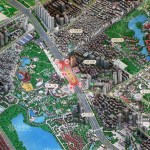
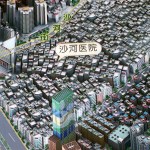
Three pictures of the northeastern corner of Baishizhou along Shennan Road. The map and detail are from a map in the Window of the World subway station, the third is a photo of the actual corner, taken from the plaza in front of 沙河世纪假日广场 (Shahe Century Holiday Plaza), the large landmark in the two maps. The contrast between the map and the territory interests me because it the ongoing (re)imagineering of Baishizhou in particular and Shenzhen more generally.

Baishizhou, as mentioned in earlier posts, is one of Shenzhen’s more “chaotic (乱)” urban villages. However, it occupies prime real estate – directly across from Window of the World and on the Line 1 Subway. Consequently, upgrading Baishizhou is an ongoing project and has included major real estate development. Tellingly, most information about Shahe Century Holiday Plaza real estate (herehere, and here, for example) emphasizes the subway convenience, views of Window of the World, and modern amenities, downplaying and often ignoring the Plaza’s neighbor, Baishizhou.

Continue reading

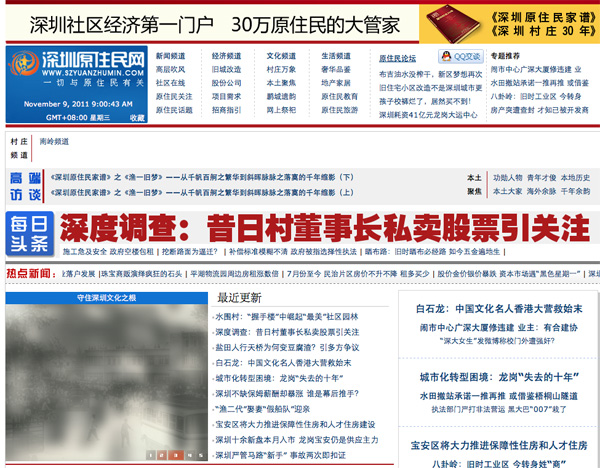
深圳原住民网 – what interests the locals?

Much has been said about Shenzhen’s urban villages (城中村). Indeed I’ve made something of a career out of talking about rural urbanization and the like. However, I’ve now stumbled upon the 深圳原住民网 (Shenzhen Original Inhabitants’ Web) and it provides all sorts of information about village histories, concerns, and their understanding of what matters in contemporary Shenzhen.

I look forward to translating posts in the future and finding out more about who’s not only running the website, but also brought villagers together under a common title “original inhabitants”. Previously, most villagers represented themselves as from a particular village, rather than having anything in common with original inhabitants from other villages. So, another interesting layer added to the amalgamation that is Shenzhen identity.

That said, I’m wondering how extensively District governments are participating in maintaining and developing content for the website precisely because they are the one’s responsible for implementing old village renovation projects. Indeed, old village renovation projects partner District governments, a village corporation, and a major real estate developer to “modernize” the area in keeping with Shenzhen’s recent efforts to promote its image as a hip, modern, and international city.

Generation 70

Shenzhen seems suddenly filled with creative people. In part, this may be the biennale and the cultural business that has been generated. In part, it may also be the upcoming Nanshan Fringe Festival. However, in large part its also due to the fact that generation 70 is now actively making decisions about how they want to live and contribute.

Shenzhen’s current “30-something” group, Generation 70 (70后) is an interesting cohort because they are clearly not residually socialist in the manner of Generation 60 (60后), but neither do they belong to the Rich Second Generation (富二代), even when they are the second generation of their family to live in Shenzhen. Instead, Generation 70 were raised to be respectable members of the middle class, have professional careers, and move China forward in solid, sober fashion. However, after graduating from college, getting that job, and starting their one-child-families, many members of Generation 70 have found themselves bored with the lives that their parents and grandparents and spouses and friends expect them to live.

Started by two members of Generation 70, ATU观筑 exemplifies the creative second career choices that some of Shenzhen’s 30-somethings are making. ATU观筑 is a non-proffit institution that organizes salons, workshops, and public education courses to debate the meaning and direction of urbanization and urbanity in Shenzhen. The directors are 30-something and the creative team is in their mid-20s. They dress fashionably, enjoy art, and want to contribute to a more vibrant society. They speak English, travel abroad, and think of transforming Shenzhen in terms of environmental and progressive values; in short, the folks at ATU观筑, like other creative 30-somethings throughout the city and the country may be the crest of a distinctly modern and Chinese wave of creativity that many – Chinese and foreigners – have been waiting to arrive since Reform and Opening began just over thirty years ago.

Jiujie / Nantou / Xin’an Old Town

Years ago, I published becoming hong kong, razing baoan, preserving xin’an, an academic paper on urbanization as the ideology informing the construction of the Shenzhen SEZ. Part of that paper included an analysis of Nanshan District’s decision to create a walking museum at Nantou, the County Seat of Xin’an from the Ming Dynasty until the CCP moved it to Caiwuwei, in Shenzhen Market. The museum didn’t survive into 1998 and Nantou settled back into urban village life – migrant workers renting space in handshake buildings, small scale manufacturing taking place both at home and in low tech factories, and bustling streets of vendors, shops, and open air markets.

Yesterday, I walked Nantou and discovered Universiade traces. The roads that connected the buildings in the walking museum had been paved with grey bricks and the buildings abutting those streets (well all two of them) had been given “traditional” facelifts – a faux grey brick facade and eves. Moreover, the museum buildings have been reopened to the public! So the universiade upgrade of Nantou included Shenzhen’s ongoing push to open small museums in the urban villages.

Here’s the rub: Houses and streets beyond the scope of the museum remain as they were. Also, the gate god, which used to inhabit the old Ming gate to the city has been removed. All that remains of that living tradition are two holes on either side of the gate, where incense has been stuffed in. And yes, that’s an upgraded pedestrian overpass at the entrance to what remains of the walled city. Impressions of revamped and still unvamped Nantou, below.

This slideshow requires JavaScript.