are there any shenzheners?

The Shenzhen Volunteer Association claims that “If you come, you are a Shenzhener (来了,就是深圳人). The claim itself is fascinating because it not only flies in the face of traditional hometown identities, but also because it implies that those who were already here aren’t Shenzheners.

There are three main labels for people in Shenzhen: 深圳人 (Shenzhener),本地人 (local),and 外地人 (outsider). As a general rule of thumb, Shenzheners are as much a construction of ongoing municipal campaigns to generate identification with the city as they are the rich second generation who grew up here. The point is that in addition to refering to an individual’s hukou status, the label “Shenzhener” also and importantly refers to a recognizable lifestyle and aesthetic that in the US we would call “middle class consumer”.

In contrast, locals and outsiders refer to the hometowns of people who live in Shenzhen. Locals have traditional roots here (through a historic village), while outsiders came from elsewhere to live and work in Shenzhen. Technically, everyone in Shenzhen is either a local or an outsider. However, as indicated above, the category of “Shenzhener” is an ongoing social construction that transvalues local and outsider identities, usually by smoothing out differences in the second generation. Thus, the children of both locals and outsiders frequently identify as Shenzheners, even when their parents have Shenzhen household residency but continue to identify with their hometown.

The distinction between Shenzheners, locals, and outsiders points to the overlap between traditional Chinese hometown identities and the reform policies that created Shenzhen. On the one hand, Chinese people identify with their hometowns, creating identity out shared language, food, and customs, such as Shanghai or Hakka people. On the other hand, Shenzhen identity has been constructed out of the transformation of Bao’an, environmentally, socially, politically, and culturally. Shenzheners are the people who have participated in and/or benefited from that process. In contrast, locals remain identified with their natal villages, while outsiders continue to identify with theirs.

The symbols through which individuals craft Shenzhener identities are vexed by contradiction and uncertainties for three reasons. First, less than 3 million people (or 1/6) of the total population have Shenzhen hukou, which means legally most inhabitants are not Shenzheners. Second, if locals are not considered Shenzheners, it is because identity remains rooted in policy, rather than history. And third, even second generation Shenzhen residents remain emotionally embedded in hometown relationships elsewhere because their were raised by outsider grandparents.

Of course, therein lays the rub. The debate about who is a Shenzhener not only raises the question of who has rights to the city, but also the question of who is willing to be responsible for the city. To date, these questions have not been explicitly addressed, begging the question: is it enough to define a Shenzhener through how an individual has used the city (to achieve political and/or economic goals), or do we need to re-imagine the Shenzhener identity in terms of contributions to society?
what does china mean to you?

 Currently circulating on we chat, another of those punny jokes that do political analysis so well:

How do you pronounce the English word “China”? The single man says “Where’s my wife?” The lover says, “Where’s my sweetheart?” The beggar says, “Where’re to?” The poor man says, “Where’s the money?” The doctor says, “Where should we cut?” The businessman says, “Where’s the scam?” The official says, “Where’s the power?” The thief says, “Where’s the mark?” The developer says, “Where’s the site?” The government says, “Where do we raze?” And the lower class says, “Where do we migrate to?”

光棍念“妻哪?”,恋人念“亲哪?”,乞丐念“去哪?”,穷人念“钱哪?”,医生念“切哪?”,商人念“欺哪?”,官员念“权哪?”,强盗念“窃哪?”,开发商念“圈哪?”,政府念“拆哪?”,贫民念“迁哪?”

two child style

IMG_1920

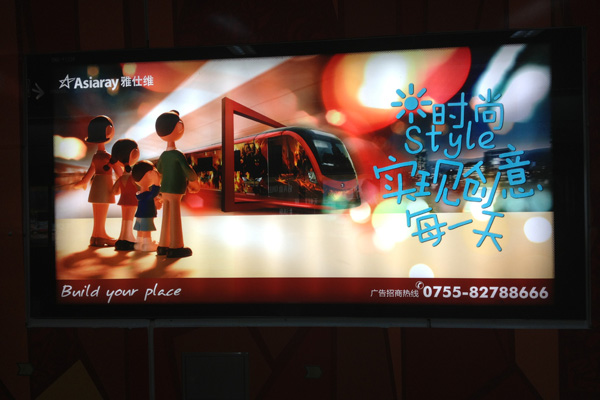
The above advertisement is for the Shenzhen office of Asiaray, a Hong Kong company that specializes in providing outdoor advertising throughout the Mainland. Three related comments:

1) This particular advertisement caught my eye because of its representation of a two-child family. Just who is the intended audience of this advertisement? Families who have paid fines for their second child? Only children couples who are permitted to have two children? Or is it another sign that China may relax the one child policy, as discussed on Reuters?

2) Cultural turning. The copy literally translates as “Fashion Style — Realize Creativity Everyday”. It may be thanks to Psy the English word “style” is now showing up in advertisements all over the city. However, the official translation of 宣传部(文体局) on the Nanshan District Government website is Propaganda Department (Style Council).

3) Backlit billboards are particularly common in the Shenzhen subway and at bus stops. Indeed, outdoor advertising is the most common form of public art in Shenzhen. Recent research suggests that how we feel can impact our actions — just not in the way we think. This particular advertisement, for example, may not stimulate people to buy backlit billboards from Asiaray. Nevertheless, it does promote both the two-child family and fashion as the means for crossing a threshold into a better future.

Thought du jour: We know that Asiaray and other agencies (including Municipal Style Councils) sell wish fulfillment, using our desires against us. And maybe that’s the point. Maybe what we want is to be caught up in a daydream, all four of us, hand-in-hand on a fashionable rush to the future … until we loop back and repeat the experience, all four of us, hand-in-hand on a fashionalble rush to the future.

the view from the top, circa 1997

The 69th floor observatory of the Diwang Building remains an important tourist destination, albeit something of a time capsule.

The Diwang building was completed in time to celebrate the Return of Hong Kong to Chinese sovereignty. The 69th floor observatory includes a museum that commemorates Shenzhen’s history from 1980 through 1997, a kitchy “Lan Kwai Fang” bar street, and observation maps that date from 1997. The key exhibit is a wax figure installation of Deng Xiaoping and Margaret Thatcher’s iconic 1984 meeting. The installation symbolizes the ideological function of Shenzhen circa 1997 — the buffer zone between Beijing and Hong Kong, which enabled the PRC to push forward its “one country, two systems” policy.

The juxtaposition of Shenzhen then and now resonates precisely because the interior design of the museum hasn’t changed since 1997. In fact, all one has to do is look at one of the maps and compare it to the view from the observation platform to remember that in 1997 Diwang precipitated the city’s glass and steel makeover. Notably absent from the 1997 maps — the civic center, the kk 100 building, and the Binhai Expressway and Northern Loop. Obviously present in the 1997 maps — the extent to which the construction of border town urban villages such as Caiwuwei, Dengba, and Hubei had shaped urban possibility in Shenzhen . Moreover, in the 1997 images, Buji and the second line seem distant, far far away from the booming border region. Nevertheless, villages still show up in the images below — the relatively dark patches are urban villages, including the remains of Caiwuwei after the construction of the KK 100.

Visiting the museum and observatory costs 80 rmb a ticket and if memory serves (because sometimes it doesn’t), fifteen years ago the price of admission was 80 rmb.

This slideshow requires JavaScript.

czc entr’acte

The entr’acte between a thriving urban village and its gentrification into mall-burbia occurs as developers scramble to get the last hold outs to sign compensation packages. To ensure that noone moves into buildings that have already been acquired by the developer, windows and doors are often cemented over and 拆 the character for “raze” is painted in bright red stencil.

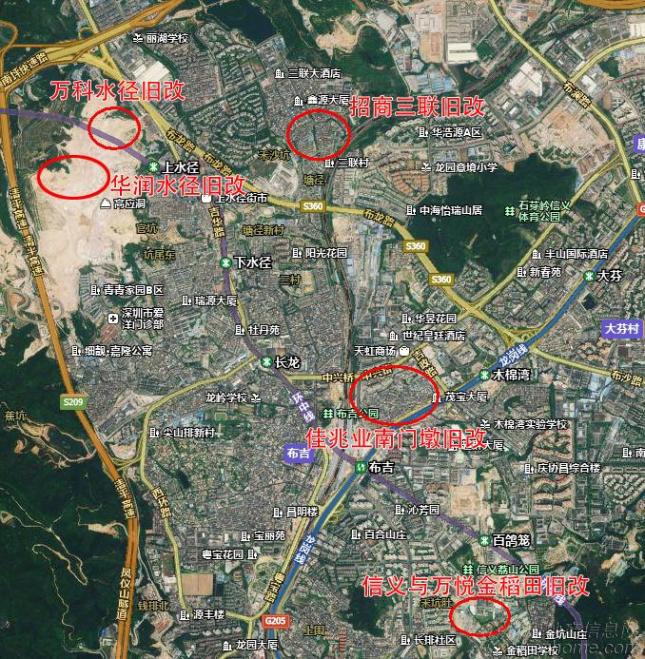
In Nanmendun, Buji (布吉南门墩), for example, the entr’acte has been in progress since May 26, 2011, when the Kaisa Group announced that it had begun the renovation project. According to the announcement, 18,879 people lived in 479 buildings (mostly handshakes, but some early 80’s and Mao era dormitories). Of this population, roughly 10% were Nanmendun residents and entitled to relocation and compensation. Roughly two years later, the process of getting holdouts to sign and stragglers to move on is still in progress.

This slideshow requires JavaScript.

Nanmendun is one of five renovation projects in Buji and the usual suspects — Vanke, China Merchants, Huarun, and Xinyi are also busy gentrifying the area. What the map below makes clear, however, is how extensive rural urbanization has been in Buji. Indeed, it is hard to speak of an “urban village” when handshake buildings and unregulated development have been the dominant form of urbanization for over thirty years.

Lay of the land:

4 renovationsin buji

tea time stories

Old Sui makes starkly whimsical woodblock prints the old fashioned modernist way — by hand, alone, and in a studio that is open to friends who drop by for tea and chats. He has collected over 1,000 teapots that when individually shelved and arranged seem oddly menacing. Not a first mind. At first, one sees artistry in the smooth lines and soft glow of each pot. However, as Old Sui opens a drawer to show part of the collection, and then another, and then says that the majority of the collection is elsewhere, the care and time necessary to make and care for a teapot gives way to numbers games and ranking; here are 50+ teapots, here are several dozens, the top  twenty or so have been displayed on a shelf that stretches around the room.

And the rest?

In a room at home.

I know the feeling of insatiable desire. I also enjoy aesthetic displays of objects. But. I am not a collector. Learning that Old Sui has set aside a room for private delectation? The intimacy of this knowledge startles me and my eye settles on a teapot crafted in black clay with flecks of golden sand. Continue reading

street life, baishizhou

Xintang and Shang Baishizhou lie northwesterly to Tangtou within the larger Baishizhou neighborhood. Where the allies widen into roads, a vibrant, bustling urbanity hints at unexpected encounters. The Baishizhou Pedestrian Commercial Street, the Baishizhou Christian Church, and inadvertent plazas, for example, speak to the social possibilities that high density street life creates.

This slideshow requires JavaScript.

suzhou garden, huanggang, shenzhen

Visited the Suzhou style garden in Huanggang Village today. The Village axis runs from the arch on Fumin Road via a main street and the central plaza to the ancestral hall and temple. The garden is located behind the ancestral hall.

Also of note: in the main plaza, the village has crafted a self representation that mimics Shenzhen billboards, in which key buildings symbolize the strength and unity of the group. Nevertheless, unlike the municipal central axis, the village central axis runs east – west. Indeed, that’s the rub. If the central axis were opened up through the convention center, it would split Huanggang and plow through the garden.

Impressions, below.

This slideshow requires JavaScript.

more community websites

Shenzhen long since gave up on “neighborhoods (居委会)” and “villages (村)”. Instead, the ruralized urban hybrids that the SEZ has spawned are legally known as “communities (社区)”. Note du jour is simply to point out that many of the sites connect landlords and renters. Soufun or “Search for a house” web, has sites that not only include rental information, but also track real estate prices. Guloucun — literally Old Lou Village Community (古楼村小区网) and Tianmiancun or Tianmian Village Community (田面村小区网), for example.

However, some community websites are more community oriented, in addition to providing a commercial forum. For the curious, checkout these community websites:

Shangsha and Xiasha Community Website (上下沙社区网)

Baishizhou Community Website (白石洲社区网)

land reform: the first SZ paper of 2013

In its first document 2013 (2013年一号文件) Shenzhen announced that its intention to finish expropriating collective lands in order to transfer land use rights for high-end development to state owned real estate developers, like China Resources and Jingji. In official parlance its know as  land reform (土改), and yes, I’m starting to think I live in a post-ironic city.

The problem of Shenzhen urban villages is, of course, that they were not villages. Under Mao, they were incorporated into the state apparatus through collectivization. Villages became teams, several teams became a brigade, and groups of brigades constituted a commune. In turn, the communes were the basic administrative unit of Bao’an County, Shenzhen’s territorial predecessor. In short, the collectives had a modern bureaucracy, and did agrarian work in not quite primitive, but very rough conditions.

In 1978, led by liberalization in rural Anhui, teams and brigades throughout China began to dismantle, and Bao’an was no exception. Redeploying the administrative structure of the Maoist state, they created “new villages”, which continued to do agrarian work, but for collective profits. Traditional village relationships and historic identities facilitated this process. In Bao’an, however, the establishment of the Shenzhen SEZ meant that collectives could also invest in manufacturing and real estate development.

In 1992, Shenzhen incorporated the inner villages into the municipal apparatus and in 2004 the outer villages were incorporated. So technically, the villages, which had not been villages, were now urban neighborhoods. Except, they were also limited holding companies. And there’s the legal rub: Shenzhen urban villages were limited holding companies which owned investments that had been legally built on collective land, but now occupied state-owned land, creating a messy, grey area of compensation demands and property rights.  According to Shenzhen Urban Planning Chief, Wang Youpeng (王幼鹏),

The government cannot take [the land] back, and the collectives can’t use it (政府拿不回,集体用不了).

The Municipality’s convoluted description of the villages reflects this complicated history. In the first document of 2013, the villages are called “Former Rural Village Economic Organization Work Unit (原农村集体经济组织单位)” — hee! But here’s the not-so-funny point: The 2013 paper legalizes the direct transfer of collective lands to real estate companies. Previously, the villages negotiated with the Municipality, which in turn accepted bids from real estate companies. Now, the Municipality has stepped back from this role. Instead, the villages may negotiate directly with the companies.

In terms of asset transfer, it means that villages must remove their technically illegal buildings from municipal lands. Their are two compensation packages. Either, villages sell their buildings, giving half the price of the sale to the Municipal government, or the villages sell their buildings and give 70% of the price to the Municipal government, but receive up to 20% of whatever is subsequently built on the land.

Xi Jinping has come and gone. The Shenzhen People’s Congress has met and disbanded. Exhortations to study the Spirit of the 2013 18th National People’s Congress have proliferated throughout Shenzhen. And now we know what it means – there is a new means of legalizing the transfer of property and resources from the urban villages to Shenzhen Municipality, further concentrating property and resources in the hands of whoever happens to be in charge of negotiating this process on behalf of the People Party.

That said, after a surge in the stock market, the general response has been one of confusion. It seems the paper is unclear on how the process will actually take place.