ongoing insights into Shenzhen’s creative ecology: and cockroach parts! who knew?
Tag Archives: shenzhen identity

ideal subject positions (by the numbers)
The current stock market frenzy has people dreaming about more than free lunches. The following adverts are from Money Daddy (钱爸爸), an online trading / investment platform based in Shenzhen. Of note? In addition to the pyramid scheme promises of rapid wealth, the site address plays with both “rich daddy, poor daddy” ideology and Cantonese numerology, where the number 8 is a homophone for the character for father and can also represents the character for “get rich”.
Translations of Money Daddy advertisements show “ideal” middle class Shenzheners enjoying their high returns. The underlying anxiety point is actually quite simple: if you’re earning an honest living in any of these jobs (including an ordinary bureaucrat), you’re not earning enough for carefree spending. And carefree spending is, of course, the site where the self is being constructed as “macho”, “successful”, “loving”, “sexy”, and “independent”, respectively. Continue reading

the dalang graffiti festival
Today we held the design workshop for the Dalang graffiti festival. 27 people attended the workshop, which involved creating designs for manhole covers. With the exception of one individual, none of the participants admitted to having taken any art classes outside of school; none admitted to sending their children to art classes. All were immigrants and during their self introductions, they mentioned their hometowns; one made a joke that her hometown was “too small to have English names”. Next week, participants will take their designs and begin painting manhole covers at a workers’ dormitory, a neighborhood, and a school.
impressions, futian
The other day, I walked from Huaqiangbei through Gangxia and Xinzhou, where I hooked back to Shuiwei via Huanggang Park, a wonderfully unexpected urban oasis. Today, I’m uploading impressions of the diverse complexity that characterizes Futian Distict, which is home to Huaqiangbei, the central business district, and some of the most well-planned urban villages in the city.
Shenzhen, China as an Electronics Ecosystem
Notes from Huaqiangbei and its ongoing integration into global consciousness.
handshake with the future
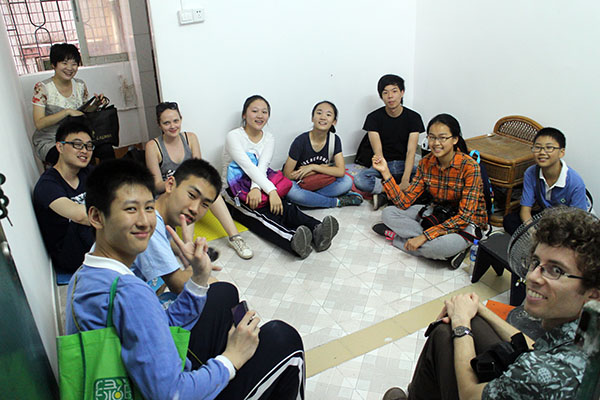
Handshake 302’s latest project is moving along. This past weekend we met with middle school students (on Saturday) and Guangdong Xin’an Polytechnic students (on Sunday) to think about how their experiences and acquired knowledge about Baishizhou might be put to the interesting work of making art. Continue reading

celebrating yuan geng’s 98th birthday in shekou
Yuan Geng continues to inspire hope for social reform in Shekou. Yesterday, the recently established Shekou Community Welfare Fund mounted the exhibition “Me and Yuan Geng” to celebrate the 98th birthday of China Merchants-Shekou’s first CEO. The Shekou Community Welfare Fund is the 14th such fund registered in Shenzhen, but it is the only one started by community members through donations, rather than through a government bureau. This matters because Shenzhen Municipality has called for the establishment of 100 funds, and we hope for more and more community–rather than government sponsored community–funds to emerge over the next year or two. Continue reading

changing expectations among shenzhen workers
I just had conversation with a friend who is the CEO of a Shenzhen based fashion firm. She said that Shenzhen (and ultimately) Chinese manufacturers were facing two problems:
- Low level manufacturing was being relocated to countries like Vietnam, where wages were lower, and;
- Workers born in the 80s and 90s generation have higher quality of life expectations than do workers born in the 60s and 70s.
Her point, of course, was that the workers from the 60s and 70s not only built Shenzhen, but are also currently factory owners and the most active in society. Therefore they are not necessarily willing to offer workers from the 80s and 90s improved working conditions, including regular time off, air conditioned dormitories, and fewer roommates. She concluded that to be successful, Shenzhen producers needed to offer higher value, niche manufacturing that incorporated both industrial and social design into new business models.
This conversation chimes in on ongoing discussions I’m hearing about dormitories in Shenzhen. It is also reflected in Re/Code”s recently published article, “A Rare Glimpse Inside Foxconn’s Factory Gates” which shows the Taiwanese multi-national’s efforts to re-brand its Shenzhen campus, as a place where workers are well treated and therefore happy.

in a globalized world, is the categorical imperative still “universal”?
Yesterday I attended a book launch for, Yang Lichuan’s second book, “The Transformation from Vertical Society to Horizontal Society: The Historical Philosophy of the Crash between Chinese and Western Civilizations (纵横之变:中西文明碰撞中的历史哲学)”. The two parts of the book title suggest the political thrust and method of intervention, respectively. The first part of the title expresses the author’s hope for social transformation to a more egalitarian society, while the second part captures the discourse–philosophy–through which this call for social transformation will be made. And yes, although the political call for social transformation was clear, the philosophical argument was as overwhelmingly comprehensive as the title suggests. Continue reading
大鹏所城 (II): history in the making
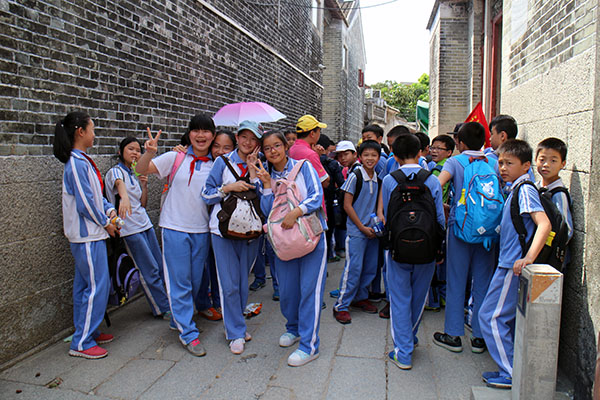
Almost seven years ago to the day, I posted thoughts on cultural history. The prompt for my speculations was Dapeng Garrison, which at the time was the lack of recognition for the site, which is Shenzhen’s only national level cultural relic. Two days ago, I returned and the space was hop, hop, hopping in all sorts of telling ways. What changes had allowed Dapeng Garrison to suddenly attract students, busloads of tourists, and random day-trippers? Like most Shenzhen stories, the answer is a twisting, convoluted story of profits, grey economies, the allure of accomplishments, and the real consequences of administrative failure. Continue reading
 Shenzhen Noted