the shenzhen-guangdong model is xi jinping’s road to recovery!

.. and it’s official! Xi Jinping’s road to recovery is the neoliberal policies of Shenzhen and Guangdong.Yes, the first signal of whither Xi Jinping is pointing to Shekou, by way of the second of Shenzhen’s top ten concepts.

If CCTV is to believed everyone is enthusiastically studying the spirit of the 18th national people’s congress. Xi Jinping and friends have charted a road to recovery that sounds exactly like Yuan Geng, 1992, except of course in English, where the translations have missed the historical citation.

Xi Jinping, 2012: 空谈误国,实干兴邦 (Empty talk is useless, only hard work can achieve the revival of a nation).

Yuan Geng, 1992: 空谈误国,实干兴邦 (Empty talk endangers the nation, practical work brings prosperity).

Not surprisingly, Xi Jinping’s “it’s the economy” moment parallels Yuan Geng’s. Yuan Geng first decried empty talk in response to Beijing educators who claimed that Shekou youth were gold diggers (Shekou Storm 1988). First time round, empty talk actually supported alternative voices. However, Yuan Geng made empty talk an official Shekou slogan response as part of Deng Xiaoping’s 1992 Southern Tour in an effort to silence critics about the June 4th Incident, returning the focus of reform to economic growth. Second time round, empty talk seemed to mean “suck it up and get back to work”.

So here we are. Again. And inquiring minds want to know: is Xi JInping talking the talk of 1988 or the talk of 1992?

Personally, I’m thinking we’re still caught in the post 6.4 quagmire. Xi Jinping’s less talk, more action comes in the aftermath of the Bo Xilai incident and the demise of the Chongqing Model, which included the call for a return to collectivist economic policies a la Mao Zedong. Speculation du jour: Xi Jinping’s road to recovery is probably the continued silencing of progressive voices for social liberalization in favor of rising GDP, or the “steady at 7 (经济保7)” policy, a reference to China’s decision to continue to grow the GDP at 7% annually.

top ten concepts of shenzhen

On November 28, I participated in a symposium to celebrate the English language edition of Top Ten Concepts of Shenzhen (深圳十大观念 for Chinese i-pad version).

The production, organization and publication of the Top Ten have been very Shenzhen, so to speak. The Publishing House of Shenzhen Press Group (深圳报业集团出版社) created an online website, where people could vote for the slogans and campaigns that they though best represent the city’s history. These slogans and campaigns were then re-presented (re-issued?) as concepts that epitomize Shenzhen’s values and way of thinking. Thus, in his preface, Guangdong Provincial Committee Standing Member and Shenzhen Party Secretary, Wang Rong, “[T]he top 10 concepts are the concrete manifestation of the era’s zeitgeist and a vivid imprint of the reform and opening-up program.”

The ideological slippage from political slogans and campaigns to civic values and zeitgeist interests me because it points to Shenzhen’s simultaneously fraught and co-dependent relationship with Beijing. On the one hand, experimentation in Shekou and early Shenzhen legitimated ongoing policy debates in the Chinese capital. On the other hand, the Shenzhen model, specifically and the Guangdong model more generally continue to be at slight odds with the rest of the country. Specifically, Shenzhen continues to advocate a managerial approach to governance, promoting not simply business, but also entrepreneurship and a vibrant grassroots economy.

Two of the slogans did, in fact, challenge prevailing political currents and concomitant power structure. Yuan Geng provided the two most obvious examples — “Time is money, efficiency is life” (1981) and “Empty talk endangers the nation, practical work brings prosperity” (1992). The first was a clear challenge to the Maoist planned economy. The second not only expressed Shekou’s ongoing support of Reform policies, but also the industrial zone’s continued advocacy of talented young people with alternative ideas. The Top Ten discussion of “Empty talk” introduces the history of the Shekou Storm. At the time, Yuan Geng emphasized that while Beijing officials blathered on about ideology, Shekou youth were building the future. The decision to erect the “Empty talk” billboard in the aftermath of the June 4th Incident was especially telling because Shekou actively hired transferred hukou of intellectuals who had been sidelined for their support of students.

Nevertheless, thirty years later, those same slogans uncannily echo neo-liberal values throughout the world. “Time is money” quickly looses its oppositional potential when we remember that in Shenzhen, workers’ wages have not kept up with the price of housing; many white-collar workers are also unable to purchase homes. Likewise, “Empty talk” no longer seems  an effort to protect those with alternative ideas as it does the instruction to “suck it up”. It is therefore unsurprising that concepts 3-10 express the municipality’s ongoing efforts to promote neo-liberal neo-confucianism. More to the point, these concepts clearly resonate with Wang Yang’s call to deepen and extend neo-liberalism not only in Guangdong, but also throughout the rest of China.

I’m thinking that it is thus best to read the Top Ten as a list of double-edged swords. As political campaigns and slogans, the concepts reflect contemporaneous power games. “Shenzhen embraces the world”, for example, was a blatant attempt to justify outrageous spending on the 2011 Universiade, while “You’re a Shenzhener once you come” is the self-serving motto of the Shenzhen Volunteer Association; what exactly does it mean that everyone is a Shenzhener when less than 1/5 of the population has a Shenzhen hukou? However, when understood as exemplars of civic values and a city’s zeitgeist, the concepts illuminate cracks within the power structure and spaces for alternative practices, both in business and everyday life. Indeed, it would be wonderful if these slogans/values might in turn reshape Shenzhen’s neo-liberal juggernaut, creating spaces for legitimate political opposition and open debate on whither the next thirty years of reform.

The top ten concepts are: Time is money, efficiency is life; Empty talk endangers the nation, practical work brings prosperity; Dare to become the world’s first; Reform and innovation are the root and soul of Shenzhen; Let Shenzhen be respected for its enthusiasm for reading; Innovation encouraged and failure tolerated; Fulfilling the cultural rights of citizens; The fragrance of the rose lingers on the hand that gives; Shenzhen embraces the world; and You’re a Shenzhener once you come here.

China Daily and Shenzhen Daily coverage of the symposium online.

maillen hotel and apartments

The Architectural Review has published my review of the Maillen Hotel and Apartments by Urbanus. In the published review, I look at China Merchants’ recent push to gentrify Shekou in terms of gated communities for Shenzhen’s expatriate community. As designed by Urbanus, the Maillen Hotel and Apartments suggest the role of traditional Chinese gardens in the ideological transformation of Maoism into neoliberalism. A synopsis of the review, below; full article, here (with pictures by Sarah Cain).

Urbanus’ stated intention was to design the Maillen Hotel and Apartment with respect to both extant geographic conditions and the traditional Chinese ideas about landscape and garden design, incorporating Nan Shan Mountain into its design with an eye to realizing the aesthetic ideal of “bu yi jing yi”, a four-character expression which literally translates as “step moves landscape moves” and refers to the experience of enjoying new garden scenes with each step taken.

By incorporating the hill into its design, Urbanus took advantage of the section of Nan Shan that remains standing. Historically mountains and hills defined the South China landscape, and Shekou was no exception. However, during the first two decades of development in Shenzhen, urban planning and design prioritized speed and price over any other value, including environmental impact. The Chinese expression for land reclamation, “yi shan tian hai” or “move mountains and fill the sea” literally describes the step-by-step transformation of the Shenzhen Bay coastline. First, raze a mountain – and many Shenzhen hills no longer exist except as place names – and, second, reclaim coastal land, creating flat, relatively inexpensive building sites. The point, of course, is that as the city has prospered and natural features such as Nan Shan have been restructured, their market value has increased exponentially.

The Maillen design also invokes traditional garden design through landscape. Elegant courtyards, perennial bamboo clusters, and delicate plum blossoms evoke literati lives in Suzhou, which during the Song dynasty codified the defining features of a traditional garden. In a classical Chinese garden, stylized elements – ponds, a rock garden, trees and flowers, as well as built structures, for example – symbolized the larger world. The key point, of course, is that the garden allowed members of the Emperor’s court, classical scholars and wealthy merchants to experience themselves as being one with nature without actually having to go into a forest or sail on the ocean.

It is at the moment of exclusivity, or rather the potential to market and sell privatized pleasure that we see the appeal of classical Chinese gardens to contemporary real estate developers. Classical gardens were restricted spaces of elite pleasure, where scholarly achievement and social rank determined who was or was not permited to enjoy the elegant topiary and tranquil spaces. Today, money and status rather than scholarly achievement or social rank might determine who crosses the threshhold, but the effect is the same, the creation of a fashionable space for a select minority. With the Maillen Hotel and Apartment, Urbanus has designed a witty, elegant, and self-enclosed space of privileged consumption.

Indeed, when we architecturally cite China’s classical past, it is important to remember that we are also invoking the feudal hierarchy that the Revolution aimed to overcome.

the new face of shenzhen homelessness?

Yesterday evening, I walked from the Peninsula housing estate along Wanghai Road, which winds around the back of Shekou Mountain through a new section of reclaimed land. I passed the walled off and abandoned construction site in the bit of land that belongs to the military policy (武警) and paused to look at the remaining  fishing boats and tangled nets that hug the remaining bit of coast, before making a left onto Houhai Road. After 8 p.m., small trucks are permitted on Houhai Road, and a line of pick up trucks backed up from the new coastline all the way to Old Shekou Road at the Shekou Oil Depot. Dirt filled the open backs and floated into the air, as the trucks trundled into a new reclamation area. I also saw a family living in a van. The lettering on the outer body of the van announced small repairs, however, the sliding side door was opened to reveal a makeshift bed, a mother rocking a child, and a man fixing an appliance of some kind. It’s not uncommon for neidi wives and children to join working husbands on construction sites, however, this was the first time that I have seen the interior of a service car remodeled for family life. So it seems that Shenzhen’s homeless are paradoxically richer because they have a car and tools for making a living and yet more isolated because the more “traditional” — if I can use the term — Shenzhen homeless families squatted in tent settlements under lychee trees, or more recently have occupied the edges of the reclamation projects, which of course, is where my walk began.

afternoon tea

Playing bridge at a late 80s teahouse in Shekou’s Sihai Park is a welcome alternative to hanging at a coffee chain or one of Shenzhen’s luxury teahouses, if for no other reason than because there is enough room between the tables to create a sense of privacy. For those interested in social history, however, the teahouse also provides visceral insight into how consumption standards have changed in Shenzhen. Nostalgic impressions, below:

This slideshow requires JavaScript.

shekou industrial road 7: echos of jane jacobs

One of the ongoing questions of urban planning is: what are the material conditions that support community life? To answer this question, we can’t simply look around and see what has been built, but rather have to reflect on what makes human life interesting, lively and fresh.

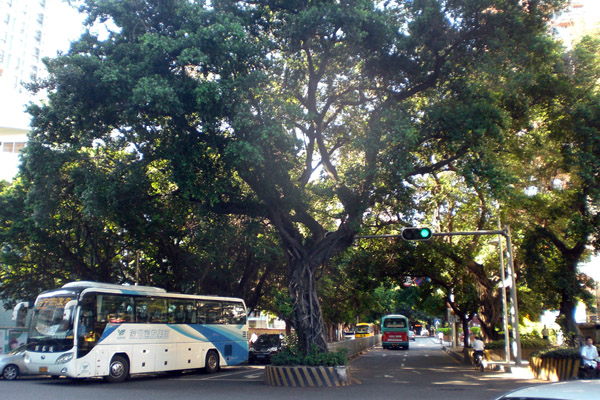
This morning I wandered Shekou Industrial Road 7 (蛇口工业7路) and realized that one of the reasons I enjoy this street is not simply the mix of residential, commercial, and industrial spaces, but also the expanse of public space and schoolyards. This public space has been created through the designation of Sihai Park and neighboring sports center, and also because the road is only two-lanes wide, with banyan trees that provide shade. Importantly, one stretch of Industrial Road 7 abuts Wanxia Village, where handshakes line-up in neat rows along one-lane roads and narrow alleys and give way to bustling urban village life.

Street life on Industrial Road 7 manifests the Chinese virtue of renqi (人气), which literally means “human air” and might be translated as “active” or “popular”. Hawkers set up stands under the trees, while elderly men practice water calligraphy on the sidewalk and pre-school children snack on steamed buns and soymilk. Window shopping (逛街) is thoroughly social as neighbors bump into each other on their way to preferred shops, or see each other’s children on their way to school. In the evening, once the sun has set and dinner bowls washed, the area becomes even more lively with families strolling and teenagers hanging out.

Admittedly, there is not much public space on Industrial Road 7. Significantly, however, many of the streets private spaces were built in the early 80s. Landscaping within residential compounds is a continuation of street landscaping, rather than planted with imported topiary that signal the end of the street and the beginning of elite consumption. More tellingly, guards do not actively prevent pedestrians from entering what are now considered low-income housing areas. Likewise, da pai dang (al fresco) mom and pop restaurants also integrate consumption into public life.

In The Death and Life of Great American Cities, Jane Jacobs documented and lamented how middle class flight from American cities to the suburbs contributed to the polarization and decay of our inner cities. In contemporary Shenzhen, a similar process is underway as the city’s middle class consolidates its identity and class consciousness through urban renewal projects and gentrification that not only result in clear razing urban villages, but also the construction of expensive malls and gated communities. The movement of people is different — the US middle class abandoned urban cores, and Shenzhen’s middle class is occupying the urban core and pushing the majority low income residents further to the periphery — but the result is the same. The unremitting blandness of these spaces announces and maintains social distinctions between the middle class and working poor, even as they homogenize differences between members of Shenzhen’s rising elite, creating an identifiable “Shenzhen” identity.

Over fifty years ago, Jacobs maintained that people like to live neighborhoods like Industrial Road 7. Moreover, she held that youngster and elders alike need accessible areas of mixed activities, cross-use of land, short blocks, mingle buildings of varying size, type and condition, and encourage dense concentrations of people. The point is to nurture marginal activities and small businesses, little restaurants and bars, as well as everything deviant, bohemian, intellectual or bizarre that make an area charming and vigorous.

I agree.

I also believe that this diversity humanizes us to the extent that we recognize ourselves in someone else’s life and consequently the wider our experience of difference, the more human we may become. In contrast, when we lay 4-lane roads without shade trees, build gated communities that isolate themselves from the street, and decide that malls, rather than parks better serve the public interest, we have proclaimed that to be human in the early 21st century is to aspire to life as a high-end mallrat.

Impressions of morning walk along Shekou Industrial Road 7, from Houhai Road west to Yanshan Road.

This slideshow requires JavaScript.

Camera download and what appeared

This past week, my path has taken me from Shekou through Hong Kong to Taichung. Some of the spaces and details that caught my attention, below. And yes, the headline in the pictured article really does read, “After the seizure of toxic salted eggs, one ton goes missing”:

This slideshow requires JavaScript.

figuring out the street, shekou gongye number 8 road

I live on Shekou Gongye Number 8 Road, translated, my address is “Shekou Industry Road #8”. There are 10 industry roads in Shekou, remnants of the Shekou Industrial Zone. Walking these roads gives a good sense of not only how the city is gentrifying, but also the different street lives that various generations of urbanization have engendered.

To understand my discussion of class differences and symbolic geography of Industry Road #8, please reform to the map below which gives a rough sense of extent of land reclamation on the Nantou Peninsula. For purposes of this discussion, key landmarks, Industry Rd #8 and Houhai Road, which connects to New Shekou Road:

The older core of #8 threads through the residential parts of Old Shekou, linking up with what was the area’s commercial center and industrial parks. However, as part of the stutterstep Houhai Land Reclamation Project, #8 has lengthened with each burst of fill. Houhai Road used parallel the coastline and marked the thick edge where Mangrove trees gave way to piers and oyster cultivation, it now marks the historic divide between the old and new coastlines, between which upscale residential areas and shopping malls continue to be built. Thus, Houhai Road also constitutes a boundary between older but poorer and new rich neighborhoods

On #8, Houhai Road also divides the area into two different kinds of street life. The older section has concrete sidewalks that connect housing developments with 7 story walk-ups, community park areas with local foliage, and simple (also concrete) benches. The gate between the housing development and the street is a security bar that controls traffic flow in and out of the area. The new section has stylized sidewalks that are embellished with granite and marble at residences. The buildings are over 20 stories, the community park areas landscaped with imported topiary, and the benches ornate designs of iron and wood. The gates are over one story high with faux noble emblems that control pedestrian traffic in and out of the development because cars have a separate entrance that leads to underground parking.

During the day, the older section bustles with ad hoc businesses — soybean milk and steamed bun venders, people sitting on plastic chairs chatting, and various kiosks selling drinks, snacks, and newspapers. In the newer section, all these activities take place indoors and no one uses the public benches because the trees haven’t grown in enough to give shade. At night, in the older section a bbq station sets up and older people play chess. In the newer section, several entrepreneurs have set up roller blade classes for the children of the housing estates.

All this to make a simple observation about the ongoing construction of the Houhai Land Reclamation Area — in Shenzhen’s symbolic geography, the reclaimed areas function as a negation of the previous areas. This is not surprising given the SEZ’s historic role as a negation of Maoist space. However, it is important to note the vocabulary through which the ongoing formation of class identities in Shenzhen is expressed. The most recent, the newest is the best, representing the improvement of the past.

In practice, this symbolic geography has depended upon building large projects on unclaimed or reclaimed land. As unclaimed and reclaimed land become increasing scarce, however, this has meant that razing older areas has become the preferred way of creating “new” space. Consequently, these new spaces do not only negate the old symbolically, but increasingly depend razing old neighborhoods and the displacement of poorer residents, so that the negation becomes explicit — you and your type not welcome in the city. At present this logic is most visible and visceral in the urban villages. Nevertheless, here in the older section of #8, we hear the bulldozers on the horizon. More notes and images of the Houhai transformation, here.

海湾村: land locked futures

The Transformation of Shenzhen Villages (沧海桑田深圳村庄30年), Episode 9: Haiwan Village tells the story the Nantou Peninsula and the reclamation of land in Houhai (the southern coast facing Hong Kong) and Qianhai (the northern coast facing Guangzhou). This was the platform from which Hong Kong entered China and Baoan villagers once launched themselves to Hong Kong.

During the Mao era, Wanxia Village was divided into two production brigades, one land based for agricultural cultivation and the other water based for oyster farming. Eventually, the Wanxia Oyster Brigade was renamed Haiwan Brigade, creating two administrative villages through the division of one natural village. This division points to the importance of production — rather than history — in defining Maoist administrative units, especially in rural areas, where villages were integrated or split depending upon production needs. Importantly, however, these administrative categories were not naturalized in the same way during the early years of Reform and Opening, when some administrative villages re-instituted traditional boundaries while others did not. Haiwan retained Maoist status and began building village level factories.

Access to the sea shaped village demographics, with a population gap of people, ages 45-65 who escaped to Hong Kong in the last large flights in 1968 and 78, respectively. Nevertheless, traditional land rights enabled Haiwan to prosper. In addition, we learn from an older, Cantonese-speaking villager that Haiwan Village is an Overseas Chinese village, with many descendants scattered throughout the world with village association buildings in the United States and Hong Kong, representing support, ranging from monetary to knowledge to investment connections. The village has also maintained its identity through traditions and ritual that centered on a small Tianhou Temple.

Watching this episode, I suddenly realized something that was clearly obvious to the filmmaker: Deng Xiaoping’s 1992 Southern Tour coincided with the establishment of guannei villages as stock-holding corporations and urban neighborhoods. In other words, the second tour did result in new policies or breakthroughs as they are known. My a-ha moment was in seeing the connection between politics and the radical restructuring of the south china coast.  The episode ending rhetorically juxtaposes images of Wall Street with Houhai, asking if Shekou can become the next Manhattan. The question is illuminating not for its booster-hype pretensions, but rather because it clearly reiterates the primacy of investment and real estate over traditional livelihoods such as oyster farming. In such a world, insofar as the sea becomes a factor in determining property values and not an independent source of value, reclaiming the sea makes good business sense.

渔一村:of old men and the landfilled sea

Yesterday’s bloggy romance with the sea continues and although I have shifted my gaze from Cuba to Shekou, it is worth mentioning that the writers’ emphasis on masculine conquest continues; today, in episode 8 of The Transformation of Shenzhen Villages (沧海桑田:深圳村庄三十年), Chen Hong tells the story of Fishing Village 1 (渔一村), Shekou. Again, the story begins in a village, but this is also where similarities between the two narratives end. Hemingway figured human life through the isolated figure of an old man navigating the Caribbean on a rickety skiff and superstition. In contrast, Chen Hong figures humanity through the construction of ports, trading ventures and the world-making connections that they enable, suggesting that the opportunity to launch one’s skiff is itself a political decision which once made determines the fate of villagers. For those who remember the 1988 television documentary, River Elegy (河殇) which linked China’s decline and ultimate humiliation to the Ming decision to ban maritime activity, a not-so-subtle critique of Maoist isolation, Chen Hong’s passion for the sea and the [free trade] world it symbolizes is self-evident.

Episode 8 opens by juxtaposing images of Ming and Qing trade centered on Guangzhou with pictures of the construction of Shekou, reminding viewers that Zheng He (郑和) set forth from or loaded supplies at Chiwan Port at least five times. Lest the viewer forget the consequences of isolation, the opening sequence ends with bleak, black and white footage of a backwater port, overgrown and clogged with weeds, small wooden boats berthed in stagnant waters. Boom! The first explosion opens the door to new world order, which is also, new village order.

Traditionally, the villagers of Fishing 1 weren’t actually villagers but individual fishing families who lived on boats, coming onshore to sell the day’s catch. Families came from all over the Pearl River Delta forming a community through their livelihood, rather than through ancestry or even a common version of Cantonese. However, in 1959, the political decision was made to organize them as a brigade (生产大队). They were 90 households with a total population of 450 people and settled as four small production teams (小队) in Nantou, Gushu, Neilingding Island, and Shekou. The Fishing Brigade worked to modernize the fleet and in 1978 during a meeting on scientific production, Hua Guofeng actually gave the brigade a first place award. Indeed, at the beginning of Reform, the Brigade had 69 ocean fishing vessels, 72 transport ships, and 18 oxygen boats that fished the South China Sea and Pearl River Delta bringing in fresh seafood for Cantonese dishes and by 1992, had accumulated enough capital to invest in modern industrial deep sea fishing vessels.

From 1978 through 1986, the Fishing Brigade lived the socialist dream, which was a traditional Chinese dream; the men fished, going as far away as Guangxi, the women kept house, children went to school and had medicine, and all ate in a common canteen, where the work team provided delicious food, including squid and shrimp. The system was called the 8 provisions (八包). However, by the late 80s early 90s, the scale of urbanization and land reclamation meant that traditional fishing areas had been contaminated and fish breeding grounds buried, and it was impossible to continue living from the sea. Suddenly, the advantages of the sea declined as property values soared and Fishing 1 faced a contradiction that many other villages would eventually face — what to do when urbanization decimated the conditions of traditional livelihood?

Once the sea was gone, Fishing 1 had no way of making a living because it did not have any land, except for that which the government had given it for housing in 1959, including a section on Neidingling Island, which Fishing 1 decided to develop as a resort and in 1992 as part of the guannei rural urbanization movement, the Fishing Brigade became the Fishing 1 stock holding corporation. However, after Fishing 1 had already invested their accumulated capital and borrowed against the development, Shenzhen and Zhuhai began a court case over who actually owned the island. Traditionally, the Island belonged to Zhuhai. However, in 1955, the Center had assigned Neidingling to Baoan, but no one could actually prove whether or not the transfer had gone through until 2002, when a copy of 1955 decision was found. In 2009, the Guangdong Provincial government finally ruled in favor of Shenzhen’s claim to Neidingling Island. However, the case raged long enough to impoverish Fishing 1 as the joint stock corporation/ fishing brigade/ village could no longer fish and except for Neidingling had no other traditional land rights. Indeed, by 2009 when the case was settled, Fishing 1’s deep sea fishing rights had already been bought out by China Merchants, which in turn sold them to Wanxia, one of Shekou’s original land-based villages.

And so here’s the neoliberal twist in Chen Hong’s story of old men and their vanishing sea: Fishing 1 re-entered Shenzhen urban planning as part of the Together Rich Project (同富裕项目), and over the past decade restructured and invested elsewhere: an industrial park in guanwai Gongming and fish breeding farms in Zhanjiang, for example. In addition, the Municipality organized training for fishermen to learn new skills. Nevertheless, the members of Fishing 1 have not only been proletarianized over the past 30 years, but are still paying off one of the debts that fueled Shekou’s growth. After all, Fishing 1 had no rights to any of the coastal property developments that enriched both China Merchants and neighboring Wanxia Village. Instead, Episode 8 ends with exhortations — from the Municipality and from the filmmaker — for individual development and initiative, ironically and inexorably returning us to Hemingway’s sea, where old men struggle feed themselves because they have been isolated by .

For more on my obsession with Houhai Land reclamation, more entries, here. A wander through the earliest Shekou landmarks, including the Shekou and Neilingding fishing families settlements, below:

This slideshow requires JavaScript.