渔农村: border lives

Connecting the Shenzhen Metro and the Hong Kong KCR, the recently opened Futian Checkpoint has provided incentive for building higher end real estate for those who live in, on and from the Shenzhen-Hong Kong border. The area teems with residential and leisure developments that target variations of Shen Kong lives.

Yunongcun (渔农村) is one of the closest urban villages to the checkpoint; simply exit, turn right, and walk 500 meters or so. The walk from the checkpoint to the village area reveals layers of history, both in the making and the discarding. One sees, for example, a soon to be razed 90s food street and mid 90’s housing, and then buildings from roughly ten years later, including a large spa and even newer shopping mall, as well as the Shenzhen river, which is guarded and sealed off from pedestrians.

This slideshow requires JavaScript.

What one does not see on this walk is Yunongcun’s important place in Shenzhen’s village renovation movement (旧村改新). Over five years ago on May 22, 2006, the Shenzhen government began the movement with a nod to Shekou’s “first explosion (circa 1979),” by detonating “the first explosion” of the village renovation movement and bringing down fifteen illegal buildings all at once. Villagers had put up these buildings as part of their negotiation for a better settlement package. A kind of holdout, but at a much larger scale than the individual family because the area only became prime real estate with the completion of the checkpoint. Continue reading
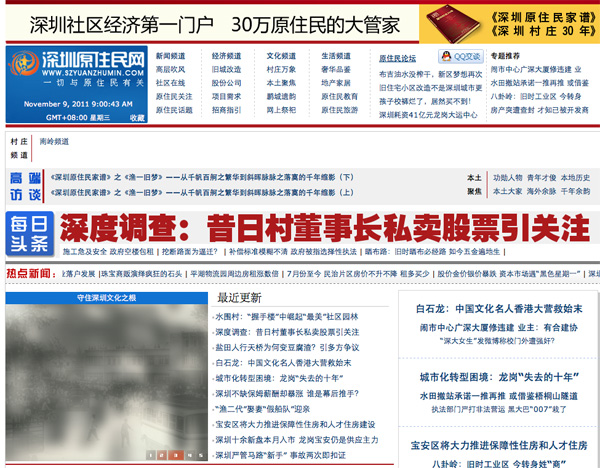
深圳原住民网 – what interests the locals?

Much has been said about Shenzhen’s urban villages (城中村). Indeed I’ve made something of a career out of talking about rural urbanization and the like. However, I’ve now stumbled upon the 深圳原住民网 (Shenzhen Original Inhabitants’ Web) and it provides all sorts of information about village histories, concerns, and their understanding of what matters in contemporary Shenzhen.

I look forward to translating posts in the future and finding out more about who’s not only running the website, but also brought villagers together under a common title “original inhabitants”. Previously, most villagers represented themselves as from a particular village, rather than having anything in common with original inhabitants from other villages. So, another interesting layer added to the amalgamation that is Shenzhen identity.

That said, I’m wondering how extensively District governments are participating in maintaining and developing content for the website precisely because they are the one’s responsible for implementing old village renovation projects. Indeed, old village renovation projects partner District governments, a village corporation, and a major real estate developer to “modernize” the area in keeping with Shenzhen’s recent efforts to promote its image as a hip, modern, and international city.

Jiujie / Nantou / Xin’an Old Town

Years ago, I published becoming hong kong, razing baoan, preserving xin’an, an academic paper on urbanization as the ideology informing the construction of the Shenzhen SEZ. Part of that paper included an analysis of Nanshan District’s decision to create a walking museum at Nantou, the County Seat of Xin’an from the Ming Dynasty until the CCP moved it to Caiwuwei, in Shenzhen Market. The museum didn’t survive into 1998 and Nantou settled back into urban village life – migrant workers renting space in handshake buildings, small scale manufacturing taking place both at home and in low tech factories, and bustling streets of vendors, shops, and open air markets.

Yesterday, I walked Nantou and discovered Universiade traces. The roads that connected the buildings in the walking museum had been paved with grey bricks and the buildings abutting those streets (well all two of them) had been given “traditional” facelifts – a faux grey brick facade and eves. Moreover, the museum buildings have been reopened to the public! So the universiade upgrade of Nantou included Shenzhen’s ongoing push to open small museums in the urban villages.

Here’s the rub: Houses and streets beyond the scope of the museum remain as they were. Also, the gate god, which used to inhabit the old Ming gate to the city has been removed. All that remains of that living tradition are two holes on either side of the gate, where incense has been stuffed in. And yes, that’s an upgraded pedestrian overpass at the entrance to what remains of the walled city. Impressions of revamped and still unvamped Nantou, below.

This slideshow requires JavaScript.

conditions of possibility – grassroots discourse at the wutongshan arts festival

The title of this post shouts “academic theorization”, but in fact, the post itself is far less ambitious. I’m simply speculating about what conditions we need to put in place in order to cultivate cross cultural discourse in and about places with vexed histories, like Wutong Mountain, Shenzhen.

Creating models and forums for cross cultural discussions in and about places with vexed histories is difficult. On the one hand, most of us are not familiar with the values and concerns that inform the ethos of another people; indeed, even when we are relatively knowledgable about cross cultural differences, often we do not share our interlocutor’s priorities. On the other hand, cultural groups are not monolithic entities, but rather vexed by class, gender, and regional differences, creating what Bhaktin called “heteroglossia” – a situation in which context (including history and culture and politics and economy and one’s interlocutor) is more important in determining the meaning of an utterance than is the text.

This slideshow requires JavaScript.

With the Wutongshan Arts Festival (梧桐山艺术节 – impressions above), organizers Gigi Leung and Michael Patte (founders of the riptide collective) aimed to generate conversations between village residents, local businesses (including Canyou), and artists who have moved there. The situation was clearly heteroglossic with both foreign and Chinese participants, who represented a range of different class backgrounds as well as different relationships to and with Wutong Mountain as well as Shenzhen. We came together to discuss future development in and of Wutong Mountain. Continue reading

Xiasha “Old village renovation”

In point of fact, the phrase “village renovation (旧村改造)” is a misnomer. What many Shenzhen villages are renovating is not the old village, but a village that was “new” in the mid-1990s. Images from Xiasha’s recently completed renovations suggest possible tradition-socialist-early reform-contemporary mashups or postmodern post-villages, so to speak.

This slideshow requires JavaScript.

historic ironies: the fanshen metro station, shenzhen

Fanshen is one of the recently opened Baoan District subway stations. Like Daxin (in Nanshan), Fanshen was the name of one of the Communes in Baoan County and now refers to the general area where commune headquarters once stood. Literally, 翻身 (fān shēn)means to turn over. In the context of the Chinese Revolution, fanshen referred to the liberation of peasants from feudal obligations by transferring rights to land and draft animals from local gentry and rich peasants. Fanshen: A Documentary of Revolution in a Chinese Village by William Hinton remains one of the best introductions to the reasons for and implementation of Maoist land reform.

Along Fanshen Road, I also stumbled upon Anle Second Brigade New Village (安乐二队新村), a place name that melds traditional values (安乐 means peace and happiness), Maoist production (小队 small production brigades based on village divisions), and early Shenzhen reforms (新村 new villages were the first local incarnation of the household responsibility system; only as urban area spread to surround them did new villages become “villages in the city (城中村)”). Continue reading

Historic traces – Xixiang Qilou (骑楼)

Buildings connected with archways, qilou (骑楼) are architectural symbols of Cantonese urban modernity. They first appeared in the early 20th century, when Guangzhou razed its city wall in order to expand streets for commerce and modern forms of transportation, but the style quickly spread throughout the Pearl River Delta. Some say that qilou were a continuation of an indigenous Cantonese architecture style, protecting pedestrians from both the sun and the rain. Others claim that qilou were a Cantonese adaptation of western architectural forms. Nevertheless, what remains clear is that like the Paris arcades or Venetian sotto portico, qilou enabled shopkeepers to display their wares and pedestrians to stroll by and window shop, creating the vibrant street cultures that we associate with these cities.

The former county seat of New Baoan County, Xixiang was one of the first areas outside the Shenzhen second line to urbanize. However, unlike guannei, where urban educated architects and planners designed with an eye to contemporary western forms, Shenzhen villagers designed with an eye to Guangzhou and Hong Kong indigenous urban forms. Consequently, on some of the streets in Xixang it is still possible to stumble upon contemporary adaptations of the qilou. Although, like Guangzhou’s early 20th century qilou, Xixiang’s 1980s qilou will most likely be razed to build air conditioned malls, further privatizing street culture. Nevertheless, glimpses of a few corners from Xixiang street life suggest the variety of possible urban forms.

This slideshow requires JavaScript.

Just FYI, in Dongmen, some qilou have been preserved during the construction of the Dongmen pedestrian commercial area. Also, there are some qilou along the older sections of Nanxin Road, just beyond Nantou, the county seat of Baoan during the Ming, Qing, and Republican eras.

qinghu – end of the line [du jour]

Walked around the qinghu station, which for the moment, is the last station on the longhua line. in its underdevelopment, the area reminds us that Shenzhen’s “villages in the city (城中村)” began as “new villages (新村)”, as locals took advantage of their land, proximity to Hong Kong, and cheap labor to jump into global chains of production. Nevertheless, with the subway, bourgeois taste has begun to restructure the landscape and upscale housing developments now push Longhua factories and dormitories further inland. Pictures below.

This slideshow requires JavaScript.

a facelift is only skin deep: dongmen

Universiade facelifts continue and, along certain paths in the city – the global, neoliberal, middle class paths – one walks through rubble under tarps and past construction sites. Nevertheless, several steps off those intended tracks, life continues undisturbed by visions of what Shenzhen leaders think foreigners / outsiders should see. The effect of this selective construction is to further isolate pockets of working class ordinariness and transform it into unsightly poverty. In fact, one of the reasons urban villages are as such is because the city grew up around them, closing them in, and distorting their relationship to greater landscape. Thirty odd years ago, a village was a tight cluster of single story story houses and narrow paths in the midst of rice paddies, streams, orchards, and small docks that opened to either the Pearl River or the South China Sea; today an urban village is a tight cluster of three to eight story rentals that hum in the shadows of thirty story apartment complexes and postmodern skyscrapers even as the sea recedes.

Below, a walk through Dongmen, Hubei New Village, and Old Luohu work unit neighborhoods, begging the question: if what we see is what we get, why aren’t we learning to look more deeply?

This slideshow requires JavaScript.

大望: Culture Highland

Yesterday, I visited the Dawang Culture Highland (大望文化高地). This is the second year that Dawang has been part of the Cultural Industries Fair; like Dafen, Dawang is using art and international art markets to urbanize. Unlike Dafen, however, Dawang is located at the foot of Wutong Mountain and is promoting a more natural and original art experience.

Dawang refers both to a particular village and the cluster of villages that nestle against the foot of Wutong Mountain and so development in the area tends to be village by village, leading to both unexpected convergences and contradictions. Importantly, the spatial layout of the area suggests interesting (if familiar) transitions between rural and urbane Shenzhen as well as the integration of neidi migrants and artists into the city. On the one hand, Maizai, for example, is the village closest to mountain footpaths and has developed a cobblestone pedestrian street for Shenzhen urbanites looking for weekend relaxation and local Hakka cuisine. Other villages specialize in selling lychee honey. There is limited, small scale production and commerce. On the other hand, transportation to the area is inconvenient, which means that land is cheap. Consequently, both artists and squatters have nestled into the edges of Dawang lychee orchards.

This layout highlights the important social function of urban villages in incubating new kinds of Shenzheners: locals as a new kind of renter class, artists as the up and coming middle class, and squatters as the lowest of the city’s urban proletariat. Importantly, the area’s distance from the city center means that its one marketable asset is precisely the feature it wants to destroy – its rural and undeveloped nature (in all senses of the world).

Dawang and its Culture Highland are featured in That’s PRD’s introduction to new artspaces in Guangzhou and Shenzhen. Pictures of the lay of the land, below.

This slideshow requires JavaScript.