韩流: caught in the undertow

A funny thing happened on the road to Heyuan. In order to keep passengers entertained, the bus company had installed a television screen and DVD system. At first, I entertained myself by composing an essay about the obvious irony of watching a Korean drama how a young girl marries up and going to visit poor people. But 15 minutes into the trip, I stopped thinking about social ironies and found myself following the intricacies of romance in an arranged marriage between an 18 year old high school student and a 28 year old district attorney.

I can’t say “The Bride is 18 ((新娘18岁)” was either intellectually compelling or even socially redeeming. The plot hinged on the question, could two radically different people get married and become a loving couple? The answer was yes. Yes because the groom understood compassion and how to teach a recent high school graduate how to be a human being. Yes also because the bride didn’t want to go to college but wanted to be a housewife.

These past few years, I have been vaguely aware of the popularity of Korean pop in China, especially music and drams. Indeed, I have listened to friends talk about their favorite dramas and even watched part of “Wish Upon a Star”, staring An Jae Wook (安在旭), who was a breakout Korean star in China. My students listen to K-pop stars Rain, se7en, and BoA. However, I never considered buying into the Korean Wave (韩流 hallyu in Korean). I classed them with Brittney Spears, Justin Timberlake and other young American popstars—cute, manufactured, well-dressed, cute, photogenic, and did I say cute?—but not really for me.

And yet.

After a four hour trip to Heyuan and then a four hour return to Shenzhen, I was still six episodes from our heroine’s happily ever after. I got off the bus, said goodbye to my students, and then felt compelled to do something I never thought I would: I bought the complete Bride just to watch those last six episodes. I was caught in the undertow.

I confessed to a good friend, who told me that Korean dramas are formidable (厉害). A business associate’s wife, she continued, is totally addicted. After breakfast, the wife is said to make herself a pot of tea, turn on the television, and cry along with her favorite stars.

So to understand how I and other 40-somethings might get hooked on k-dramas, I took an unscientific survey of my friends. One said that k-dramas are good to watch. The sets are fashionable, the costumes are beautiful, and the actors are really attractive. Another added that the shows are really relaxing because you don’t have to think when you watch them. Yet another added that she liked to follow k-dramas because they’re realistic. At this, I raised a disbelieving eyebrow, “Realistic?”

“They talk about urban life. And young people’s hopes and dreams. Not like Chinese dramas.”

My husband watched an episode with me. He thought that the attraction lay in the main characters’ rebellion against social norms, without actually breaking human ties. “Asian people,” he said, “live in relationships. But sometimes we just want to do what we want.”

“Yes,” another friend mused, “it’s that the shows always end with reunion (团聚). Real life isn’t like that. It’s comforting to see everybody come together, no matter what their differences were. And the actors really are attractive.”

Perhaps that’s all it is. Pretty people living beautiful lives. An easy distraction. A coffee break conversation. But then, again, I wonder. How could a contrived melodrama about a girl who gives up college to be a housewife hook me? It wasn’t the story. Not the pretty faces. Not even coffee break conversation. But I’m also sure that simply turning off the TV won’t make me immune. I want. Want powerfully. And in those shows wanting brings about its own reward. Forever.

和平县阳明镇新塘村: field-tripping


新塘村:new tang village, sunrise

the attitudes of young shenzhers, especially the children of the city’s upper classes, confound their elders, who really don’t know what to do about a generation that hasn’t experienced material poverty. almost thirty years into the shenzhen experiment, a certain material standard of living has become the norm among these children. they expect to have new clothes, pocket money for snacks, and the latest technological gadgets. indeed, if newspaper reports are to be believed, they are a wasteful and lazy group, who take long showers, play online games, and shirk homework responsibilities; in the language of american pop sociology, shenzhen’s young people think they’re entitled not only to what they have, but also to whatever they want.

to counteract their children’s sense of entitlement, wealthy shenzheners tell stories about impoverished childhoods and hungry farmers. these stories are as unsuccessful as those my parents told me: when i was a child, we walked four miles to school; eat all your food because there are starving children in africa. on the one hand, i think these stories fail because children don’t have the experience to imagine beyond their immediate lives. on the other hand, i think these stories fail because children know (even as i knew) that our parents aren’t going to radically restructure their lives to help either starving africans or farmers. instead, these stories aim to change the behavior of children, not to ameliorate social inequality.

nevertheless, adults still try and children still play along. on the 26th and 27th of october, our middle school went on a field trip to greater tang village, yangming township in heping county, in heyuan city (河源市和平县阳明镇大塘村) which is considered an impoverished area (贫困区). according to the heping township officials who hosted us, the official definition of “impoverished” earns less than the national average income but still has enough to eat. usually, families can afford school fees up through middle school, but often have difficulty meeting high school costs, let alone university expenses. according to a people’s daily report the 1,000 odd villagers that make up greater tang village (an administrative territory which is composed of 15 “natural” villages) demonstrate the fact that even if the richest villages are in guangdong province, their are villages that haven’t started getting rich, let alone keep up with the coastal villages. in chinese the expression for these poor cousins is “后无追兵” or “no following soldiers”.

the purpose of the trip was two-fold. our school wanted to give our students a new perspective on the privileges they enjoy as wealthy shenzheners as compared to impoverished students. our yangming middle school hosts wanted their students to be inspired to study even harder to break out of the cycle of poverty. as we discovered during the two-day fieldtrip, many of the yangming students had older brothers and sisters who had dropped out of middle school or not gone to high school in order to begin laboring in places like shenzhen. indeed, a fifteen year-old ninth grader told me she wouldn’t bother taking the high school entrance exam and go right to work after graduation from middle school next june.

the yangming high schools arranged host families for our students and teachers. two of us were assigned to a home, where we ate, slept and were shown the village. yang ming eigth grader, huang shanshan hosted me and my student nicole. shanshan and her family live in new tang village (新塘村), one of the 15 natural villages in the greater tang administrative village nestled between rocky slopes, rice paddies, chicken coops, and family gardens. xin tang village is a hakka (客家) settlement, where paths and shared walls connect the homes to each other, creating a densely populated space. there is a clear spacial division between the village and cultivated areas. indeed, the relative care given to the rice paddies and gardens was striking in comparison to the village proper, where it seemed people took care of inside their homes, but did not care for common areas, which were given over to garbage and scavanging chickens. people seemed to spend a great deal of time outside on paths, working and chatting.

nicole and i shared the only bed in the house; shanshan and her parents slept upstairs on mats. the house was made from local bricks covered by cement, wooden beams supported the ceiling. the first floor consisted of a main room and a kitchen. the main room was divided into two sections, a sleeping section, where the bed was and a social section, with a table, television, and several chairs, some plastic, two made of bamboo. the wash room was a concrete room built next to their pump. for our evening wash, shanshan heated water in the kitchen and then added pump water to adjust the temperature. the outhouse was a separate brick building with a trench dug into the earth. above the trench was a bamboo plank, where i squatted several times a day to relieve myself.

shanshan and her parents moved me with their generousity. they killed a chicken for us and prepared fresh vegetables, eggs, and homegrown rice. when we left, they gave us fresh eggs, homegrown peanuts, and special deep-fried potato cakes for the trip. yangming township gave us a box of kiwi fruits that were locally grown. indeed, their generousity eased the relationship, enabled it to move beyond a tour of poverty. i had feared that the trip would turn the villagers, especially our hosts, into exhibits in living museum and would turn us into tourists. the school had instructed students to give money to their host families as a token of their appreciation, and much thought had been given to what would be the correct amount: not too much so that the families were embarrassed but not so little that they lost materially by hosting us. although the act of hosting didn’t unmake our material inequality, it nevertheless did ameliorate some of the awkwardness of the visit. it certainly reminded me that each of us has something to give and that all of us have a responsibility to accept what is given graciously.

a native of longgang, shenzhen, nicole is also hakka. she enjoyed the trip because it brought back memories of her childhood before her family moved to downtown shenzhen. she grew up in a village like shanshan’s and used to sleep on the same kind of bed. more importangly, she remembered the beauty of the countryside and wondered about why modernization meant the destruction of beautiful places. specifically, as part of shenzhen’s ongoing expansion, her natal village will soon be razed and an upscale housing development built in its place. also, nicole said that she only understood about 70% of what shanshan and her parents said and preferred to speak with them in mandarin, reminding me again of how many variants of local languages (方言) there actually are. after all, heyuan is only a 3 hour drive away from shenzhen.

the belief that youth can be motivated by direct experience inspires this project. more specifically, adults in both places expressed that more communication (交流) between students from both areas would be beneficial. on the one hand, shenzhen youth might learn humility and social responsibility, while yangming youth might learn their are higher goals than working in a factory or restaurant. consequently, our schools hope to establish a hand-in-hand (手拉手) relationship with the yangming first and second middle schools, enabling students and teachers to visit each other.

i hope that this kind of experience might accomplish what exhortations rarely do–inspire us adults to help our children change the world. i know that this experience manifests one, more traditional (in the socialist sense of the word) meaning of the shenzhen experiment, which not only aimed to open china to the world, but also to improve the material wellbeing of all chinese people. in fact, at 63 our school principal is a child of the revolution and she still approaches education with an eye to socialist goals. as a friend of mine said, if china can improve the living standard of all chinese people, bringing stability to its internal affairs, it will have contributed to world peace. one could say the same for the united states and that we start one friendship at a time. i have posted some fieldtrip memories in my galleries.

Visiting the Nanyue King Mausoleum

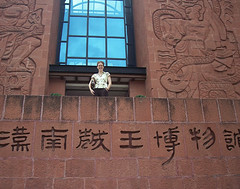
The other day I went to the American Consulate in Guangzhou and, before returning to Shenzhen, I visited the Western Han Nanyue King Museum. Like my visit to Xi’an, this visit helped clarified some of the contradictions that animate the construction of Shenzhen by indexing both national trends and regional specificity.

Located on Jiefang Bei Road in Guangzhou, the Museum of Zhao Mei, second king of the Nanyue State of the Western Han Dynasty (206 B.C.-24 A.D.) is the oldest and largest Han mausoleum in Lingnan. The simple act of walking through the museum suggests the way architecture not only sutures one era to another, but does so by highlighting the radical differences between eras.

The site was discovered in 1983 when developers began leveling Elephant Mountain in order to build needed housing. At the time, Guangzhou and the other 13 coastal cities were still a year away from reforming and opening the local political-economy. This is important because the housing built at the time, housing which now surrounds the museum was built under the Maoist work unit system. Consequently, Stalin inspired apartment buildings surround the museum’s modernist silhouette.

The museum complex consists of two main buildings—the exhibition hall and Zhao Mei’s mausoleum. Architect, Lu Yanzhi won the Liang Sicheng prize for its striking modernism. Green grass and sculpted topiary set off the buildings’ red stone base and glass pyramids. Walking from the exhibition hall toward the mausoleum chamber, however, my eyes kept moving from the set scene toward the spill of Stalinesque housing and Maoist factories. Two kinds of cognitive dissonance kept my eyes darting from the museum complex to the surrounding environment. First was the obvious difference in upkeep between the museum’s well-tended garden and the neighborhood, which seemed to be crumbling. Second was the City’s glorification of ancient history and the implicit denial of the importance of both Mao and Stalin to Guangzhou. After all, in order to build the museum, a building project was put on hold. Yet the surrounding neighborhoods will be razed as soon as it is economically feasible to do so.

I suspect several factors contribute to the social production of these differences. One might be historical age. 25 years really isn’t all that much in comparison to 2,200. Another might be rarity. There is only one mausoleum and many, many crumbling monuments to Stalin. There’s also a hint of elitism—tourists and political leaders agree that dead kings continue to matter more than living commoners, even as the museum implicitly sutures contemporary Chinese society to past empires without actually acknowledging the Cultural Revolution.

All these contradictory impulses animate Shenzhen, of course, but they seem so much more obvious in Guangzhou, where a longer urban history makes it both easier and harder to erase the recent past in favor of imperial glory. On the one hand, there actually are significant archeaological sites in Guangzhou which make imperial claims seem viable. There are several interesting sites in Shenzhen, but they’re either far away from the beaten path so unvisited except by foreigners or rennovated beyond recognition; Shenzhen’s imperial claims (except for Diwang and that’s imperialist of a different kind) feel contrived. On the other hand, Shenzhen has more or less successfully razed traces of the Maoist past. A few Mao heads remain on older village walls, but Mao-era buildings, especially of the industrial urban kind didn’t fit into Baoan County’s plan, so there wasn’t much past to deny, unlike in Guangzhou. But again, precisely because Guangzhou has this deep history and the odd archaeological site, the city might gets tied up in debates that Shenzhen easily sidesteps with the claim, “There was no history here,” moving right along with the task of building a modern international city. All this to say, that even if erasing history seems pretty straight-forward–raze a building here, don’t mention the factory that used to be over there–it doesn’t follow that its easy to rewrite the past simply because garbage accumulates despite our best intentions. The stubborn fact of unwanted (or once-wanted-now-denied) buildings and highways and stores now vexes Shenzhen leaders intent on handling the municipality’s urban villages, ironic remnants of Shenzhen’s earlier boom, which doesn’t count as “history” and so, by definition, needs to go.

The social differences staged by the museum and its immediate environ are lived on the steps to the museum entrance, where recent migrants sell artifacts to tourists. The day I visited, three young men from Gansu tried to tempt me into purchasing animal skins. (I’m not sure if they were real or not, but suspect the latter simply because in Shenzhen all the folks who traffic in wild animals have gone underground and one needs a personal introduction to eat alligator and badger.) When I asked who bought their skins in this heat, they laughed and said, “People like you.” They helpfully offered to take my picture for the memories; I took theirs’ for the same reason. Come tour theWestern Han Nanyue King Mausoleum
.