Hi, Fringe, High 艺穗!

In December this year, Nanshan District will organize and host the First (might become) Annual Shenzhen Bay International Fringe Festival. The purpose is to bring alternative artists and their art to the city.

Yeah!

More to the point, those in the city during December will be able to enjoy performance art, installations, theater, and low carbon creativity throughout the Nanshan Culture Area (which includes the Poly Center, Coastal City, and the area around Nanshan Book City, including the small park).

As events are finalized I will post more details.

a character is a universe

today, i met chang hongcai, a calligrapher. teacher chang’s studio is located in liuxiandong (留仙㓊),an artist colony of sorts. the liuxian village head has rented out (at cheap cheap prices) an entire six story factory to a group of artists, who use the building as studio space. importantly, these artists are not struggling emergents, but established artists whose work is shown throughout china and the world. teacher chang, for example, is a highly respected calligrapher whose work hangs in some of china’s top museums.

we talked about many things – tea, the book of changes, and taichi – but all topics departed from and returned to calligraphy as the essential philosophy of china. according to teacher chang, how one holds the brush, each brush stroke, the actual meaning of the character, all this together forms a universe. he used the character “one (一)” to develop his point:

to write a proper yi one holds the brush with the entire body, arms loosely held as in taiji, one’s qi flowing. the brush stroke itself (and it is one fluid motion) actually follows the contours of the symbol for yinyang, stretching beyond the limits of a line and returning into infinity as the brush circles, pauses, and then quickly flicks back into itself. according to teacher change, the process of writing is itself chinese philosophy; calligraphy cannot be rushed, but must be cultivated, like breathing.

teacher chang also spoke of 势 (shi) or immanent tendency of a stroke. his explanation of 永字八法 (the 8 methods in the character yong) focused on how each stroke was in fact in motion. a heng, for example, was pulled like a bow and a gou was kicked back, strongly and decisively. a stroke that just ended because the brush was lifted, was a stroke that had been cut off, was empty. fullness came from the motion of the stroke, which had its own rhythm and spirit. in fact, when teacher chang helped me see a character, he emphasized the moving brush such that it seems possible to understand shi as traces of the calligrapher’s spirit; her body, her hand, her knowledge, her state of mind, her understanding of the world – all this comes together in the stretch and flick of ink on paper.

practicing calligraphy helps us center the mind and cultivate a good attitude because the idea that “a character is a universe” reminds us that we constantly (re)create the world. indeed, that is all we ever do.

tangtou, baishizhou


tangtou old housing, new village

Baishizhou has the distinction of being Shenzhen’s “city that isn’t a city, village that isn’t a village (城不城,村不村).”

The first stop (bus or subway) after Windows of the World themepark, Baishizhou has come to refer to a 7.5 sq km sprawl of handshake buildings that was originally part of the “Shahe Overseas Farm (沙河华侨农场)”. This highly congested and irregularly built area is also the first stop for many new migrants to Shenzhen because of its central location, convenience, and lowest of the low priced housing.

Inquiring minds ask, “How did (one of) Shenzhen’s most beautifully landscaped high end residential, tourist and arts area (OCT) end up next to what is acknowledged to be one of the city’s largest slums?” Continue reading

chiwan 2009


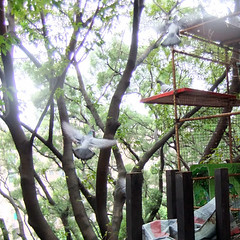
pigeons

Originally uploaded by maryannodonnell

today was the 15th of the 10 month of the lunar calendar, so i did what all good girls do – went temple hopping. chiwan is one of the natural harbors that constitute the port of shenzhen. before reform, chiwan could only be reached by way of a boat launched from shekou, heading north up the pearl river. today, chiwan is easily accessible by the 226 or 355, but still retains something of a backwater feel. indeed, chiwan has the scruffy feel of a potentially hip artist colony, except for the lack of artists and the vanishing coastline.

that said, chiwan is fun because it also boasts some of the oldest sites in shenzhen – the tianhou temple (technically the oldest in the area. zheng he reputedly stopped here, and emperors from the ming and qing gifted stele to commemorate upgrades and rennovations (!) to the temple). chiwan is also site of the grave of the last song emperor – a child who was drown with and by a loyal follower so he would not be dishonored by the yuan. the little emperor’s tomb is maintained by the zhao family.

hop, hop.

玉历宝钞:return of the repressed, reworked for the current age


old museum entrance

Originally uploaded by maryannodonnell

Recently I have noticed that buddhist iconography is seeping into local shrines, which have been growing stronger this past decade. At the Daxin Tianhou Temple, for example, Guanyin (boddhisattva of compassion, but also the Goddess of conception) and 天花娘娘 (Tiānhuā niángniáng the Goddess of pox -cow, small, and vaccines thereof, who also heals disease in general and is somehow related to conception) have joined Tianhou on the alter. Also, popoular Buddhist texts and sutras are being distributed in local shrines and temples. In fact, the Shenzhen Hongfa Temple in Fairy Park is actively publishing and presumably delivering these tracts. Other sutras are published by very local printers, whose addresses include place markers such as “side alley”. Continue reading

the gift of ruins


doubly noted

Originally uploaded by maryannodonnell

Friend Frank Meinshausen has stopped by on his ’round the world journey. We first met Frank four years ago, when he translated Hope (Chinese > German) for a staged reading at the Schaubuhne, Berlin.

Yesterday, we walked through Zhongshan Park, one of my favorite Shenzhen greenspaces.  At the center of the park are the ruins of the former Ming Dynasty city wall that once enclosed the County Seat of Xin’an County, the adminstrative predessor to Baoan County, which in turn predated Shenzhen Municipality.

So obscure and uncared for is the ruined wall that vines have overgrown the first stone marker and a second has been placed at the base of a tiled staircase, which rises sharply and ends as suddenly as it began. Sundry trails emerge from the park and disappear into the undergrowth, connecting the Ming Dynasty to the rising city of Shenzhen. We walked the narrow path, which traced the boundary of a world that has become as elusive as crumbling fistful of dry earth. We climbed the molding, vaguely imperial concrete viewing platform that abruptly interrupted our steps. We listened to birdsong and inhaled the fragrence of magnolia.

Further flights of romatic fancy, here.

xiao chen – thoughts on how to do “small” business


xiaochen tea

Originally uploaded by maryannodonnell

More thoughts on how Shenzhen does and does not work, this time inspired by a conversation with Xiao Chen, my tea vendor.

Yesterday afternoon I went to Nanshan Tea City, where Xiao Chen and her husband have a tea stall. They are from Fujian and sell amazing Iron Guanyin (the new tea is in and fragrant) and different grades of pu’er, which is what I usually drink. Pu’er is a fermented tea, and, like red wine, becomes richer and more complex with time.

Xiao Chen had just received an order of 13 year old pu’er that she wanted me to try. We sat at the table, where she prepared the tea, washing the leaves three times instead of two, poured the tea from the clay teapot into a class pot, and then into my small teacup.

As she has taken it upon herself to educate me about tea, Xiao Chen explained the importance of each step. Washing the tea leaves insures that one drinks the best taste, the small clay teapot preserves the fragrance and quality of the leaves, moreover it achieves these high quality results without wasting tea leaves. A glass pot is necessary because when the tea is poured out of the clay teapot the tea does not have uniform flavor. Instead, the first tea is relatively weak and the last tea is relatively strong.

While we were sipping the tea, Xiao Chen explained how she and her husband do “small” business (做小生意). Unlike big business, she said, small business depends upon “renyuan (人缘)”. According to Xiao Chen, renyuan is about the trust that people have within a human relationship. For their business to succeed, she and her husband need return custumers. To maintain the trust, the vendor and the custumer have to believe that the other has their best interest at heart: the custumer wants the vendor to earn enough money to make a living, and the vendor wants the customer to purchase high quality goods at the most reasonable price. Continue reading

阳光家庭 – Sunny Families on a Rainy Day


social work

Originally uploaded by maryannodonnell

Sometimes the anthropological moment comes to me.

This morning, I was hanging clothes despite the drizzle when a bullhorn announced the opening of a Nanshan District Sunny Family Pre-School Haiyue Community Event in our housing development. Specifically, the group was recruitng for its summer program, which would run from June 6 through July 4. From the information I gathered, it looks like more kindergarten. From the children dancing in gold costumes, it still looks like a summer of more kindergarten. SF also announced a program they will be holding on Household Relationship Management for the Professional Woman (职业女性家庭关系经营). Continue reading

海岸城:city on the fill


coastal city, west and east

one of the newest, most expensive, and flashiest of the recent crop of development projects on houhai reclaimed land, coastal city (海岸城) sparkles even in a winter drizzle. i suspect that coastal city will soon enough fade into some post-whatever background, but today as i walked around both the east and west complexes, i wanted this to be important, not just an object of anthropological critique, i wanted all this building to mean something other than wild real estate speculation and irresponsible environmental policy. i wanted it to become a city to fall in love with, even though i can’t bring myself to say i like shenzhen. clearly if not misplaced, my sentiments are vexed.

so pictures.

guankou (关口)


who’d’ve thunk it? stalin in shenzhen

silo has gone. floating lives went off better than expected, primarily because mutual goodwill enable a lot of cultural and aesthetic difference to be used creatively, rather than becoming an obstacle. that in itself was a lesson. so, i am back taking pictures of shenzhen’s odd corners, which are actually multiplying even as they are increasingly hidden in the black holes between highrise developments. the other day, i went to guankou, the remnant village located just west of the western gate into nine streets (once upon a time the entrance into the nantou yamen and hence the name “gate entrance village”).

in a parallel china, guankou was located just north of daxin brigade (大新大队), which had been the administrative center of the nantou commune (南头公社) and subsequently became the base for the nantou administrative (南头管理区)area (before shenzhen had districts, it had administrative areas, which were basically communes redeployed. in 1990, shenzhen rezoned itself into city districts–nantou became a street (街道办事处) in nanshan district). ever at the edge of western (shenzhen) wealth, guankou was one of the first industrial areas in the shenzhen special economic zone. (today is a day of using discarded language–“special economic zone” has gone the way of “brigade” and “commune”; a historic remnant visible in the landscape but no longer used in everyday conversation. i knew if i procastinated long enough, shenzhen would change enough for me to attain historical perspective! so another promissary note: an entry on “what happened to the sez?”) consequently, guankou was one of the first areas in shenzhen to be industrialized and circa 1982, guankou had factories. these factories lined “nantou old street”, that (before nanyou road became nanhai road) once linked the nantou yamen to shekou.

the architecture of these factories interests me. as does shenzhen’s limitless ability to manifest the ironies of history. at the same time that my old friend, rao xiaojun (shenzhen university college of architecture) had organized an exhibit of photographs of china’s disappearing mega-industrial structures (massive concrete and steel factories), and at the same time that shenzhen is vigorously converting laterday shenzhen factories into cultural centers, guankou still has functioning factories that look like mini concrete leaps forward.

fortunately, because shenzhen is still south china, there are twists on the concrete industrial theme: one-story houses, a central market area, and pink-tiled houses from the mid 1990s. for those, who like me are fascinated by the ongoing shenzhen explosion visit 关口 (a final aside: i’m starting to think of urbanization in shenzhen as somesthing akin to a prolonged volcano eruption. the lava just keeps oozing out, over and in between extant topography, constantly reshaping the landscape.)