who’s the happiest in your circle?

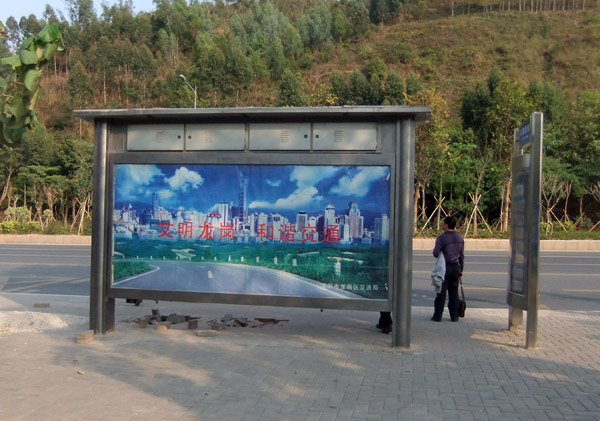
I have gotten somewhat inured to spiritual civilization campaigns like Longgang’s “Civilized Longgang, Harmonious Traffic” (above). After all, the offices have to do something with their budget and I actually support calls for more and better observation of traffic regulations, as well as teaching children to wait for others to get off a bus before charging on. However, this weekend YQ informed me that Shenzhen’s various Spiritual Civilization Bureaus (usually a division of the Ministry of Propaganda  精神文明办公室) have been asked to produce documentaries on “the happiest person I know (我身边最幸福的人)”. Nanshan is filming him because “we want to teach Shenzhen people that there’s more to life than making money.” Apparently, I was not selected because “foreigners do whatever they want, so there’s no educational value in [my] life.” — hee!

my new favorite map

I have just found my new favorite map of Shenzhen. Published in 2009 by the Bureau of Land Resource Use and Real Estate (深圳市国土资源和房产管理局), the map is not only large, but reads like a beautiful promissory note. Indeed the map promises that, “The Beautiful Shenzhen Will Have a Brighter Future.”

Said map includes the complete plan of the subway system, which is still under construction, proposed buildings, and as yet incomplete parks. Moreover, in the spirit of international goodwill, it includes the addresses of foreign consulates in Guangzhou, a map of the domestic and international flights from Shenzhen, business hours of the city’s various border crossings, and a list of rail connections to other cities. Indeed, its as if the map was designed to anticipate growth, much like a parent buys larger clothing for young children to grow into.

I’m not sure if the purpose of this map is to attract people to live in the city or facilitate their passage through on their way elsewhere. I do think, however, that the point is to eventually find oneself off the map. After all, we are walking forward into the not yet constructed, rather than heading toward the already built.

what is the social function of wilderness?

The Chinese word, 荒地 (huāng dì) translates into English both as “wasteland” and as “wilderness”. More specifically, huāng dì usually refers to “land that has not (yet) been converted into arable fields”. At first blush, this dictionary translation alarms me because, as an American, wilderness refers to (yes) untamed places where the infinite creativity of the universe might be experienced – primordial forests, huge swathes of desert, the looming vastness of an ocean voyage, no matter the size of my ship. Wilderness, for me, is not simply good, but sacred -beyond the human in some foundational way; it is where we go for enlightenment. In contrast, wasteland oozes, disgusts, evokes images of wasted land, industrialization gone array – dystopian visions of Gotham. So how is it that the dictionary definition of huāng dì is both wilderness and wasteland?

Continue reading

how do talk across our experience?

On the ride home from RDU airport to Southern Pines, my brother pointed to the road leading to friend’s new house, “She lives out here in the country.”

I asked incredulously, “And you live in the city?”

“That’s right. Downtown.” And we all laughed.

Now I knew that town and country were relative concepts, but it is difficult here in Southern Pines to describe the scale and velocity of urbanization in Shenzhen.

What can I say in response to the question, “How urban is it where you live?”

I usually answer, “Very. There are few places in the US (outside NYC and LA) that are as expansively urban as Shenzhen, but even NYC and LA have significantly fewer people than Shenzhen.”

And there’s the rub. It’s difficult to imagine the intricacies of Chinese urbanization here in Southern Pines, where the wind rustles through long pine needles as the tree tips bend toward each other in early summer warmth. I keep asking myself, what would allow the diverse experiences of urbanization in Shenzhen and Southern Pines to become reciprocally meaningful? After all, over the past few years Southern Pines has experienced an estimated 20% growth rate. Life here, too, isn’t what it used to be. Nor is it the straightforward alternative to China that many people – both here and there – believe. But there are commonalities – shared desires for better education, government accountability, and public safety, to name the tip of grassroots unrest – that could grow into dialogue.

So point du jour: If we are to figure out a language of global sustainability, we need to develop empathy for each other’s reality in the absence of compatible experience.

Topics you’d like to see comparatively discussed? And why?
border crossing

Yesterday, custom officials at Seatac detained my husband in order to convince him to surrender his Green Card because they said that holding a Green Card was a privilege rather than his right. They maintained that a Green Card only gave a foreign national the privilege of residing in the United States because a Green Card is not a “travel document”. Their language use implied that as a Green Card holder my husband did not have the right to freely enter and leave the United States. However, when my husband and I entered Seattle, we had been abroad roughly half a year, well under the one-year time limit on overseas stays for Green Card holders. In other words, my husband had the legal right to freely enter the United States. Thus, the officers had to convince my husband to surrender his Green Card because it could not be revoked legally.

I am distressed and saddened by yesterday’s events. I am distressed because by choosing to interpret my husband’s right to freely enter and leave the United States as privilege, the officers chose to undermine my husband’s legal rights, rights in which all Americans have enshrined in the Constitution. I am saddened because those same actions imply that the officers also chose to close American borders to my husband without considering that there are many ways of being an American family in a globalizing world.

capitalist crises, news induced ADD, and making sense of the world

I’m reading Bateson reading Margaret Mead:

Dr. Mead’s contribution consists in this—that she, fortified by comparative study of other cultures, has been able to transcend the habits of thought current in her own culture and has been able to say virtually this: “Before we apply social science to our own national affairs, we must re-examine and change our habits of thought on the subject of means and ends. We have learnt, in our cultural setting, to classify behavior into `means’ and `ends’ and if we go on defining ends as separate from means and apply the social sciences as crudely instrumental means, using the recipes of science to manipulate people, we shall arrive at a totalitarian rather than a democratic system of life.” The solution which she offers is that we look for the “direction,” and “values” implicit in the means, rather than looking ahead to a blueprinted goal and thinking of this goal as justifying or not justifying manipulative means. We have to find the value of a planned act implicit in and simultaneous with the act itself, not separate from it in the sense that the act would derive its value from reference to a future end or goal. Dr. Mead’s paper is, in fact, not a direct preachment about ends and means; she does not say that ends either do or do not justify the means. She is talking not directly about ends and means, but about the way we tend to think about ways and means, and about the dangers inherent in our habit of thought.

Lovely.

And on to thoughts inspired by the ever relevant Steps to an Ecology of Mind.

Roughly nine months ago, Shenzhen news media reported on the quicksand building incident (楼陷陷事件) and then a month later on the Foxcomm Suicides (富士康跳楼事件). Character by character, 楼陷陷 means “building trap trap,” however I’ve translated as “quicksand buildings” because the term referred to buildings that were literally sinking into reclaimed land in Houhai, Qianhai, and the Baoan Center District. At the time, both incidents received much Shenzhen press, although Foxcomm ultimately eclisped quicksand, both in Chinese and English. Indeed, I haven’t noticed any English press on the quicksand building incident and would appreciate links and/or references.

There are many possible explanations for the focus on Foxcomm rather than quicksand. Continue reading

more about tea

The price of tea continues to shock me, which in itself is interesting given that I’ve become accustomed to buying tea that sells for 300-500 a jin (roughly $US 45-70 for 1/2 a kilo). Today, while I was waiting for my tea to be packaged by an assistant, the owner of the shop invited me to try some Iron Buddha that sells for “only” 700 a jin ($US 100). I drank several cups and thanked him for his hospitality, but wasn’t tempted to purchase because I prefer stronger teas – Yunnan Red, puer, and dancong, for example.

But. When I actually translate prices into US dollars rather than simply think about the prices in local terms, I wonder what it is I’m doing paying over $US 45 for 1/2 a kilo of tea. Continue reading

earthly abstractions

Coming into Shenzhen on the Tianjin-Shenzhen train, I heard a broadcast about the City’s historic importance and sites of touristic interest. Nothing out of the ordinary, until the broadcast introduced the Daya Bay Nature Conservation Park. I tend to think of Daya Bay in terms of nuclear power and French technologies thereof, rather than in terms of conservation. Today, the unexpected juxtaposition of nuclear power and nature preserves has me thinking about paradoxes in urban planning.

Continue reading

generations

Lately I have been writing about Generations 80 and 90 because much of what they do and think mark interesting sites of departure from older generations. Today, a brief comment about my experience watching Beijing Opera with an 80 year-old friend.

Continue reading

watching the SZ evening news in Tianjin

I have been watching the Tianjin evening news, but last night had the chance to watch the SZ evening news (via SZ satellite television) and the differences between program content were as interesting as the similarities. Impressions below. Continue reading