yuehaimen village

When I first arrived at Shenzhen University, Yuehaimen was the urban village where I rented a conveniency apartment for 600 rmb a month. Located at the southeastern border of the SZU campus, there was an open gate between the village and the campus. However, by the time of SARS (2003) the gate was sealed off and students took to clambering over the wall between the village and campus in order to get to school. The university built dormitories at its southwestern border in Guimiao campus. That small, backdoor gate was the easiest to slip through during the SARS quarantine.

Piece by piece, urbanization near the SZU campus isolated Yuehaimen from the city. On its eastern border, Yuehaimen abuts the southern section of the Shenzhen Science and technology park. During construction of the park (from mid to late 1990s), another wall was built between the village and the white-collar work and residential area. The village’s southern border was the coastline that is now Houhai Road, and yes, a wall was built to separate the village from land reclamation, and has remained in place to cordon off ongoing construction of SZU’s southern campus.

These successive construction projects (SZU campus, Science and Technology Park, and reclamation of Houhai Bay) meant that Yuehaimen was an important home for construction workers, SZU students, and office staff. Having limited land resources, villagers built early and tall; these 6-8 story buildings are not prototypically “handshake” buildings, which emerged in the mid-1980s. Instead, Yuehaimen buildings resemble early 1990s work unit housing. More importantly, given land constraints and building styles, villagers did not own individual property, but units within jointly held buildings.

Yuehaimen is scheduled for razing by the end of the calendar year, or early next year. Most of the residents have been evacuated. What remains is an urban ghost village, where a few stragglers wait until the very last-minute before slipping into another urban enclave. In turn, Yangguang Real Estate developers promise to build another gated community on the footprint of Yuehaimen — this one shiny, modern, and meant to house Shenzhen’s technocratic managers and leaders.

Impressions, below.

This slideshow requires JavaScript.

moving on up…shenzhen identity and urban villages

Urban villages inform and shape popular understandings of Shenzhen, both domestically and abroad. Intellectuals, also here and elsewhere, have decried the decision to raze villages and put up new and improved postmodern housing estates, offices and shopping malls as it short-sighted and violently anti-working class. However, in Shenzhen, there has been no street level organizing as such to stop the razing; a decision is made, plans approved, people moved.

In this context, it is interesting to note the temporary nature of Shenzhen patterns of inhabitation. Even before settling in to their first dorm room or urban village share, migrants intend to move. This intention might be vague — I’ll move when I get a better job, or buy my house — but “moving on up” is one of the reasons people migrate to the city. Moreover, in practice, people move when they change jobs, they move when they get a raise, they move when they have a partner, they move when their parents come to live with them. They also move as investment strategies, from one home to the next. Indeed, as far as I can tell, people only seem to stop moving (for the time being), when their child is at a desirable school. If the school is undesirable, changing school district zones or moving to parts of the country where gaokao competition is less fierce.

In other words, inhabitation patterns seem to preclude the time necessary to grow attached to neighborhoods. The current fondness for urban villages seems overwhelming is often nostalgic (missing the challenge of first coming to Shenzhen) or political (we need housing for the working poor), but it is rarely the result of long-term living in a village. Many of the people I have interviewed who do live in a village want to leave. They want their own home (not a rental), or if they are a landlord who lives in a handshake, they want to live in a modern high-rise.

All this to say that the lack of grassroots resistance to razing urban villages in Shenzhen isn’t as counter-intuitive as it may seem from the outside. Those who want to keep the villages don’t actually live there, and those who live there are anticipating moving out. Indeed, I have come to believe that the social questions posed by urban villages have less to do with preserving these neighborhoods, as they do with making long-term inhabitation possible. If the villages were places that people actually wanted to live, raise their child, and retire, then there would be a very different political and economic response to the ongoing demolitions.

NOTE: Handshake buildings as a form of local real estate development were an artifact of the 1992 decision to transfer inner district village lands to the city. In the 1980s, villagers built free-standing homes for themselves, and some collective rental properties and dormitories. However, once the 1992 policy limited village land resources, villagers stopped building individual free-standing homes and built multi-story rental buildings. In the outer districts, where land remained under village control until 2004, villagers built neighborhoods of free-standing homes for themselves, and multi-story rental properties next door.

shekou tour — from villages to the new coastline via a few side streets

Wonderful walking tour of Shekou with Huang Weiwen, Director of the Shenzhen Center for Design. Of particular note (in no particular order):

Nanhai Road was the primary artery and all industrial parks and housing were built along that road. This road has pride of place on the original China Merchants plan for Shekou. However, on the same map, the village areas were blank. Moreover, road and infrastructure construction served to isolate, rather than integrate the villages into Shekou society. Nevertheless, public facilities such as hospitals, post offices and schools were built in the border zones between the village and China Merchant settlements.

The craze for creating material traces of a history for Shenzhen continues. Next to the Shekou wet market — which has been externally renovated with LED screens — a strip of village holdings / former factories is being converted into “Fishing Street”, where there will be restaurants and other places of consumption. The design for Fishing Street juxtaposes three different Chinese traditions: Guizhou style houses, bas relief murals of Dan or Tan people fishing history, and palm trees. The Guizhou houses were first seen in the Meillen hotel and apartments, but the style has clearly trickled down. The Dan, of course, were the people who lived on fishing boats, only coming online with land reform during the early Mao era. Before they were used as ornamental topiary, the palm trees were used locally as cash crops to make fans. This new development further deepens other murals and village museums in the area.

The most distressing change? The almost complete privatization of the coastline. The new marina includes a private road to that last stretch of leasure coastline. Indeed, residents may now access the coastline either through the Shenzhen Bay Park or window views from a highrise.

ALso, as we walked from the village areas toward China Merchants developments, I couldn’t help but notice the abandoned telephone booths — they litter the older sections of the city. Moreover, it is only when actually noticing these empty stalls that I realize there are no public phones throughout the newer sections of the city. Instead, we all carry phones (of varying degrees of intelligence.)

Impressions, below.

This slideshow requires JavaScript.

bounded histories

Yesterday, I went to the Bao’an Archives Office (深圳市宝安区档案馆) and met with one of the editors of the Bao’an Gazetteer (宝安史志).

The conversation turned to the paradoxical dependency of historical narratives on a sense of immortal China and actual historical archives. This paradox might be glossed as a contradiction between “emotional” and “documented” history. On the one hand, patriotism, tradition, and the deep history of Han settlement anchors the idea of “Shenzhen history”. The emotional sense that Shenzhen is and has always been part of “China” is created through a narrative that links the history of Xin’an Ancient City, for example, is written with respect to the area’s integration into the Eastern Jin Dynasty and the development of the imperial salt monopoly. Thus, ongoing political restructuring — beginning with contemporary Shenzhen and arriving at the Eastern Jin via Bao’an, Xin’an, and Dongguan — is rewritten as evidence of the city’s ongoing participation in something that might be glossed as “eternal China”.

地图-东晋东官郡、宝安县示意图
This map is of the Eastern Jin when Nantou City was the prefectural seat of the Guangdong Eastern Prefecture (东晋东官郡), including present day Dongguan City, Shenzhen, and Hong Kong.

On the other hand, the actual archives to which a historian has access bureau is an artifact of political restructurings and the concomitant shifting of administrative borders. The question of land titles (地契) that were issued during early land reform (1950-52) is an interesting case in point. Originally, all Bao’an county land titles were held in Huizhou City, which administered the county from 1950-1979. These land titles, of course, became void during collectivization movements (second half of 1950s) and land holdings shifted from individuals to collectives. Consequently, during the 1980s household responsibility system (家庭联产承包责任制), land rights were redistributed via collectives. Nevertheless, in the early 1980s, the land titles were sent to Bao’an, where they are incomplete, but nevertheless have been increasingly used by villagers to make land claims.

The ongoing construction of Shenzhen has further complicated the actual practice of creating viable historical archives. Theoretically, archives have followed administrative hierarchies. In practice, this means that when an administrative unit is promoted and/or redistricted documents have to be moved from one building to another. For example, the transfer of Bao’an land titles from Huizhou to Bao’an. Moreover, the ongoing construction of Shenzhen municipal and district offices means that these archives have not only been packed and sent to another building, where they may or may not have been unpacked, but also during the redistribution boxes of material have been lost.

Our conversation concluded with the recognition that history — as we are writing it in Shenzhen and I suspect elsewhere — turns on context. Are we responding emotionally to patriotic calls? Or are we developing arguments out of extant documents? In either case, here on the ground, the tension between these two extremes serves to buttress both emotional and documentary uncertainties. When we lack a document, we can turn to the hyperbolic understanding that Shenzhen has always been part of China and when we need to assert the truth of our feelings, we can point to these maps, which although now virtual, continue to reassure us that history is not just of our own making.

what is the party’s benevolence?

In news broadcasts and interviews, old peasents frequently evoke “the Party’s benevolence (党恩)” to explain their lives. Young and hip urbanites hear these interviews as more evidence that old peasents are the dupes of corrupt officials. However, when I take the time to listen to an old peasent’s life history, it’s clear that more often than not, these peasents did benefit from the establishment of the People’s Republic.

Yesterday afternoon at the Dalang Culture Center, for example, I helped conducted interviews with Uncle Chen and Aunt Zhang for an oral history project. Both Uncle Chen and Aunt Zhang were both born into peasant families in 1930 and 1940, respectively. Auntie’s family owned three single-story houses, while Uncle had left home early because his family did not have room for him. Auntie mentioned that at the turn of the last century, her grandparents went to Singapore to work. Her mother was “brought home” as a child bride for her father. In contrast, Uncle did not mention his family except when asked about how poor his family had been, he remarked that two of his sisters had been sold to strangers, but where they ended up was unclear.

As a poor man, Uncle could not afford to marry. Instead, he went to find work in Hong Kong. In 1951, Uncle became sick and returned to his hometown, where he could recieve care. In 1952, although he had a sporadic education, Uncle was able to secure the documents necessary to join the first test for admission to the Bao’an Normal School. He passed the test and was admitted to an elementary school teachers program, which was located in the Nantou High School building. Teacher Chen emphasized the extent to which his current wellbeing was a result of the Party’s benevolence. He was assigned to teach at Langkou Elementary School, where he met Auntie.

As a young girl, Auntie stayed at home and helped her parents. However, when she was 10 years old, Auntie began attending Langkou elementary school because her father asked the school principal to allow her to bring her brother. 10 year-old Auntie strapped her brother to her back and attended classes. At lunch time she fed her brother a bottle of condensed milk that had been thinned with water. Several years later, she carried her sister to school. Altogether, Auntie carried her siblings for six years. At the end of elementary school, Auntie tested into middle school, where she studied elementary education. Auntie emphasized that her teachers like her because she was a good student. Moreover, her younger siblings were well-behaved and didn’t cry during classtime.

After Auntie graduated from middle school, she married Uncle, who was still teaching at the village school. Auntie’s mother exhorted her to marrie Uncle because he “could do anything”. Uncle could not give Auntie any presents for the marriage. However, he did have housing at the elementary school, where Auntie was also hired to teach first and third grade. The school was located near Auntie’s parents’ house. Auntie did not attribute any of her life history to the Party’s benevolence, but rather emphasized her family background and her mother’s words.

Implicit in Uncle and Auntie’s simple story were the gendered contours of rural poverty in South China, where one of the most important events of a lifetime was to continue family lines through marriage and children. Uncle and Aunt were born into South Chinese villages, where bringing in wives or selling out daughters was a common practice before 1949. However, they married 10 years after the establishment of the People’s Republic, when some policies had already restructured traditional social structures. Auntie married because her family could afford to give her an education, but not to keep her at home. In contrast, Uncle had delayed marriage until he could afford a family, which was a direct result of attending teaching school. He described that opportunity — and all that followed, a job, a house, and eventually a wife and children — as an expression of the Party’s benevolence.

laying siege to the villages: xixiang and fuyong

A five-part essay, “Laying Siege to the Villages” has been published online at Open Democracy. Here’s part four, which discusses informal urbanization beyond the Second Line (erxian).

4. Informal Urbanization in the Outer Districts: National Highway 107

Shenzhen township and village enterprises (TVEs) in the outer districts (formerly New Bao’an County) were quick to take advantage of reform policies. By 1985, village-teams, township brigades, and the recently re-established Bao’an County government had already registered over 50 industrial parks (Map 6).

national highway 107

Map 6: Industrial Urbanization in New Bao’an County, 1985

Nevertheless, this massive social restructuring occurred outside and despite municipal urban planning (Map 7). A comparison of these two maps reveals three important features of informal urbanization in Shenzhen. First, the total area of Shenzhen’s informal industrial urbanization was over four times greater than planned urbanization in inner districts (original SEZ). Second, urbanization in the outer districts occurred outside official urban planning. Moreover, the density of industrialization along National Highway 107 becomes on the 1986 Plan an incomplete red thread. Indeed, as targets of urban planning, the outer districts did not appear in official maps until the release of the 1996 Shenzhen Comprehensive Plan. Third, the scale of development in the outer districts indicates the high level of informal organization in the villages. Informal urbanization did not arise sui generis, but through the redeployment of TVEs, which did not only represent the economic interests of the collective but also traditional identities and social constituencies.

guannei-wai

Map 7: 1986 Master Plan for the Shenzhen Special Economic Zone Transposed onto the 2013 Shenzhen Municipal Map

In addition to the New Bao’an County TVEs, the outer districts also saw the development of private stock companies formed by alliances between individual villagers and investors, often from Hong Kong or an Overseas Chinese community. The diversity of ownership, notwithstanding, all of these enterprises engaged in low-tech labor-intensive assembly manufacturing. The factories themselves were long, concrete buildings, usually 4-6 stories in height. These buildings usually had electricity and water hook-ups, and depending on the complexity of assembly, individual tables for detail work. Outside firms contracted a TVE to assemble a product according to spec. Earliest manufactured goods included textiles, toys, and cheap electronics. These early industrial parks also included 4-6 story dormitories for migrant workers. Dorm rooms were narrow, and fitted with four bunk beds. Opposite the door was a small window, while along the remaining walls two bunk beds were placed back-to-back. There was enough space between the bunk beds for residents to walk to their bed. Consequently, most conversations occurred sitting on a bed or outside on the lawn. Importantly, these factory complexes were built either along National Road 107 or the railway, along which goods were transported to the port of Hong Kong, where in turn the goods were shipped overseas.

In the early 1980s, when the Shenzhen TVEs opened, there were no other manufacturing jobs available to rural workers, who were still tied to collectives and mandatory agricultural production quotas through hukou status. This meant that the Shenzhen TVEs had labor reserves throughout Guangdong and neighboring provinces, where rural workers who were effectively excluded from wage labor. The number of migrants who took advantage of these opportunities constituted the Shenzhen population boom, transforming the landscape in three important ways. First, more people came than there were jobs and by extension, dormitory space. This created an immediate need for rental properties. Second, the increasing population also needed food and social services, which in turn created more jobs for migrants across sectors, but primarily in construction and service industries. Third, urban construction this area was largely informal. By the time that Shenzhen Municipality had annexed New Bao’an County in 1990, local collectives had emerged as the de facto urban planners in the outer districts. Moreover, when considered in terms of population and territory, urbanization in the outer districts constituted the primary form of urbanization in Shenzhen. Moreover, by the mid-1990s, many domestic and international companies chose to rent use rights from the collectives and build campuses in the other Districts, especially Longgang near the railway. As of 2013, high profile electronics manufacturers in Shenzhen included Foxconn, Tencent, and Huawei.

The fuzzy nature of ownership rights over-determined the haphazard direction of urbanization in the outer districts. Indeed, throughout Shenzhen, the foresight of a collective leader and the willingness of members to coordinate development has shaped the quality of life in specific villages. In the post Mao era, land ownership rights belonged to the collective, while “use rights” were delegated to members of the community. This slippage provide a brief window of opportunity for individual villagers to engage in individual profit-seeking activities, however, the most successful enterprises belonged to the county, townships, and villages that expropriated use rights by exerting their ownership rights. Indeed, conflicts between Shenzhen Municipality and its “urban villages” have also arisen due to the distinction between ownership and use rights. As of 1992 in the inner districts and 2004 in the outer districts, Shenzhen Municipality owned all land within its borders. However, through housing and industrial parks, the collectives continued to exercise use rights. Indeed, since 1992 and 2004, villages and developers have been negotiating compensation for transferring these rights; Shenzhen Municipality has mediated these transfers through its Master Plans.

laying siege to the villages: luohu and dongmen

A five-part essay, “Laying Siege to the Villages” has been published online at Open Democracy. Here’s part three, which discusses the opening of the Sino-British border at Luohu. Hong Kong lay south of the border and Shenzhen to its north.

3. Neo-Liberalizing the Bamboo Curtain: Luohu and Dongmen

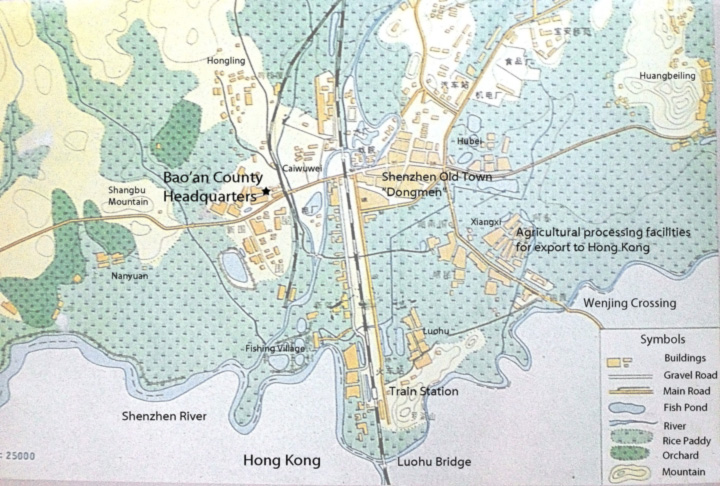
Two factors – political and economic – motivated the 1953 decision to move the Bao’an County Seat from its historical site at Nantou, on the Pearl River to Caiwuwei, a village located next to Shenzhen Old Town and the first station on the Chinese side of the Kowloon-Canton Railway (KCR). Politically, Shenzhen Market was located at the actual Sino-British border and this is where the Chinese military was stationed after England supported the American action in Korea. This border became metaphorically known as the Bamboo Curtain, a reference to the Cold War Iron Curtain that split Europe into Capitalist and Communist blocks. Luohu Bridge was the southern entry point into the People’s Republic. Beginning in 1955, it is estimated that between 1 and 2.5 million Mainlanders attempted to escape through Bao’an to Hong Kong, with mass exoduses occurring in 1957, 1962, 1972, and 1979. Economically, the Shenzhen train station connected the area to the national railway system. The socialist planned economy relied on an extensive railway system to transform the scale of the Chinese economy from a traditional economy of peasants to a modern economy based on mass transfers of goods and people. In addition, the location of the new County seat also facilitated processing of foodstuffs that were sold for hard currency in Hong Kong via the Wenjing Crossing (map 5).

 luohu train station area, circa 1978

Map 5: Bao’an County Seat and Luohu Train Station Area, circa 1978

The establishment of the Shenzhen Special Economic Zone in 1980 was also motivated to take advantage of proximity to Hong Kong to achieve national goals. The earliest plan for the Shenzhen SEZ was to develop the 50-km2 area that extended east and west from the KCR railway tracks, upgrading extant roads and developing the rice paddies and Lychee orchards that surrounded the County headquarters, commercial area of Old Town, and extant villages. Two of the most important decisions were to restructure the traffic flow of the area. First, the railroad tracks that traversed County Headquarters were removed. Industrial Parks were built along the remaining extension line and the northern portion of the railroad. Second, the area’s main road, Jiefang was widened west beyond County Headquarters and east near Huangbeiling. The stretch of Liberation that traversed Old Town remained intact. Instead, the People’s Engineering Corps lay a segment of new road that went around the southern border of Old Town or Dongmen, connecting the newly widened sections of Jiefang Road. This new road was called Shennan Thoroughfare and its layout informed all subsequent urbanization of the area. Subsequent development either followed the railroad north toward Buji or west toward Guangzhou.

Villages immediately adjacent to Luohu Bridge, Wenjing Crossing, County Headquarters, and the KCR railroad tracks boomed. In 1980, the villages had four primary sources of revenue – monetary compensation for land rights transfer from collectives to the state; profits from agricultural produce sold to the immigrants; rental properties, and; contraband goods that were smuggled into Shenzhen and sold in either the village market or a stall in Dongmen. However, very quickly the villages also built leisure facilities and commercial areas that targeted Hong Kong day-trippers, who enjoyed services and bought products at prices well below Hong Kong rates. Indeed, by Deng Xiaoping’s 1984 tour of the SEZ, the Luohu Villages had become the symbol of “Small Prosperity (xiaokang)”, the material quality of their homes, furniture, and income even surpassing that of workers in state-owned industries, let alone the rest of China.

The most famous Luohu Village was Yumin or Fishing Village, which held an important place in both national Chinese and local Shenzhen symbolic geography for three reasons. First, the name “Fisher People Village” indicates the ongoing smoothing of local hierarchy and integration of Dan households into first Bao’an County and then the city.  Yumin Villagers were ethnically 蛋家 (Literally “Egg Households”), the group of South Chinese fishermen who did not have land settlement rights. Historically, local governments did not permit Dan to wear shoes when they came ashore, to use red lanterns at wedding ceremonies, to marry land villagers, or to participate in the imperial examination. Under Mao, the Dan had been given land from Caiwuwei Village (location of Baoan County headquarters), moving onshore to build homes.

Second, Yumin Village was one of the first villages to take advantage of reforms, but not in the form of the Household Responsibility system, but rather as a collective. In 1979 – even before the official establishment of the SEZ, Yumin Village Head, Deng Zhibiao organized the purchase of tractors to build increase the size of Yumin fish farms by converting all unused land into fisheries, increasing production from several to over 100 mu. According to Deng Zhibiao’s calculations, at the time one mu of fish produced several thousand yuan. Within a year, the village had saved enough money to collectively build 2-3 story private homes as well as factories. Yumin Village thus had the distinction of being the first “10,000 yuan village” in the country. When Deng Xiaoping visited Shenzhen in 1984, he was taken to view one of the small 2-3 story houses that the villagers had built and shown a modern parlor, complete with tv, curtains, and new furniture. In news reports about Deng’s 1984 Southern Tour, Yumin Village was mistaken for Shenzhen’s “original settlement” and the myth that Shenzhen was once upon a time a small fishing village embedded itself in future reports about the city.

Third, Yumin Village’s location meant that they were positioned to develop rental properties for the massive influx of Shenzhen migrants. Even as Deng Xiaoping was pushing through reforms to the 14 coastal cities, by the late 1980s and early 1990s, Yumin villagers were razing the original private homes and putting up 6-8 story handshake buildings to take advantage of rental opportunities. After all, Yumin Village was conveniently located next to the train station. Consequently, in 2,000 when Luohu began to negotiate village renovation with Yumin Village the stakes had been raised significantly. At the end of the process in 2004, Yumin Village had been rebuilt as an upscale residential area, under a single village owned property management company. The New Village consisted of eleven 12-story buildings and one 20-story multi-purpose building. Each village household was given 30 units within the new complex.

Importantly, Yumin was only one of the Luohu area villages. Each of the other villages – Caiwuwei, Hubei, and Xixiang, for example, underwent similar transformations with one important exception. Unlike Yumin, Caiwuwei, Hubei and Xixiang had histories that stretched into the Ming-Qing dynasties. This meant their land holdings were not only more extensive than Yumin, but also gave them a stronger bargaining position vis-à-vis the state apparatus. Moreover, since the 2007 decision to make urban villages the focus of urban renewal, the Luohu villages have been the sites of the strongest popular resistance to upgrading for two reasons. First, as of 2013, the villages remained the cheapest and most convenient housing option for the working poor. Secondly, the older sections of the villages represented the history of Shenzhen, both ancient and contemporary. Over thirty years after the establishment of the SEZ, Luohu has become an object of nostalgia for many early migrants, second generation Shenzheners and young professionals. Not unexpectedly, perhaps, villagers themselves have been willing to sell their housing rights to the highest bidder, while low-income families have viewed the villages as gateways to better living conditions in one of Shenzhen’s formal housing estates.

laying siege to the villages: the nantou peninsula

A five-part essay, “Laying Siege to the Villages” has been published online at Open Democracy. Here’s part two on the Nantou Peninsula.

2. Concentric Occupations: Nantou Peninsula

The built environment of Shenzhen urban villages references three historic moments – late Qing and Nationalist-era rural society, Maoist collectivization, and post Mao reforms. Spatially, this history has been expressed as concentric occupations, with the oldest sections being first appropriated and then surrounded by newer developments. In turn, older settlements have been downgraded and converted into low-income neighborhoods. Locally, this process has been called, “cities surround the countryside”, which not only resonates ironically in post Mao China, but also identifies poverty with rural status. Maoist theory and practice had identified cities with all that was foreign and reactionary, and villages with all that was truly national and revolutionary. In contrast, the elevation of Bao’an County to Shenzhen Municipality began the administrative transvaluation of the rural-urban relations, which was formalized in 1982 Chinese Constitution.

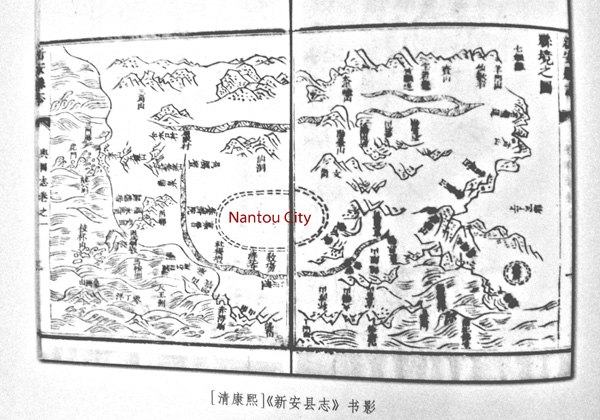
Over 1,000 years ago, salt fields were developed in the Shenzhen-Hong Kong area, and the yamen for the local salt intendant was located on the Nantou Peninsula. The area was also famous for its oyster and pearl production. The peninsula provided protected harbors and access to Guangzhou via the Pearl River. During the Ming dynasty, the Shenzhen-Hong Kong area was called Xin’an County and Nantou City was designated its County Seat. Located on the southeastern banks of the Pearl River, Xin’an was historically poorer than the counties on the eastern banks. Nevertheless, the harbors of the Pearl River’s eastern coastline were significantly deeper than those on the western coastline. Consequently, Chinese maritime access to the South China Sea traditionally went through Humen (in neighboring Dongguan) and Nantou. Indeed, Zheng He’s fleet stopped at the Tianhou Temple in Chiwan Harbor on their voyages of exploration (1405-1433), which took the Ming explorer as far as Africa. After the Ming ban on ocean travel made it possible for pirates to control the South China Sea, Guangzhou remained the southern gate to China and the ports on the eastern coast of the Pearl River became even more coveted by international traders (map 2).

nantou old city

Map 2: Xin’an County Seat in the Reign of the Kangxi Emperor (1661-1722)

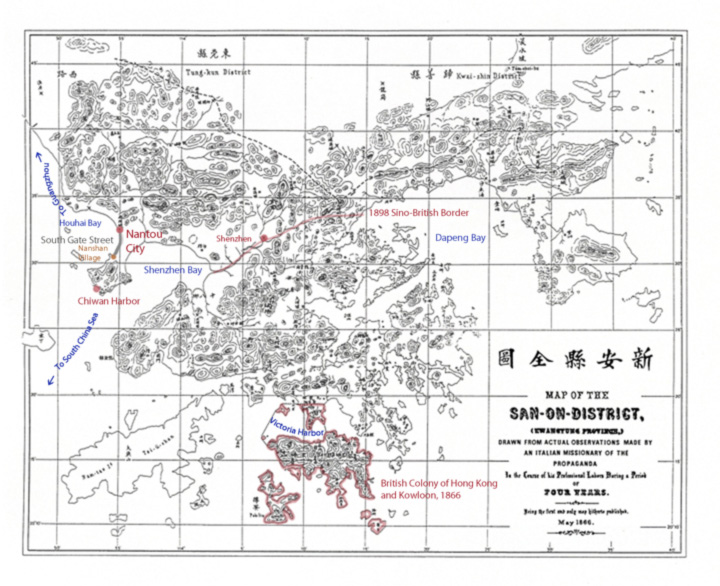
By the late 18th Century, Guangzhou had not only become and important financial center, but also the center of opium trade. The first Opium War ignited when Lin Zexu dumped the opium stocks of British traders in the Pearl River. In turn, the traders successfully pressured the British government to use military means to secure compensation for their losses. China’s defeat in the Opium Wars resulted in British colonialization of southern Xin’an, including Hong Kong Island, the Kowloon Peninsula and the New Territories. The Sino-British border was drawn along the Shenzhen River and passed just south of Shenzhen Market (map 3). The laying of the Kowloon-Canton Railway in 1913 further shifted the flow of goods and people toward Hong Kong and away from Nantou. Small-scale trade between settlements on the Pearl River continued, although Nantou no longer played a dominant role in the regional political-economy. Instead, Shenzhen Market, the first station on the Chinese side of the KCR became the political and economic center of Xin’an County, which was renamed Bao’an at the start of the Nationalist era.

incursions

Map 3: Riparian Trade Routes, Nantou City, and British Incursions

In fact, the establishment of Shenzhen explicitly invoked colonial history, making the return of Hong Kong to Chinese sovereignty one of the key political impulses behind economic liberalization. Maoist modernization of Nantou, for example, included a two-lane road (today known as New South Road), which was laid parallel to the ancient South Gate Road and connected the peninsula villages to the national railroad and highway system. In the post Mao-era, however, state investment has aimed to urbanize the area, rather than to integrate rural settlements into the state apparatus. Land reclamation of Pearl River coastline gives the clearest indication of the scale and ambition of these plans – replacing Hong Kong and possibly even Guangzhou in the global organization of South China trade.

The reform-era transformation of the Nantou Peninsula illustrates the broad contours and social contradictions that have characterized “cities surround the countryside”. During the Ming Dynasty, a pounded earth wall enclosed Nantou, but by the time of the first Opium War, the wall had crumbled into disuse and only the southern and eastern gates still stood. A road stretched from the decrepit Southern Gate and along the coast of the Pearl River to Nanshan Village, which was located at the foot of Nanshan Mountain. Between Nantou Old City and Nanshan Village six villages – Guankou, Yongxia, Tianxia, Xiangnan, Beitou, and Nanyuan – claimed land that included access to the Pearl River, a portion of South Gate Road that they identified as Village Main Street, and farmlands that extended inland. However, through land reclamation and the emplacement of a grid of four- and six-lane roads, such as Qianhai Thoroughfare, Shenzhen’s rural origins have been surrounded and isolated South Gate Street neighborhoods from the larger city (map 4).

 surrounding the countryside

Map 4: Cities Surround the Countryside: The Nantou Peninsula

laying siege to the villages: lessons from shenzhen

An essay written for Open Democracy is now online. Here’s the introduction. Over the next few days, I will put up the sections on Nantou, Luohu-Dongmen, Xixiang, and Baishizhou.

Laying Siege to the Villages: Informal Urbanization in Shenzhen

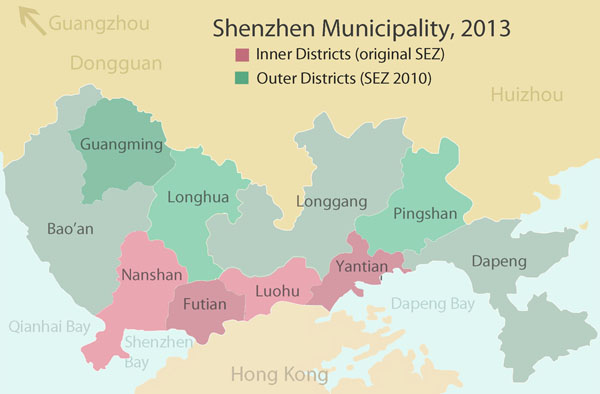
Although Shenzhen is famous for its “urban villages” or “villages in the city” (城中村 chengzhongcun), nevertheless, in 2004 Shenzhen became the first Chinese city without villages. Full stop. This fact bears repeating: legally, there are no villages in Shenzhen. As of 2007, Shenzhen Municipality had a five-tiered bureaucracy consisting of the municipality (市shi), districts (市区shiqu), new districts (新区 xinqu), sub-districts or streets (街道jiedao), and communities (社区shequ). Since 2010, the Districts have been known as the inner districts and outer districts, reflecting when they were incorporated into the Shenzhen Special Economic Zone (SEZ) (Map 1).

 Administrative_Divisions_of_Shenzhen_City

Under Mao, rural areas were China’s revolutionary heart and “villages surrounded the city (农村围绕城市)” was an explicit political, economic, and social strategy for revolutionary change. The Mandarin expression “surrounds (围绕)” can also be translated as “lays siege to”, highlighting the rural basis of the Chinese Revolution. Early Chinese Communists had followed the Russian example and entered cities to organize workers. However, when Nationalist forces led by Generalissimo Chiang Kai-shek violently suppressed Communist organizations in Chinese cities the Communists retreated to the countryside. Moreover, communists and local people identified colonial ports such as Hong Kong with the proliferation of traitors, parasitic merchants, and corrupt officials. Consequently, while Marx claimed that modern history was the urbanization of the countryside, the Chinese revolution aimed to re-occupy and purify the cities. Beginning in 1927 until the occupation of Beijing in 1949, the Communists organized rural resistance to both Japanese invaders and Nationalist hegemony, literally surrounding the cities with an estimated 5 million rural soldiers.

The establishment of Shenzhen signaled the beginning of a new era in Chinese history – “cities surround the villages (城市围绕农村)”, an expression which Shenzhen urban planners and architects have self-consciously used to describe urbanization in the city. Historically, there were legally constituted villages in Shenzhen. The present ambiguity over the status of villages and villagers is a result of contradictions between Maoist economic planning and post-Mao liberalization policies. Under Mao, the country was segregated into rural and urban areas. In rural areas, villages were designated production teams and organized into work brigades that were administered by communes. Communes had to meet agricultural production quotas that financed industrial urbanization and socialist welfare policies in cities, which were tellingly defined as “not-agrarian (非农feinong)”. Importantly, the hukou or household registration policy literally kept people in place – the allocation of food, housing, jobs, and social welfare took place through hukou status. Food and grain coupons were city-specific, for example, and a Shanghai meat coupon could not be legally exchanged in a neighboring city, let alone Beijing. In rural areas, however, communes and production brigades provided neither food coupons nor housing to members. Instead, brigade members produced their own food (usually what was leftover after production quotas had been met) and built their own homes or rural dormitories as they were known in the Maoist system.

In 1979, when the Guangdong Provincial Government elevated Bao’an County to Shenzhen Municipality, the area was rural, and the majority of its 300,000 residents had household registration in one of 21 communes, which were further organized into 207 production brigades. However, hukou status notwithstanding, the integration of brigades and teams had not been complete and members continued to identify with traditional village identities. Although the names of Shenzhen’s current districts were the names of ten of the larger communes, for example, with the exception of Guangming, they were also historically the names of large villages that had been the headquarters for communes. In 1980, the Central government further liberalized economic policy in Shenzhen by establishing the area that bordered Hong Kong as a Special Economic Zone (SEZ). This internal border was known as “the second line”, in contrast to the Sino-British border at Hong Kong or “the first line”. The re-designation legalized industrial manufacturing and foreign investment (primarily from Hong Kong) in the new SEZ. Outside the second line, Shenzhen Municipality established New Bao’an County, which was still legally rural and administered through collective institutions.

The elevation of Bao’an County to Shenzhen Municipality created an anomalous situation within Socialist China because the administrative division of Shenzhen into the SEZ and New Bao’an County only legalized new economic measures; it did not transfer traditional land rights from brigades and teams to the new municipal government. Instead, the first task of urban work units that came to the SEZ was to negotiate the equitable transfer of land rights from the collectives to the urban state apparatus. The goal was to insure that rural workers would continue to have space for housing and enough land to ensure agricultural livelihoods. And this is where historical village identities reasserted themselves. In theory, the urban work units negotiated with brigade and team leaders to transfer the administration of land from the rural to the urban sector of the state apparatus. In turn, the brigades and teams would continue to produce food for the new urban settlements. In practice, however, brigade and team leaders acted on behalf of their natal villages and co-villagers, asserting a pre-revolutionary social identity.

The legal slippage between collective identity within China’s rural state apparatus and collective identity through membership in a traditional village arose because although the Constitution and subsequent Land Law of 1986 stated that rural farmland belonged to the collective, neither document went so far as to define what a collective actually was in law. Indeed, the difference between rural and urban property rights has been the foundation for post-Mao reforms, first in Shenzhen and then throughout the country. In 1982, the amended Constitution formally outlined the different property rights under rural and urban government. According to Article 8 of the Chinese Constitution:

Rural people’s communes, agricultural producers’ co-operatives, and other forms of co- operative economy such as producers’ supply and marketing, credit and consumers co-operatives, belong to the sector of socialist economy under collective ownership by the working people. Working people who are members of rural economic collectives have the right, within the limits prescribed by law, to farm private plots of cropland and hilly land, engage in household sideline production and raise privately owned livestock. The various forms of co-operative economy in the cities and towns, such as those in the handicraft, industrial, building, transport, commercial and service trades, all belong to the sector of socialist economy under collective ownership by the working people. The state protects the lawful rights and interests of the urban and rural economic collectives and encourages, guides and helps the growth of the collective economy.[1]

In contrast, according to Article 10, land in cities is owned by the State:

Land in the rural and suburban areas is owned by collectives except for those portions which belong to the state in accordance with the law; house sites and private plots of cropland and hilly land are also owned by collectives. The state may in the public interest take over land for its use in accordance with the law. No organization or individual may appropriate, buy, sell or lease land, or unlawfully transfer land in other ways. All organizations and individuals who use land must make rational use of the land.[2]

The contradiction between the fact that villages no longer have legal status in Shenzhen and their traditional claims to land rights and social status – both of which are recognized by Shenzhen officials and residents – has constituted a serious political challenge for Shenzhen officials, who have viewed the villages as impediments to “normal (正常)” urbanization. Officials have defined “normal” urbanization with respect to the Shenzhen’s Comprehensive Urban Plan, which has already gone through four editions (1982, 1986, 1996, and 2010). In other words, “normal” urbanization has referred either to formal urbanization or informal urbanization that has secured legal recognition. In contrast, Shenzhen’s urban villages emerged informally as local residents not only built rental properties to house the city’s booming migrant population, but also developed corporate industrial parks, commercial recreational and entertainment centers, and shopping streets. As of January 2013, for example, it was estimated that half of Shenzhen’s 15 million registered inhabitants lived in the villages. Moreover, these densely inhabited settlements also provided the physical infrastructure that has sustained the city’s extensive grey economy, including piecework manufacturing, spas and massage parlors, and cheap consumer goods.

In Shenzhen, urban villages have been the architectural form through which migrants and low-status citizens have claimed rights to the city. Importantly, informal urbanization in the villages has occurred both in dialogue with and in opposition to formally planned urbanization. On the one hand, informal urbanization in Shenzhen urban villages has ameliorated many of the more serious manifestations of urban blight that plague other boomtowns. Unlike Brazilian favelas, for example, Shenzhen urban villages are not located at the edge of the city, but rather distributed throughout the entire city and many urban villages occupy prime real estate. Consequently, Shenzhen’s urban villages have been integrated into the city’s infrastructure grid and receive water, electricity, and also have access to cheap and convenient public transportation. Moreover, as Shenzhen has liberalized its hukou laws, urban villages have also been where migrants have access to social services, including schools and medical clinics. Thus, Shenzhen’s urban villages have provided informal solutions to boomtown conditions. On the other hand, the lack of formal legal status of urban villages and by extension the residents of urban villages has allowed the Municipality to ignore residents’ rights to the city via the convenience of centrally located low-income neighborhoods. In fact, the ambiguous status of urban villages became even more vexed in 2007, when the Shenzhen government initiated a plan to renovate urban villages. It has been widely assumed that the government promulgated the new plan in order to benefit from the real estate value of urban village settlements. Critically, the Municipality’s plans for urban renovation compensated original villagers while ignoring the resettlement needs of migrant residents. Thus, the status of at least half of Shenzhen’s population suddenly entered into public discourse as it has become apparent that although the urban villages resulted from informal practices, nevertheless, they have been the basis for the city’s boom.

Ruralization: The Ideology of Global Inequality

Each of the sections in this essay explores the social antagonisms that have emerged through the transformation of Bao’an County into Shenzhen Municipality via informal urbanization in the villages. The point is that Shenzhen’s so-called urban villages are in fact urban neighborhoods that grew out of previous rural settlements through rapid industrial urbanization. Nevertheless, the designation of “rural” or “village” still clings to these neighborhoods, making them the target of renovation projects and ongoing calls for upgrades. In turn, these calls justify razing neighborhoods and displacing the working poor with upper and upper middle class residential and commercial areas. Recently, Caiwuwei was razed and rebuilt as the KK 100 Mall, while Dachong was razed and as of 2013 a new development under construction. Hubei, the old commercial center in Luohu has been designated as the next major area to be razed, while in late 2012, the Shenzhen Government and Lujing Developers announced their intention to raze and rebuild Baishizhou as a centrally located luxury development.

In Shenzhen, ruralization is primarily an ideological practice through which neighborhoods for the working poor and low-income families have been created by denying the urbanity of these neighborhoods and their residents. In this practice, the city’s rural history is invoked to demonstrate that neighborhoods which grew out of villages are continuations of the village, rather than the results of informal urbanization. Indeed, there are few actual remains of Shenzhen’s rural past. Instead, the target of official rural renovation projects are in fact the informal housing and industrial parks that were built roughly between the mid 1980s through 2004/5, when the municipal government began actively preventing informal construction.

In addition, I have included annotated maps and photographs that illustrate the spatial and social forms of these different contradictions have taken. With respect to recent Chinese history, this level of specificity aims to make salient how Shenzhen enabled national leaders to reform Mao’s rural revolution. With respect to contemporary research on mega-cities, this essay draws attention to the ways in which architectural forms have facilitated neoliberal urbanisms that exclude the poor from desired futures.


[1] Constitution of the People’s Republic of China (adopted on December 4, 1982), accessed at http://english.people.com.cn/constitution/constitution.html on February 26, 2013.

[2] Ibid.

as if it never happened…

So, after a long silence, I return to The Great Transformation (沧海桑田:深圳村庄30年) and the ongoing composition of an official history for Shenzhen’s villages.

This official history begins with poetry. Located on Shenzhen Bay coastline, Shazui Village was established over 900 years ago. Villagers were surnamed Ou and their ancestors immigrated from Pingyang, Shaanxi via Shaoguan in northern Guangdong. At first, Shazui specialized in harvesting sea salt. However, over time the water became sweeter and it was no longer possible to making a living harvesting sea salt. According to Shazui oral history, village ancestors then started fishing and expanded village holdings inland, planting lychee orchards and rice paddies. The village’s history was recorded in poetry and couplets that villagers transmitted orally. For example, a seven-line poem that traced the history of the migration guaranteed hospitality between communities that shared the Ou surname.

金陵被乱始南辕    Chaos during the Jinling era forced the southern migration

唯有祯昌百代传    Only luck has been inherited by a hundred generations

一举汀州二细滘    The first stop was Dingzhou, the second Xijiao

三子石壁四陈村    The third stop was Shibi, the forth Chen Village

自从棉圃而交广    Leaving northern cotton fields, they entered Guangdong

世起堂梁厉宗元    The ancestor re-established the family

支派不拘分欠别    And new branches were established

明溪桥内祖根源    The ancestral well is by the Ming Creek bridge

In 1943, over 40 of Shazui’s less than 400 villagers died during a drought. This history was recorded in the following verse, “Thousands remember, ten thousands remember that in the 33rd year of the Nationalist era, a dollar bought 10 grams of rice (千记万记,记得民国三十三,一元买米三钱二).”

Subsequently, the official history of the transformation from socialist to capitalist collective begins with creative appropriation of the household responsibility system. In 1978, Shazui took advantage of easing policies to introduce a hybrid form of collective production, selling surplus vegetables and fish both in Shenzhen and in Hong Kong. One person from each family could join a voluntary association of 10 people. Each group gave 100,000 rmb to the collective, and then divided the profits amongst association members. Leaders were not permitted to join an association, however, any laborer could join an association. Within five years, many Shazui villagers had become rich and by 1983, Shazui villagers had put up new homes on their 30 m2 Mao-era plats. The villagers then decided to plan Shazui New Village, putting up handshakes as well as collective property, including factories.

Building the factories further transformed village organization, as the village secretly formed a limited stock-holding company. In 1984, Shazui leaders asked each villager to invest 10,000 into the factory zone. At first, villagers refused and leaders hoped to borrow 5 million from a bank. However, at the time, banking restrictions were strict and villages did not have an opportunity to secure finance capital. Instead, village leaders went back to the village with the following proposal: each villager would invest 10,000. Over the next three years, the village could use this capital to grow its industry. Beginning in the 4th year, the village organization and village investors would split profits 40-60. In the eleventh year of operation, the percentage would reverse, with the collective receiving 60% of the profits and villagers sharing 40%. At the end of this second decade, all profits from the collective enterprise would go to the village.

As of 1985, the new village occupied an area of 6.3 km2 and had earned commendations from Shenzhen Party Secretary and Mayor, Liang Xiang. Many villagers secured plats (宅基地) of 300 m2, three times larger than the area that would be formally recognized by the Shenzhen Government in later years. Moreover, the village also had to put in roads that would be wide enough to connect the village factories to cross-border shipping points at Wenjingdu. Indeed, although Shazui was only five kilometers from the Luohu border, until the new roads were laid, it took one hour to travel from Shazui to the Luohu. And this is where the official story ends until it jumps twenty years to a village cleanup and environmental upgrade.

What happened during the twenty years that the official story skips? In the years between 1985 well into the new millennium, Shazui went from being an enterprising village to Shenzhen’s most infamous second wife village. Village investment in planning and construction meant that relative to the surrounding area, Shazui New Village was a cheap, convenient, and comfortable place to live. Investors and visitors took up residence in Shazui and villagers opened restaurants, discos and bars. By the early 1990s, the collective was itself promoting the shift to a sex-based economy building hotels, restaurants, rental properties, and spas. This history cumulated with the infamous public shaming of Shazui prostitutes in 2008.

And there’s the rub: if we are to talk about the transformation of Shenzhen’s villages from poor rural settlements into neighborhoods for the working poor, we aren’t actually talking about what the villagers alone were up to. We’re actually writing the history of global capitalism and its rebranding by ambitious governments. Suddenly, Shenzhen’s villages become the quintessential rags to riches story. Or to quote Mark Ravenhill’s observation in Shopping and Fucking: Making money is barbarous, but having money is civilization.