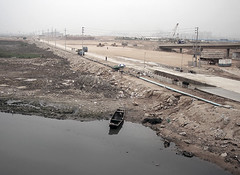
futian village

After several months, I return to my synopsis of The Great Transformation (沧海桑田:深圳村庄三十年). This episode is about Futian Village (富田村), which begins raising the counterintuitive question of why Walmart would build a megastore in Futian Village. The underlying message of the episode might be half-facetiously summarized as “location, location, location”.

The story of how Futian Village became known as Futian suggests the shifting contours of village lands. 田 (tian) of course meant “paddy” or “fields” and has been constant over history. Over 900 years ago. One went to Futian, one settled in Shangsha, and the third went to Yuanlang in what today is known as the Hong Kong New Territories. However, the village was originally called “Getian (隔田)” because it was separated from the mainland by a stretch of seawater that extended to Tianmian. Over time, sedimentation filled the marshy areas between the coast and the separate fields. This new agricultural land was called Futian (幅田). When the name was formalized during the Mao era, the village was named Futian (福田), which included the character 福 (fu – prosperity), a homophone for 幅 (fu -meaning landfill). According to an old villager, “real Shenzheners” call him “Getian person (隔田佬)”.

In fact, the history of the area is the transformation of the status of fields. Before 1980, Futian villagers cultivated grain, sugar cane, and peanuts. The village itself was defined in terms of these land holdings. They were organized as one brigade, which was further organized into two work teams – total population 1,000 people. However, according to the old Village Party Secretary Huang many more villagers escaped to Hong Kong before reform. At the establishment of the SEZ, the village occupied had strategically located land holdings, at the edge of the Luohu downtown area. In 1992, when inner district villages transferred historic land rights to Shenzhen Municipality, the village developed rental property and commercial areas. There were two key developments that went on to have national impact. Firstly, in 1998, Walmart opted to open its first megastore in Futian Village. In turn, the Futian megastore became the model of how to operate a Walmart in China. Secondly, the Venice Hotel chain also opened its first hotel in the village.

1990s and early turn of the millennium corporate village development emphasized profit rather than public space. Importantly, however, Futian Village was located directly adjacent to the new central axis area. However, when the new Civic Center opened, Futian Village was required to upgrade accordingly. In 2007, when Futian decided to build a new culture plaza, then Futian District Party Secretary, Lv Reifeng reputedly said, “I can’t give you funding to build the plaza, but I can give you a policy.” The policy was quite simple: Futian District gave 30% of the total cost to build the plaza.

To recap: The Great Transformation tells the story of thirty Shenzhen villages. Importantly, the idea of “village resident” in the series constantly shifts between “indigenous villagers” and “migrants who live in the village”. This slippage is subtle but hinges on the way in which urbanization has not only transformed fields, but more importantly restructured property rights. For example, when the narrator says “villager/s (村民)”, he clearly means “local villager/s”, referring to those who own buildings and have stock in the collective holdings. However, when he speaks of “urban villages (城中村)”, he means the urban neighborhoods that evolved out of the previous village. More tellingly, the slippage between “villages” and “urban villages” structures rhetorical questions throughout the series. The episode, “Futian Village”, for example, opens with the rhetorical question, “Many wonder why one of the world’s 500 richest companies would choose to open their first megastore in an urban village.” Clearly, the intended audience of the serial documentary continue to view urban villages as rural villages rather than urban neighborhoods.

下沙陈杨候王庙: mapping the transition of property rights in shenzhen

Dedicated to Chen and Yang, a scholar and general, respectively, the Xiasha Houwang Temple 候王庙) is worth a visit and not only because these kings-in-waiting represent the Confucian ideal of uniting literary and military talents in governance, but also because they remind us that the contemporary figures of “high intellectual (高知)” and “high cadres (高干)” have historical president. What’s more, a glance at the plaque of sponsors suggests the extent to which reinvented traditions have been incorporated into Shenzhen’s urban village renewal projects. In addition to Xiasha Village Holdings Limited CEO, Huang Chaoying, CEOs from the various companies involved in Xiasha renewal also donated to temple construction, including Chen Hua (CEO Kingkey – 3 million yuan); Huang Chulong (CEO Galaxy – 2 million yuan); Huang Kangjing (Lvgem – 2 million): and Huang Guangmiao (CEO Centralcon– 2 million).

These four Shenzhen based conglomerates have a been major players in the implementation of the Municipality’s post 1996 urban plan, with investments that began either as a joint venture with an urban village or winning a bid from the government. Over time, these conglomerates have emerged become active in larger projects, participating in this second “village urbanization” effort and thus extending their holdings through collaboration with other Shenzhen urban villages as well as extended holdings throughout neidi. Kingkey, of course, is best known for the KK 100 in Caiwuwei, but also built the upscale mall, KK Baina in the reclaimed Hongshuwan area. It began as a Luohu developer, most notably the Jingdu Hotel, near the train station. Within the past decade, Kingkey has also expanded to open branches in Tianjin, Beijing, and Zhejiang.

The three other developers also followed this path – from developing buildings or housing complexes in a particular district (Kingkey began in Luohu, while Galaxy, Lvgem, and Zhongzhou had their start in Futian)  through urban village renovation (negotiating to lead the renovation of entire urban villages) to national player. All were formed in the early 90s, when Shenzhen began dismantling the State’s benefit housing system. The key point about the rise of real estate developers is that they are all less than twenty years old, profit(eer)ing from the Chinese State’s decision to discontinue public housing for middle class workers (For more details, see Historic Footnote, below).

Less than fifteen years after the end of public housing, the fact that four Shenzhen real estate developers are collaborating with Xiasha isn’t surprising. After all, the only remaining land to be developed in Shenzhen is under the control of Village Community Limited Corporations. Indeed, much of what is currently glossed as “renovation” is in fact, a process in which land rights transfer from the Village Holding Company to the Municipality by way of a developer, who sells buildings but not land. What is interesting, however, in how these developers are working with Xiasha to create a recognizably traditional and Confucian identity. In other words, Xiasha is being presented as a viable form of upgraded urban village that explicitly references tradition, rather than Communist history and the establishment of New China. Significantly, renovation at Xiasha not only marks the convergence of Village Community and Enterprise interests, but also reveals the ideological form of this convergence as an upscale urban village. What remains to be seen is whether or not Xiasha Limited can expand as the real estate companies have, or if it will remained tied to its traditional land.

Below, impressions caught on a walk from Chegongmiao to Xiasha. Several notes. 1. Chegongmiao was a mid-80s industrial park. It is now being renovated with restaurants and office space, but it does save the older urban layout as well as benefit housing stock. Thus, the area offers middle class workers relatively affordable and convenient housing. 2. Just across the street, Xiasha will soon boast a major KK skyscraper, which will make the urban village prime real estate. 3. I finished my walk by having my fortune told, by a Tianjin grandma, whose hand-written notebook reminds us that popular religion is not simply about respecting social hierarchy (as in the Chen-Yang Temple), but also manipulating fate to get ahead.

This slideshow requires JavaScript.

Historic Footnote: The Privatization of Work Unit Housing and the Creation of Shenzhen’s Housing Market

Before the 1992 Southern Tour, housing in Shenzhen was typically of two kinds — either work unit housing, which was built by state work units for their staff or rental properties in the urban villages. Accordingly, state work units and independent crews were responsible for most housing design and construction. After the Southern Tour, however, Shenzhen began extensive housing reform (房改), which entailed both privatizing extant housing and creating commercial housing stocks. Until 1999, when the last work unit developments had been approved, Shenzhen had three kinds of housing — benefit housing (福利房), small profit housing (微利房), and commercial housing (商品房). Benefit housing belonged to the work unit, which assigned housing to staff by calculating such factors as seniority, tenure and hukou status. Small profit housing was just that, work unit housing whereby the unit building the housing was able to earn a small profit. Commercial housing was just that, housing that was developed with an eye to making a profit.

During the 1990s, most middle class Shenzhen residents lived in either benefit or small profit housing. In order to make their housing attractive to people who might otherwise settle for benefit or small profit housing, nascent real estate development groups sold life styles, the most popular of which was known as “European style”. Many middle class workers who already had a benefit or small profit home invested in commercial housing. However, most middle class workers aspired to either benefit or small profit housing. Nevertheless, housing reform transformed this system and by the end of the 90s and especially first years of the new millennium, commercial housing stocks had become the most common option for middle class migrants, who arrived in the city after benefit and small profit housing had been discontinued. For the next five years, work units allocated the last of benefit and small profit housing. Then, in mid 2007 – early 2008, Shenzhen’s real estate market took off, with housing and building prices abruptly doubling within one calendar year.

tianmian update

Has been a while since I last visited Tianmian. In the interim, the biggest changes have been to the relentlessly upgrading lay of the land. In the north, renovations to the outer factories have been completed and there are now higher end restaurants and several chains. In the west, the border between New Tianmian Village and the City of Design has been eliminated so that people now pass freely from one section to the other, even though the aesthetics suggest a clear distinction between office workers in Design and New Villagers. To the east, the former red line of the 1980 SEZ at the Shanghai hotel continues to transform itself higher and bigger as Tianmian rents remain higher than service wages in neighborhoods diners, convenience shops, and beauty parlors.

This slideshow requires JavaScript.

Shuiwei’s New Park: Commemorating Reform and Ancestor Zhuangzi

As part of its ongoing upgrades, Shuiwei has finished a small park dedicated to Zhuangzi. In fact, the village traces its genealogy back to the famous philosopher; according to the plaque, the village’s founder Zhuang Sen (庄森) was born into the 48th generation of Zhuangzi descendants. The commemoration, like others throughout Shenzhen villages, links the establishment of the village with its Reform era rejuvenation.

This slideshow requires JavaScript.

先祖立村六百载,幸福小康颂党恩,围昌万年是祈愿,和谐共荣新家园,改革开放越千秋,庄氏族系倍兴旺,水环四壁换新颜。承先启后永向前。

Our founder established the village 600 years ago, for happiness and prosperity we praise the Party’s magnanimity,

Our prayer is that our compound thrives 10,000 years, harmony, co-prosperity, a new homestead,

Reform and Opening surpasses 1,000 autumns, the Zhuang family descendants to flourish,

The moat and old walls have been replaced. We connect past and future generations, eternally going forward.

Xiasha: What continues and what fades away

Yesterday, I met Chen Hong (陈宏), executive producer of the Shenzhen Villages documentary mini-series (桑海桑田:深圳村庄三十年) and was gifted my own set of DVDs and associated book! No longer dependent on the odd youku upload, I can now finish my review of episode 5, The Background of Xiasha (下沙背景).

The opening begins with the last Song Emperor fleeing the Yuan. His grave, of course is in Chiwan, but it turns out, over 800 years ago, Xiasha villagers met the imperial refugee and his ragtag army with large casseroles of chicken, seafood, pork, and vegetables or pencai (盆菜) as they are known in Shenzhen. The mini-series narrator solemnly intones that although the Emperor died before his ninth birthday, the pencai tradition lives on in Xiasha Village.  Continue reading

华强北:constructing progress

located in futian district, 华强路 (huaqiang road) is the name of the central axis of the area known as huaqiang north. the area itself is bordered by yannan road (east) to huafu road (west), and hongli road (north) to shennan road (south). importantly, the southern border of shennan road with its strip of postmodern glass and steel buildings is often included in the area. with dongmen, huaqiangbei is one of the two most important commercial areas in the city. it has an area of roughly 1.45 square kms and according to futian government online, as of april 25, 2006 boasts over 700 shops, averages 500,000 visiters per day, and generates 26 billion net sales rmb per year. catic, the chinese aviation bureau and major huaqiangbei investor has uploaded a flash picture of the huaqiangbei skyline (looking east) to celebrate the area’s economic vitality. and the commercial interests in huaqiangbei have opened their own webpage.

we have come to a reader be warned moment: telling this history frustrates me because i end up feeling like i understand the general process, but have missed all the details. the problem of course is that i suspect the story is to be found precisely in those lost details. indeed, i don’t know if the details can be known. in part, my doubt springs from the lack of reliable books and information on the web. the early years of shenzhen simply weren’t systematically documented. in 1995, i went to the city’s 15th anniversary exhibition at the shenzhen museum, but it was a celebration of the present, rather than an investigation into the past.

moreover, with all the different governments moving from one building to another (part of the huaqiangbei story below), stuff got misplaced. i once tried to gather pictures and documents from the 80s, but was told either the pictures weren’t taken or the papers lost in a move. the thing is, i don’t believe i was simply being kept at bay to protect state secrets. what got boxed and moved is around here somewhere, but… i understand. i too have lost papers and documents in moves from one office to the next. i also believe my interlocutors when the tell me that in the early 80s there wasn’t time to take pictures; they worked long hours and moved from one job to the next. also, its sometimes hard to remember that over 25 years ago, there weren’t all that many personal cameras in shenzhen, and so people tended to take pictures of people and places that mattered to them.

i doubt the availability of relevant details because (given the lack of documentation) they can only have been carried in the hearts and minds of the people who were actually there. even allowing for the instability of human consciousness, these events are scattered accross the population, rather than located in one neat spot. so, no matter how many people i talk to, i feel i’ve missed something.

i also feel outside the historical loop because the process itself remains counter-intuitive to me, in the way that football does. so even when i do meet up with someone who can tell the story, i’m not always sure what to ask or, more importantly, how to ask it. now, i have chinese friends who can memorize levels of government and rankings as easily as my brother remembers footbal statistics. in fact, not a few have patiently gone through the system with me, two of them several times. but still i need to lay things out and look at organizational charts before i understand what i’ve been told and then i find myself feeling about it the same way i feel about my brother’s statistics. i realize it matters to him, i appreciate the time and effort that went into cultivating that kind of knowledge, i even understand why someone would want to have that kind of knowledge easily available in any conversation. but, political ranking isn’t my game.

all this to say, i realize this history is important. i’m trying to figure out why the space itself fascinates me, but the history doesn’t. it may be that i’m interested in a different kind of history, smaller, more persoanl and intimate. it may also be that at the level of generalities, i’ve heard this story all too many times. i once heard a reknown sinologist say that research was boring because marx had already outlined the process; been here, done that. at the time, i was outraged. how can it be the same? how can people’s lives be boring? but i have come to hear that comment as a comment on the limits of knowledge. we do reduce everything to generalities, and then are surprised when we don’t find anything new. so if i could find another way to approach urban rankings it might fascinate me.

by shenzhen standards, huaqiang north is an old area. and, like most of the city did not start out as either a commercial area or an administrative unit within a district government. indeed, the history of huaqiang north not only anticipates many of the transformations happening in other parts of the city, but also illustrates the neo-liberal vision of progress: through hard work the people have moved from working in factories through owning commercial properties toward wheeling and deeling in international finance. what’s more, this vision is not simply futian district’s plan for the huaqiang north area, but rather a scaled-down version of the overall plan for shenzhen, which has called to transform the economic base manufacturing to higher value-added production in real estate and financial services. the critical point, which is glossed over in the neoliberal account, is that those working and those benefiting aren’t always the same people. economic growth and expansion hasn’t meant that every shenzhen immigrant has worked their way out and up of relative poverty; many factory workers are still factory workers; many factory owners are now stock brokers.

also, like other places in shenzhen, the history of the area has resulted from complex negotiations between different interests, none of which fall into neat categories. a brief history of those interests:

when the central government first elevated baoan county to shenzhen city in 1980, it did not immediately redristrict the lower levels of government. this meant that although shenzhen city now existed, it was placed on top of a rural administrative apparatus. in an ordinary chinese city, administrative levels are: city (市), district(区), street(街道办事处), and neighborhood(居委会). at the time shenzhen replaced baoan county(县), but beneath it were communes (公社), large and small brigades (大小队). the large and small brigades corresponded to administrative and natural villages (行政村、自然村), respectively.

crudely, one of the main purposes of the new city government was to transform rural administrative structures into urban structures. in previous entries, i have focused on the structural position of the new villages within shenzhen, in this entry, i want to look at the new urban structures which replaced the villages. what is interesting is to keep in mind the dissolving and restructuring of economic units within the government. specifically, although shenzhen has been heralded as a place where state-owned industries constitute a small percentage of actual businesses, it remains the case that the most lucrative businesses are linked to the government either directly or indirectly.

the earliest shenzhen plan was approved in 1982. in it, shekou was set up as an independent industrial zone (another fascinating history of 1980 experimentation). in what would become downtown, the plan identified about 50 square kms, stretching from the wenjindu border crossing in the east to huafu road in the west. within this area, land was appropriated by urban work units that were then responsible to develop the area according to the plan. the area that is now know as huaqiangbei was originally part of the shangbu industrial area.

the organizations that came included the former national electronics ministry (电子工业部), the weapons ministry (兵器部), the national bureau of aviation (航空局), and the guangdong provincial bureau of electronics (广东省电子局). each was given the authority to negotiate for a tract of land on which to construct electronics factories. of course, this included putting in the infrastructure necessary to run this factories. nevertheless, the project took off and by 1986, the shenzhen municipal and guangdong provincial governments brought these companies together to form the shenzhen electronics company, which was named saige electronics (赛格电子集团)in 1988.

a bird’s eye of huaqiang north bears traces of this history, where the tracts of factory buildings stretch across the landscape:

first attempt to restructure the area was in 1998, when the municipal government invested 45 million rmb in infrastructure for huaqiang road to build better sidewalks, install better street lighting, a large screen, more electrical wires, and benches for resting under imported palm trees. these investments transformed huaqiang road into a pedestrian friendly strip of large malls. according to the above mentioned futian government online statistics the government’s investment stimulated 1.2 billion rmb commercial investment in the larger area.

visit huaqiangbei.

旧村改新:initial observations

this is another thoughts-in-progress entry. these past few days, i have been trying to organize thoughts about the 旧村改新 (old village make-overs), a recent government initiative to clean-up shenzhen’s new villages (now understood as “old”). this was part of the reason for posting on luohu; i actually took that series of pictures last december, but the juxtaposition of new luohu village, the era of two cities building, the new housing development, and the renovated train station point to issues that come together in the make-over initiative. so if you haven’t yet, you may want to first take a walk about luohu.

the point, of course, is simple: there are many shenzhens and they all abut one another. indeed, it’s as difficult to miss new villages, which have a distinctive layout and architecture, as it is to overlook a high-end housing development. these different urban forms actualize the different development trajectories that shenzhen’s villagers and white-collar migrants have pursued. that is to say, even if we bracket for the moment the question of whether or not shenzhen has deep, imperial history, nevertheless, it has been over 25 years since deng xiaoping began reform and opening just north of hong kong. architecture styles and urban plans actualize different moments in this process, providing a material history of the city. with the village make-over initiative, the government seems determined to remove traces of historic difference, even as cultural officials continue to moan about shenzhen’s lack of history. below is a picture of the arch at the entrance to huanggang new village.

the old village make-over initiative first came to my attention over dinner last year, when friends were discussing the government’s decision to raze 18 mid-rise buildings), right at the huanggang cross-border checkpoint. the topic came up not because those at the table disagreed with the make-over process, but because this was the first time china was simultaneously imploding 18 buildings. the event was know as “china’s first blast (全国第一爆).the buildings belonged to yunong village (渔农村). if memory holds, the conversation focused on the technology involved, the need for a modern area to face hong kong, and the avarious fearlessness of villagers, who continued to errect illegal, rental properties.

this past year, i have watched construction teams lay the foundations for a new yunong with something of a jaded eye. this is not the first time that the municipal government had directed a movement specifically at shenzhen’s urban villages. and in a certain sense, it often feels like a more of the same kind of project.

in 1991, the government initiated the rural urbanization movement (农村城市化运动) with the goal of integrating all villages into the municipal government and giving all shenzhen peasants, citizen status. this was called the double transformation. this movement finally ended in august 2004, when baoan and longgang districts announced that all villages had been redistricted and all villagers had been given a new hukou. shenzhen was thereby the first city in china to have neither villages nor villagers within its borders.

for officials determined to turn their city into a global, international city, the end of rural shenzhen was a major milestone. indeed, in this area shenzhen has been heralded as a national leader. these administrative changes, however, did not irradicate the visceral spatial differences between shenzhen villages and the surrounding city.

in order to deepen the integration of the villages into the fabric of the city, shenzhen officials turned their gaze to the built environment as a sign of rural-urban difference. consequently, the following year, in 2005, the government decided to start the old village make-over initiative. crudely, this entails razing what are known as “handshake buildings” and replacing them with modern residential developments. handshake buildings are so-called because they are so close to each other that neighbors can reach out their windows or across their balconies and shake hands. the initiative includes building plazas and public areas, as well as different kinds of housing developments. i include a picture of a row of handshake buildings, huanggang new village.

compare with an image of the new urban dreams currently under construction in huanggang:

the old village make-over initiative was formally approved on october 28, 2005. it is a special five-year plan to improve the urban villages (城中村), speed up urbanization, promote the unification of infrastructure within and outside the sez, realize the joint planning and harmonious development of urban villages and other areas in the city, and to advance the architecture of a global, modern, and key city, errect a harmonious and efficient shenzhen. the curious can check out the full old village make-over plan online.

nevertheless, the question of make-overs and everyday life only became interesting the other day, when i was in shuiwei and huanggang, two of the futian villages that abut the hong kong border. frankly, i was impressed with the layout of shuiwei’s culture plaza, which boasts a funky (if derivative) outdoor stage, a curious rocks museum (the rocks are mainly from guangxi), and a library. i also had tea at a colorful hong kong style teashop, where the milk tea was strong and rich. suddenly, i wanted to move from tianmian, which is conveniant but not like shuiwei. (the lack of tasty but reasonable restaurants in tianmian is a bone of ongoing contention. after all, one of the defining features of the urban villages has been the quality and price of the restaurants.)

my desire to move to shuiwei points to an underlying fact about new village life; the primary source of income for most villagers is rental property. this has meant that villagers have built as densely and as highly as possible, with little concern for the overall environment. it also has meant a density of cheap beauty and massage parlors, restaurants, places to play mah johng, food markets. indeed, since the mid-1990s, as most of shenzhen’s factories have been pushed outside city limits, the importance of rental property and services to village economies has grown. the main residents of the villages are low income migrants, usually from the countryside.

it seems that the ratio of villagers to migrants in the villages concerns the government. the villages maintain their own militias (民兵) that act as a police force within village borders, shifting social regulation from the state to these quasi-governmental organizations. according to futian government statistics, for example, there were 19,353 villagers registrared in 15 administrative villages (there are 20 natural villages in futian.) those villagers provided housing for 572,143 migrants. a ratio of 1 villager for every 29.5 migrants. (these figures do not include unregistered migrants, some of whom live in illegal housing, but others who live in the underground walkways that connect villages to the city proper.) these migrant laborers are precisely the persons regularly identified in the press and popular opinion as causing social unrest. outside the sez in baoan and longgang districts, the villager to migrant ratio is even higher. thus, this research suggests that the greatest challenge facing the make-over movement is a contradiction between the villagers’ economic interest (as landlords) and the state’s interest in maintaining social discipline.

i conclude with a picture of the home of the shuiwei militia (水围民兵之家).

Integrating the Pearl River Delta

Sunday afternoon, I walked east along the Houhai coast, from Houhai to Sand River (沙河). This is a strip of land that was formerly designated to be part of the Nanshan District Binhai green zone, which connects up with the Shenzhen Natural Mangrove Reserve in Futian District. My interest in the area grows with the audacity of land reclamation in Shenzhen. This area marks a second rezoning of the coastline. The first was part of the effort to build the Binhai Expressway, which connects Nanshan to Futian and Luohu Districts. This second stage was districted later and remnants of that now-obsolete coastline litter the new construction site.

(The curious can check out the Shenzhen’s overall urban plan (1996-2010) maps, while the even more adventurous can go to the Nanshan District overall urban plan. On those maps, I walked along the strip of coast facing Hong Kong. Offline, if your library has any of the Shenzhen yearbooks from the 1980s, there are interesting comparisons to be made. Published in the early 1990s, the last Baoan County Gazetteer is also fun, but harder to find.)

On my walk, I stumbled upon guardhouses that were never staffed by border guards and the chain-link fence that separates pedestrians from Houhai. The entire area had been filled with earth and pumps were busy squeezing out the last of the ocean. Dump trucks rumbled past and people carrying nets biked out to the new coastline. I learned there was a two-week window to catch newborn crabs before they swam out into what remained of the ocean. These baby crabs would be used to stock fisheries in Baoan District. The crabbers carried the crabs in plastic soda bottles that hung around their necks. Eventually, I arrived at Sand River, I came across one of the construction sites for the Shenzhen Western Corridor Bridge, which set me to thinking about the various infrastructures which integrate Shenzhen and Hong Kong. What follows is a longish outline of Shenzhen history as mapped by Shenzhen-Hong Kong checkpoints. You can skip the discussion and go straight to the Western Corridor land reclamation pictures, or you can indulge my sudden urge to document comprehensively the transformation of Shenzhen.

(I’ve just realized that I only use Mandarin and Shenzhen place names in this blog. I promise to start documenting the different names for the sites. I may even talk about what these differences in talk might mean…)

Anyway, the fourth land connection between Shenzhen and Hong Kong, the Shenzhen Western Corridor Bridge was completed in January 2006. The corridor itself should be finished later this year. It is a 3.8 km long dual-carriageway 3-lane bridge connecting Nanshan District to Hong Kong at Ngau Hom Shek. The construction is being overseen by OPAC, a San Francisco based engineering firm. Trying to figure out the actual cost of the corridor is somewhat difficult. According to the China Daily, the bridge cost $US 111 million to build. On their webpage, OPAC estimated that the cost of the Western Corridor Bridge would be $US 400 million. The Nickel Institute website quotes the Hong Kong Highway Authority as putting the estimated cost at $US 2.7 billion. Perhaps the China Daily quote refers just to the cost of the bridge, the OPAC quote to the cost of the entire corridor, and the Hong Kong Highway Authority quote to related infrastructure in Hong Kong. What can be concluded is that the corridor is expensive and somebody is making a lot of money from it.

And making money seems to be the point. The Western Corridor Bridge is part of a larger effort to transform the Pearl River Delta into one of the most vibrant economic regions in the world. On August 28, 2003, at the Foundation-stone Laying Ceremony for the Hong Kong-Shenzhen Western Corridor in Shenzhen, Hong Kong Chief Executive, Mr Tung Chee Hwa said, “Hong Kong and Shenzhen are a key nexus in land transport to the Mainland…The three existing land boundary crossings between Shenzhen and Hong Kong are nearing the saturation point, such that both administrations have agreed to build the Hong Kong-Shenzhen Western Corridor as the fourth land crossing to accommodate growth. Traffic flows at the three existing boundary crossings have increased greatly over the past five years. The average total daily vehicular traffic at boundary crossings is expected to reach 65,000 vehicles in 2006, far beyond the daily capacity of 42,000 vehicles, which the three existing crossings offer now. Upon its completion, the Western Corridor will provide additional daily traffic capacity of 80,000 vehicles, raising the overall daily traffic capacity to 122,000 vehicles, thereby easing the current congestion. And yet, even four land crossings are considered inadequate to meet the future demand arising from further development. A working group drawn from among officials of the Hong Kong, Guangdong and Macao administrations will convene its first meeting tomorrow to press on with the advance preparations for construction of the Hong Kong-Zhuhai-Macao Bridge…”

The figures for vehicular land crossings do not include statistics for all border checkpoints (in order of numbers of passenger crossings)—Luohu, Huanggang, Shekou, Shenzhen airport, Wenjindu, and Shatoujiao. Official Shenzhen customs figures showed entry and exit passengers at the city’s six checkpoints reached 137 million in 2004. Crossings surge during Chinese holidays, especially Chinese New Years, when an estimated 5-6 million people (over a period of two weeks) cross at Luohu alone. During the holiday season, all checkpoints extend hours and increase staff handling document inspection. Each of these crossings has a distinct, but interconnected history that illuminates different aspects of the Shenzhen-Hong Kong nexus as part of globalization. A crude synopsis of the six sites follows and provides a very, very, very rough outline of Shenzhen’s deep history.

(I try to problematize the idea of history with respect to Shenzhen most entries. However, this is the first time in this site that I’m trying to locate Shenzhen with respect to larger currents. I’ve learned how to think about this history from Giovanni Arrighi in his wonderful book The Long Twentieth Century. Helen Siu and David Faure have turned an anthropological lens on this process in Down to Earth: The Territorial Bond in South China. I’ve picked up some online sources that may be helpful and embedded in the following notes. I assume it’s all as reliable as statistics about Western Corridor Bridge finances are.)

In a certain sense, the Luohu checkpoint has been in existence since the leasing of the Hong Kong New Terriories in 1898, when the Sino-Anglo border moved to the Shenzhen River. Previously, the Qing Dynasty had ceded Hong Kong Island and the area south of the Kowloon Mountains to Great Britain in 1842 (end of the first Opium War) and 1860 (end of the second Opium War), respectively. Luohu (Lo Wu in Cantonese) was the first stop on the Chinese side of the Hong Kong-Guangzhou railway, which was built in 1913 and more effectively integrated south-eastern China into the British Empire. So thinking about Luohu leads to thoughts about British imperialism, the transition to the Cold War, and the postsocialist realignment of international political-economies with a focus on East Asia. Suddenly, Shenzhen is neither hinterland nor no man’s land, but vying for the center of global trade. In a recent defense of building the Hong Kong-Zhuhai-Macao Bridge and associated costs, the Executive Director of the Travel Industry Council of Hong Kong, Joseph Tung, has said that the Luowu checkpoint is one of the busiest land crossings in the world, with more than 90 million people passing through it every year.

The Huanggang Checkpoint opened for 24-hour border crossings Jan. 27, 2003, at which point crossing figures surged from 50,000 to 110,000 per day. Buses to and from the Huanggang Checkpoint, connect Shenzhen to six Hong Kong destinations, including the Hong Kong airport. Since 1995, Huanggang has been the primary conduit between Shenzhen and Hong Kong Disneyland. Until the construction of the Western Corridor Bridge, Huanggang was the newest of the land crossings. It is interesting because it was part of a geographic shift in Shenzhen from “Downtown” referring to Luo Hu to the new “City Business Center” in Futian. The shift began in 1996, when the Shenzhen Municipal Government accepted plans for the new CBD. Michael Gallagher gave a talk about the Shenzhen CBD in 2002. But for a sense of the scale of this transformation and the debate about it, google 深圳CBD and check out all the different sites. Thus, the shift from Luohu to Futian allows for specifying the differences between a Hong Kong centered development in the early 80s to a more diffuse integration of the region, and therefore a more Mainland-centered pattern of economic development.

The most expensive connection between Shenzhen and Hong Kong, the Shekou ferry makes 13 round trip voyages a day, except during Chinese New Year, when the number of trips increases to accommodate the numbers of visitors. An additional 8 daily voyages connect Shekou to the Hong Kong airport. Most frequent passengers on the ferry are Shekou-based foreigners. The Shekou Ferry is interesting for a number of reasons, most related to the role that China Merchants has played (by way of Shekou) in the development of Shenzhen. The role of China Merchants then leads back to Luohu and questions of national development first raised during the later years of the Qing Dynasty. As of 2004, China Merchants has posted its own historical archive online, which highlights the role that commerce and international relations have played in modern Chinese history.

Along with Hong Kong, Guangzhou, Zhuhai, and Macau, the Shenzhen Airport is one of five international airports in the Pearl River Delta. In terms of passengers served, it ranks behind Hong Kong and Guangzhou. The five international airports have been built within a radius of 25 km. illustrating the level of competition and inter-city rivalry that has characterized development in the Pearl River Delta, rather than regional cooperation and planning. Moreover, the redundant infrastructure in the Delta has led to serious environmental problems, according to a report by K. C. Ho and C. S. Man.

Wenjindu is primarily a crossing for goods between Shenzhen and Hong Kong. It was opened in 1950, as part of the new Mainland government’s strategy to bring hard currency into the country. Throughout the Mao-era, agricultural products flowed from the Mainland into Hong Kong, a development strategy that has been more fully exploited since Shenzhen’s establishment. So thinking about Wenjindu allows one to question commonly held understandings about China’s so-called isolation during the Mao era outside of the obvious connections with the former Soviet Union and other socialist and third world countries. In the era of Avian flu, Wenjindu regularly appears in Hong Kong news reports as the site where chickens and other poultry cross the border. With suspicious regularity, indeed with an almost ritualized compulsion, Hong Kong public health officials regularly express astonishment on conditions north of the border.

So a rough outline of Shenzhen’s history with respect to the construction, use, and re-appropriation of Shenzhen-Hong Kong border checkpoint infrastructure. It touches upon British imperialism, the Cold War, the East Asian economic miracle, the rise of China as a global player, international epidemics, and the concomitant transformation of the environment. This is how we make our world, one reclaimed special zone at a time.

home, tianmian garden


home, tianmian garden
Originally uploaded by mary_ann_odonnell.

I realize that I’ve spoken about inhabiting Shenzhen without actually taking about where I live. I’m not sure if this evasion was deliberate or simply the result of habits—research is other than my quotidian reality, even if I write myself into the story. This doesn’t mean that I haven’t taken pictures of Tianmian, the village/development where I live, but have thought about the actual story being elsewhere, in the anywhere but here mode of ethnographic inquiry, which, I’ve come to suspect, is tied up in the throes of middle class American angst about standing still when I should be moving on (to something better, of course). Certainly that impulse, even more than an affinity for things Asian, propelled me out of high school and into China studies.

Today’s project then is to sit and think about Tianmian.

An urban village, Tianmian is located next to Shenzhen’s Central Park, west of the Shanghai Hotel. Throughout the 80’s and most of the 90’s, the Shanghai Hotel marked the western edge of “downtown”. The Luohu Train Station, a main crossing point into Hong Kong, marked downtown’s eastern border. However, since the mid-90’s, development has moved west and with it the city’s center, or perhaps it’s more accurate to say that the edges between downtown and the rest of the municipality have blurred. Once considered part of the “suburbs”, Tianmian is now prime real estate, being located just west of the new City Hall Building (the old building was located east of the Shanghai Hotel) and a ten-minute cab ride from Huanggang, a recently opened crossing point into Hong Kong.

It is important to understand that Tianmian encompasses a wide variety of folks and livelihoods. In this, Tianmian is highly representative of Shenzhen, although at a smaller scale than in Longgang and Baoan Districts, where the villages retained much more land than did villages within the SEZ proper (Nanshan, Futian, Luohu, and Yantian Districts). Millennium Oasis is a high-end housing development, where established professionals and their families live. Interestingly, many of these are extended families, who either live in the same condominium or have bought condominiums in the same building (older sister lives on the fifth floor and younger on the seventh, for example). New Tianmian Village includes the Village’s factories, mid-level housing development (Tianmian Gardens), and the New Village proper. These constitute the basic livelihood of all Tianmian villagers, who have stock options in both the factories and Tianmian Gardens, where young professionals and working families live, again many extended families here in a smaller space than Millennium Oasis. The New Village condos/apartments are the cheapest to own or rent. Many singles live there, as do friends who have pooled their money to move in together. Each of the buildings in the New Village belongs to one of the village men and it provides revenue that is independent of collective resources.

I’m not sure how many people live and work in Tianmian, but there are approximately 670 units (9 buildings) in Millennium Oasis, 780 units in Tianmian Gardens (5 buildings), and 2,048 units in the New Village (63 buildings). There is also a dormitory associated where Tianmian factory workers live. I live in Tianmian Gardens.

I first came to Tianmian in 1996 to interview the developers, who subsequently became good friends. The government requires developers to build a kindergarten and school as part of the development. Once the school has been built, the developers can choose to either give the school to the state to run, or to run the school themselves. My friends chose to run the school themselves. Part of the curriculum included an emphasis on English. They originally hired a teacher, who for various reasons, didn’t come. Subsequently, they asked me teach until another teacher could be found. That was four years ago. The first year, I thought it was a temporary arrangement. I left to take a visiting position at the Rhode Island School of Design and maintained my research affiliation with Shenzhen University. However, when I returned two years ago, I had signed a three-year contract with the school, where I am now vice principal in charge of internationalization. Crudely, internationalization includes reforming the English curriculum, setting up programs with international schools in Shenzhen, and implementing an English language curriculum in the High School.

Sometimes, I think my trajectory from conducting research to setting up a school is very Shenzhen, where folks pride themselves on being practical rather than idealistic. Before I came to the school, my friends joked that I was wasting myself at the University, especially as everything was happening outside the (increasingly porous) University walls. I also recognize in it a disconnect between my research style and that of the US Academy, where I managed to obtain visiting positions, but never a tenure track appointment; I grew tired of looking for the next job. Yet my husband lives and works in Shenzhen. My friends live and work in Shenzhen. One day I realized that I wanted to commit to being present to those lives. So I stayed.

In my personal map of Shenzhen, Shenzhen University has symbolized my attempts at ethnography. From 1995 through 1998, the University was my base while I conducted fieldwork for my dissertation. I have taught there and continue to return for seminars and to meet with friends to talk about our various projects. The University also symbolizes a particular way of being in the world—moving from one academic appointment to the next, placing that ambition in front of everything else. In contrast, Tianmian has represented another impulse, one to settle, to come home after years of always moving on. It is not simply that I have resided here for the past two years, but that Tianmian is where I settled. Please visit.

inscribed history, briefly: shennan road

Shennan Road is the oldest east-west artery in Shenzhen, until a few years ago when the opening of the northern loop and the Binhai road, it was both Main Street (in the sense of the center of town activities) and the main artery for transporting goods and people from one side of the city to the other. Today, most trucks travel from factories along the northern loop, crossing the border at either Wenjindu or Huanggang, and most cars and all express buses travel along Binhai. However, Shennan Road has maintained its symbolic and functional importance in the organization of the city.

This weekend, I went for a walk along the strip of Shennan Road between the old city hall and the recently opened new city hall. There’s much to be said about the difference between the two buildings, but the point I want to emphasize here is the inscription of history through architecture that is visible along this strip. It is, in many respects a history that can be understood through the movement from the low, concrete municipal building (a Stalinist concrete block), representing the idea of Shenzhen as a manufacturing center to the post-modern glass and steel of the new municipal building, which points to Shenzhen’s aspirations in global finance and management. All this to say, throughout the strip one encounters concrete factory buildings and modernist office buildings that abut newer, taller, and more expensive buildings.

This twenty-five year history is also the history of replacing the collectivist economy with a market economy. This history, while less visible than the progression from manufacturing to finance manifest in the city halls, is nevertheless a structuring feature of this bit of land. This structuring has several levels.

• First, twenty-five years ago, when Shenzhen planners first approached the project of opening the west, they only marked the land from Luohu train station to the Shanghai Hotel. That is to say, for many years when Shenzhen residents said they were going into town, they meant the area between the train station and the Shanghai hotel. This means that the new city center has been moved from the original downtown to what was previously a leechee orchard outside the scope of the original urban plan. Traces of this other history remain in Shenzhen’s center park, which stretches alongside the new city center, large tracks of which are still used to cultivate leechees.

• Second, the transfer of commune land to urban work units predicated this transformation. The Ministry of Aviation developed the area on which the Shanghai hotel was built. The Ministry of Aviation annexed this land from the Shangbu Commune, which is memorialized across the street from the Shanghai hotel in the form of the Shangbu Building, a concrete skyscraper from the mid-1980s.

• Third, this transformation entailed economic re-orientation. The production of electronics for foreign markets financed the construction of the Saige building, which towers over the Huaqiangbei area. Throughout this area, entrepreneurs continue to sell electronic products, which are no longer primarily manufactured in this area. Instead, this area has become a center of leasure and high-end consumption, symbolized by the Zhongxin Plaza, built across the street from the old city hall.

A brief reading of the landscape that unmakes the often heard phrase “Shenzhen has no history”. It also reminds me that simply driving from one end of town to the other involves the reiteration of history through spatial landmarks. What gets confusing in Shenzhen is the speed at which buildings come and go, thereby making us think everything is always new, enabling us to forget what was previously here. It is also a history that connects with the history of landscaping that I talked about in a previous entry. What seems to boggle the mind is the speed, and yet the history is there. How is it we become trained only to see what is new? And how is it that historic difference seems not to matter (in all senses of the word)? What seems important is the ongoing replacement of one set of buildings and environments and lifestyles with another set: I am reminded of how the American West was, in a manner of speaking, won and how then what remained were ghost towns and abandoned mines, farmers with rundown farms.

(I remember when the Shanghai hotel was given new façade over 10 years ago. During the mid 1990s, there was a time when old concrete buildings were dressed up to look like postmodern architecture, but that then gave way to simply razing large areas of land and building newer, taller, and certainly shinier buildings.)

For an incomplete view of this strip of Shennan Road, please visit: http://pics.livejournal.com/maryannodonnell/gallery/0000k20k