Not your cup of tea?

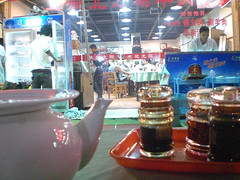
Ten of us were having dinner at a private style restaurant. Unlike mom and pop “family style” diners, which serve standardized fare at similar prices, a private style restaurant caters to the discerning rich, who have a good relationship with the owners. Trust and taste define this good relationship. Guests trust that the owner will provide quality tea, food, and service for a price that includes a “reasonable” profit. In turn, the owner trusts that these guests not only desire, but also can afford high quality teas, expertly brewed, seafood delicacies and soups adorned with beautifully shaped fungi. There is a menu, but it seems to be used for pedagogical purposes, including the health benefits of particular foods and herbs. Consequently, guests don’t order individual dishes, instead a meal’s host discusses a menu with the owner, who then plans the meal. The price of the meal is either set ahead of time (the host setting an upper limit, for example) or, if the guest returns regularly, the owner can plan a meal based on the number of guests. Special requests for imported seafood can be accommodated with 24-hour notice. Private style restaurants set the stage for intimate displays of taste and friendship. Sharing a meal of this quality, for example, enabled my friend both to demonstrate how much he cares for us (because the food is outstanding) and to show off how very good his good life is (because really, the food is that outstanding. And the tea. Wow.)

Bourdieu, of course, has reminded us that elites use aesthetic distinction or good taste to solidify class identity, arguing that cultivated predispositions to certain foods, music, and art enable us to recognize relative social status; we “like” that which is appropriate to our social position and “dislike” that which is not. Continue reading

the real reason behind the proliferation of shaxian snack bars

Franchises of the Fujian based chain, 沙县小吃 (Shaxian Snack Bar) have sprouted up all over China, and Shenzhen is no exception. However, Shaxian Snack Bars aren’t upscale, in fact, the standardized fast food chain veneer notwithstanding, each Snack Bar seems your ordinary mom and pops dive. Moreover, with all the razing and rebuilding going on, the small restaurants and stalls suddenly appear and just as easily vanish. Currently burning up the web, this bit of satire about the real reason for the success of Shaxian Snack Bar brings together two of my favorite things — political satire and food (中文版).

“The war is over.”

The Snack Bar owner had a cigarette hanging from his mouth and his ass in the chair in front of me, as his eyes darted this way and that. A wisp of smoke came out of his mouth.

I was no longer happy. I had been enjoying a basket of steamed buns and a large portion of wonton, thinking about ordering another drumstick. Actually, I wanted a large rib from the large rib set meal, but it couldn’t be purchased independently, so I was thinking about my options. That was when this middle aged man plopped his ass on the chair in front of me, a lone customer with a smile on his face, and said that meaningless sentence. And he was smoking.

“What war? Also, how much is a large rib from the large rib set meal?” I asked patiently. Continue reading

Good food — Love!

I have 口福 (kǒu fú), which might literally be translated as “mouth happiness” and means something like “the destiny to eat delicious food” – and what good fate this is.

I didn’t realize the blessed state of my culinary fate until I moved to Shenzhen, where I have truly enjoyed eating. Apparently, my joy at the table and mad chopstick skills have convinced many Chinese people that I am good friend material. Early on, when friends invited me to eat larvae or dog hotpot, I said, “Sure!” When Yang Qian and I started dating, we made a point of trying a different restaurant several times a week. Moreover, when I had a cold or minor physical discomfort, I went to the local market, bought herbs from a former barefoot doctor, and on her instructions, concocted delicious and healthy Cantonese soups in an ordinary clay pot. The unadulterated pleasure I felt when eating and the joy of sharing good food were critical to how I settled into an ex-patriot life in Shenzhen. Continue reading

happy spirits – 喜酒

wedding food

yesterday, i went to a wedding banquet. the bride and groom, a kindergarten teacher and elementary school teacher, respectively, held a small banquet that nevertheless offered all culinary delights of a cantonese feast: lobster, shrimp, roasted pigeon, different preserved meats, beef cutlets in pepper sauce, a plate of savory preserved meats that are (according to dict.cn) unappetizingly translated as “marinated meat combination”. in chinese their are 卤水 (brine marinade) and 拼盘 (selection – as in my favorite “chef’s selection of desserts”).

i mentioned that i still wanted to dance at weddings (especially now that i’m trying to be a vegetarian and the organizing principal of the meal seemed to a bite of every kind of flesh) and my friend agreed that dancing and/or karaoke (?!) would make the event more festive. she then asked what my husband and i had done for our wedding. i said we had registered.

she laughed and then said, “if you don’t invite people to eat, you’re not married in chinese people’s eyes.”

i asked if my husband should be worried.

“no,” she replied quickly, “i think you should hold a great big fabulous wedding banquet.”

my friend is gentle and kind, with a light touch when the tips of her fingers rest on my forearm, “yes,” she continued dreamily, “think how much fun it would be.”

hmmm.

however, before i was drawn into another debate i couldn’t win (and never when the subject is my life), a group of guests jostled laughingly to our table chanting “big arm, big arm,” a way of drinking where couple’s embrace each other and down an entire glass of wine. the target of this happy teasing were jessica and percy, who had just recently become a couple. they stammered and blushed, and tried to drink through the giggles and cheers.

yes, in addition to eating delicious food, we were imbibing happy wine – the spirits drunk at chinese weddings (喜酒).

in point of subjective fact, one of my favorite chinese characters is 醉 (intoxicated), a word that like its english translation evokes those special moments when we float on happiness – drunk on life and friendship and love… and the happy spirits of the bride and groom. so yes, my friend was right – it is generous to share one’s love through food and drink, drank, drunk.

may all partake.

thinking food: images from the houhai overpass, 2002-2010

this post is a brief contextualiztion of  china lab’s  landgrab city exhibition for the shenzhen-hong kong biennale 2009. the exhibit draws attention to the the ways that cities are imagined without reference to the countryside and food production. it also usefully brings china into international conversations about urbanization.

The countryside is a vital but frequently overlooked category in the contemporary discourse around spatial policy, and its role with respect to the future of urbanism is more often than not neglected. Landgrab City is an attempt to visually represent the broader spatial identity of the 21st century metropolis; it proposes a new spatial definition of the city and thereby a more complex understanding of urbanism, one that no longer considers city limits as the boundary of its remit, but instead looks beyond – even across international borders – to the spatial, social, economic and political implications of the planet’s rapid urbanization.

i support efforts to think about food – its production, distribution, unequal consumption – are all critical to how shenzhen is imagined, experienced, and reproduced. nevertheless, this exhibition disturbs me because it discusses shenzhen as if the city were one wealthy enclave, rather than an amalgamation of enclaves -rich, poor, and destitute, which abut and constantly disrupt one another.

shenzhen has sold itself and reform in precisely the terms that china lab uses to describe the city’s “reality”. unfortunately, by taking shenzhen’s self-promotion as fact, rather than promotional fantasy, china lab overlooks  how rural migrants inhabit and  transform shenzhen. this silence distresses me because the spatial, social, economic, and political consequences of shenzhen’s modernization are not implied; they are facts of life for many migrants.

so a very simple point:

In reality, of course, these agricultural territories are not actually clustered around Shenzhen, as in the installation, but scattered across China and contiguous regions.

counter point: a five minute walk from the land grab project, agrarian squatters have persistantly grabbed, evacuated, and reoccupied  a portion of the houhai land reclamation area to grow food, which they eat and sell. the differences between overpass then and now are now are instructive because they illustrate both the persistance of shenzhen’s rural poor as well as their increasing destitution.

the map below locates the land grab project with respect to several generations of agricultural squatters at the houhai overpass.  pictures of the squatters and their gardens, here.

the houhai overpass is located at the intersection of houhai and binhai roads. in the map, the squatter areas are located in the southeast quadrant of the intersection, coastal city in the southwest, and the land grab in the northwest. these areas are roughly a five minute walk from each other. in the map, the blue areas used to be underwater; the brown areas were not.

food related note

two food related links.

the first is a chinese introduction to the food-scape project, here.

the second is a story about belo horizonte, a brazalian city that has ended hunger through innovative policies, here.

al fresco and imported greens


al fresco

Originally uploaded by maryannodonnell

last night, we returned to a very old haunt–the nanyou food street, which used to be a thriving world of al fresco seafood, sichuan hot pot, and the odd miao restaurants. today, the street still bustles, but in a crumbling, obviously down-graded kind of way. it’s interesting to note that chains have moved in where independent restaurants used to be, while several spaces have been consolidated into larger restaurants, and rennovations were under way for another mega-restaurant.

for years, shenzhen has been actively upgrading its image by removing al fresco restaurants and other small, independent stores that used to spill onto the uneven sidewalks. all this grooming has resulted in neat, straight, clean streets that cut through beautifully tend and imported topiary–we are overwelmed by palm trees, where the restaurants and stores and kiosks used to be. the restaurants, of course, have (been) moved indoors, where air-conditioning, private rooms, and stylish chairs allow people to not only dine in comfort, but also eat in environments where open-toed high heals and business suits can be kept clean. after all, one of the downsides to al fresco dining is the grime that accumulates under the grill, between the tables, and in street gutters.

so, clear stratification under way in terms of unique dining experiences for those with money and increasingly mass produced for those with less. indeed, it is noticible that the al fresco restaurants continue to thrive in working class and older neighborhoods, while in more middle class neighborhoods (and those that have been subjected to beautification projects), the restaurants are all tucked away behind glass doors. unfortunately, for small restaurants, this layout is not comfortable. given the noise and proximity of fellow dinners in a successful chinese restaurant, big is better if you don’t have the sidewalk. thus, more fallout from the street-cleaning: larger, high capital restaurants do better in middle-class areas because they can provide a better dinning environment, while opportunities for low capital food entrepreneurs diminish.

yes, i am waxing nostalgic for old shenzhen, the shenzhen that friends once derided as “nothing more than a small town,” the shenzhen where al fresco dining was the norm, where workers and employees both jostled for tables under magnolia trees along uneven streets, and where cargo trucks rushed past, spewing carbon monoxide into our drinks.

FBI: 2009 The God of Argriculture Plan

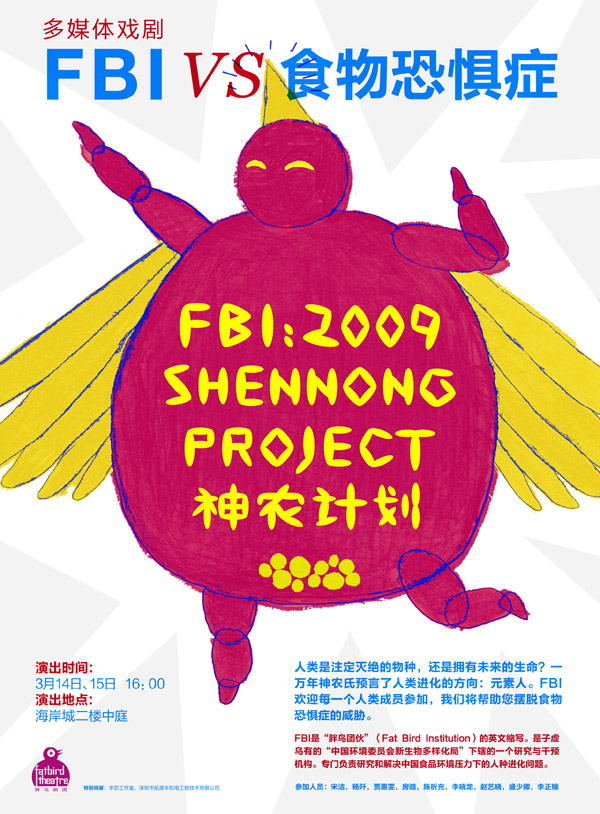
Fat Bird developed FBI: 2009 The God of Agriculture Plan through a series of workshops that explored the meaning of eating in post “3-Deer” China. “3-Deer” products had been exempted from food safety inspections because of the companies previous contributions to society. However, the contamination of milk products shook the confidence of processed food consumers, resulting in the rise of comephobia, a pyschological condition marked by hallucinations, high levels of anxiety, and market place aggression.  See the results of FBI effort at the Fringe Club City Festival!

comephophia VS 食物恐惧症


It seems that Three Deer scandal remains a sensitive topic. Even as representatives in the People’s Congress are arguing over whether or not stars who advertised for the company, in Shenzhen Fat Bird has adapted FBI: 2009 Shennong Plan to fit more snuggly into the rhetoric of Coastal City’s plan du month – “知性女性聪明消费 (The Intelligent Woman Shops Smart)” advertising focus.

So, as of last night, the advertising and and title of the play have changed. The play is now called “胖鸟VS食物恐惧症 Fat Bird Takes on Comephobia”. “Comephobia – fear of eating” was in the original production an ironic medical condition. This weekend, comephobia will be staged as a real social problem. The other major change to the piece is the staging of ritual. In Hong Kong, the piece also spoofed Falun Gong. In Shenzhen, the rituals have all been “upgraded” to modern dance.

Strange indeed which venues fear what. In Hong Kong, there was pressure to make sure everyone understood that “FBI” was an ironic naming of the theatre troupe. In Shenzhen, we must make sure that everyone realizes the troupe is making a joke about a problem that while real, isn’t so serious that it can’t be mentioned at all. FBI still hopes it will be able to sing its theme song to the tune of the Olympic theme song. However, that decision has not yet been imposed.

Time of the show has also changed from 3 to 4. The venue, 2nd Fl, Coastal City Mall, above Jusco.

FBI in Shenzhen!

On Mar 14 and 15 at 3 p.m, Fat Bird will perform “FBI: 2009 Shennong Plan” in the second floor public space of Coastal City. The space is located just above Jusco. After both performances, there will be an open discussion with with the audience about food safety and regulation.

This performance continues and elaborates Fat Bird’s efforts to use theater as a vehicle for encouraging public debate. Fat Bird began as a street theatre troupe which made strategic invasions into public space. In contrast, the Coastal City performance marks Shenzhen’s acceptance of Fat Bird into mainstream venues.

Come, enjoy, debate, and support Fat Bird! One bird, so much good.