union elections in shenzhen

In keeping with Shenzhen’s place at the core of Guangdong reforms, Shenzhen has announced that 163 companies with more than 1,000 employees will introduce elections for union leaders. These elected representatives will then work with the City, District and Precinct level union organizations in order to represent worker rights in negotiations with company management. According to Southern Daily, the impetus for this move has been ongoing independent worker demands for better wages and benefits. Indeed, the first company to implement the election system was OMO, a German company with a plant at Bantian. The article notes that holding union representative elections seemed to have dispelled worker dissatisfaction.

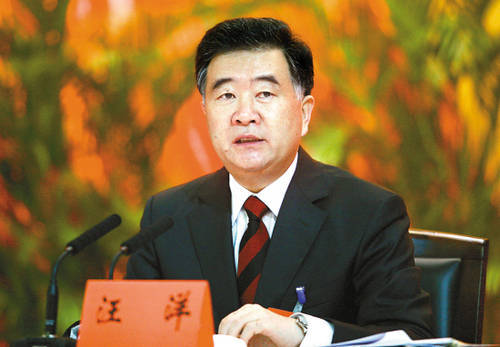
I’m not sure how to interpret this development other than to note that provincial Party Secretary, Wang Yang is actively promoting this reform. Indeed, as we approach the Two Conferences season, Wang Yang has been very active promoting “Happy Guangdong (幸福广东)” and its recognizably middle class values. It is also worth mentioning that the targeted 163 companies are large and many are foreign. Hopefully progressive change at larger plants will help less protected members of the workforce. The problem, of course, is that like the US American workforce, the Chinese workforce is fragmented into segments that receive more and less protection depending not only on worker skills, but also public visibility. Large, international companies are monitored not only by Chinese unions and news media, but also to some degree by foreign groups and media. In contrast, a large segment of the population works under unseen conditions in smaller factories, restaurants, and services or does piecework at home.

But still. One hopes.

the 5.12 beichuan incident, nuclear war games, and why the party fears religious organizations

The Party’s refusal to either share power or make political decision making transparent and open to public debate creates mistrust: just what have they got to hide anyway, inquiring minds want to know. In addition, through its control of cultural resources, including the arts and the right to convene, the Party has demonstrated a refusal to acknowledge any viewpoints other than those that shore up the influence of high-ranking officials.

Neitizens and western journalists have responded to Party control over and access to information with reports that (more often than not) conflate conspiracy theories with the “truth”. Not unexpectedly, citizens spend an inordinate of time trying to piece together a big picture out of rumors, veiled allusions and gut feelings. Sadly, the more the Party doesn’t say about Beichuan or Bo Xilai or Chen Guangchen, for example, the more accusatory rumors circulate via the net, weibo, and text messages and with them the festering anxiety that no one can be trusted to speak truthfully. Thus, in today’s China, common sense has it that Party members don’t tell the truth because the truth would harm them politically, while the rest of us are incapable of telling the truth because we don’t know it.

Keywords of the day – trust (信任), good faith (诚意), and loyalty (忠诚) – pivot on the relationship between a healthy society and how good our word might be. The characters for person (人) and word (言), for example constitute 信, the first character in the compound for trust. The character word (言) also appears in sincerity (诚, literally “word” “is realized”), which is an element of the expression good faith (literally “sincere meaning”) and loyalty (faithful sincerity). Moreover, the question of belief (信仰, literally a person who trusted and admired) resonates throughout all levels of society and the most trusted forms of organized alternative to Party disinformation and rumor mongering tend to be religious – Tibetan Buddhism, Xinjiang Islam, and popular Buddhism, Falungong, Christianity in Han communities.

“A Report on and Lessons from the 5.12 Underground Nuclear Explosion at Longmen Mountain, Beichuan,” a recent Epoch Times (大纪元) article illustrates the co-dependent relationship between belief, opposition, and efforts to figure out the truth. The Epoch Times, of course, is the official Falungong news outlet and the article author Lu Deng is the spokesperson for the Chinese Christian Democratic Party. The gist of the article is that the Party used the 5.12 Wenchuan earthquake to cover-up the fact that on the same day, it detonated a nuclear devise at Beichuan, destroying an entire region. Based on a few facts, knowledge of how the Party operates, and deductive reasoning, the argument is compelling and compellingly legal:

The article reconstructs the events of May 12, 2008 by giving a quote from Feng Xiang’s decidedly poetic and vague blog and then re-interpreting it in terms of a nuclear blast. For example, in February 6, 2009 post, Feng Xiang wrote, “In 80 seconds, the mountain collapsed, the ground split open, the mountains shook and the earth moved, the river changed its course. The green mountain lost its color, and all I see is disaster. This was Beichuan’s most devastating moment. A level 8 earthquake, with level 11 destruction”. According to Lu Dong, the phrase “the green mountain lost its color” refers to the fact that all the mountain foliage was burned. Lu Deng also analyzes sections where he asserts that Feng Xiang’s original text, including references to a Chief Pan of the Anti-Chemical Corps of the Second Artillery (二炮防防化部隊隊長番号) have been changed.

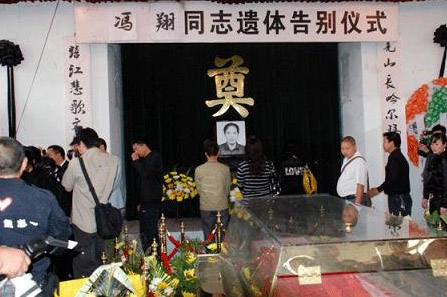
As an opening witness, Feng Xiang  (冯翔) is a compelling figure because his position within the Party hierarchy placed in a position to learn the truth, while his loss as a father and a teacher gave him moral authority. Feng Xiang was a teacher and then a vice minister in the Qiang Minority Autonomous County, Beichuan Ministry of Information (北川羌族自治县宣传部). His eight-year old daughter died in the Wenchuan earthquake. Subsequently, his efforts to uncover the truth about her death led to charges that an underground nuclear explosion rather than the Wenchuan earthquake caused the Beichuan disaster. The truth of his position was confirmed through allegations that Feng Xiang was harassed into committing suicide when he attempted to bring this story to the public.

Lu Dong then moves on to analyze corroborating evidence from other sources; it is an “open secret (公开秘密)” that the damage at Wenchuan was minimal and the strength of the quake insufficient to have destroyed Beichuan. In his book “The Epicenter was in Human Hearts (震中在人心)” Mainland author, Li Ming claimed that the Wenchuan quake gave Party officials an excuse to cover-up the real disaster at Beichuan. Web reports suggest the same pattern of information: Wenchuan was serious, but not a disaster and certainly not enough to have decimated Beichuan. Moreover, web posts included reports that indeed anti-chemical corps had gone into the Longmen Mountain Nuclear facility. In addition, local eyewitnesses said that the heat from the blast burned off the skin of water buffalo. Blogger Xiong Furong said, “The geologists may have different explanations for what happened here, but for us ordinary people, we know it was a detonation (熊芙蓉說,“地質專家對此可能有各種不同說法,但對我們普遍人來講,這就是爆炸。)”

Examples from media reports are brought in: a video on youtube; reports from 21st Century Economic Report (21世紀經濟報導) that the mountain continued to reverberate through the night; Southern Weekend (南方週末) reported that the tremors were so strong that villagers clung to each other to keep themselves from falling into the sinkholes; Western China News (華西都市報) reported that in the Green tablets river basin, there were nearly 10 kilometers of cracks in the mountain, some of which were 42 centimeters deep; and even Party media acknowledged the extent and scale of Beichuan exceeded that of Wenchuan. Beichuan TV broadcast, “The entire 2869 km2 County Area was destroyed, 10s of thousands of buildings were destroyed in mudslides. Over one million square meters collapsed and over 100 areas effected by mud. (北川電 「全縣境內2869平方公里受災,出現了數萬處塌方,泥不流和大滑坡。垮塌百萬立方的特大滑坡達100多處.)” A quote from an elderly gentlemen summarizes and ends this section, “The earthquake had the force of the nuclear explosion at Hiroshima (能量相當干400顆廣島原子彈.)”

Lu Dong is relentless in his case. He notes differences between the pattern of damage at Wenchuan, which fell away from an epicenter and Beichuan, which fell in a different pattern, away from Longmen Mountain. Evidence from the Tangshan earthquake is brought in. Even at Tangshan, after the quake subsided there were some buildings and trees standing. In contrast, at Beichuan everything collapsed: 498 kilometers of highway, 6066 kilometers of ordinary roads, 1503 bridges, 131 power stations, 8,944 kilometers of electrical transmission lines, 26,000 kilometers of fiber optic cables, 597 water reservoirs, 9,416 kilometers of channels, 282 broadcast stations, and 2,432 different sites of geological disaster.

Even more disturbingly, after the 5.12 Beichuan disaster, doctors from Sichuan Medical University, the University of Illinois, and Imperial College released studies documenting that many people and animals in the disaster area suffered from radiation poisoning. In addition, specialists suggested that iodine 131 is a radioactive isotope that could have caused spontaneous abortions similar to those seen at Beichuan. However, the Sichuan Party Secretary ordered a blackout on all reports on over 100 fetuses that had died in utero.

If all this wasn’t enough, the Japan Aerospace Exploration Agency reported that an earthquake did not adequately explain the yellow color and condition of vegetation in Beichuan. Lu Dong ominously concludes, however, that these conditions were consistent with the effects of a nuclear blast. And yes, ongoing Party inspection tours and scientific reports from Beichuan seem consistent with the after effects of a nuclear blast and not an area healing from a natural earthquake.

Clearly, Lu Dong believes that there were underground nuclear experiments at the Longmen Mountain Facility and that an accident occurred. He is a compelling rhetorician, concluding his argument with the reminder that Hawkish General Zhu Chenghu (朱成虎) has threatened to use nuclear weapons to destroy the United States if the country should ever help Taiwan and calling for the Party to meet face these accusations in court.

And there it is. The reason that the Party fears religious organizations.  The unstable situation of chronic Party secrecy and corrosive public suspicions has created an environment in which many people “don’t feel safe (没有安全感)”. However, religious groups continue to investigate and make public charges (if even from abroad), rather than hiding behind anonymous weibos and innuendo. The Chinese Christian Democratic Party has thrown down a political gauntlet in a Falungong newspaper, which also publishes pieces that support the Dalai Lama, forcing those of us living in murky half-truths and deliberate cover-ups: when all is said and done, who do you believe?

early edition vs weibo: who are you reading on the way to work?

Successful monopolies not only dominate an industry sector, but also provide enough diversity within their fiefdom to create the illusion of choice and competing views. Take, for example, the Shenzhen News Publishing Group, Ltd. (深圳报业集团发行有限公司), which was formed in 2002 through the merger of Shenzhen Special Zone News Group and the Shenzhen Commercial News Society. Today, the Group publishes ten newspapers and five journals, owns a book publishing house, and operates the city’s largest news website (深圳新闻网).

The Group has identified four primary news audiences. Shenzhen Daily (深圳日报) offers a Party-centric take on news of the city, country, and world and its audience is self-identified through their (actual or aspired) level of integration into the Municipal apparatus. Shenzhen Commercial News (深圳商报) provides daily reportage on the economy and investors, businessmen, and white collar workers constitute its intended audience. Shenzhen Nightly News (深圳晚报) is a comprehensive newspaper aimed at blue collar workers and ordinary people, who are interested in gossip, local happenings, and a concise reiteration of who’s in charge. Jing Bao (晶报) seems aimed at Generation 80, who are interested in hip takes on the news, more arts reportage, and have slightly “new social movement” impulses, including interests in environmentalism, social justice, and healthy yoga lifestyles.

What happens when new social media challenge that monopoly? Insight comes from how the Shenzhen News Publishing Group has targeted morning commuters on the Shenzhen subway.

During the Shenzhen morning commute, subway riders read Subway 8 a.m., read weibo, or space out; few actually talk to each other or watch the incessant advertising broadcasts on the LED screens (four to a car so that everyone can watch). Shenzhen News Publishing prints Subway 8 a.m. (地铁早8点) under its Shenzhen Metropolitan (深圳都市报) brand and distributes it to commuters on their way to work. The free newspaper unabashedly rehashes news in the most provocative ways, foregoing either analysis or background, reproducing in paper form the weibo experience. In yesterday’s edition, for example, the drought in Lijiang is covered in 91 characters, with a picture three times the size of the text area. Likewise, a 131 character report on Shenzhen’s heatwave was sensationalized with an over-saturated image of a human silhouette against an azure sky and white cloud. In a more explicit weibo reference, a story about a drunken subway rider who used a fire extinguisher to smash a window and then attacked the subway worker who tried to stop him included four surveillance coverage photos, a brief description of what had happened, and a report of weibo cries for human flesh. What’s more, Subway 8 a.m. does not include political news; this isn’t a newspaper, but a collection of sensationalist stories, sports coverage, and gossip.

The differences between Subway 8 a.m. and weibo are also instructive because they remind us that although the weibo and Subway 8 a.m. provide the same content, nevertheless the form of reporting is critical both to a reader’s experience and  (as yet) to capitalist experience, indicating why the Shenzhen Publishing Group has decided to publish a free gossip rag. On the one hand, from a reader’s perspective, Subway 8 a.m. comes in paper form with all the advantages thereof: bigger characters for easy reading, space for somewhat longer stories so that readers can choose between weibo-shorts and more detailed reports on why your child is always coughing or services for wishing neidi mothers, “Happy Mother’s Day!” Consequently, Subway 8 a.m. appeals to those of us who are tired of backlit spaces or enjoy the feel of newsprint or may even want to read an article that will occupy our imaginations for longer than it takes to ride from the Window of the World to the OCT station. On the other hand, from a business perspective, Subway 8 a.m. includes space for advertising. The early edition’s front page includes the masthead, one headline, and two half-page advertisements. Consequently, in between the front-page and the back-page gossip (“We no longer believe in love” was the title of the article on Zhang Yimou’s decision to sign with CCA and split with Zhang Weiping’s Beijing New Pictures (北京新画面影业公司) and yes it was a report on a weibo report!) are 22 pages filled with advertisements that look suspiciously like weibo stories — compelling pictures and seductive blurbs, such as: luxurious homes on the subway line.

Point du jour: the Shenzhen News Publishing Group has met the weibo challenge to its monopoly over local news (and sports and entertainment and society) coverage by becoming a print edition of weibo plus. Like weibo, Subway 8 a.m. is free-of-charge and content-lite, plus easy to read characters, plus slightly longer stories, and plus plus: advertising and info-stories.

the secret to happiness…

Yesterday, Guangdong Party Secretary Wang Yang (汪洋) addressed the 11th Guangdong Provincial Congress of Party Representatives, making five statements which have set him apart from other high-ranking leaders. Once a rival of Bo Xilai for a place in the 18th Naptional People’s Congress appointments, Wang Yang has also made his gesture to gain the support of the people. However, where Bo Xilai went poor populist, Wang Yang’s speech has me remembering the Province’s historic role in the 1911 Xinhai Revolution, when 100 years ago, with its links to overseas Chinese and relatively advanced economy, Guangdong was the cradle of China’s bourgeois revolution, in contrast to the rural uprising that Mao Zedong transformed into a socialist revolution. Wang Yang is a leader for China’s emergent and increasingly vocal middle class. And yes, many of them live in the Pearl River Delta.

Wang Yang’s Five Statements

1. The People are the agent that makes history, as well as the agent that constructs and enjoys Happy Guangdong. The people have the right to pursue happiness; it is the responsibility of the Party and the government to benefit the People. We must discard the mistaken idea that the People’s happiness is a result of the Party and government’s benevolence. (人民群众是创造历史的主体,也是建设和享有幸福广东的主体。追求幸福,是人民的权利;造福人民,是党和政府的责任。我们必须破除人民幸福是党和政府恩赐的错误认识.)

2. We need to discard unwritten rules and bad habits, creating a just, lively, and orderly social environment, where those who follow the rules don’t suffer, where talented people can take the lead, and can pursue and create their own happy life to the best of their ability. (破除潜规则陋习,创造公平公正、活力有序的社会环境,让守规矩的人不吃亏,让有本事的人有奔头,各尽所能地追求和创造自己的幸福生活.)

3. The greatest threat to the Party’s long-term political control is becoming too far from the masses. Our Party can only achieve eternal success to the extent that it comes from the People, is rooted in the People, and serves the People. (党长期执政的最大危险是脱离群众。只有始终坚持来自人民、植根人民、服务人民,我们党才能永远立于不败之地.)

4. We need the courage to use personal revolution to firmly destroy the interests that have turned their backs on socialist market economic reforms in order to resolve problems of government agents exceeding their function, absenting their function, and mistaking their function, making government into a provider of public goods and services. (我们要以自我革命的勇气,坚决打破背离社会主义市场经济改革方向的利益格局,解决政府职能越位、缺位、错位等问题,使政府真正成为公共产品和公共服务的提供者.)

5. Guangdong’s market society has already begun to change… If we take hold of this opportunity, we can breakthrough many difficulties and problems on the road ahead of us, smoothly entering the ranks of more modern areas; if we don’t take hold of this opportunity, we may be unable to escape “the middle income trap”, stagnating and retreating, and the advances we have already made could be lost.  (广东经济社会已经步入转型期……把握得好,我们就能破解前进道路上的各种困难和问题,顺利步入比较发达的现代化地区行列;把握得不好,我们就有可能跨不过‘中等收入陷阱’,出现停滞和倒退,已经取得的发展成果也有可能断送.)

cultural revolutionaries? bo xilai, mao zedong and populist politics in china

According to a politically savvy friend, if anyone has a chance to democratize China, it will be a leader like Bo Xilai because 1. he had the support of the people; 2. he had support within the Party; and, 3. he could have held power after the transition from a one party to a multi-party system.

The purpose of government is to distribute and justify the distribution of goods, which range from food and shelter through education opportunities and healthy living environments throughout society. Some societies use money as the primary tool to mediate the allocation of social goods, in China, however, political status — power with explicit connection to either the military or the police — is the primary social means of deciding who gets what and how it is delivered. This means that the closer one is to the Center, the more opportunities one will have to monopolize not only the allocation of social goods, but also what those social goods are and how they are produced. In short, opportunities to control and benefit from state monopolies over the means of production.

My friend explained that Chinese politics is a series of expanding circles. At the center are high officials, in the next circle their family and friends, and then lesser relatives, and then the families of friends of friends of family friends… The point, of course, is double.

First, with respect to those who have occupied the center, there are no compelling reasons to change the current structure of unequal distribution. What’s more, successfully changing the structure would entail creating political alliances that cut across all those circles in such a way as to first be able to dismantle the system and then maintain power in the new system.

Second, the one hundred surnames are so far from the center that direct appeals to the people constitute a political wild card, which can be wielded by anyone with a wide enough power base. This is frequently the case in local and regional level politics where national appointees navigate and negotiate unfamiliar terrains before they are sent to their next position. However, most national appointees do not become popular in their brief bureaucratic tenures and popular local leaders rarely convert their local appeal into national charisma.

Bo Xilai, however, was exceptional: he had widespread national appeal; he had deep support within and across the Party organization, including ties to the military and the police; and, he was savvy enough to navigate political upheavals. Indeed, he seemed particularly adept at outside-the-box responses to unexpected problems and it will be interesting to see if he is executed or ends up back at the center in ten years time.

On my friend’s reading, the insular structure of Chinese political interests  overdetermined the Cultural Revolutionary connection that linked Bo Xilai to Mao Zedong. Like Mao, Bo Xilai made highly symbolic gestures to help the people. In Chongqing, fore example, Bo set up neighborhood help systems for elderly residents whose family was working in other cities. A solitary elder could directly ring a bell that linked her to the neighborhood committee representative who would be responsible for coming to her aid. This gesture resonated across generations who have been separated as children have left home to work in other cities. Moreover, Mao and Bo’s willingness to upset high-ranking leaders when making these gestures further endeared them to the people.

Bo Xilai skated at the edge of central Party politics for many years before transmuting a minor appointment in a Dalian county into a springboard to national politics precisely because like Mao, he not only dazzled the people, but also impressed journalists and intellectuals, who in turn promoted his project. Not only journalists sang Bo’s praises, but recently closed leftist websites like Utopianet (乌有之乡) publicly supported the Chongqing Model in contrast to the Shenzhen Model, which remains a key symbol of the success of Reform and Opening.

Bo Xilai symbolized the possibility of an end to Party politics as usual and his “Sing Red, Attack the Black” campaign resonated across Chinese political classes in ways that nothing Xi Jinping or Hu Jintao or Jiang Zemin have done. Today, there are efforts to disparage the Mao-Bo connection, but none have addressed the man’s capital C charisma. In fact, I’ve heard someone say, “I don’t care who he did or didn’t kill, Bo Xilai moved me. I only saw him once, but I felt like a crazy fan, who wanted a body autograph” and this comment goes straight to my point du jour.

Weber has warned us that charismatic leaders do not necessarily overturn unpopular regimes and establish democratic governments. Moreover, the rise and fall of populist leaders in Eastern Europe and Russia have demonstrated that its difficult to uproot the Party machine from national politics. Nevertheless, Bo Xilai’s popularity despite his acknowledged crimes not only hints at just how high levels of dissatisfaction with Chinese politics as usual are, but also alerts us to how much violence is necessary to maintain the status quo.

gu kailai: he made me do it!

As Chongqing Turns takes no prisoners, literally.

According to Mirror News (明镜新闻网), Gu Kailai claims she had nothing to do with the alleged murder of Neil Heywood. Instead, she says that Bo Xilai’s secretary acted on the former Mayor of Chongqing’s orders to kill the British businessman. Her role in all of this was simply to invite Heywood to Chongqing. Moreover, she couldn’t refuse to help Bo Xilai because he frequently beat and sexually abused her.

It seems that Hu Jintao may have successfully arranged for Chongqing’s former power couple to receive the death sentence for their role in Heywood’s death. Or at least that’s cliff-hanger du jour, not to be confused with anything like verifiable news.

Meanwhile, there are reports (here, here, and here) that two days ago several thousand took to the streets of Chongqing to protest the government by singing red, a direct challenge to Bo Xilai’s administration and a call for change a la Mao. They also sang the national anthem: “Ten thousand hearts as one, braving the enemies canons — forward march!” In response, the government ordered the police disperse the protestors using teargas yesterday.

Online, extreme left websites such as “乌有之乡”, “毛泽东旗帜网”, “民声网” and “红色中国” have been closed down, although it is still possible to find their site addresses in Baidu’s cache and the British speculate about how Heywood’s Chinese wife is “suffering“, quote unquote.

Shajing Wanfeng Community learns from Wukan

Weibo reports that on the afternoon of April 8, 5-600 Wanfeng (万丰社区) community members/ villagers took to the street to protest Community Secretary and  Wanfeng Ltd CEO, Pan Qiang’en selling off collective lands for private profit. The protests began February 17, when 20-30 elder villagers gathered outside village offices and have continued until today.This afternoon, Epoch Times reported on the event, noting that villagers are calling for an accounting of the past twenty years. Currently, Wanfeng Community has an area of 6.8 sq km and a population of 2,067. Most are surnamed Pan. It is estimated that over 50,000 migrant workers also live in Wanfeng.

gu kailai arrested: “as chongqing turns” really is one of the best shows on the worldwide web

In today’s episode of As Chongqing Turns, Bo Xilai’s wife, Gu Kailai has been arrested for the murder of Neil Heywood, a Beijing-based British businessman.

When we last visited Chongqing, Guagua had been urging his father to truly reform Chongqing’s political-economic system instead of singing Cultural Revolution karaoke and cracking down on “black” activities. One of Bo Xilai’s patrons, Noodle Master Kang (played by Zhou Yongkang) had been fighting with Direct Line to Heaven (played by Wen Jiabao) and Tire (Hu Jintao) for control of the Center. There were rumors of bullets having been fired in Beijing, rumors which increased levels of paranoia because of the administrative separation between control of the military and control of the police. Remember, the military is controlled by, well, the military and in the hands of Tire. The police, however, report to Noodle Master Kang and although the military is larger than the police force, nevertheless the police have more ground forces than the military, who serve and protect Chinese people in the air and at sea, in addition to on land…

Flashback to November, 2011, place: a fancy Chongqing hotel room. Neil Heywood is found dead. Representatives of the Chongqing government tell Heywood’s family that he died of a heart attack. They tell the British Embassy that he died of an overdose of alcohol poisoning. Strange, someone says, I never knew him to drink…

Flashback to Wang Lijun’s mad dash to the US Consulate in Chengdu. Close up of the Chongqing police surrounding the building, demanding that the Americans release Wang Lijun. We jump to a reconstruction of what the New York Times says took place: Wang Lijun telling the Americans (large and in blue suits) all sorts of things about the inner workings of the Center. He lowers his voice and accuses Gu Kailai of poisoning Heywood and to force the Center to reopen the case. Wang Lijun begs the US officials for asylum, but it is not granted. Instead, 30 hours after he entered the Chengdu Consulate, he leaves “of his own accord”, which is what was said at the time and we now know not to be true…

Meanwhile, the Chinese internet pulses and throbs with speculation and analysis. If Gu Kailai did poison Heywood and if hubby, Bo Xilai did cover up the murder, then speculations about the absolute lack of any moral restraints in Chinese leadership seem confirmed. If, however, Wang Lijun lied and now Bo Xilai’s enemies are using the case to end his political career, then speculations about the absolute lack of any moral restraints in Chinese leadership also seem confirmed. And what is to be done when there are two separate armed forces — the military and the police –reporting to (at least two) amoral leaders engaged in a power struggle?

This episode leaves us in Shenzhen to ponder appropriate levels of paranoia. Suddenly, for example, I’m recalling that after the recent Politics and Law Committee Training (政法委书记培训) in Beijing, I’ve notice increased police presence throughout Shenzhen. What’s the reason? I’m reconsidering Bo Xilai’s earlier trip to Kunming Military museum in terms of internal divisions. As Mayor of Chongqing, Bo Xilai had police, his chief supporter, Zhou Yongkang is head of the Politics and Law Committee and  and thus can deploy police from any part of the country anywhere else. Was Bo Xilai actually cultivating military support from his father’s old friends in preparation for a worst case scenario?

And yet. I’m also thinking that the mountain is high and the emperor far away (山高皇帝远) and most of the people in the hot and heavy pursuit of Chongqing rumors tend to be either newspaper reporters, who pursue these sorts of stories for a living and friends from Beijing, who actually identify with whatever the Center is up to and spend time online tracking the rumors. Many of my southern friends don’t seem so interested, except to wonder how the political maneuvering will or will not impact manufacturing, financial services, and summer vacation plans.

That said, I may re-read my Machiavelli just to remind myself that any act by a leader should be interpreted as a power play and not within the rhetoric of serve the people. And sadly, I’m looking at you, too, American politicians who might use this fiasco to pander to anti-Chinese sentiments and American media personalities who would use anti-Chinese sentiments to increase ratings in my homeland. Unfortunately, As Chongqing Turns isn’t a telenovela. It’s what’s happening instead of necessary work to improve the lives of millions of Chinese people, which in a shared world means improving all of our lives.

Thoughts on Shenzhen’s New New Districts: Longhua and Dapeng

This past week, when the Center brought the country’s 3,300 provincial, municipal, and county members of the Politics and Law Committee (政法委) to Beijing to learn “what to do and how to do it,” they did so to strengthen top-down unity, or the line from the Center (中央) to the “local (地方)”. Party control of the Politics and Law Committee means that it directly controls the writing of laws, their interpretation, and enforcement. As far as we know, Zhou Yong “Noodle Master” Kang remains the Chair of the National Committee. We hypothesize that Hu Jintao was critical to making the decision to convene a Politics and Law Committee meeting and what would be taught there. Ergo, we are waiting to see whose line actual becomes the standard that will be brought back to Local governments, like Shenzhen.

How does this administrative apparatus shape the possibility of progressive social transformation in Shenzhen?

One way to answer the question is to think of all the districting and redistricting and micro-districting and statutory planning that create what the Municipality spins as Shenzhen’s “Industry First” as ways of side-stepping Center intervention and oversight by giving investors in hi-tech manufacturing, logistics, finance, and cultural industry preferential policies without any kind of political reform. Continue reading

the tale of hotpot waters…

For a brief moment, the following bit of satire circulated on the Chinese web:

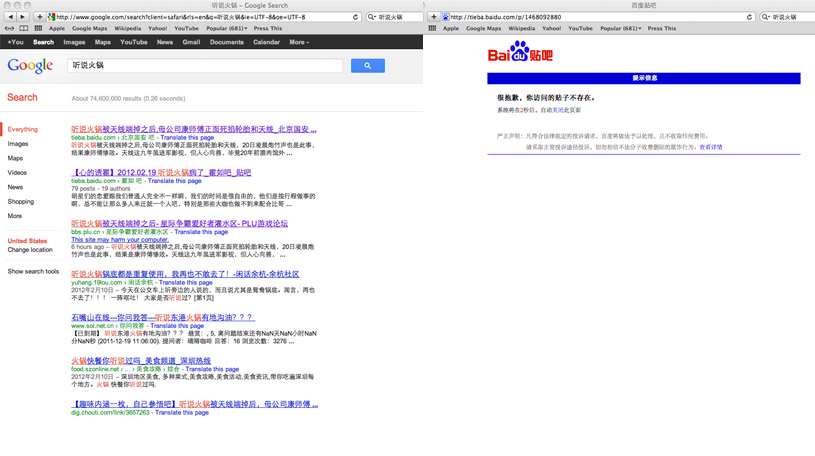
Rumor has it that after Hotpot was swept away by the Direct Line to Heaven, Noodle Master Kang of the Mother Company was openly fighting with Tire and Heaven Direct. The morning fireworks on the 20th were also part of this fight, with the result that the Noodle Master Kang took a serious hit. Even though these past nine years Heaven Direct has charged his way into the silver screen, nevertheless he’s well intentioned. After all, twenty years ago just outside the preserved ham shop, he was the man who stood behind Yangzhou Fried Rice. If y’all sing and eat hotpot again, his nine years of blood and sweat will be as nothing. Thus, it’s a good thing that Tire has the camouflage firmly in hand and soundly thrashed those instant noodles. [original: 听说火锅被天线端掉之后,母公司康师傅正面死掐轮胎和天线,20日凌晨炮竹声也是此事,结果是康师傅惨败。天线这九年虽进军影视,但人心向善,毕竟20年前腊肉馆外他是站在扬州炒饭背后的男人,你们再唱歌吃火锅,人家九年心血全没了,所以幸亏轮胎紧握迷彩涂装不放,才狠摔方便面。]

Traces of the passage remain in google cache but can no longer be accessed on Baidu (image below).

Why was the spoof so quickly removed from Baidu? Continue reading