aging in tangtou, baishizhou

This past week I have been listening to stories from the residents of the Tangtou row houses. Here is one:

Old Xu was born on November 12, 1945. In neidi, he was an accountant on a production team and then for the village enterprise.  After the redistribution of land during the household responsibility system, he and his wife did not receive enough land to farm cotton profitably. Consequently, his three children left to work elsewhere and the land has gone fallow except for a small vegetable plot.

Two years ago, Old Xu came to Shenzhen at the age of 65 because he did not want to burden his children with the cost of his retirement. His wife continues to live back home, taking care of their grandchild.His pension is only 30 or 40 rmb a month. Together, he and his wife need 20,000 rmb annually, or about 1,700 a month to meet their expenses. In Baishizhou, he makes a living collecting and reselling cardboard boxes and other garbage. He says he can save money this way because although there’s no real profit, he makes enough to support himself and to bring a little home for Chinese New Year.

At present Old Xu lives with two other old men in one of the 25+ square meter houses. This house is one of the cheaper in the settlement, with a rent of about 600 rmb a month plus water and electricity. His share is 200 rmb a month, or roughly 5 times his retirement pension back home. A bathroom has been added to the outside of the building. Inside, the space has been divided for sleeping and simple cooking.

When I asked him how the environment could be improved, Old Xu said that old people have no place to exercise. Instead, they just sit around talking, but that was the fastest way to an unhealthy old age! Old Xu also admitted that he was lonely because except for his roommates, he didn’t know anyone in the area. He then shrugged and asked rhetorically, “What can be done? If I go home, I can only become a burden for my children.”

bo xilai: true heir to the revolution?

Bao Tong (鲍彤) was Zhao Ziyang’s secretary. Zhao Ziyang, of course, was the Secretary General of the CCP who fell from power because he supported a non-violent resolution to the Tian’anmen protests. Yesterday, Bao Tong chimed in on the Bo Xilai scandal and how it relates to the upcoming 18th National People’s Conference — and yes, whether or not Gu Kailai killed Niel Haywood is a matter of secondary importance, rather than being a question of life or death for the Party. For Bao Tong and like minded CCP politicos, the question is still one of the absolute authority of the Party.

Here’s the rub: Bo Xilai has become a negative example of abuses of Party authority and power. However, like Deng Xiaoping before him, Bo Xilai is the direct heir of Marxin, Lenin, Mao and Stalin. If the Party removes Bo Xilai, they have rejected the justification for absolute power. If they continue with Bo Xilai, then they must deal with the fact that Bo Xilai has been discredited. Bao Tong thus provocatively and accurately raises the question: If Bo Xilai (or someone like him) is the heir to the revolution, what’s the Party to do? Translation of Bao Tong’s op-ed piece, below.

There are Two Choices at the 18th NPC

Bo Xilai has already become history. The reason he has entered the annals of history isn’t because of his wife, Gu Kailai was convicted, but because he pursued the “Sing Red, Attack Black [mafia] (唱红打黑)” campaign.

Some have slandered Bo Xilai by saying he isn’t a filial descendent of the Party. This is unfair. He really was immoral and lawless, but wasn’t Mao Zedong?  Lenin openly defined revolution as “only dependent on the direct action of the masses and not dependent on any law”, and is thus the even more immoral and lawless ancestor. Under Lenin’s strategy and leadership, the Bolsheviks brazenly dispersed the elected All Russian Constituent Assembly, starting the age of Red Terrorism. Mao Zedong delighted in bragging about his lack of conscious and lawlessness. He didn’t believe this was a source of shame, but rather a source of honor. All Chinese people are familiar with this history. Bo Xilai was merely the direct heir to this tradition. There is no possible discussion about Mao Zedong and Stalin’s personal morality. Thus, if we are to fairly evaluate Bo Xilai, we cannot say that he was the unworthy son of the Party, but must say he was the Party’s worthy son, its skillful and finest son, most worthy in the extreme.

If we are speaking of Party nature (党性), who is more truly of the Party than Bo Xilai. Singing red is to walk with the Party, and attacking black is to struggle against those enemies that the Party has identified. This is the highest essence of revolution and strongest discipline. Bo Xilai had a strong body. During his youth, he was bewitched by Mao Zedong into entering a life or death struggle with his father, Bo Yibo, who Mao had called a traitor. Who else has demonstrated this level of innocent and pure revolutionary spirit and loyalty to the Party?

It must be pointed out that by calling the Chongqing Model “Sing Red, Attack Black”, Bo Xilai had completely digested the marrow of the Party’s authoritative government. Standing in the position of a Party leader, to sing red is to respect only the Party, and to attack Black is to suppress anyone else (异己).

For the masses, singing red is the obligatory way to serve the Party, and attacking black is the willingness to fight on the Party’s behalf. Without exaggeration, we can say that the existence of a political campaign called “Sing Red, Attack Black” signals that the Party’s monolithic control of government has ended. [Within the State Party system] Anything that does not belong to the system is beside the point. Even if it is important, it cannot be a life or death conflict. For example, the difference between Mao Zedong and Deng Xiaoping’s respective policies or that between Stalin and Hitler’s policies is no doubt one of better or worse, but these differences were differences within the context of serving the absolute political power of the Party.

Consequently, when cutting up a cake, there is always the question of who gets the bigger slice. On the the issues of public housing and hukou, Bo Xilai was not rigid, in fact he was extremely flexible. This is one of the reasons he won the hearts of the people. However, he he could only tentatively hold his deep seeded “follow me and flourish, oppose me and perish” attitude (“顺我者昌逆我者亡”这条命根子). He blatantly raised his “Sing Red, Attack Black” banner, brandishing his sword, declaring his strength and prosperity, without giving any quarter. What was this? This was nothing other than the Bo Xilai Model, or we could call it Bo-ism. It was also Maoism for the 21st century. Bo Xilai didn’t invent “follow me and flourish, oppose me and perish”. However, in order to call corruption a miracle and to paint cruel and inhuman philosophy as miraculous revolutionary truth, Bo Xilai needed extreme sincerity in order to succeed as he did.

Some argue that “Red is true! Black is crime!” Is this true? When were the “nine types of black” established in the legal domain? “The whole country is red” campaign was obviously an unprecedented catastrophe. Governance depends upon clear legal ideas, and does not require romanticism or catchy slogans, and does not permit illegal gutting and rewriting the law.

The especially pernicious aspect of singing red was that it called an ass a horse, sedating the people and deifying leadership. In Bo Xilai’s Sing Red campaign a “power grab” was mystified as “the great victory of democratic revolution”. The ongoing impoverishment and alienation was mystified as “the great victory of socialism”. The widening gap between rich and poor was mystified as “Socialism with Chinese characteristics”. Human rights abuses were mystified as “stability”. And immorality and lawlessness was mystified as “the greatest glory”. Of course, with respect to Bo Xilai himself, he was the new savior of the world.

The especially pernicious aspect of attacking black was using law to solve problems that could not be solved through legal means. It made people crazy to attack wherever the Party pointed: attack rightists, attack anti-rvolutionaries, attack liberalization, attack vulgar values, attack those protest, attack those with power, attack lawyers, attack those with the courage not to submit to the Party’s leaders, attack the enemy in Bo Xilai’s eye; charge with out fear of death, attack! All that was necessary was to raise children who daily sang red and attacked the black, and everyone would be in crazy sedation. The highest power would then naturally pass from generation to generation, flourishing for 1,000 years, the establishment of an imperial house. This was the perfect strategy concealed in Bo Xilai’s four characters “Sing Red, Attack Black”.

Even if this campaign had entered high levels of Party debate, nevertheless early on some clear sighted people saw it was unfeasible. Those who sang red were “Party parrots (党八股)”. Lin Biao advocated reading Mao everyday, but Minister of Propaganda Lu Ding disagreed. Lu Ding contradicted Lin Biao with the colloquialism “even delicious Yunnan ham if eaten everyday will cause indigestion”. Clearly, Lin Biao didn’t have Lu Ding’s experience in propaganda. Attacking black everyday was the same as doing the Cultural Revolution everyday. Likewise, how could Bo Xilai be more knowledgeable than the General Secretary in determining the importance of harmony to social stability? Unsurprisingly, when Bo Xilai first appeared on the list of potential candidates for the Standing Committee, how hard it was for people of understanding to stand like pillars in flowing water. They didn’t make a pilgrimage, they didn’t chant sutras, and they didn’t cheer! (With all the drama for becoming General Secretary, the situation is extremely complicated. Those who had risen by attacking black and made their living singing red were probably a small minority.)

The 18th National People’s Congresses faces a choice: either tie itself to Bo Xilai or cut him loose. If they are unwilling to open the 18th NPC under Bo Xilai’s shadow, then it is time to quietly begin ending the “Sing Red, Attack Black” campaign. Of course, if they are willing to openly and properly join Bo Xilai in singing red and attacking black, this is even more commendable, more deserving of everyone’s welcome and support.

sustainability is a collective decision

Netizens have joked that using a blow dryer or tanning may now infringe on national property rights.

Just recently, Heilongjiang Province promulgated laws governing the analysis of atmospheric resources and conservation (黑龙江省气候资源探测与保护条例). The key and controversial point, of course, is the decision that atmospheric resources, including wind energy, solar energy, precipitation, and ambient air are natural resources and as such belong to the country.

What does that mean?

According to Minister of Meteorology, Zheng Guoguang (郑国光) the laws do not mean that air has been privatized — “impossible!” he said — but rather that the research and development of energy resources will be centralized. The legislation seems to me a rather straight forward decision to institute state monopolies on the production and allocation of sustainable energy. It also anticipates state appropriation of sustainable energy technologies that are developed outside the context of national research and development, but within national borders.

Other countries have also begun to dispute the question of “wind rights”. Denmark, for example, compensates neighboring landowners for loss of property value due to the erection of wind turbines. More interestingly, the Danish government has adjudicated on disputes that (depending on placement) new wind turbines “take wind” from extant turbines.

Ron Rebenitschhas considered water laws (first in time, first in right) and oil right laws (compensatory unitization) as models for developing wind laws. In the former, the first user to develop a qualified use of water (i.e., irrigation) from a flowing stream develops certain rights to divert a defined quantity of water from the stream if it is available. Later users of water from that stream can still divert water from that stream, but only in quantities that do not affect the earlier users’ ability to divert the allocated quantity of water.

In contrast, when an oil well is drilled, the oil flows to the well from all directions, without regard for ownership of mineral rights. Thus adjacent mineral rights holders could theoretically have their oil drain to the nearby well, without recompense. Under unitization, the production of an oil field is then allocated proportionally to the surrounding mineral rights owners, in accordance with pre-determined impact.

Like the Danish and US American discussion, China’s nascent foray into wind rights discussion do not take international borders and sustained regional inequalities into account. Consider, for example, the Law of the Colorado River.

This thicket of deals, trade-offs, set-asides, subsidies and politically sanctioned thievery is nearly impenetrable to even the most seasonedand cynical observer. But from the Mexican side of the border,the law is devastatingly simple: The US retains 95 percent ofthe Colorado River’s water and Mexico gets what’s left over. Most years this is about 1.5 million acre feet, roughly the same amountthat Sonoran desert farmers were using to irrigate their beanand onion fields in 1922.

Likewise, in the Middle East, long-term sustainable economic development depends on access to clean and dependable supplies of freshwater. In turn, this access continues to depend upon region wide management agreements (Gleick, Yolles, and Hatami). More recently, US American Intelligence has predicted increasing risks of water conflicts worldwide. As in the Middle East, shared water resources are increasingly used to threaten neighboring states, while the over-pumping of groundwater supplies threatens the agricultural production, which accounts for 70% of freshwater usage.

All this to make a simple point.

In China, the rhetoric of a centralized state frames the discussion of sustainable resources, while in the Middle East and United States, we can speak of “water security” and thereby transform drinking water into weapons of war.  Thus, the development of sustainable energy sources is as potentially fraught as the development of other resources (oil and now water) because we are proposing to use the same, unsustainable models of production, distribution, and allocation.

daoist china: weibaoshan

Another commercial center on the Tea and Horse Route, Weishan (巍山) is located about 75 minutes from Dali. Weishan was the first capital of the Nanzhao, but was soon replaced by Dali, which has a more temperate climate because located on the banks of Lake Erhai (洱海).

One of the main Weishan tourist sites is Weibaoshan (巍宝山), which literally means “Treasure Mountain Wei”. The mountain has been designated a national park and walking paths that thread from and between Daoist temples have been laid. Contemporary Daoists have occupied many of these temples and it is possible to stay the night there for a donation. However, the architectural treasure is the Long Spring Retreat (长春洞) which was constructed between 1779 and 1799 and is dedicated to the Jade Emperor, the Lord of the Underworld.

Sites like Weibaoshan vex me. I studied Chinese language and history in order to experience places like Long Spring Retreat, as if the poetry and philosophy of classical China still animated everyday life. However, 17 years in Shenzhen have taught me that even if the contemporary cultural mix includes Daoism, nevertheless capitalist forms and modern desires more obviously structure human relationships and desires in China.

And yet, if not for capitalist forms, I could not have visited Long Spring because I not only needed to purchase a ticket to enter the park, but also get myself from Shenzhen to Dali, Dali to Weishan, and then from Weishan to the mountain. Alas, none of those plane rides and car trips  manifest the Daoist virtue of regulating my life by according to natural rhythms. Instead, they more properly manifest the US American virtue of satisfying individual desires through post-industrial convenience.

The point seems to be remembering to take time to reflect on our place in the world, not only as individuals, but also as a species. What does it mean to be human? What does Long Spring Retreat teach that we cannot learn through Shenzhen’s rush to reproduce and exceed the material wealth of North America?

Impressions below.

This slideshow requires JavaScript.

entitled: the demise of comrade and ritualization of inequality

The other evening northern friends of a certain age lamented the demise of “comrade (同志)” as a form of address. They weren’t so much distressed by the Cantonese queering of the term, as they were by the fact that Chinese forms of address no longer assumed (or aspired to) equality between comrades. Instead, etiquette now demanded that social fields be charted and hierarchical relations marked. Officials, for example, are called by their bureaucratic position. Not surprising in the case of higher ranking officials — the City Party Secretary and Mayor, for example — but somewhat excessive in the case of neighborhood heads.

Even if they chafe at the ritual acknowledgement of political hierarchy and concomitant social inequality, nevertheless, they also remarked that official status does simplify the question of how to address someone. In contrast, they noted that the real awkwardness lay in deciding how to address someone without either a clear social role or a defined relationship to the self. They addressed professionals by their job (Lawyer Chen, Teacher Dong, Doctor An, Theatre Director Yang, and Engineer Liang come to mind), but often blanched at calling rich acquaintances “boss (老板)” or the more refined “executive (总)”. Friends were addressed by nicknames and fictive kin terms, while new friends could be called “Mr. (先生)” or “Ms. (小姐)”, but workers, including waitstaff and other service workers posed a problem because they could also be hailed as fictive kin or just young people. Moreover, gender and age play an important role, and in conversation my friends often call working men “craft master (师傅)” or “boy (小伙子)” and working women “auntie (阿姨)” or “younger sister (小妹)”.

In anticipation of the 18th National People’s Congress and to give a sense of just how complicated is the system of Chinese bureaucracy and relevant titles, I have translated the fifteen official levels of government from a Baidu entry. Positions are listed in order of ranking within a category. Hence, the General Secretary ranks higher than the President, who in turn ranks higher than the Chair of the Military Commission. When making introductions, most people will qualify a title with the appropriate administrative status, as in City Level Vice Mayor, after which however, they will use the full title “Mayor” unless the actual Mayor is around. These rankings also matter because they map the bureaucratic journey that ambitious functionaries must make. Shenzhen is a sub-provincial level city, for example, and so its Mayor cannot be directly considered for a national post, but must first obtain a provincial or ministerial position. In contrast, a the same position in an independent city, like Beijing or a full provincial ranking, would be a rank higher, placing the office holder in contention for national assignments.

Should your eyes not glaze as you read the list, you’ll get the hang of assigning rank and how using titles has ritualized inequality by reiterating the Chinese bureaucratic system from the General Secretary all the way down to a functionary in a community or village office.

First level, national level (国家一级):General Secretary, President, Chair of the Military Commission, Chair of the National People’s Congress, State Council Premier, Vice General Secretary, Standing Member of the Political Bureau of the CPC Central Committee.

Second and third level, national government (国家二至三级):Member of the Political Bureau of the CPC Central Committee, Alternative Member of the Political Bureau of the CPC Central Committee, Secretary for the Central Disciplinary Commission, Vice Chair of the NPC Standing Committee, Vice Premier of the State Council, State Council Member, President of the Supreme People’s Court, Vice Chair of the CPPCC National Committee.

Third and fourth level, national ministries and provincial government (部级正职、省级正职三至四级): Provincial governor, Vice Secretary for the Central Disciplinary Commission, Standing Member NPC, Secretary of State, all sub-national administrative chiefs and enterprise heads (including Party organizations), leaders of all People’s organizations (including Party organizations) at the provincial, autonomous region, independent city level. These organizations include Party Committees, People’s Congresses, Government, and Chinese People’s Political Consultative Conference. Exceptions can be made to give provincial rank to leaders of sub-provincial organizations;

Fourth and fifth level, vice ministries and sub-provincial government (部级副职、省级副职四至五级): Vice Governor, Members of the Central Disciplinary Commission, all sub-provincial administrative chiefs and enterprise heads (including Party organizations), leaders of all People’s organizations (including Party organizations) at the sub-provincialand sub-autonomous region. These organizations include Party Committees, People’s Congresses, Government, and Chinese People’s Political Consultative Conference. Exceptions can be made to give sub-provincial rank to leaders of Office of the Council or Regional organizations [Shenzhen Municipality];

Fifth through seventh level, Council Heads, Regional Chiefs and Counsels (司级正职、厅级正职、巡视员五至七级);

Sixth through eighth level, Vice Council Heads, Sub-regional Offices and Assistant Counsels (司级副职、厅级副职、助理巡视员六至八级) [Shenzhen Districts];

Seventh through tenth level, Department Heads, County Commissioner and  Investigators (处级正职、县级正职、调研员七至十级);

Eighth through eleventh level, Vice Department Heads, Vice County Commissioners, and Assistant Investigators (处级副职、县级副职、助理调研员八至十一级) [Shenzhen Precincts];

Ninth through twelvth level, Section Heads, Xiang Heads and Chief of Staff (科级正职、乡级正职、主任科员九至十二级);

Ninth through thirteenth level, Vice Section Heads, Vice Xiang Heads, and Vice Chief of Staff (科级副职、乡级副职、副主任科员九至十三级) [Shenzhen Communities/Neighborhoods];

Ninth through fourteenth level, Staff Members (科员:九至十四级);

Tenth through fifteenth level, Office Workers (办事员:十至十五级).

the 5.12 beichuan incident, nuclear war games, and why the party fears religious organizations

The Party’s refusal to either share power or make political decision making transparent and open to public debate creates mistrust: just what have they got to hide anyway, inquiring minds want to know. In addition, through its control of cultural resources, including the arts and the right to convene, the Party has demonstrated a refusal to acknowledge any viewpoints other than those that shore up the influence of high-ranking officials.

Neitizens and western journalists have responded to Party control over and access to information with reports that (more often than not) conflate conspiracy theories with the “truth”. Not unexpectedly, citizens spend an inordinate of time trying to piece together a big picture out of rumors, veiled allusions and gut feelings. Sadly, the more the Party doesn’t say about Beichuan or Bo Xilai or Chen Guangchen, for example, the more accusatory rumors circulate via the net, weibo, and text messages and with them the festering anxiety that no one can be trusted to speak truthfully. Thus, in today’s China, common sense has it that Party members don’t tell the truth because the truth would harm them politically, while the rest of us are incapable of telling the truth because we don’t know it.

Keywords of the day – trust (信任), good faith (诚意), and loyalty (忠诚) – pivot on the relationship between a healthy society and how good our word might be. The characters for person (人) and word (言), for example constitute 信, the first character in the compound for trust. The character word (言) also appears in sincerity (诚, literally “word” “is realized”), which is an element of the expression good faith (literally “sincere meaning”) and loyalty (faithful sincerity). Moreover, the question of belief (信仰, literally a person who trusted and admired) resonates throughout all levels of society and the most trusted forms of organized alternative to Party disinformation and rumor mongering tend to be religious – Tibetan Buddhism, Xinjiang Islam, and popular Buddhism, Falungong, Christianity in Han communities.

“A Report on and Lessons from the 5.12 Underground Nuclear Explosion at Longmen Mountain, Beichuan,” a recent Epoch Times (大纪元) article illustrates the co-dependent relationship between belief, opposition, and efforts to figure out the truth. The Epoch Times, of course, is the official Falungong news outlet and the article author Lu Deng is the spokesperson for the Chinese Christian Democratic Party. The gist of the article is that the Party used the 5.12 Wenchuan earthquake to cover-up the fact that on the same day, it detonated a nuclear devise at Beichuan, destroying an entire region. Based on a few facts, knowledge of how the Party operates, and deductive reasoning, the argument is compelling and compellingly legal:

The article reconstructs the events of May 12, 2008 by giving a quote from Feng Xiang’s decidedly poetic and vague blog and then re-interpreting it in terms of a nuclear blast. For example, in February 6, 2009 post, Feng Xiang wrote, “In 80 seconds, the mountain collapsed, the ground split open, the mountains shook and the earth moved, the river changed its course. The green mountain lost its color, and all I see is disaster. This was Beichuan’s most devastating moment. A level 8 earthquake, with level 11 destruction”. According to Lu Dong, the phrase “the green mountain lost its color” refers to the fact that all the mountain foliage was burned. Lu Deng also analyzes sections where he asserts that Feng Xiang’s original text, including references to a Chief Pan of the Anti-Chemical Corps of the Second Artillery (二炮防防化部隊隊長番号) have been changed.

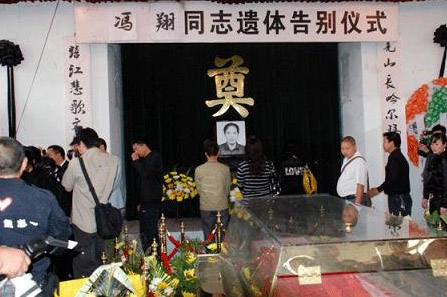
As an opening witness, Feng Xiang  (冯翔) is a compelling figure because his position within the Party hierarchy placed in a position to learn the truth, while his loss as a father and a teacher gave him moral authority. Feng Xiang was a teacher and then a vice minister in the Qiang Minority Autonomous County, Beichuan Ministry of Information (北川羌族自治县宣传部). His eight-year old daughter died in the Wenchuan earthquake. Subsequently, his efforts to uncover the truth about her death led to charges that an underground nuclear explosion rather than the Wenchuan earthquake caused the Beichuan disaster. The truth of his position was confirmed through allegations that Feng Xiang was harassed into committing suicide when he attempted to bring this story to the public.

Lu Dong then moves on to analyze corroborating evidence from other sources; it is an “open secret (公开秘密)” that the damage at Wenchuan was minimal and the strength of the quake insufficient to have destroyed Beichuan. In his book “The Epicenter was in Human Hearts (震中在人心)” Mainland author, Li Ming claimed that the Wenchuan quake gave Party officials an excuse to cover-up the real disaster at Beichuan. Web reports suggest the same pattern of information: Wenchuan was serious, but not a disaster and certainly not enough to have decimated Beichuan. Moreover, web posts included reports that indeed anti-chemical corps had gone into the Longmen Mountain Nuclear facility. In addition, local eyewitnesses said that the heat from the blast burned off the skin of water buffalo. Blogger Xiong Furong said, “The geologists may have different explanations for what happened here, but for us ordinary people, we know it was a detonation (熊芙蓉說,“地質專家對此可能有各種不同說法,但對我們普遍人來講,這就是爆炸。)”

Examples from media reports are brought in: a video on youtube; reports from 21st Century Economic Report (21世紀經濟報導) that the mountain continued to reverberate through the night; Southern Weekend (南方週末) reported that the tremors were so strong that villagers clung to each other to keep themselves from falling into the sinkholes; Western China News (華西都市報) reported that in the Green tablets river basin, there were nearly 10 kilometers of cracks in the mountain, some of which were 42 centimeters deep; and even Party media acknowledged the extent and scale of Beichuan exceeded that of Wenchuan. Beichuan TV broadcast, “The entire 2869 km2 County Area was destroyed, 10s of thousands of buildings were destroyed in mudslides. Over one million square meters collapsed and over 100 areas effected by mud. (北川電 「全縣境內2869平方公里受災,出現了數萬處塌方,泥不流和大滑坡。垮塌百萬立方的特大滑坡達100多處.)” A quote from an elderly gentlemen summarizes and ends this section, “The earthquake had the force of the nuclear explosion at Hiroshima (能量相當干400顆廣島原子彈.)”

Lu Dong is relentless in his case. He notes differences between the pattern of damage at Wenchuan, which fell away from an epicenter and Beichuan, which fell in a different pattern, away from Longmen Mountain. Evidence from the Tangshan earthquake is brought in. Even at Tangshan, after the quake subsided there were some buildings and trees standing. In contrast, at Beichuan everything collapsed: 498 kilometers of highway, 6066 kilometers of ordinary roads, 1503 bridges, 131 power stations, 8,944 kilometers of electrical transmission lines, 26,000 kilometers of fiber optic cables, 597 water reservoirs, 9,416 kilometers of channels, 282 broadcast stations, and 2,432 different sites of geological disaster.

Even more disturbingly, after the 5.12 Beichuan disaster, doctors from Sichuan Medical University, the University of Illinois, and Imperial College released studies documenting that many people and animals in the disaster area suffered from radiation poisoning. In addition, specialists suggested that iodine 131 is a radioactive isotope that could have caused spontaneous abortions similar to those seen at Beichuan. However, the Sichuan Party Secretary ordered a blackout on all reports on over 100 fetuses that had died in utero.

If all this wasn’t enough, the Japan Aerospace Exploration Agency reported that an earthquake did not adequately explain the yellow color and condition of vegetation in Beichuan. Lu Dong ominously concludes, however, that these conditions were consistent with the effects of a nuclear blast. And yes, ongoing Party inspection tours and scientific reports from Beichuan seem consistent with the after effects of a nuclear blast and not an area healing from a natural earthquake.

Clearly, Lu Dong believes that there were underground nuclear experiments at the Longmen Mountain Facility and that an accident occurred. He is a compelling rhetorician, concluding his argument with the reminder that Hawkish General Zhu Chenghu (朱成虎) has threatened to use nuclear weapons to destroy the United States if the country should ever help Taiwan and calling for the Party to meet face these accusations in court.

And there it is. The reason that the Party fears religious organizations.  The unstable situation of chronic Party secrecy and corrosive public suspicions has created an environment in which many people “don’t feel safe (没有安全感)”. However, religious groups continue to investigate and make public charges (if even from abroad), rather than hiding behind anonymous weibos and innuendo. The Chinese Christian Democratic Party has thrown down a political gauntlet in a Falungong newspaper, which also publishes pieces that support the Dalai Lama, forcing those of us living in murky half-truths and deliberate cover-ups: when all is said and done, who do you believe?

the secret to happiness…

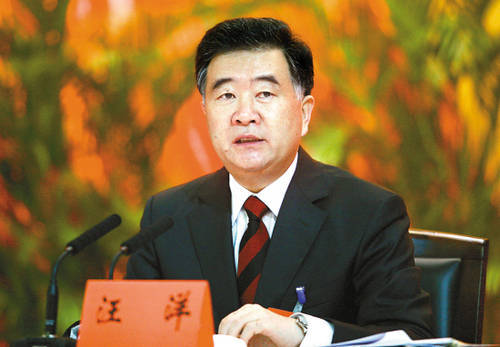
Yesterday, Guangdong Party Secretary Wang Yang (汪洋) addressed the 11th Guangdong Provincial Congress of Party Representatives, making five statements which have set him apart from other high-ranking leaders. Once a rival of Bo Xilai for a place in the 18th Naptional People’s Congress appointments, Wang Yang has also made his gesture to gain the support of the people. However, where Bo Xilai went poor populist, Wang Yang’s speech has me remembering the Province’s historic role in the 1911 Xinhai Revolution, when 100 years ago, with its links to overseas Chinese and relatively advanced economy, Guangdong was the cradle of China’s bourgeois revolution, in contrast to the rural uprising that Mao Zedong transformed into a socialist revolution. Wang Yang is a leader for China’s emergent and increasingly vocal middle class. And yes, many of them live in the Pearl River Delta.

Wang Yang’s Five Statements

1. The People are the agent that makes history, as well as the agent that constructs and enjoys Happy Guangdong. The people have the right to pursue happiness; it is the responsibility of the Party and the government to benefit the People. We must discard the mistaken idea that the People’s happiness is a result of the Party and government’s benevolence. (人民群众是创造历史的主体,也是建设和享有幸福广东的主体。追求幸福,是人民的权利;造福人民,是党和政府的责任。我们必须破除人民幸福是党和政府恩赐的错误认识.)

2. We need to discard unwritten rules and bad habits, creating a just, lively, and orderly social environment, where those who follow the rules don’t suffer, where talented people can take the lead, and can pursue and create their own happy life to the best of their ability. (破除潜规则陋习,创造公平公正、活力有序的社会环境,让守规矩的人不吃亏,让有本事的人有奔头,各尽所能地追求和创造自己的幸福生活.)

3. The greatest threat to the Party’s long-term political control is becoming too far from the masses. Our Party can only achieve eternal success to the extent that it comes from the People, is rooted in the People, and serves the People. (党长期执政的最大危险是脱离群众。只有始终坚持来自人民、植根人民、服务人民,我们党才能永远立于不败之地.)

4. We need the courage to use personal revolution to firmly destroy the interests that have turned their backs on socialist market economic reforms in order to resolve problems of government agents exceeding their function, absenting their function, and mistaking their function, making government into a provider of public goods and services. (我们要以自我革命的勇气,坚决打破背离社会主义市场经济改革方向的利益格局,解决政府职能越位、缺位、错位等问题,使政府真正成为公共产品和公共服务的提供者.)

5. Guangdong’s market society has already begun to change… If we take hold of this opportunity, we can breakthrough many difficulties and problems on the road ahead of us, smoothly entering the ranks of more modern areas; if we don’t take hold of this opportunity, we may be unable to escape “the middle income trap”, stagnating and retreating, and the advances we have already made could be lost.  (广东经济社会已经步入转型期……把握得好,我们就能破解前进道路上的各种困难和问题,顺利步入比较发达的现代化地区行列;把握得不好,我们就有可能跨不过‘中等收入陷阱’,出现停滞和倒退,已经取得的发展成果也有可能断送.)

as yet shenzhen has no capital h history…

The experience of walking Shenzhen is significantly different from visiting, Beijing or Shanghai, Xi’an or Guangzhou, where the meaning of the past has already been codified, renovated, and can be consumed on a nostalgic tour. In school we learn that Beijing’s history is Ming-Qing imperial, Shanghai’s history is East-West colonial hybrid, Xi’an’s history is ancient, while Guangzhou’s history is South China sea commerce and migration. We then go to the respective tourist destination to have our knowledge confirmed and perhaps enriched by and through an appropriate activity. We walk Beijing’s hutong and the Forbidden City, drink coffee or cocktails in a stylish restaurant in Shanghai’s shikumen and the Bund, admire Xi’an’s beilin and terracotta soldiers, and wander the small shops of Guangzhou’s West Gate. Indeed, each of these tourist destinations succeeds as such precisely because the site metonymically represents the respective city’s place in China’s “5,000 years” of civilization. We leave thinking we have a deeper understanding of where we have been. Maybe we do. Most likely we don’t. But there is something reassuring in having our stereotypes confirmed, and those stereotypes are what I mean by capital h history.

Now, there are historically significant sites in Shenzhen — Old NantouDapeng Fortress, the Chiwan Tianhou TempleDongmen, and Yumin Village. However, municipal efforts to promote Old Nantou and Dongmen, notwithstanding, none of these historical sites has captured the imagination of either residents or visitors. I suspect this is in part because each of these places represents a portion of Chinese history that is already preserved elsewhere. Old Nantou and the Chiwan Tianhou Temple, for example, represent ancient efforts to develop the Chinese salt trade and settle the Pearl River Delta, but there are finer examples of that era to be imagined and seen in Guangzhou, while ancient Chinese history is more elegantly preserved in Xi’an and Jiangnan. Even the Tianhou sea cult is more closely identified with Tianjin and Xiamen than it is with South China temples and shrines. Likewise, Dapeng Fortress is an outpost of Ming-Qing military imperialism, but of a failed variety, rather than successful garrisons to be explored throughout the north.

Dongmen and Yumin Village are perhaps more representative of Shenzhen’s importance as the epicenter of early reform. However, both are historically compromised. Although Dongmin is identified with so-called Shen Kong commerce, for example, there really are more upscale malls throughout both Shenzhen and Hong Kong where one might purchase global products. And what about Yumin Village? Deng Xiaoping visited Yumin Village in 1984, inspecting one of the three-story private homes that local villagers had just built. He declared that Shenzhen speed was a good thing and that the rest of the country should follow. The 1995 exhibition to commemorate the 15th anniversary of the establishment of the Shenzhen SEZ included an installation that reproduced the interior of one of those homes, which at the time, was more luxurious than the homes of urban cadres in Beijing and Shanghai. Here’s the rub: although Yumin Village has been integrated into the Shenzhen municipal apparatus as a Luohu neighborhood, nevertheless the actual buildings that Deng saw and even the home he inspected were razed over ten years ago. There is a history board there, but nothing from 1984 remains and Yumin Village continues to function as a border urban village, with low rents for migrants who work nearby, spas and massage parlors for visiting Hong Kong people, and places where villagers play mah jong and gather to drink tea and gossip.

The absence of an agreed upon master narrative means that walking Shenzhen allows individuals to judge what does and does not represent capital h history in the SEZ. Now Shenzhen does boast upscale skyscrapers that represent achievements within this process — Guomao, Diwang, and the Civic Center all come to mind and are worth a visit. Those wanting to see the “real” capital h historic Shenzhen, I suggest visiting either an industrial park or an urban village. Early 80s work unit housing in Luohu and Shekou are also great examples of how industrial urbanization transformed the area. Personally, however, I believe that if Shenzhen has a place in China’s 5,000 years narrative it is as an epicenter of rural urbanization, including transformation of the local environment, proletarianization of rural migrants to SEZ factories, and the forms of urbanization that returned workers have promoted or their remittances enabled. However, even after over 30 years of reforming and opening Baoan villages, the city is only just starting to come to terms with this legacy and most villages, even the most famous such as Baishizhou are scheduled to be razed. All this to say that as yet, the meaning of Shenzhen’s cultural and historical inheritance is still up for grabs because we are only just starting to come to terms with the urban legacy of Reform and Opening. This means that as yet the city has no capital h history and no corresponding historical sites that one can visit and say, “Yes, I’ve been to Shenzhen and I know where I’ve been.”

Walk anyway. The Shenzhen you experience will be only loosely tethered to stereotypes about China and you might make something else of it. Below, impressions of a recent walk in Fuyong.

This slideshow requires JavaScript.

怀德村:virtue’s rewards

It’s been a while since I’ve summarized an episode from The Transformation of Shenzhen Villages (沧海桑田深圳村庄三十年) and so today, episode 6: The Secret of Huaide Village (怀德的秘密), which puns the village’s name and also means “the secret to cherishing virtue”.

The episode opens by telling viewers that Huaide is a revolutionary village, which contributed over 40 soldiers to the People’s Liberation Army. The connection between good Party leadership, virtuous villagers, and getting rich is then personalized through the story of Pan Baliang, a Huaide villager, who fought in the Korean War, (or the Resist American War as it is known in Chinese). However, during the Cultural Revolution he was jailed because his children were abroad, and was only to be rehabilitated in 1980, when out of gratitude for his fellow villagers continued support, he petitioned the village/ brigade if he could open a factory.

In 1988, Huaide was chosen as the location for Shenzhen’s Baoan International Airport. At the time, the SEZ decided that guannei land should be saved for urban development, rejecting a proposal to build at Baishizhou, which was then considered the suburbs and choosing instead to stimulate the guanwai economy by converting Shenzhen’s largest duck farm into an international airport. The Shenzhen airport expropriated over 1,000 mu of village land and in return Huaide received a compensation package of 3.5 million yuan. The question became: should the sum be divided evenly and distributed to each villager (as many villages had chosen to do) or should the village create a jointly held corporation and invest the money in common cause?

In 1988, guanwai New Baoan County was still rural. This meant that the village was still organized as a collective brigade, which provided the organizational infrastructure for Huaide’s subsequent development as a jointly held corporation. Huaide’s current CEO and current Party Secretary, Pan Shansen earnestly explains that Huaide Party leaders understood that unless they could correctly direct the thinking of the villagers, the village was in danger of making a collective mistake. Collective and Party leaders then went to work on villagers with dissenting opinions in order to make sure that everyone was on board with the next step — using the money for capital investment to build and manage Cuigang Industrial Park. Pan Shansen then expresses his gratitude for the previous Party leaders’ foresight in using the Airport compensation to create a strong, collective economy.

Pan Shansen describes the work of creating “a center where there was previously no center” as arduous and only possible through the cooperation of the people and their government. In addition to creating a large wholesale furniture market, in 1996 Pan Shansen established a venture capital fund that provided interest free loans to young villagers who wanted to start up companies. The fund started with 1/2 million when and grew to 2 million, and loans grew from 20-50,000 per project. In 2005, this venture capital project was expanded through collaboration with Shenzhen’s rural bank, providing low interest loans of up to 300,000 yuan to Huaide Villagers. By 2010, when the documentary was made, in addition to the villages collected holdings, over 40 families had used Village venture capital to create family businesses.

Fiscal conservatism of the defining features of Huaide Village’s success. Huaide Village has its own “constitution” that requires any private investment over 5 million yuan to be approved by the village, they set up a legal aid office for villagers to consult when writing contracts, and since 1992 have not sold any village land rights. Telling, Pan Shansen makes a point of reminding documentary viewers that Huaide Villagers are farmers — to break their ties to the land and the village is tantamount to destroying what makes them who they are, regardless of how they actually make money. Land is at the heart of Huaide’s neo-Confucian CCP virtue and unlike many Shenzhen villages that no longer have collective land, Huaide still owns almost 1/2 of the land they owned before 1980. What’s more, the Village has actively purchased land rights from other Shenzhen villages, leaving its own land for future use.

The rewards of Huaide’s virtue are a neo-Confucian-socialist hybrid capitalist success story, or as it is sometimes said, villagers washed their feet and left the paddies. In addition to its village venture capitalist fund, Huaide invested in social services and local culture. Huade provides medical insurance, education, including college scholarships, and old age activities for its 700 villagers, and in 2010, its Lion Dancing Troupe was the only village level troupe to receive an invitation to perform at the opening ceremony of Belgium’s Chinese Culture Festival. And thus, the moral to this episode tallies with Shenzhen’s ongoing campaign to promote Confucian ethics: good party cadres are at heart neo-Confucians, serving their people, who become collectively rich. In turn, inquiring minds wonder: to what extent has Huaide’s ethical sensibility extended to the organization of workers’ rights in the village’s three industrial parks?

Cultural postscript: the Lion Dance Troupe is talented and fun. Check out a performance, here.

cultural revolutionaries? bo xilai, mao zedong and populist politics in china

According to a politically savvy friend, if anyone has a chance to democratize China, it will be a leader like Bo Xilai because 1. he had the support of the people; 2. he had support within the Party; and, 3. he could have held power after the transition from a one party to a multi-party system.

The purpose of government is to distribute and justify the distribution of goods, which range from food and shelter through education opportunities and healthy living environments throughout society. Some societies use money as the primary tool to mediate the allocation of social goods, in China, however, political status — power with explicit connection to either the military or the police — is the primary social means of deciding who gets what and how it is delivered. This means that the closer one is to the Center, the more opportunities one will have to monopolize not only the allocation of social goods, but also what those social goods are and how they are produced. In short, opportunities to control and benefit from state monopolies over the means of production.

My friend explained that Chinese politics is a series of expanding circles. At the center are high officials, in the next circle their family and friends, and then lesser relatives, and then the families of friends of friends of family friends… The point, of course, is double.

First, with respect to those who have occupied the center, there are no compelling reasons to change the current structure of unequal distribution. What’s more, successfully changing the structure would entail creating political alliances that cut across all those circles in such a way as to first be able to dismantle the system and then maintain power in the new system.

Second, the one hundred surnames are so far from the center that direct appeals to the people constitute a political wild card, which can be wielded by anyone with a wide enough power base. This is frequently the case in local and regional level politics where national appointees navigate and negotiate unfamiliar terrains before they are sent to their next position. However, most national appointees do not become popular in their brief bureaucratic tenures and popular local leaders rarely convert their local appeal into national charisma.

Bo Xilai, however, was exceptional: he had widespread national appeal; he had deep support within and across the Party organization, including ties to the military and the police; and, he was savvy enough to navigate political upheavals. Indeed, he seemed particularly adept at outside-the-box responses to unexpected problems and it will be interesting to see if he is executed or ends up back at the center in ten years time.

On my friend’s reading, the insular structure of Chinese political interests  overdetermined the Cultural Revolutionary connection that linked Bo Xilai to Mao Zedong. Like Mao, Bo Xilai made highly symbolic gestures to help the people. In Chongqing, fore example, Bo set up neighborhood help systems for elderly residents whose family was working in other cities. A solitary elder could directly ring a bell that linked her to the neighborhood committee representative who would be responsible for coming to her aid. This gesture resonated across generations who have been separated as children have left home to work in other cities. Moreover, Mao and Bo’s willingness to upset high-ranking leaders when making these gestures further endeared them to the people.

Bo Xilai skated at the edge of central Party politics for many years before transmuting a minor appointment in a Dalian county into a springboard to national politics precisely because like Mao, he not only dazzled the people, but also impressed journalists and intellectuals, who in turn promoted his project. Not only journalists sang Bo’s praises, but recently closed leftist websites like Utopianet (乌有之乡) publicly supported the Chongqing Model in contrast to the Shenzhen Model, which remains a key symbol of the success of Reform and Opening.

Bo Xilai symbolized the possibility of an end to Party politics as usual and his “Sing Red, Attack the Black” campaign resonated across Chinese political classes in ways that nothing Xi Jinping or Hu Jintao or Jiang Zemin have done. Today, there are efforts to disparage the Mao-Bo connection, but none have addressed the man’s capital C charisma. In fact, I’ve heard someone say, “I don’t care who he did or didn’t kill, Bo Xilai moved me. I only saw him once, but I felt like a crazy fan, who wanted a body autograph” and this comment goes straight to my point du jour.

Weber has warned us that charismatic leaders do not necessarily overturn unpopular regimes and establish democratic governments. Moreover, the rise and fall of populist leaders in Eastern Europe and Russia have demonstrated that its difficult to uproot the Party machine from national politics. Nevertheless, Bo Xilai’s popularity despite his acknowledged crimes not only hints at just how high levels of dissatisfaction with Chinese politics as usual are, but also alerts us to how much violence is necessary to maintain the status quo.