opening ceremony of the first annual dalang graffiti culture festival

So. Today, Handshake 302 extended its reach and joined hands with the Dalang Street Office to curate the first annual Dalang Graffiti Culture Festival. It rained, so not much painting happened. Nevertheless, we had a great time with balloons, handprints, and a short “WeChat” play. I made the emoji box masks!

Impressions of event, below.

This slideshow requires JavaScript.

pointless inc at 302!

On Friday, May 7, the performance artist 坚果兄弟 (nut brothers) spoke at Handshake 302 about his recent piece, “30 Occupations”. 坚果兄弟 specializes in extended performances of absurd situations. He especially enjoys (and yes, the word is “enjoys”) creating pieces that blur the boundaries between art and everyday and thus highlight the delicate balance required to maintain plausible fictions such as “work is meaningful” or “art is special”. Thus, he tends to work with none artists in everyday spaces, where the “audience” that gathers may or may not realize it is a performance piece. Continue reading

chai jing’s “under the dome”: investigating china’s air pollution

If you haven’t seen Chai Jing’s documentary on China’s air pollution problems, here’s the first ten minutes with subtitles. To view subtitles start the video and then click the icon to the right of the clock in lower right hand corner of the screen.

Compelled to learn more? The full documentary can be viewed on youtube. There is also a written English summary online at Unworthy.

in a globalized world, is the categorical imperative still “universal”?

Yesterday I attended a book launch for, Yang Lichuan’s second book, “The Transformation from Vertical Society to Horizontal Society: The Historical Philosophy of the Crash between Chinese and Western Civilizations (纵横之变:中西文明碰撞中的历史哲学)”. The two parts of the book title suggest the political thrust and method of intervention, respectively. The first part of the title expresses the author’s hope for social transformation to a more egalitarian society, while the second part captures the discourse–philosophy–through which this call for social transformation will be made. And yes, although the political call for social transformation was clear, the philosophical argument was as overwhelmingly comprehensive as the title suggests.  Continue reading

the thing about egalitarian ideologies

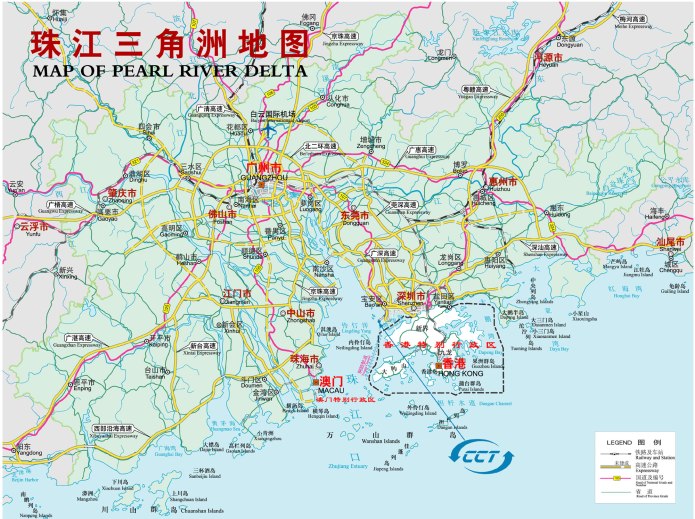
is that very unequal material living environments have to be made to look, well, equal. This is why the current Chinese government focus on growth rates, rather than actual GDP figures matter. With mandated growth rates, every city looks like they’re growing (more or less) equally, while others don’t look like they are stagnating. However, when the actual GDP figures for, let’s say, the Pearl River Delta cities are compared, what we see is that three cities–Hong Kong, Guangzhou, and Shenzhen–completely dominate the region, even as collectively the 9 PRD cities are estimated to account for 70% of Guangdong’s GDP (and only 30% of population). Moreover, given that sub provincial Shenzhen can’t (yet) officially have a higher GDP than provincial Guangzhou, we have know way of knowing if Shenzhen is in fact earning less than Guangzhou.

Provocation du jour: government growth rate targets directly impact a functionary’s ability to rise within administrative ranks, even as the business of Shenzhen remains, well, profitable business. Inquiring minds want to know: is this a contradiction between the people, or a meaningful crack between the government and its residents (居民)?

业绩 is calculated in terms of GDP percentages!!

I’ve been searching for 2014 GDP statistics for cities in the PRD. One would think that would be easy. But it’s not. The reason, I’ve discovered while jumping from city website to city website is that targets are set in terms of growth rates, rather than the actual GDP figure. In turn, government websites tend to publish growth percentages (to advertise that they’ve hit their targets), rather than rawer data. So, my a-ha moment du jour.

identity card politics

So today a return to a theme near and dear to my heart: satirical text messages, or as we have now stopped texting and use WeChat, satirical blog posts that are forwarded via WeChat. This time, the Op-Ed piece, “We were never Chinese citizens, just Chinese people who live on the Mainland (原来我们都不是中国国民!只是居住在大陆的中国人!) has caught my attention. Inquiring minds want to know, what’s up with that? Continue reading

affordable housing, thoughts on

Affordable housing is a hot topic in Shenzhen and in fact, the topic is of current interest because one of the utopian impulses at Wutong Island is a proposal to bring back dormitories and cafeterias for single young professionals. Affordable housing also frames debates on the value that urban villages provide the city of Shenzhen. Results from a non-random survey of my friends on the state of dormitory housing in Shenzhen follow. Continue reading

on china’s maritime consciousness

The recently published Exploring China’s “Maritime Consciousness” offers quantitative insights into public opinion on the South and East China Sea disputes. The survey was conducted in Beijing, Shanghai, Guangzhou, Chengdu, and Changsha. The survey summarizes responses to give a sense of what “urban Chinese” think about a variety of issues. Of the five cities, only Shanghai is actually a coastal city, while only Guangzhou functions within South China seas cultural formations. Beijing is, of course the national capital, while both Chengdu and Changsha are inland provincial capitals.

seeking alterity

After we left Tantou, we visited several other scenic spots in Kaihua. Beautifully other to Shenzhen’s clogged roads and noisy crowds, these scenes suggested that the gate to an other worldly adventure was just around the bend in the road or nestled snuggly behind a crumbling wall. And yet. Each time we spoke with local residents, they asserted, “There’s nothing here.” In turn, the visitors from Shenzhen responded that this beauty was enough, but the locals remained skeptical; beautiful enough to bring in tourists? Continue reading