…in an urban village?
This was the topic of the first Paper Crane Tea 2014.03.09. I’m posting the link because my VPN isn’t fast enough to tunnel video over or under the great firewall. Will upload next time I’m in Hong Kong. Sigh.
…in an urban village?
This was the topic of the first Paper Crane Tea 2014.03.09. I’m posting the link because my VPN isn’t fast enough to tunnel video over or under the great firewall. Will upload next time I’m in Hong Kong. Sigh.
Yesterday, the Shenzhen Government online portal announced that Baishizhou is on the list of areas designated for urban renewal.
The plan to renew “the five Shahe villages” was submitted by the Shenzhen Baishizhou Investment Company Ltd. It calls for razing 459,000 square meters of built area. The area has been zoned for residential and commerce, with at least 135,857 square meters of public space.
Baishizhou is one of 18 projects announced. All plans take place at the street level, and all target communities and/or early industrial areas. All emphasize the planned public area, but do not mention plans for evicted residents or scheduled construction.
Of note, the urban renewal announcements were tucked away in the Bureau of Land, but the announcement of Shenzhen’s plans for its first village preservation project, Shayu (沙鱼涌古村保护项目) made the front page.
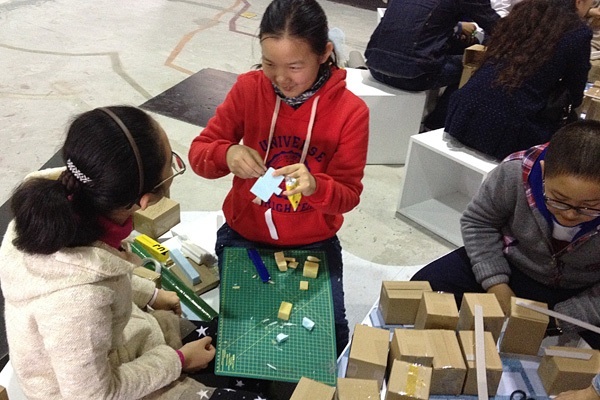
This weekend (Feb 22-23), two events organized for Shenzhen children focused on Baishizhou. On Saturday, ATU/观筑 held a “Young Architects” program in Venue B of the Biennale. On Sunday, CZC Special Forces and Ya Ya Theatre co-produced “Baishizhou Theme Park”, a 20-minute play that was written, directed, and performed by six of Baishizhou’s youngest residents in Venue A.
For the past two years, ATU has run the Young Architects program to teach architectural literacy through experience. They have intervened in the Baishizhou Tangtou row houses, building chairs and also built small spaces to spec, for example, a study room for one person that connects to another, but remains private. Saturday’s program was a urban renewal workshop for Baishizhou. Led by architects, Huang Jingjie and Feng Guochuan, six groups of pre- and teenagers took responsibility for one area. The requirements were, the total building area cannot change and improvements must be affordable so that rents will not increase dramatically. Each group had a professional consultant and 90 minutes to rethink urban renovation.
For over four years, Ya Ya Theatre has developed intimate performances that express unique experiences. Earlier in this year’s Biennale they produced a version of “One Person, One Story” in which members performed autobiographical and biographical monologues about a life-changing event. Lora Wang and Chen Lihua ran the two-month workshop that included exploration of Baishizhou and then developing a series of autobiographical vignettes. Sites visited included a dry swimming fountain, the Jiangnan Department Store plaza, and a video arcade.
So, the during the last official weekend of the Biennale, we had two events that developed the theme of the relationship that Shenzhen children have to Baishizhou, and by extension other urbanized villages. This in itself indicates that interest in the urbanized villages is spreading beyond commercial and academic enclaves. Moreover, we also saw community projects that assume urbanized villages as an important component of Shenzhen as an imagined community. This marks an important shift in the public awareness. Previously, urbanized villages existed outside Shenzhen representations of the city. The villages were (and to a large extent remain) glaringly absent from urban plans. Suddenly, the villages have emerged in public discussions about wither urban development and renewal?
These questions were at the heart of the post performance discussion “Learning from the Urban Villages” with Lora, Feng Guochuan and Zeng Guansheng. Audience members were not only interested in where the working class and young migrants would first settle in Shenzhen, but also in questions about the social value of street life and neighbors. This kind of conversation provided a glimpse into a larger, more general search for Shenzhen identity. This new identity reworks the version of high-speed development and red heroes that has been the previously ignored but not challenged vision of who Shenzheners are and what the city might be.

As part of the Hanshake 302 program, Lora and Lihua have been running a theatre workshop at the Mingzhu culture station in Baishizhou. Workshop content has included games, narrative structure, and exploring Baishizhou. The children developed short pieces about their lives in a Baishizhou. A few observations:
1) Baishizhou (and other urban villages) are home to two generations of Shenzhen youth–the children of migrants and recent high school and college graduates who have migrated to the SEZ. The urbanized villages shelter Shenzhen’s future;
2) The young children have grown up in Baishizhou. They have improvised playgrounds and special places. Of note, they don’t actually know where Baishizhou’s boundaries are, and they have also figured out how to sneak into neighboring gated communities;
3) The children run relatively freely in Baishizhou. Unlike highly protected children in upscale communities, in Baishizhou the children mingle more widely and I am reminded of studies about US suburbs, where community friendships grew out of children’s play.
Today, we ran a dress rehearsal in Baishizhou. On Feb 23 at 2:30 pm we will bring Baishizhou children to perform at the Biennale Venue A. The performance will help us think through the question, what can we learn from the urban villages? Impressions of dress rehearsal, below.
The day before yesterday I participated in a Biennale forum on high density living. I thought high density living referred to number of people living in so much space. Rumor has it, for example, that there are roughly 19.5 million people living in Shenzhen — a mere 4 million over the official unofficial population count (read generally accepted and quoted). Shenzhen has an official area of 1,952 square kilometers, which would make the SEZ’s estimated actual population density to be around 10,000 people per square kilometer. The population density of people with hukou would be significantly less dense, around 1,300 people per square kilometer, but no one believes that figure. On the recently updated Chinese Wikipedia the population density is given as being 5,201 per square kilometer.
Population density can be appropriated to give us a sense of forms of social inequality. Baishizhou, for example, is located in Shahe Street Office, which has an area of approximately 25 square kilometers. The estimated population is around 260,000, giving us an average population density of 10,400 people per square kilometer, which is close to the guesstimated municipal average above. However, when we account for Baishizhou, we see an interesting realignment.
Baishizhou occupies an area of .6 square kilometers (the rest of the area’s original holdings has already been annexed by the state). It has a guesstimated population of 140,000 people. This means that Baishizhou has a population density of 23,333 people per square kilometer, while the rest of Shahe, which includes Overseas Chinese Town and Mangrove Bay estates has a population density of 4,898 people per square kilometer. So Baishizhou has a population density which is over twice the municipal average and OCT and Mangrove Bay areas have a population density that is less than half the city average.
I was wrong in thinking that population density is the only way to operationalize unequal access to space. In archi-parlance (that’s a personal neologism for “how architects and urban planners talk about the world and stuff they’re building), there are two more definitions of density that they’re interested in measuring– floor area ratio (FAR) and dwelling unit density (DU). And if you’re wondering do they further abstract these descriptions of the built environment by using acronyms, the answer is a resounding yes! The density atlas provides an illustrated explanation of terms. Below, I try to work through what these terms might tell us about the spatialization of unequal access to space through and within Shenzhen’s urbanized villages.
FAR density refers to how much building occupies the space. And it’s three-dimensional. So floor area ratio means the total area on all floors of all buildings on a certain plot. Thus, a FAR of 2 would indicate that the total floor area of a building is two times the gross area of the plot on which it is constructed, as in a multi-story building. So, a FAR of 10 would be ten stories, if the base was consistent (as in a box). (And yes, I’m grappling to get my mind around this kind of abstraction so I think in simple terms, or word problems if you will.)
In order to calculate DU density, you posit so many square meters per person. A 100 square meter building with a FAR of 6 would have 600 square meters. If we then posit 20 square meters per person, our 600 square meter building could shelter 30 people. In other words, if we were to take standard person to space ratio used by many Shenzhen urban planners, then 30 people could comfortably live in one handshake building.
But clearly that’s a calculation for one, single purpose building. Once we start allocating space for functions, we need to make value judgments. How much space for business? For women’s restrooms in public spaces? For sleeping? In other words, to allocate spaces within the built environment we need to make decisions that will reveal and confirm our sense of what is the good life and how we will share that life and it’s material components. To return to our hypothetical 6-story handshake building, if we give the first floor to business and then build subdivide a floor into (3.5 X 6) 21 sq meter efficiencies (still above the magic 20), three on one side of the hallway and one on the other, we would get four rooms. However, if we further subdivide those rooms, we could get eight even smaller rooms (leaving space for hallway and stairs).
In practice, design is not that simple. But the numbers do begin to operationalize inequality in terms that resonate the ethical discourse modern education has equipped us with. For example, the layout of Handshake 302 shows a living space of (4.335 X 3.06) = 13.2651 square meters. There is a small cooking space and toilet which also allows for standing baths. Our neighbors live in similar sized rooms, and share the space and rent among two or three roommates. This suggests that the actual DU in a Baishizhou handshake efficiency can be as low as 4.4 square meters per person. At 850 per month, wear talking a rental cost of 64.1 yuan per meter.
In contrast, it costs 18,600 to rent a condo at neighboring Zhongxin Mangrove Bay, for example. The flat has four bedrooms, two living rooms, and three bathrooms that take up a total of 265 square meters, or slightly less than half a handshake building. It is a family home, so let’s guesstimate a pair of grandparents, a set of parents and one kid, totaling five people. Each of them enjoys 53 square meters of living space. Each square meter has a rental cost of approximately 70 yuan, which is not that much higher than Baishizhou.
Admittedly, one can tell many stories with statistics, but the square meter story of Baishizhou and its neighbors is one of gross inequality. Mangrove Bay residents can occupy anywhere from 15 to roughly 18 times the space of Baishizhou renters, and pay about 22 times the cost for that privilege. At this scale, one can begin to imagine what razing Baishizhou means in terms of affordable housing on the one hand and potential profit on the other. Point du jour, however, is that there is no “standard” square meter per person ratio, just expanding levels of inequality.
So, some stats du jour that should give us pause to reflect on the values we are constructing into the built environment.
For the curious, a folk song about Baishizhou.
The song is credited to 七弦花 and the lyrics make it clear — cheap housing make Baishizhou the station of choice for young migrants.
The song begins, take a walk with me through where I live. Crowded buildings stretch to the sky and we cannot see the sky. Girls smile like flowers and hold cigarettes in their hands. The kiosks keep expanding and money goes missing from a bowl.
And continues: you see adverts for housing everywhere, and it’s easy to get a room. Old stub and second hand stores and never ending bills. Moving trucks parked on the side of the road and business cards from moving companies.
The heavily accented voices of immigrants saying where they live in Baishizhou.
Smell of beer and charcoal briquettes are burning lives. And the smoke stings our eyes inside Baishizhou. Pop songs permeate the streets here in Baishizhou.
Images and sentiment reflect the mood of many young immigrants who want the shenzhen dream and live Baishizhou reality…

The Tangtou row houses are finally empty. My favorite family has moved elsewhere, leaving behind butterflies, flowers, and a stencil that reads “Southern Weekly, Southern Weekly, Southern Weekly”. The father earns his living by selling advertizing space for the print edition of Southern Weekly. All in all a poignant reminder of how vulnerable civil society and debate remains.
Southern Daily was the one newspaper that has been vocal about evictions and the rights of migrant workers. However, on December 27, 2013 it undermined its credibility by giving the police the names of protesters who had supported the newspaper during January 2013 protests. The newspaper’s decision to cooperate with the police has angered and disgusted many who are calling for the publishing house to release the names of the leaders who have betrayed the people who came to their defence. As with last January’s Southern Weekly Incident, the public learned of this incident because staff broke ranks to blow the whistle on them. Details gathered in the article “Southern Weekly, it would have been better for you to have died, then to have lived to commit today’s shame (南周 恨不当年死 留作今日羞)
Sigh.

In Xintang, Baishizhou, this 60-year old gentleman has been protesting for a month. His demand? He wants the right to depend on his son for his old age care.
In Shenzhen, parents can transfer their hukou from hometowns to the SEZ based on their children’s hukou status. Once they have this hukou, they can take advantage of subsidized medical care from their 65th birthday. The problem? This gentleman’s son does not have a Shenzhen hukou. In addition, he does not own a house and is facing eviction upon the completion of negotiations to raze Baishizhou (admittedly at least two or three years in the future). At such time, he will loose his shop, and without equity in the building, will not receive compensation. So he is facing a perilous retirement.
The wording of the protest is of interest. 投靠 (tóu kào) literally means “throw oneself to depend upon”. It can also be translated as “become a retainer of”. Within the rhetoric of this protest, this gentleman is demanding the right to become his son’s retainer.
The form of his demand is similarly coached in feudal language; indeed his banners function as petitions to leaders rather than as social demands. He asks Xi Jinping, for example, if the General Secretary realizes that although in Beijing old people have welfare, the old people in Shenzhen have a different situation. He then asks Xi Jinping to visit Shenzhen and see the situation. Likewise, he asks Shenzhen Secretary Wang Rong and Shenzhen Mayor Xu Qin where the Communist Party is.
The moral economy of noblesse oblige gives these questions their oppositional force. The question put to Xi Jinping implies that if the General Secretary understood the true situation in Shenzhen, he would rectify it. The question put to Wang Rong is even more pointed: has the Communist Party abandoned its responsibility to take care of the people?
In order to make this moral claim, the gentleman also demonstrates that he has upheld his end of the moral contract between government and the future. First, he followed the one child policy and only gave birth to a son. Second, he came to Shenzhen twenty-three years ago to make a better life for himself and his family. During that time, his son was back in his hometown to go to school. Third, he never broke any other laws.
Shenzhen has been at the forefront of reforming its pension system. In practice, this has been the commodification of services. For those with Shenzhen hukou, there are still some benefits. However, as this gentleman reminds us, in the present real security comes through family ties and home ownership.


Fat Bird premieres another play!
This Saturday and Sunday afternoon at the Value Factory, Fat Bird will perform Urban Fetish / Baishizhou. After the performance, I will lead a discussion about “Life, Labor and Desire” in and around the Shenzhen Dream. The show and discussion begin at 2:30 and will end between 4:30 and 5:00, depending on how lively the discussion gets.
Here’s the curatorial statement from Yang Qian (urban fetish baishizhou curatorial statement english):
Discussion Theater
URBAN FETISH / BAISHIZHOU
A Historic Interlude that did not, will not and cannot Exist
Sun up; work
Sundown; to rest
Dig well and drink of the water
Dig field; eat of the grain
Imperial power is? and to us what is it?
The fourth; the dimension of stillness.
And the power over wild beasts.
– Canto 47, Ezra Pound
The life that Ezra Pound described was once quite close, with memories only three generations away from the present.
However, today we live in a world where you are what you own. This is a material era, transforming fetishism into poetic theater.
At 2:30 p.m. on the fourth and fifth days of January 2014, during the Fifth Edition of the Shenzhen Hong Kong Bi-City Biennale of Urbanism/ Architecture, in Venue A, Fat Bird Theatre invites each member of the audience to travel to a future Baishizhou. As one of the lucky property owners, you will experience unimaginable luxury from your seat in the theatre. Indeed, this surreal, poetic experience will make your neighbors – homeowners in Portofino, Shenzhen’s most expensive real estate development – envious because their future has already been built. But you are about to create a future that can only belong to you. Compared to them, you are successful.
In the theater, you will see a community buried, and on its ruins a dreamlike city emerge, and you and others like you will own this new world. You will see a place where 140,000 migrant workers once lived. Like you, they came to realize the Shenzhen Dream: wearing designer clothing, luxury housing, and lazy shopping mall days. But you are the lucky one; they have been pushed aside. Compared to them, you are successful.
You own a car, but sometimes you walk the streets of Shenzhen, and when you do, you see the posters that read, “When you arrive, you are a Shenzhener”. But in this theater you are sure of one truth: “Arriving you live in an urban village, when you get out, you are a Shenzhener”. So your experience in theater will tell you – the urban village is not Shenzhen. Urban village residents are not Shenzheners. Compared to them, you are successful.
If this theatrical experience confirms your belief in objects, your desires, and your optimism about the future then you should have no doubts about what you do and will obtain.
The discussion theater Urban Fetish / Baishizhou is a symbolic exploration of architecture and its objects, urban forms and what it means to create an environment. It is a meditation on the meaning of the urban village, a historically specific artifact. It is part of a search to discover the meaning and problems of urbanization.
After the performance, Dr. Mary Ann O’Donnell will lead a discussion with the audience on the topic, “Life, Labor, and Desire”.

We’ve known for a while that the Tangtou rowhouses had been condemned. In fact, for the second half of 2012 and a few months in 2013, CZC tried to rent a room for our art intervention, but could not because even though people still lived in the houses, there had been ongoing evictions. Instead, we ended up renting a handshake efficiency (302!)in Shangbaishi, near the Jiangnan Grocery Store.
Yesterday, I saw that they had actually begun the process of sealing off the alleys between buildings. But the eviction process is just that, a process and there are still signs of inhabitation. In addition, the well at the southern edge of the Tangtou row house plaza has been hidden behind a white screen. The screen, however, has created a semi-private area, where women seem more comfortable doing their laundry. In fact, I haven’t seen this many women working at the well in a while.
I also wandered south across Shennan Road into the actual Baishizhou, where the wall between the urbanized village and Window of the World dramatically announces mixed-use with post-modern characteristics. The Baishizhou side of the wall reads like a half-built and abandoned handshake building, while the WoW side models the Corcovado mountain range just outside Rio de Janeiro, where Christ the Redeemer blesses theme park visitors.
Impressions, below.
 Shenzhen Noted