特 – a manifesto against special privileges

More from 乌有之乡, this time an essay on “Why is creating SEZs a logical fraud? (为什么说搞“经济特区”是一个“逻辑骗局”?)” And yes, these thoughts have been expressed before, but they really do bear repeating. And then, it’s worth applying the analysis to other, non-Chinese spheres where legal exceptionalism remains the primary form of creating competitive advantage. As the anonymous author argues, governments have made it their business to help multinationals squeeze even more out of workers.

Why is Creating SEZs a Logical Fraud?

Key point: The original purpose and core intention of creating “Special Economic Zones (SEZs)” was to explore possible paths for reforming and opening China. However, the problem appeared with the character “special (特)”. If what is being created is a “special” zone, logically speaking it isn’t relevant to ordinary life. In other words, the paths that are suitable for a “special” zone are “special paths”, and not the ordinary path of reforming and opening China.

[translation note: 法律特权 literally translates as legal privilege, however, it functions analogously to the American English concept of legal exceptions — the rules don’t apply to me — and where appropriate that is how I have translated it. In most places, however, I’ve tried to stick to “privilege”.] Continue reading

Qingming

Yesterday, went to Hongfa Temple for Qingming, or grave sweeping day. The traditional day to celebrate was the 15th day from the Spring Equinox, which usually falls around April 4, 5, or 6. Ever curious, I asked friends why a traditional Chinese holiday was celebrated according to the solar calendar. It turns out their were two explanations. First, Qingming was a lunar festival, usually celebrated on the third day of the third month. Second, Qingming was one of the 24 solar periods (二十四节气), when people came out to see the sun after winter. It could have been instituted as a shifting day holiday like the Spring or Mid-Autumn Festivals. Why it was not, I still don’t know. I do know, however, that when the Mainland reinstated Qingming as a public holiday in 2008, it was immediately associated with venerating national heroes and martyrs. Pictures from Hongfa Temple, the first temple built in China in the Post-Mao era. Yes, Reform-era public support for religious practice was also a Shenzhen “first”.

This slideshow requires JavaScript.

song of the china merchants group

Lest we forget the relationship between art, patriotism, and corporate success, the Song of the China Merchants Group reminds us how easy it is to fall for the singer, rather than observe what’s happening on the ground, say in Shekou. Click and sing along, “You ask how far my ship has travelled”.

who’s the happiest in your circle?

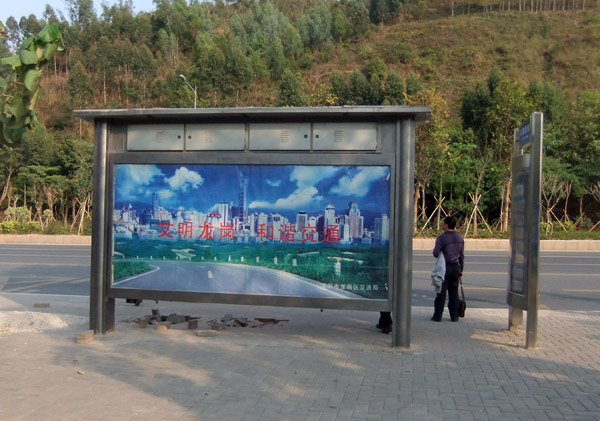
I have gotten somewhat inured to spiritual civilization campaigns like Longgang’s “Civilized Longgang, Harmonious Traffic” (above). After all, the offices have to do something with their budget and I actually support calls for more and better observation of traffic regulations, as well as teaching children to wait for others to get off a bus before charging on. However, this weekend YQ informed me that Shenzhen’s various Spiritual Civilization Bureaus (usually a division of the Ministry of Propaganda  精神文明办公室) have been asked to produce documentaries on “the happiest person I know (我身边最幸福的人)”. Nanshan is filming him because “we want to teach Shenzhen people that there’s more to life than making money.” Apparently, I was not selected because “foreigners do whatever they want, so there’s no educational value in [my] life.” — hee!

cultural homogenization in shenzhen. and not.

Most discussions of Shenzhen emphasize that as an immigrant city, Shenzhen is a Mandarin speaking outpost of national culture in the midst of Guangdong Province. However, this description glosses over the historical division of Baoan County into Cantonese and Hakka cultural areas, and how urban development focused on the SEZ (rather than the entire Municipality).

The establishment of Baoan and Longgang Districts in 1992 institutionalized these historic divisions, with a Cantonese cultural-linguistic area (Baoan District) and a Hakka cultural-linguistic area (Longgang District). At the same time, the traditional SEZ (bounded by the second line) formed the core of Mandarin national culture in the city.

Thinking about Shenzhen as a tri-cultural city enables understanding of how cultural homogenization does and does not take place. Today, I’m thinking specifically about the creation of a recognizably “rural” local identity versus an “urbane” Shenzhen identity. In the area surrounding the Universiade Village, for example, these various trends are most visible in ongoing construction and demolition projects.

Construction wise, the planned Universiade Village boasts beautiful, glass stadiums and swimming areas, which reflect urbane aesthetics. Indeed, the nearby 5-star hotels and upscale residential areas lump Shenzheners (the Mandarin nationals) with cutting edge international taste and consumption. This aesthetics contradicts that of the mid-90s generation of handshake buildings that constitute much of the Longcheng Street residential area. Architecturally, it all seems a straight-forward contradiction between rural and urbane Shenzhen, which in turn is often misread as a contradiction between Cantonese and Mandarin spheres.

In fact, walking through a small Hakka Village, like Dawei indicates how recent handshake buildings as an architectural sign of the rural are in Shenzhen. In Dawei, the handshake buildings have been built into and on top of a traditional, small Hakka compound (similar to the one in Sungang). In other words, handshake buildings create a common “rural” or “Baoan local” identity for (once culturally and linguistically distinct) Cantonese and Hakka villages only in contradistinction to a Mandarin identity.

Visual evidence in slideshow, below.

This slideshow requires JavaScript.

street life

From a walk through one of Shenzhen’s older areas, Hubei New Village and slightly north of Dongmen.

This slideshow requires JavaScript.


conversation


Shen Kong wholesale flower market

Located in Xili, the Shen Kong Wholesale Flower Market provides wonderful plants and hosts the annual Shenzhen Spring Festival Flower Arranging Competition. Nevertheless, the market is so far off the beaten track that rentals are cheap cheap cheap, which means that several artists have rented space for workshops, while several families have moved into the large spaces. And yet. The extensive market is a strangely empty,as if waiting for the rush of development. Pictures from my wanders today.

This slideshow requires JavaScript.

Woody Watson’s forty years on the other side of the border

I’ve just finished reading James Watson’s piece “Forty Years on the Border: Hong Kong / China” and am struck by the ongoing creation of national culture throughout the area, even before the establishment of the SEZ and concomitant migration deepened this trend. Consider Watson’s description of the Lok Ma Chau Lookout:

Stretched out in front of us is a meandering, muddy creek that constitutes the border, or what the British called “the Frontier.” On the south side, in the British zone, is a set of three, steel-link fences, topped with barbed wire. One hundred yards back from the fence are gun emplacements for Gurkha troops. Land Rovers filled with Scots Guards and the Black Watch drive by, along single-lane roads. British regiments are in full battle garb; weapons are on loaded and ready. Continue reading

shenzhen administrative structure

I’ve been making charts to organize my thinking. Below is an organizational chart of Shenzhen, circa 2010.

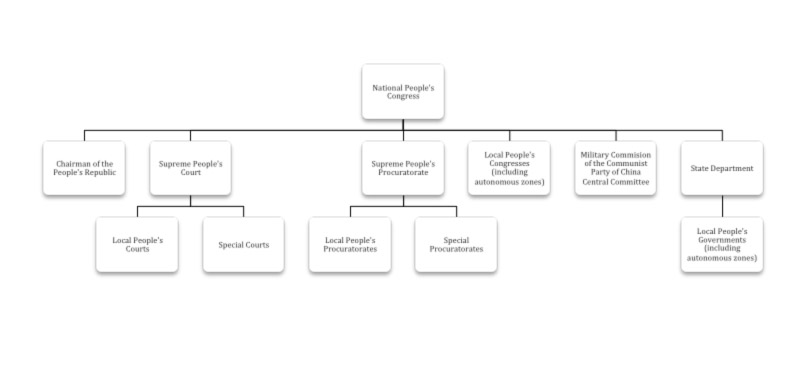
Also, a simplified version of the organizational relationship between the Central government and local governments. Guangdong is the provincial local; Shenzhen is a sub-provincial city, however, as an SEZ, Shenzhen has all sorts of legal privileges that provinces and direct cities do not.