

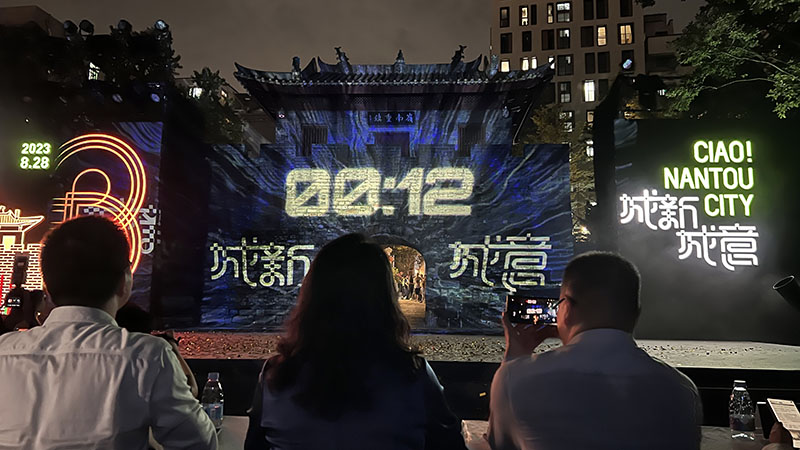

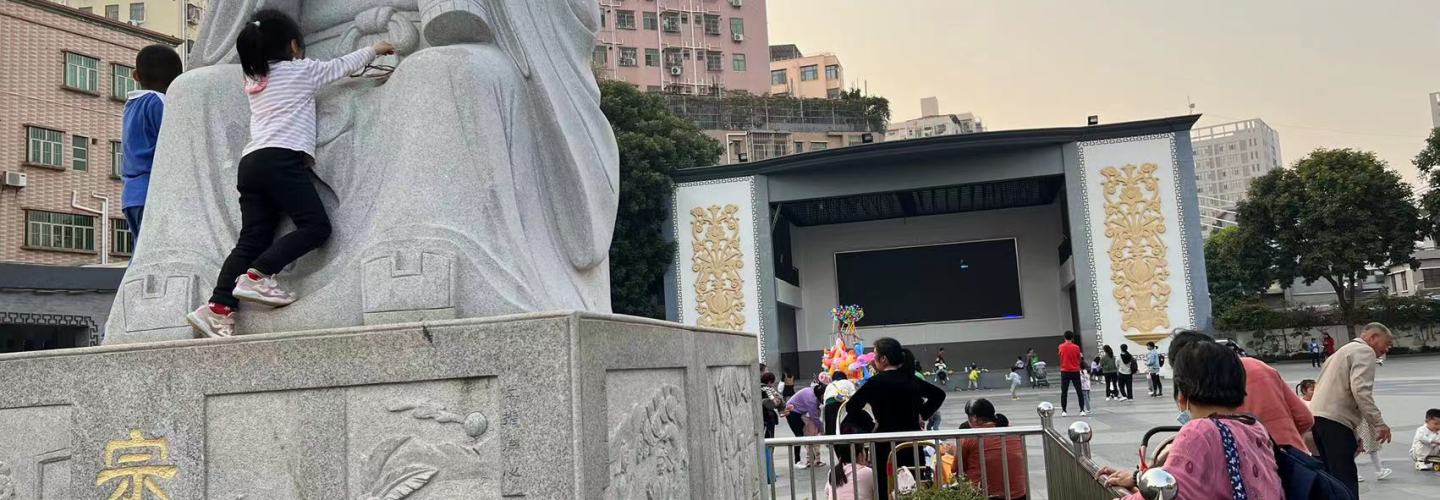
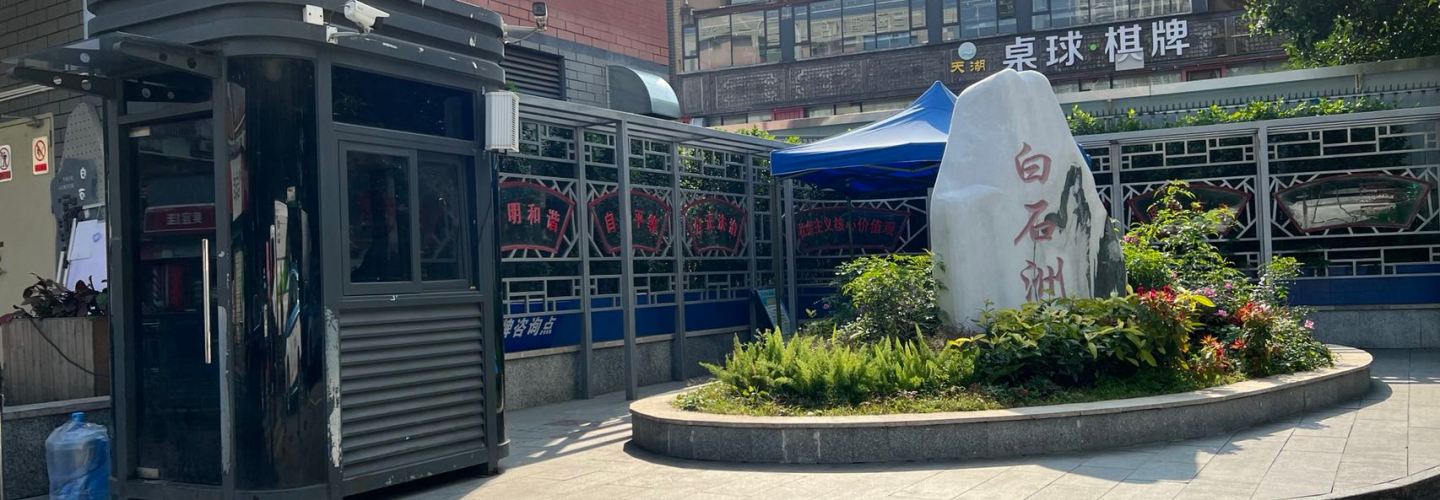

I’ve learned a new expression, face engineering projects (面子工程), which I understand to mean large scale social mobilization that is just for show and will vanish with the project’s intended audience. Continue reading
Roadside witness
Mud-splattered irises, temporary shrines, cracked toilets, and tightly held rows of imported topiary churn up and turn over at constructions’ edge. At dusk, the laws of science and the mind loom inevitable, rather than take their place among other hypotheses about how and what a modern world might be. So yes. Entropy and Freud – we bury the rubble of once coherent stories to reclaim Houhai waters. And yet. Here was once a mangrove boundary. A path to the docks. A boat to the oyster beds. Another world.
manhole covers
For several years, I have been taking pictures of manhole covers because they suggest how decentralized Shenzhen planning and development were back in the day. One of the “five connections and one leveling” or “seven connections and one leveling” was setting up a sewage system and so many early sewage connections were made by developers, rather than the city. Below, a sampling of manhole covers, ranging from village level through enterprise and district areas to the city itself.
Japan Talk
Yesterday at lunch, a friend from Hong Kong talked about the influx of Japanese and how there was now speculation about how the local housing market would be impacted. This led to speculation that soon Shenzhen might also see Japanese home buyers. Someone then commented that the problem had been caused by arrogance — the Japanese thought a dike would be enough to protect them, when they should have sited the nuclear plants well above the coast. Then partial sentences about Japanese national character and a pause in the conversation, which was broken when someone commented, “The Japanese really are to be pitied.”
My friends are of an age that they were raised to hate Japan. Indeed, a large component of their nationalism has been anti-Japanese. No matter how bad CCP abuses of power have become, nor how strongly they support anti-corruption efforts, nevertheless every National Day, they have celebrated winning the War against Japan and remembered Japanese atrocities in Nanjing. So yesterday was interesting because my friends were actively processing anti-Japanese sentiments along with a strong ethical sense that victims of disasters are to be pitied and helped. Their ethical sense carried the lunch.
Obviously human empathy can be engaged before tragedies of this magnitude occur; my friends had been amazingly sympathetic for Wenchuan earthquake victims, for example. Yet yesterday’s lunch conversation has me wondering about how much tragedy or meditation or ethical training is needed to get each of us out of the complacent antagonisms that define us as individuals or activists or patriots. And as citizens, how do we learn to hold our leaders more accountable for nationalistic hate-speach even when (and yes because) we have come to believe so much of it?
weibo protests Shenzhen police action against migrant workers
Follow-up on last post: there have been weibo posts about Shenzhen’s decision to force 80,000 people out of the city. Of note, the incident has led to Lu Xun spirited condemnations of “Chinese character”. A few translations from the past 1/2 hour:
Shi Shusi‘s summery: 深圳为了确保大运会顺利举办,确定“黑八类”予以驱逐本身是个闹剧,而不少人在俺的博客留言对此政策表示拥护则是个杯具。他们不是神马强势阶层,仅仅有幸没被列入驱逐黑名单——类似阿Q面对更弱的小D,肆意欺凌,没有任何慈悲和怜悯。这证明深圳此举是有一定群众基础的,这有些令人绝望。
In order to insure safety at the Universiade, determining “a playoff list” to determine who is banished is a farce, and many people posted that those upholding the policy were in a bad play [sic]. The ones upholding the policy aren’t the advantaged, but rather the lucky ones who didn’t get black listed — like when A Q faced the even weaker Little D, wantonly humiliating him, without compassion or sympathy. This shows that the policy has a wide base, making some people despair.
-
说明当权者成功的一面。许多人不知不觉中成为阿斗,成为帮凶,到自己也深受其害是才发觉周围已没有人再为自己呐喊了,华夏民族的悲哀。This just goes to show one side of success. Many aren’t aware that they’ve become fools and accomplices until they discover that there is no one around to yell for help when they are in trouble. This is the sadness of Chinese people.
- 文革是外来共产主义与中国传统专制思想杂交怪胎的结晶。当唱红打黑读三字经的新闻在耳朵堆成耳屎的时候,离文革已不远了。The CR was the bastard crystalization of foreign communism and traditional Chinese thinking. When news about singing red, going after the black [bad guys], and reciting the Three Character Jing have accumulated like wax in our ears, we’re not far from the CR.
- 想到了鲁迅笔下“药”中观看杀人的国民。This reminds me of Lu Xun’s story “Medicine”, when all anyone did was watch the killing.
- 中国人就这么可怜可悲可恨,中国人总是活在自己的小圈子里与家庭里,既没有博爱也没有良好人格的个人主义。公交车上的扒手任意扒,没有人放个屁,反正没有扒自己的,没有被偷的还暗暗庆幸自已的运气。Chinese people are just this pathetic, tragic and hateful. Chinese people always live in their little circle and homes, and thus don’t have universal love or a good sense of individualism. On buses, pickpockets take whatever they want and nobody even farts, as long as nobody touches my things, then those who haven’t been pickpocketed quietly congratulate themselves on their good fortune.
-
抵制大运会,还屁民以尊严。Boycott the Universiade, where’s our fucking national pride.
cleaning up Shenzhen: were there more than 80,000 dangerous people in the city?
The published facts demand interpretation:
According to reports, as of April 6 in the “One Hundred Days Movement”, municipal police have gone out 284,000 times; they have made over 330,000 inspections of rental housing, 32,000 inspections of internet bars, 60,000 inspections of tourist agencies, 20,000 inspections of clubs, and 40,000 inspections of other spaces. As a result, over 2,300 landlords have been penalized [for infractions] and over 1,180 illegal internet bars, travel agencies, and other spaces have been closed, effectively cleansing areas that have had difficulty insuring public safety.
据悉,截至4月6日,在“百日行动”中,我市警方共出动警力28.4万人次;检查出租屋33万余间(次)、网吧3.2万余家(次)、旅业6万余家(次)、休闲娱乐场所约2万家(次)、其他场所4万余家(次);处罚出租屋主2300余人,停业整顿、取缔黑网吧、旅业及其他场所1180余家,有效净化了社会治安难点地区。 Continue reading
why up?
Post pieced together out of memories of an article I once read, a conversation I once had, and a before and after moment walking past the Shanghai Hotel this afternoon. In reverse order, before (2005) and after (2011) moment, below.
The conversation was with several real estate brokers that everyone in Shenzhen wanted to live on the highest floor possible, that’s why developers kept building skyscrapers.The article was about Mumbai as an exemplar of a postmodern city; in conditions of high population density (as in Shenzhen), social stratification is realized by going up, rather than through segregation (as in less populated cities with neighborhoods). Thus, in cities like Shenzhen, street level tends to be a mix of everyone, chaotic (乱) as many often complain, while lives get increasingly rarified the higher one goes.
So if a desire to realize social prestige by moving into the penthouse is not only driving real estate prices, but also driving constant reconstruction of the city, is there any limit other than Babel? Or do we just keep ascending until it all falls down?
(The observant will also notice in just six years how the smog has increased. The Saige Building is actually over a block away from the Shanghai Hotel. The new Rainbow building is going up in that block.)
baishizhou
Sunday afternoon in Baishizhou – sunlight, children playing, and fresh markets.
getting ready for the universiade
Landscaping at the Spring Cocoon is moving forward as Shenzhen gears up to great the world. Today, I was given a neon green sticker that says “Start Here”, which Nanshan Second Foreign Language School students were distributing. I offer seven photos to give a sense of before and after changes at that particular corner, right in front of the Kempinski Hotel and next to the school. #1 The entrance to the stadium, that mascot string of bubbles, which sometimes have faces and speak in cartoons; #2 that corner in June 2003 and then #3 in April 2011; #4 the old coastline at that corner, June 2003 and then #5 in April 2011; #6 a picture of the area taken from Binhai road, looking northwest, and; #7 topiary details.
吃一堑长一智 – lessons from being robbed
Yesterday, while waiting for my rice to be weighed at the Coastal City Jusco, my purse was robbed. The thief made off with cash, a camera, my keys, bankcard, and Shenzhen metro pass. Unexpected and disquieting. What did I learn?
First of all, I learned the proverb, 吃一堑长一智 (chī yī qiàn zhǎng yī zhì), which literally means in taking a moat, you gain knowledge. A bit of wisdom a la trench warfare, where for the military to take a city, they lost a lot crossing the moat. It seems to be used, however, in the way I might say “live and learn” or Oscar Wilde once said, “Experience is the name we give to our mistakes”. Continue reading
 Shenzhen Noted