lecture notes – SCUT

Yesterday, I participated in a Biennale event at 华南理工大学 (South China University of Technology campus slideshow, below).  The event was organized into three sections: SZHK Biennale 2011 Main Venue; SCUT professors who had participated in SZHK Biennale 2009; and a SZHK Biennale 2011 sub venue event, the Enning Road Transformation Study Group (恩宁路改造学术关注组), an alliance of students and residents to voice concerns about Guangzhou’s plans to raze this historically important part of the city.

This slideshow requires JavaScript.

Now, visiting Guangzhou, especially with Guangzhou people is pleasurable because they love their city. They also love to compare their city to Shenzhen, which is interesting for what it tells us about the different ways we create a sense of belonging to “our” cities. The conversations I had highlighted important differences between the creation of urban identities in Guangdong Province’s two most important cities. Continue reading

naked marriages; stripped at divorce

I’ve recently heard the phrase 羡慕妒忌恨 (envy covet hate) to refer to situations where another is happy in a situation that shouldn’t make her happy. For example, someone with a full-time job might envy-covet-hate a part-time worker who is happy with her situation – free time, low stress job, low pay, few high-priced objects. The point, of course, is that those with “everything” the new economy has to offer – prestigious jobs, upscale homes, and fancy cars – aren’t happy and thus envy-covet-hate someone who feels happy with her life. In Mandarin, this deep sense of satisfaction / contentment / happiness is called 幸福感 and friends are quick to point out, published accounts notwithstanding, Shenzhen has one of the lowest happiness indexes in China. Continue reading

roundtable in guangzhou

For those in Guangzhou, this Weds, Sept 28, I’ll be participating in a biennale roundtable at Huanan Ligong. Please join us:

Time: 6:00-8:35 pm, 28 September 2011

Place: Multimedia Room, Building 27, School of Architecture, Huanan Ligong

时间:2011年9月28日18:00—20:35
地点:华南理工大学建筑学院27号楼一楼多媒体教室

What is an election?

This past week, I learned that I didn’t know how Chinese elections are actually organized, a confessional moment that speaks to the heart of how deeply cultural assumptions construct my understanding of Shenzhen. (Oh yes, reader beware!) I thought that as a citizen of the – land of the free, home of relentless election campaigning even when its not an election year – United States, I knew what it meant when a Chinese newspaper printed pictures of Chinese people voting.

What did I think and how did I learn I was wrong? Continue reading

Historic traces – Xixiang Qilou (骑楼)

Buildings connected with archways, qilou (骑楼) are architectural symbols of Cantonese urban modernity. They first appeared in the early 20th century, when Guangzhou razed its city wall in order to expand streets for commerce and modern forms of transportation, but the style quickly spread throughout the Pearl River Delta. Some say that qilou were a continuation of an indigenous Cantonese architecture style, protecting pedestrians from both the sun and the rain. Others claim that qilou were a Cantonese adaptation of western architectural forms. Nevertheless, what remains clear is that like the Paris arcades or Venetian sotto portico, qilou enabled shopkeepers to display their wares and pedestrians to stroll by and window shop, creating the vibrant street cultures that we associate with these cities.

The former county seat of New Baoan County, Xixiang was one of the first areas outside the Shenzhen second line to urbanize. However, unlike guannei, where urban educated architects and planners designed with an eye to contemporary western forms, Shenzhen villagers designed with an eye to Guangzhou and Hong Kong indigenous urban forms. Consequently, on some of the streets in Xixang it is still possible to stumble upon contemporary adaptations of the qilou. Although, like Guangzhou’s early 20th century qilou, Xixiang’s 1980s qilou will most likely be razed to build air conditioned malls, further privatizing street culture. Nevertheless, glimpses of a few corners from Xixiang street life suggest the variety of possible urban forms.

This slideshow requires JavaScript.

Just FYI, in Dongmen, some qilou have been preserved during the construction of the Dongmen pedestrian commercial area. Also, there are some qilou along the older sections of Nanxin Road, just beyond Nantou, the county seat of Baoan during the Ming, Qing, and Republican eras.

rumors of excess: the shenzhen universiade

I’ve been talking to people about how much Shenzhen spent on the Universiade and the rumors are flying.

According to a report from the Expenditures Department, Shenzhen Municipality budgeted 17.39 亿元 (272 million USD according to my online currency converter), or roughly 36.4% of the 2010 expenditure budget. In 2011, there were two adjustments to the budget, bringing the official total spent on the universiade to 29.15 亿元 (457 million USD). So yes, I’m trying to imagine the “difficulties” that the center overcame to insure the smooth opening of the Universiade (克服各种困难,助力大运顺利召开), after which there were no more universiade expenditures. So how much is roughly 457 million USD? One answer is, Shenzhen spent 92% of the first quarter total trade between China and Cambodia (498 million USD) on a collegiate sporting event.

But it’s unclear what this money was actually spent on and whether or not, for example, they include infrastructure upgrades or just money spent on flower arrangements and strategically placed sculptures. Continue reading

nasa flicks, again

Several years ago, I posted a link to the nasa animation of land reclamation in houhai, one of my obsessions. I repost because the flick rewards – in that i can’t stop watching – repeat viewings. I’m also hoping that at some point the movie will be updated to include the past ten years. Also of note, G Burak and Karen C Seto (2008) have analyzed the environmental effects of urbanization, using Shenzhen as their case study. All scary, but unfortunately not unique. Shenzhen is merely a useful baseline for evaluating urbanization as a geological process because thirty years ago the area had not been industrialized. To see how New York has remade the world, for example, we close our eyes and imagine Mannahatta.

imported greenspace, clear skies, and sun

clear skies have returned and shenzhen shimmers, entices actually. when the horizon opens, walking settles the heart and has me thinking that we need sustainable worlds for no other reason than the joy they bring; smog discourages in all senses of the word.

yesterday, i wandered through some of the universiade greenspace/ coverage to prevent visitors from seeing nearby construction sites and noticed, once again, the extent to which the city and developers have taken to importing foliage to create beautiful spaces. the (malaysian, i believe – if you know please tell me) trees grow here. and yet. bringing this foliage requires uprooting other landscapes, burning fossil fuels, and (in houhai) filling in coastal waters with imported soil. moreover, these high end landscapes do not flourish without extensive care, so that this beauty remains entangled not only in unnecessary, but also unsustainable inequalities.

shenzhen is not the only city importing foliage in order to make a more perfect world. certainly los angeles and las vegas have set the global standard for transplanting eden. and perhaps that’s the point. in our rush to build a perfect world, we fail to realize we’re already there.

This slideshow requires JavaScript.

What is a boomtown?

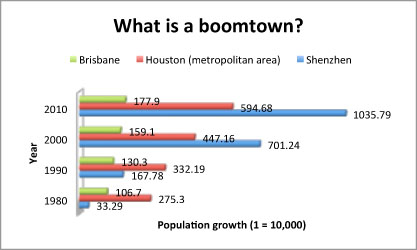
Many readers are no doubt aware that Shenzhen’s sister cities are all (more or less) boomtowns. Two of the most famous are Brisbane, Australia and Houston, Texas. Both Brisbane and Houston, like Shenzhen have seen major demographic changes over the past thirty years, both have also profited from restructuring to the global economy.

To get a sense of the scale of Shenzhen’s population boom, I created the following chart, which compares census statistics from Brisbane, Houston and Shenzhen from 1980 through 2010.

What this simple chart clarifies is the extent to which we (westerners) need to reconceptualize “booms” in order to think about the kinds of demographic, social, and political change that is happening not only in Shenzhen, but throughout China. In a smaller nutshell than even an excell chart, what we see is that Shenzhen blew past Brisbane in 10 years and then past Houston in under 20. Final tally: Brisbane – 1,779,000; Houston (metropolitan area) – 5,946,800, and; Shenzhen – 10,357,900 (plus undocumented inhabitants), begging the question: how do we, who share the planet and this worldwide political economic system talk about and across disparate experiences of urbanization without giving over to either Chinese exceptionalism (as in, that’s just China) or ethnocentrism (as in, why is China acting like us?)

And yes, for practical purposes I’m still using 1 = 10,000 to count.

exhibitionism

Yesterday, I went to the OCAT Contemporary Art Space opening, 小运动:当代艺术中的自我实践(Little Movements: Self Practice in Contemporary Art). I saw many friends and we chatted about what we are doing. Yes, this is the point: the Little Movements exhibition formally presents videos, writings, and photos of artists talking about being artists. And at this level, I like the idea of examining how we make art through day to day encounters. So, if you are interested in this history, the exhibition is well worth the trip. If, however, you want to know what young Chinese artists are doing, visit He Xiangning, the Art Space’s mother organization to checkout the Fresh Eyes exhibit.