hearing meaning in chinese and english

yesterday, enjoyed a wonderful bbq with friends of friend. the conversation vered here, as it so often does in shenzhen to: how did i learn chinese?  the assumption behind the disbelief that i speak chinese is that it is difficult to learn chinese. i hear the same distancing shock when chinese people are surprised by the facts that i eat with chopsticks, navigate the public transportation system, and successfully bargain for goods.

it is more difficult to go from english to chinese than it is to go from chinese to french or spanish because english shares so much with the romance languages and very little with chinese. when i learned french, for example, it really was just a question of learning how to translate, once i knew the rules, i just needed to practice execution. were there details i din’t get? yes. do i still struggle with proper use of the subjunctive? yes. do i have difficulty navigating all those gendered nouns. yes.

and yet. did i already understand the use of the past tense and the importance of conjugation to making meaning? yes. did i have vague familiarity with french history and culture? yes. did my u.s. humanities education prepare me for themes i would find in french literature and philosophy? again, yes.

at first glance, then it does seem more difficult for an english speaker to learn chinese than it may be to learn french. the structures of english and chinese share little in common. and, given the tendencies of u.s. american education in the 70s and 80s, i was also unfamiliar with chinese history and culture, as well as great themes in literature and philosophy. all this to say, i understand the difficulty that native speakers of either english or chinese encounter when we attempt to crossover that divide.

nevertheless, learning chinese became easier when i realized that we share many linguistic features but not only use them, but also listen for them differently.  Continue reading
cultural tendencies – what does it mean to be lazy?

a few nights ago, i had a conversation with two friends, one old and one new about “resignation” and this has led me to rethink possible translations of 懒 (lan usually translated as lazy), especially within educational contexts.

my friends and i had just had drinks with an old married couple, who clearly still cared for each other and this led to a conversation about resigning oneself to unhappiness in a marriage or working towards one’s own happiness, whether or not this meant going through with a divorce at age 70. i mentioned a common mandarin expression, 懒得离婚 (lande lihun) from chen rong’s eponymous novel about a couple who stay married simply because they’re “too lazy divorce”. however, in context, it’s clear that chen rong is talking about laziness as a form of resignation (as in 无奈 wunai) and not as a form of non-cooperation (as in 不合作 bu hezuo).

this conversation prompted me to think about the different cultural valences of “lazy” in english and “懒” in mandarin because i hear chinese parents and teachers frequently complain that their children and students are “lazy”. as a general rule, i have had three interpretions of statements such as “he’s so lazy , he doesn’t love studying and is greedy to play (他很懒,不爱学习贪玩)”. if said by the parent / teacher of a student with high marks, i take the statement as negative boasting or a warning for the student not to become complacent. if spoken by the parent / teacher of spirited underachiever, i have understood the statement to mean the student needs to start studying and stop goofing off. and third, if spoken by a parent / teacher of clearly bored and unhappy student, i have assumed that the student was engaging in some form of let’s-see-if-you-can-make-me-study / get-good-grades passive resistance. i did not, however, associate laziness with resignation, especially when describing students who aren’t studying. indeed, i have tended to empathize with students who don’t study materials that bore them because i often understand laziness to be a form of self-protection.

so insight du jour, thinking of laziness in terms of resignation offers a fourth interpretation about what chinese teachers and parents might mean when they tell me a child / student is lazy. it is possible to think of statements about student laziness in terms of parental / teacher anxieties that a student is resigned to doing badly in school, indifferent to or perhaps unmoved by academic advancement, which in turn easily feeds anxieties about not getting into a good college, which in turn is thought to lead to a bad job (in the best case) or unemployment, which would prevent a happy marriage . . . and so yes, i suddenly see why it might be nerve-wracking to have a “lazy” child / student. i remain skeptical, however, about where the lines between over-achieving, doing one’s best, not trying, and opting out get drawn and more importantly, how parents and teachers recognize these different students responses to school.

p.s. my friend, a teacher has just read this post and commented that as an elementary school teacher in nyc, laziness distresses her as well because through their laziness, students learn that it is okay not to strive.

in nyc this summer

i am in nyc for the summer and will be blogging about stories i hear about shenzhen, here. i’m curious about the pattern and frequency of knowledge about / experience of shenzhen because globalization seems to me a question of uncanny immanence. we think tend to think that globalization is obvious – a korean zen center in the lower east side or a parc guell in yantian district, but then, suddenly, during the circle talk, i learned that a teacher’s brother is based in hong kong four months of the year and yes, spends time in shenzhen. there, in the lower east side, among all that obvious globalization hovered immanent connections and spectral possibility.

and a housekeeping note, which follows from being in nyc and the joy of being able to blog without a proxy and concommitant time lags. i am playing around with blog format. hopefully, by the end of the summer, i will have a new look and more integrated tag system / virtual filing system. then i can return to shenzhen and subverse posting. unless, wordpress is unblocked…

what’s the point of college?

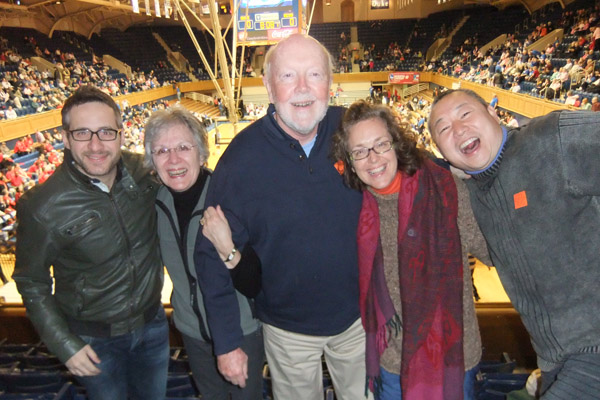
last night, went to cameron indoor stadium to watch the lady blue devils defeat the nc state wolfpack. well, we watched the first half and then returned home. mascot basketball at halftime was a bit much, even for my father who was thrilled to be there because (rumor has it) cameron is a shrine of sorts. certainly, yang qian found the pageantry fun. in contrast, nico (by way of italy) was somewhat nonplussed: how is such a display possible? he seemed to wonder and this was only a women’s game?! yes, those were students camping outside the stadium to purchase tickets for men’s home games, which do sellout. every time. i mentioned that in “utopian verses” wang anyi described her sense of alienation and acute loneliness when attending a university of iowa football game. nico nodded wisely, but remained silent.

watching a duke basketball game with two non-americans made me viscerally aware of the distance between the cultural meaning of “preparing for college” in the u.s. and china. Continue reading

thinking food: images from the houhai overpass, 2002-2010

this post is a brief contextualiztion of  china lab’s  landgrab city exhibition for the shenzhen-hong kong biennale 2009. the exhibit draws attention to the the ways that cities are imagined without reference to the countryside and food production. it also usefully brings china into international conversations about urbanization.

The countryside is a vital but frequently overlooked category in the contemporary discourse around spatial policy, and its role with respect to the future of urbanism is more often than not neglected. Landgrab City is an attempt to visually represent the broader spatial identity of the 21st century metropolis; it proposes a new spatial definition of the city and thereby a more complex understanding of urbanism, one that no longer considers city limits as the boundary of its remit, but instead looks beyond – even across international borders – to the spatial, social, economic and political implications of the planet’s rapid urbanization.

i support efforts to think about food – its production, distribution, unequal consumption – are all critical to how shenzhen is imagined, experienced, and reproduced. nevertheless, this exhibition disturbs me because it discusses shenzhen as if the city were one wealthy enclave, rather than an amalgamation of enclaves -rich, poor, and destitute, which abut and constantly disrupt one another.

shenzhen has sold itself and reform in precisely the terms that china lab uses to describe the city’s “reality”. unfortunately, by taking shenzhen’s self-promotion as fact, rather than promotional fantasy, china lab overlooks  how rural migrants inhabit and  transform shenzhen. this silence distresses me because the spatial, social, economic, and political consequences of shenzhen’s modernization are not implied; they are facts of life for many migrants.

so a very simple point:

In reality, of course, these agricultural territories are not actually clustered around Shenzhen, as in the installation, but scattered across China and contiguous regions.

counter point: a five minute walk from the land grab project, agrarian squatters have persistantly grabbed, evacuated, and reoccupied  a portion of the houhai land reclamation area to grow food, which they eat and sell. the differences between overpass then and now are now are instructive because they illustrate both the persistance of shenzhen’s rural poor as well as their increasing destitution.

the map below locates the land grab project with respect to several generations of agricultural squatters at the houhai overpass.  pictures of the squatters and their gardens, here.

the houhai overpass is located at the intersection of houhai and binhai roads. in the map, the squatter areas are located in the southeast quadrant of the intersection, coastal city in the southwest, and the land grab in the northwest. these areas are roughly a five minute walk from each other. in the map, the blue areas used to be underwater; the brown areas were not.

food-scape updates, closure

Closure on the foodscape project. Last Wedensday, Sept 16, 19:30 at the Hong Kong Arts Centre, mccmcreations hosted a book launch for foodscape, the book. The book is on sale at the Bookshop of said Arts Centre. Please stop by, puruse, and buy a book!

Also, Milan Buttner completed Inter-view, his 30-minute exploration of inter-cultural exchange and multi-lingualism during the project. Click, view, and enjoy!

mar 30 – arrival in switzerland

Have just returned from twelve wonderful days in Switzerland as part of the Food-scape project. While there, Yang Qian, Debby Sou (苏慧琼) and Lo Kwai-cheung (罗贵祥), and I joined Margrit Manz, Martin Zeller and many other wonderful people to get a taste of Swiss food and culure.

I’m still thinking through what happened. This is one of the upside/downside effects of my life in Shenzhen. I seem able to think about experiences in Shenzhen faster than I am able to think through my experience elsewhere. However, I am not alone in thinking about the exchange. A teaser from Milan Buttner’s Interview gives a sense of the inspirations of and from the project.

Prosthetic Cosmologies Sitka Gifting

The gifting chart for “Prosthetic Cosmologies – Sitka” is now online. Please visit and follow the ebb and flow of story-making.

Prosthetic Cosmologies gallery up

the-invitation2This is the first panel in the image poem “Your Presence is Requested” from Prosthetic Cosmologies. My artist statement follows.

My work aims to make visible the shared processes – cultural, environmental, political, and economic – that define daily life in both the People’s Republic of China and the United States of America. I believe that any person, any organism, any word, indeed, any object, connects us in transformative dependency and as yet unrecognized possibility. I proceed in the faith that respectful seeing reveals the structure of interconnection and new forms of hope. I compose images that testify to the poetic beauty of this complexity.


While at the Sitka Center for Art and Ecology, I added ten panels to an ongoing series of image-poems entitled Prosthetic Cosmologies, which chronicles the globalizing myths that situate Shenzhen across diverse levels of historical experience. The formal structure of each image-poem combines genre conventions from classical Chinese poetry, anthropological theories about the human quest for meaning, and photographic images from Shenzhen and elsewhere. I used my time at Sitka both to reflect on the mythmaking that emerges in delta cultures and to track those myths along the Oregon Coast.

Continue reading

images from sitka


path leading to Salmon River Estuary

As promised, images of Sitka and the surrounding environs. Myths take root here.