人才公园: the new new coastline

Several days ago, I walked from Coastal City (海岸城) to Shenzhen Talent Park (深圳人才公园). Previous walks–now long ago and far away, and besides that was a different city–had me wandering the reclaimed land behind Coastal City. However, the new coastline is as firmly in place as anything on shifting sands. What’s more, its a popular destination for families and this popularity deserves comment. After all, people are walking from the old new coastline (at roughly Houhaibin Road) to its newest coastline, a walk that takes at least fifteen minutes one way. Below are images that give a sense of the layout of the new park. In the maps, the purple line is Houhaibin Road, the approximate old new coastline. Continue reading

SZ8X80104//The_Myriad_Transformations//Cut and Pastiche: Emplacements

When I first came to Shenzhen in 1995, the idea was to find a group of people who were willing to be interviewed, fill spiral notebooks with handwritten notes, and return to Rice to write-up said notes in 1996, or at the very latest, 1997 and then writing my way into an academic position. That didn’t happen. Instead, I stayed in Shenzhen until 1998, finished the dissertation in 1999, held a post-doc for one year, and then began the transition from trying to secure a tenure-track offer at a US university to figuring out what an American ex-pat might do in Shenzhen, which was itself transitioning from being a manufacturing hub into an innovation city.  Continue reading

first week of ethnographic “field camp” in heshun

The first week in ancient Heshun (腾冲市和顺古镇) was a rush to the senses. Clean air and clear skies set off renovated homes and fields of rape flowers, while at night it was possible to count stars. We ate bean porridge seasoned with local chili sauce and stood in line to eat  bean cake rolls, and as we left the restaurant we brushed our hands against the cool surface of volcanic stone. Although roads now thread through protected forest areas, nevertheless tourism has transformed Heshun’s “scenic area,” which costs 55 yuan to visit. The ticket includes entry to the town’s main historic attractions. Consequently, “scenic” Heshun is as modern as anywhere else in China: within its narrow allies, tourists navigate a smorgasbord of imported goods and plastic containers, fluffy kittens and easy-going golden retrievers, as well as stores selling luxury items such as Myanmar jade, “southern red” jade, silver jewelry, and local ceramics.

This slideshow requires JavaScript.

Continue reading

SZ8X80102//The_Myriad_Transformations//Cut and Pastiche: Of Global Bullies and Their Girlfriends

In 2006, I visited Dafen Oil Painting Village for the first time. This was several years before Dafen became an important landmark–both in and outside China–in the Shenzhen imaginary. This was also over a decade before the metro system connected Dafen to downtown. In fact, even the road signs reflected the segregation between “Shenzhen” and the rest of the city. Consequently, the first time I visited Dafen I experienced it as a typical urban village that produced an atypical product.

100_0698

In 2006, this road sign outside the main entrance to Dafen Oil Painting Village still gave directions to four market towns–Bantian, Longhua, Shiyan, and Longgang–as well as to “Shenzhen,” which referred to the Luohu “Downtown” area.

This slideshow requires JavaScript.

Continue reading

…and what happens to people after they leave shenzhen and return home?

Heshun is a township located in Tengchong, which these past few years has been heavily promoted by the Yunnan Tourist industry. Heshun is indeed a fun place to stop off and explore for a day or two. In addition to enjoying great local food, jade, hot springs, and Bai ethnicity architecture, tourists can learn about the role of Han Chinese in the history of Southeast Asia, including Vietnam, Laos, Cambodia, Thailand, Myanmar, and the mainland territory of Malaysia. In Heshun, specifically, Han families tell multiple stories of cross-border family ties with settlements in Myanmar. In fact, in the Cun Ancestral Hall, the jeweled portraits of important ancestors were produced in Myanmar, while last year the wood for renovating the ancestral hall was imported from Myanmar. According to the tour guide, the wood cost over 5 million rmb.

This slideshow requires JavaScript.

Continue reading

SZ8X8//The_Myriad_Transformations

The Myriad Transformations comprises sixty-four images that I created using photographs taken between 2002 and 2010. These dates are arbitrary but not random, marking the purchase of my first digital camera (August 2002) and the decision to my rudimentary photoshop skills to create a project to commemorate the thirtieth anniversary of the establishment of the Shenzhen Special Economic Zone (during an artist residency at the Sitka Center for Art and Ecology, December 2008-January 2009). I finished the images in 2010. In the process of saving and transferring these files to smaller drives with larger storage capacity, many of the original photoshop files were lost. What remains as a complete set are the files I created to print photographs of the images in 2011 or 2012. I reopened one of these files in January 2019 and  realized they were more interesting in retrospect than they had been when I made them precisely because over the past decade (2010-2020), Shenzhen has re-invented itself yet again, and suddenly, abruptly, we see the latent structure of today in images that once upon a time seemed definitive, eternal even. Continue reading

hubei ancient village update

Images of the recently demolished area of New Hubei Village, including Luohu Culture Park, which used to be one of my favorite downtown sites. For those who have following the resistance to the demolition of “Ancient Hubei Village,” the demolitions have incited architects, urban planners, and public intellectuals to submit detailed counterproposals and cultural events to protect the area. These demolitions have risked destroying the older settlement. In the pictures you can see the section of Hubei New Village that is still standing, the blue steel roofs of Hubei ancient village, and and the surrounding skyscrapers of Luohu.

This slideshow requires JavaScript.

This slideshow requires JavaScript.


Rediscovering Shenzhen Market: The Commercial Culture of the Old Special Zone

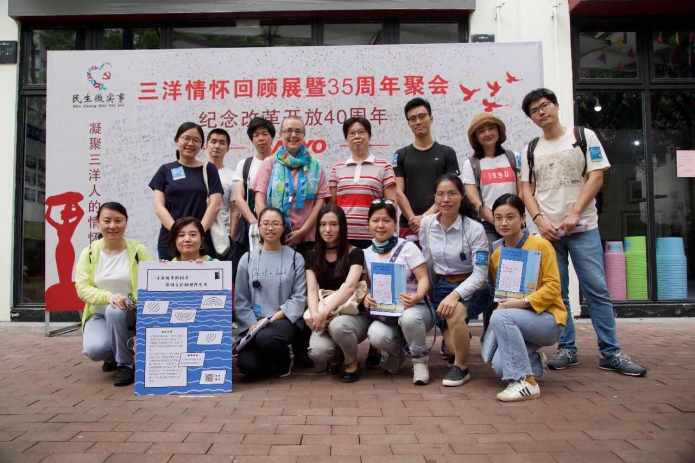
On Saturday November 24, 2018, over twenty people joined Handshake 302 on our rediscovery of  the commercial culture of the “Old Special Zone.” The program began in Hubei, traversed Dongmen and ended in the historic Guomao Revolving Restaurant. Over the course of the day, we discussed how Chaoshan migrants influenced Shenzhen’s “entrepreneurial” cultural geography, the role of the garment industry in Shenzhen’s early industrialization, and the way in which new infrastructure—especially the railroad and the East River waterworks—allowed the city to compensate for its lack of water resources. Continue reading

hubei: bearing witness

So, Hubei Old Village isn’t being demolished, but it’s not being protected from the fallout of master plans and hammer drills. I walked the edges of the demolition area in and around New Hubei Village and the former Luohu Culture Park, which used to be one of my favorite public spaces downtown. Impressions of the withering practices that encroach on the “Old Special Zone, below.”

This slideshow requires JavaScript.

cutting edge: shekou and the construction of the global order

On October 27, Handshake 302 welcomed 15 Shenzhen people to participate in the second chapter of “Urban Flesh and Bones”–Shekou: Globalized Geographies. Our walk traced the original coastline of old Shekou and made several stops in the landfilled gardens of new Shekou. terms, Walking along the coastline of the Old Shekou reminds us that the “local” Shekou is actually composed of important elements such as international connectivity, industrialization, business culture and personal mobility.

5211541198849_.pic Continue reading