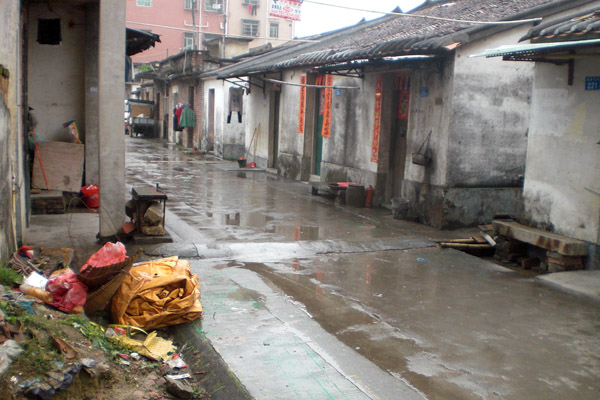
Daban Bridge Road

The other day, Annette Kisling and I walked from Xiangnan Village-Neighborhood to Guantou along Daban Bridge Road (大阪桥路), which once paralleled the coastline, connecting the old Yamen at Nantou to Dongjiaotou, a small cove that geographically marked the entrance to the Shekou Port. The stone bridge went over a small tributary from the inner Pearl River Delta. Today, of course, Daban Bridge Road twists parallel to Qianhai Road and the tributary has been reclaimed. In addition, Nanshan District’s extensive road network has partitioned the villages/ neighborhoods that Daban Bridge Road used to link, creating city blocks. Unfortunately, these blocks to not conform to historic breaks between villages along Daban Bridge Road, but rather enforce a strict traffic grid. Pay attention not only to the diversity within neighborhoods, but also between. Enjoy.

This slideshow requires JavaScript.


Textual Logic: life as gerund

For me calligraphy has been one of the real pleasures of learning Chinese. Indeed, even when I can’t read what I’m seeing, I enjoy trying to following the line and figure out the character. Yesterday morning as part of the Textual Logic (书与法) exhibition at the OCAT Contemporary Art Terminal there was a calligraphy performance by Qiu Zhenzhong (邱振中) and Wang Dongling (王冬龄). So I was kind of “wow, calligraphy onstage. Fun.” However, it turned out that I had approached the event naively; calligraphers may or may not be fun, but the event felt like a cross between a movie star press conference and an art seminar.

The audience for the calligraphy performance was not OCAT’s typical audience who tend to have western aesthetics and a passion for conceptual art. Instead, the audience (not including the calligraphers’ respective entourages) was made up of calligraphers and folks who might be classified as calli-groupies, whose comments ranged from how the room had been set up through how the ink was mixed to how difficult it was or was not to write at this scale for so long. Indeed, it was a happy, almost fair-like event with pauses for watching and then commenting. Needless to say, the audience also complained that photographers and videographers had been given front row positions and could follow the calligrapher.

This slideshow requires JavaScript.

The level of audience participation in the exhibition struck me wonderful.  Continue reading

handshake urbanity — xinqiang community

In 2003, Shenzhen initiated a sanitation beautification project called the “clean, smooth, peaceful project (净畅宁工程)”. The aim of the project was to clean up roads and gutters and trash and beautify public areas, which included razing the shanty communities (棚户区) that once flourished deep in the area’s lychee orchards.

How common were the lychee orchard shanties? Continue reading

(光明新区)楼村: Of what use is [urban] planning?

Located in Guangming New District (光明新区), Lou Village has the largest area of any in Shenzhen and a villager population of 4,000. Of course, it is no longer Lou Village but Lou Village Neighborhood (楼村居委会) and its population is no longer under 5,000 — and therein lies today’s tale.

At the 15th Anniversary of the Establishment of the Shenzhen Special Economic Zone, the second line (二线) still divided Shenzhen into two distinct administrative structures, the SEZ (now called guannei or “inside the gate”) and Baoan and Longgang Districts (now called guanwai or “outside the gate”). The year was 1995 and Baoan and Longgang District governments had been built and staffed, 25 urban markets soon to be precincts (镇 into 街道办事处) had been designated, and consequently the work of incorporating over 200 guanwai villages into the municipal apparatus begun. Economic advancement was an important aspect of political incorporation precisely because 15 years into reform, Shenzhen had discovered that “allowing a few to get rich first (让一部分人先富裕起来)” undermined social stability. Continue reading

in the aftermath of housing reform (房改)

Much of what I know about Shenzhen, I know through hearsay. How much might be confirmed through other sources — people, reports, maps, or books, for example — is a methodological question. Sometimes I can track down confirmation, other times I can’t. What I do know, however, is that most folks are willing to talk about other people’s affairs, even when not willing to disclose anything about themselves. The other day, I heard a story about the Baoping Community compound and here’s how it goes:

Built in the area around the train station and then moving north parallel to the train tracks, the earliest residences for Shenzhen cadres were small, danwei compounds. In 1980ish, the Xili Industry and Trade Enterprise bought land rights from Caiwuwei Village and built a small compound along what became Heping Road, just east of the railway. Xili went out of business and Shenzhen Travel took over the compound. However, Shenzhen began privatizing danwei houses in 1988, a full ten years before the rest of the country. Thus, China Travel employees who had housing in the residential area were able to purchase their benefit housing (福利房) at cost.

Sometime after privatization, the residential compound was renamed, Baoping. Old and small, the residential compound is no longer upscale housing. Instead, most of the homes are shared rentals (合租), in which each bedroom is rented out and then the kitchen, bathroom, and living spaces are shared. Continue reading

hubei old village, dusk

Thursday last, I walked Old Hubei Village with Chen Ting, an architectural graduate student with an interest in the landscape of Shenzhen’s state-owned industries. A walk around the train station and then through the Dongmen pedestrian street brought us across the Dongmen pedestrian overpass to the complex neighborhood where Hubei Villages Old and New abut the Luohu Culture Park, crumbling 80s factories, and 90s high-rises and one of the oldest Shenzhen food-streets eased into dusk. Impressions below:

This slideshow requires JavaScript.

蛇口荔园路 — fraying urban fabric in Old Shekou

A shaded, two-lane boulevard that borders Sihai Park, Liyuan Road (荔园路) retains the intimate spatial layout that characterized Old Shekou urban planning. Indeed, the scale of planning suggests the contours of the utopian society that Yuan Geng and his supporters hoped to build — residential, working, and leisure spaces all within walking distance to each other. Indeed, the architectural differences between management housing, Shuiwan New Village, and nearby factory dormitories were noticeable but not overwhelming because the layout of Liyuan Road, the predominance of concrete construction, and common access to Sihai Park made all residents neighbors.

Over the past few years, as residential and manufacturing plats have been razed and rebuilt, and factories have been repurposed for yuppie consumption, the Liyuan Road neighborhood has become somewhat frayed. 80s residences now function as low-income housing, Shuiwan has been razed for urban renovation, and many upgraded manufacturing spaces have privatized leisure consumption. Indeed, one of the newest China Merchants’ real estate projects, Park Mansion Estates (雍景湾) entices buyers with the promise of “Undisputed Possession of the World” in its advertising. Nevertheless, Liyuan Road still threads through an interesting patchwork of Shekou Old and ever Newer. Images below:

This slideshow requires JavaScript.

old haunts

In the mid-1990s, when Nanshan District launched “Cultural Nanshan” most events were held in or around the Nanshan Cultural-Sports Center (南山文体中心), which included a sculpture museum and the Red Earth Cafe and Bar, where Zero Sun Moon, an early incarnation of Fat Bird first performed. The design and scale of the Cultural-Sports Center reflected early Shenzhen values; it was three stories high, had an outdoor stage for Everybody Happy (大家乐video) events, and small, cultural entrepreneurs rented rooms. I remember walking two-lane boulevards to use the computers at one of those shops, as well as playing go at the weiqi and western chess club.

Located diagonally across the street from the Cultural-Sports Center, the Nanshan Library was finished in time for the Handover and signaled the area’s future designs. Beijing sculptor, Bao Pao collected discarded metal and sutured it together to make the Library’s fence, which still stands. However, the Cultural Center crumbled where it stood until 2009, when Nanshan District approved an 800 million (8亿) budget to build a landmark building on the site. By this time, of course, the Coastal City mall was already open and the abutting Tianli and Poly Center Malls were nearing completion in anticipation of the Universiade. The point is that this area of upscale consumption is now called “the Nanshan Cultural Center” and the Nanshan Cultural Sports Center has been demoted to a bus station even though that’s where all the cultural infrastructure was / is being built.

Below, pictures from a walk around the Nanshan Cultural Sports Center block. Of note, Nanshan District’s neo-Confucian propaganda, the remnants of Old Nanshan, and the neoliberalization of the cityscape, including a high-concept Marriage Registration Bureau Hall and shopping plaza. Also, there will be a diamond market just around the corner.

This slideshow requires JavaScript.

field at hongshuwan

Plastic bags and spent firecrackers accumulate on reclaimed field at the Hongshuwan subway station.

This slideshow requires JavaScript.

On the banks of the Newly Established — Peanuts

Yesterday, enjoyed a lovely walk and conversation with Sara, a young curator visiting from Canada. We took a bus to Fuyong, one of the Baoan precincts which abuts the old Guangshen highway and is now more commonly known as National Highway 107.  Guangshen / 107 is (in)famous for its factories, migrant workers, and more recently container dwellers, which have entered Shenzhen conversation as extreme examples of the SEZ’s cost of housing problems.

This slideshow requires JavaScript.

Sara’s interest in urban gardening brought us into conversation with Aunt Xu, who migrated from Fujian to live with her son in Lixinhu (Establish the New) Estates, a 90s era housing development located next to the Lixin Reservoir. Aunt Xu had come to live with her son and take care of her grandchild. But five or six years ago, the grandchild started school and no longer needed childcare. Aunt Xu abruptly had time on her hands. Uninterested in television programs and full of energy, Aunt Xu decided to cultivate peanuts on the banks of Lixin reservoir.  Continue reading