long ago and far away

The OCT Dongfang Garden villas were built in the 1980s before the age of theme parks and land reclamation. A glance at the relevant OCT real estate webpage indicates how close the villas were built to Shenzhen Bay as well as the basic suburban layout of free standing homes. Over the past decades, the area was forgotten and is in the midst of being re-gentrified by a second generation of homeowners. Nevertheless, the neighborhood still feels abandoned despite being nestled between the Splendid China and Windows of the World. Impressions below.

This slideshow requires JavaScript.

…a village by any other name…

Huaxin Village is not a village. Located at the intersection of Huaqiang and Hongli Roads, Huaxin was one of the earliest residential areas built in Shenzhen. It boasted 30 lowrise apartment buildings, a business office, and an office for neighborhood offices. In total, the neighborhood had 1007 homes. Walking west, the neigborhood abutted Fuhua Village and then opened into the northern section of Shenzhen’s Central Park.

To walk this area is to get a sense of the excitement and utopian discourse that permeated early Shenzhen. Huaxin literally means “China New (华新)”, Fuhua means “Prosperous China (福华)”, and Huaqiang means “China Strong (华强)”. Moreover, in the 1980s, the area north of Hongli Road was considered suburban with respect to the Dongmen and Luohu areas near the train station. Consequently, planning in this area primarily included factories and residential neighborhoods, such as Huaxin.

The layout of Huaxin  illustrates early understandings of public space and semi-public spaces. In addition to a public garden, the residential area also had a soccer field and areas for sitting and chatting. Moreover, along walkways, designers had included planters. When Huaxin housed the young SEZ’s managerial class, the ornamentals filled the planters. Over the past decade, the value of the housing stock has declined, even as property values have increased dramatically leading to a typical “urban village” phenomena: the owners have moved out and rented their homes to working families. In turn, these farmer-migrants have converted the planters to urban vegetable gardens, while first floor homes have been repurposed as shops.

Despite the value of the land, it’s not easy to raze rennovate these old, centrally located neighborhoods because the housing belongs to old Shenzheners, who — again like local villagers — are in negotiation with developers and the city to transfer the property rights. Again, compensation buy-outs are figured by square meter of housing. As early as April 15, 2009 — almost four years ago — there was news that Huaxin would be razed and the area upgraded. By 2011, DZT had published a feasibility study of how to upgrade the area inline with its position next to Shenzhen’s large electronics market, Huaqiangbei.

Of note du jour, in order to make these plans profitable, the new plans cannot include the same amount of space for urban gardening and semi-public gathering. Impressions of yesterdays walk from China Strong through China New past Prosperous China and into the northern section of Central Park, from where skyline views suggest the contours of thirty years of architectural and urban planning.

This slideshow requires JavaScript.

the shenzhen gospel

Swedish missionary, Theodore Hamberg arrived in Hong Kong on March 19, 1846. The following year, he joined what became known as the Basel Mission, focusing on converting Hakka communities to Christianity. Indeed, Hamberg was the first to draft a dictionary of Hakka into a western language. Hamberg died in Hong Kong in 1854, however, his efforts to bring the gospel to Hakka people prospered. Located in Langkou Village, Dalang Street, Bao’an District, Shenzhen — and yes, I do enjoy the dense specificity of Chinese place names — the Langkou Gospel Hall (or Church) was built twenty years after Hamberg first arrived in 1866.

The first pastor of the Langkou Gospel Hall was Charles Piton, who served the congregation from 1866 through 1884. The next few years, there was no foreign pastor at the Church. However, in 1891, the German missionary 骆润滋 (and if you know his Western name, please let me know) came to Langkou from the Hong Kong Mission. That same year, the mission also established the “Devout and Chaste” Girls School (虔贞学校), moving from Hong Kong further inland.

During the Mao era, the church and school buildings were used as schools and administrative centers. In 1984, the central government allowed for religious services and the Langkou Gospel Hall reopened as a church. In 2003, the community broke ground to build a new church on neighboring land. The school building was used until 1986 and then abandoned to squatters until recently, when the Dalang Street government decided to restore the school and church as historic buildings. Presumably construction will begin in several months and early next year, the school and former Gospel Hall will reopen as public cultural centers. The Church will continue its mission, including exhibitions that document the history of Christianity in Guangdong generally, but amongst Hakka communities specifically.

Below, impressions of a visit to pre-restored Devout and Chaste Girls School and Langkou Gospel Hall, which is currently occupied by a migrant worker family, who earn their living doing piecework for a nearby factory.

This slideshow requires JavaScript.

walls and sun

Today I walked the OCT Eastern Group buildings between meetings.

This slideshow requires JavaScript.


the view from the top, circa 1997

The 69th floor observatory of the Diwang Building remains an important tourist destination, albeit something of a time capsule.

The Diwang building was completed in time to celebrate the Return of Hong Kong to Chinese sovereignty. The 69th floor observatory includes a museum that commemorates Shenzhen’s history from 1980 through 1997, a kitchy “Lan Kwai Fang” bar street, and observation maps that date from 1997. The key exhibit is a wax figure installation of Deng Xiaoping and Margaret Thatcher’s iconic 1984 meeting. The installation symbolizes the ideological function of Shenzhen circa 1997 — the buffer zone between Beijing and Hong Kong, which enabled the PRC to push forward its “one country, two systems” policy.

The juxtaposition of Shenzhen then and now resonates precisely because the interior design of the museum hasn’t changed since 1997. In fact, all one has to do is look at one of the maps and compare it to the view from the observation platform to remember that in 1997 Diwang precipitated the city’s glass and steel makeover. Notably absent from the 1997 maps — the civic center, the kk 100 building, and the Binhai Expressway and Northern Loop. Obviously present in the 1997 maps — the extent to which the construction of border town urban villages such as Caiwuwei, Dengba, and Hubei had shaped urban possibility in Shenzhen . Moreover, in the 1997 images, Buji and the second line seem distant, far far away from the booming border region. Nevertheless, villages still show up in the images below — the relatively dark patches are urban villages, including the remains of Caiwuwei after the construction of the KK 100.

Visiting the museum and observatory costs 80 rmb a ticket and if memory serves (because sometimes it doesn’t), fifteen years ago the price of admission was 80 rmb.

This slideshow requires JavaScript.

shangbu

One of Shenzhen’s first administrative zones (管理区) and former commune, Shangbu (上步) disappeared from the Municipality’s administrative nomenclature during the restructuring of 1990. Nevertheless, architectural traces remain, even as the Nanyuan New Village and Badeng New Village handshakes have been creatively upgraded. Shenzhen’s Minority Work Team  is also located in the area, reminding us of the diversity of Shenzhen’d migrant population.

This slideshow requires JavaScript.

the shape of space: buji village #1

In the urban villages around the Old Buji Market (布吉墟), alleys and narrow roads wind upward, accomodating dense settlement and inadvertant public spaces. The most notable feature of the space is the proliferation of walls and determined privatization of small plots, or homesteads (宅基地). The isolating spatial organization of Buji reflects what urban planners disparagingly call “small farmer mentality (小农民意识)”. In practice, this means only investing in one’s own home, and minimal investment in public spaces and programs. Obviously, not only farmers have this mentality.  The Shenzhen Dream entails homeownership, while Tea Party populism represents one version of the US American  urge to privatize land and resources. However, the term “small farmer mentality” is usually a pretext for urban renewal programs that involve razing neighborhoods where the working poor live and replacing them with mall-burban settlements, where only the upper middle class can buy into the dream. Spaces like a Buji urban village  illustrate one of the key conundrums facing not only Shenzhen, but cities everywhere — creating livable neighborhoods for the working poor, rather than leaving urbanization in the hands of privatizing opportunists, whether they be individual farmers or employees of an urban planning board.

This slideshow requires JavaScript.

scale of gentrification, buji

Gentrification in Shenzhen not only means displacing the working poor, but also rescaling the city. In Buji, the process has just begun and thus the palatable violence of this transformation is more visible than it is in the inner districts, where neoliberal environments have a more polished veneer. The images below highlight the extent to which the construction of massive public infrastructure effectively isolates neighborhoods and privileges car-owners.

This slideshow requires JavaScript.
czc entr’acte

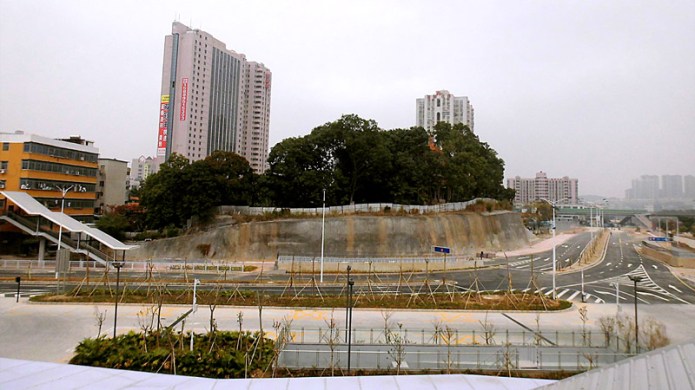
The entr’acte between a thriving urban village and its gentrification into mall-burbia occurs as developers scramble to get the last hold outs to sign compensation packages. To ensure that noone moves into buildings that have already been acquired by the developer, windows and doors are often cemented over and 拆 the character for “raze” is painted in bright red stencil.

In Nanmendun, Buji (布吉南门墩), for example, the entr’acte has been in progress since May 26, 2011, when the Kaisa Group announced that it had begun the renovation project. According to the announcement, 18,879 people lived in 479 buildings (mostly handshakes, but some early 80’s and Mao era dormitories). Of this population, roughly 10% were Nanmendun residents and entitled to relocation and compensation. Roughly two years later, the process of getting holdouts to sign and stragglers to move on is still in progress.

This slideshow requires JavaScript.

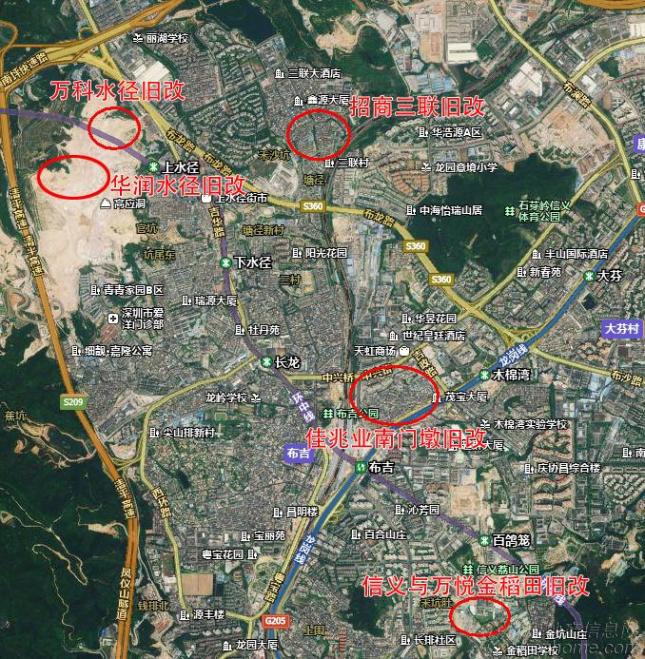
Nanmendun is one of five renovation projects in Buji and the usual suspects — Vanke, China Merchants, Huarun, and Xinyi are also busy gentrifying the area. What the map below makes clear, however, is how extensive rural urbanization has been in Buji. Indeed, it is hard to speak of an “urban village” when handshake buildings and unregulated development have been the dominant form of urbanization for over thirty years.

Lay of the land:

4 renovationsin buji

old trees

It’s true, there’s a category of cultural relic known as “old tree (古树)”. These old trees root the community in histories that stretch back to the late Ming Dynasty (early 1600s). Moreover, their beautiful limbs create poetic interludes throughout the remnants of Shenzhen’s old village homesteads. Buildings may decay through lack of care, but the trees grow despite threat of urban renewal.

This slideshow requires JavaScript.