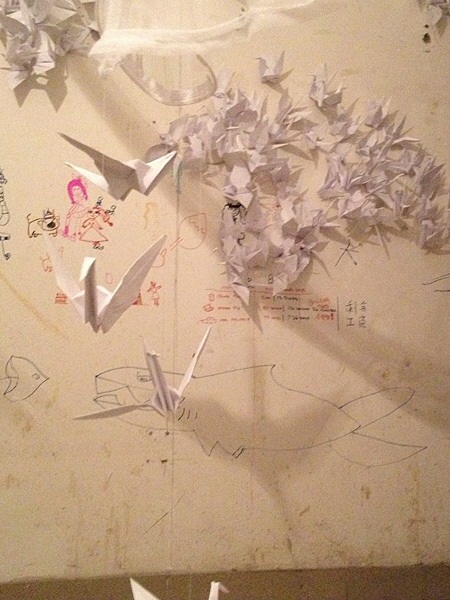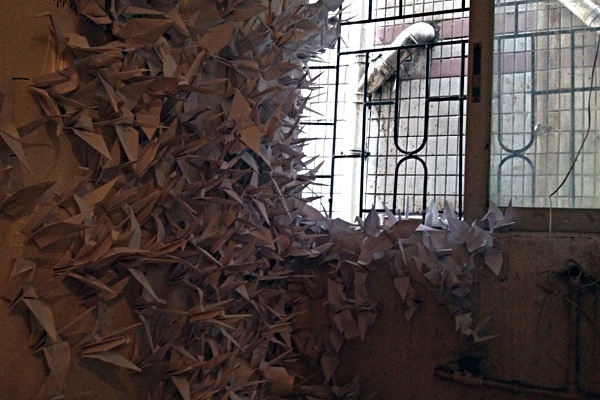
paper cranes

The inspiration for Paper Crane Tea came from Wan Yan, an architecture student by way of the fine arts. Below, her statement on the current installation at Handshake 302:

We’ve probably all heard about paper cranes; if you fold 1,000 they will take flight and help you realize your aspirations. Children believe this story, but for adults it is. Nothing more than a pipe dream. And that transition–from hope to resignation and simultaneously from ignorance to understanding–is the journey of a human heart.

The repetitive task that is folding 1,000 paper cranes symbolizes an important truth about being human. We are constantly repeating some task to achieve some goal; in order to graduate, we memorize and review coursework; to earn a living, we go to work from 9 to 5; to master a new skill, we practice, practice, practice. Each of these repetitions is like folding 1,000 paper cranes–it embodies the hope and determination necessary to realize a particular goal.

In an urban village handshake building, renters come and go, but the spirit that haunts each cramped rental unit remains–the recurring struggle to realize a dream. Indeed, achieving a a goal by diligently repeating he same activities is like folding one’s life in order to realize the crane of freedom. And there is something exuberantly childlike in that image. However, there is no unambiguous desire. In an era of heterogeneous values, different desires and ambitions will create fierce conflicts and mental confusion. Hope can be simple and even pure, but to realize an ambition requires unavoidable complexity and sufficient flexibility.

The first time I came to Handshake 302, in addition to feeling how cramped and narrow it was, I also thought about the repetitive suffering and struggles that every inhabitant would have to undergo in order to move into a “respectable” home. I also thought about how difficult it would be to find oneself (as the expression has it) in that vexed space between desire and it’s realization. But ultimately, each of us must inhabit that mental crucible where relentless economic and social pressure smelt perseverance, inner voices, and anxiety into “me”.

Handshake 302 is our stage, where members of Urban Village Special Forces perform stories of and about Baishizhou and it’s 140,000 residents. For some people, however, Handshake 302 symbolizes he cage they are trying to escape, or the long ago first stop on thei Shenzhen sojourn. In this space, 1,000 folded paper cranes take on new meanings, not only drawing our attention to what it means to be human, but also reminding us that we strive to achieve our humanity in specific contexts.

And photos of the Paper Cranes Fly installation at Handshake 302.

This slideshow requires JavaScript.

blooming contradictions

Unfortunately, more often than not modernization leaves us with street names instead of actual landscape features.

Shenzhen public landscaping, for example, has been defined by its enthusiasm for inaccessible green space that adorn its roads. Throughout the city, there are lovely swathes of topiary and grass that pedestrians (and even birds) can’t actually access except in passing. In part to rectify this problem, but also in response to the city’s white collar residents, a vast network of bike trails have been installed throughout the city. Moreover, these trails have been mapped and the public encouraged to walk and ride through the cities green belts.

Here’s the moment of ecological dissonance: at the same time that functionaries are being encouraged to bike on the weekend, plans have been announced to reclaim 39.7 sq kilometers of Dapeng Bay. The corporate culprit is China Oil, which intends to use the reclaimed land for extracting South China Sea oil reserves. And yes, these plans are moving forward despite the fact that Dapeng New District is an environmental conservation district.

So pictures of the Nanhai (literally “South Ocean”) Road, below and a link to an article about the land reclamation project, here.

What’s in a name, indeed.

This slideshow requires JavaScript.

next to go: huanggang

The plans for renovating Huanggang have been released–just in case you were wondering, “How quickly can Shenzhen remake itself in its own ever shifting image?” That said, Tianmian has also evicted the design companies and is gearing up to raze and renovate its former industrial park. In fact some areas of the city–looking at you OCT–are preparing the fourth generation of urban plan. Below, the maps and images of Huanggang 3.0, urbanized villages vanishing except as real estate companies.

This slideshow requires JavaScript.

de-industrialization with chinese characteristics

This past week I have been in Wuhan, the political, economic, cultural, transportation a land educational center of China. Like it’s US American sister cities Pittsburgh and St Louis, once upon an early industrial time, Wuhan thrived and sparkled and offered developmental opportunities that paradoxically challenged and reinforced coastal hegemonies, in New York and Shanghai, respectively.

Wuhan also faces the challenge of restructuring its heavy industrial economy, even as young people migrate to coastal cities for more contemporary opportunities. In Shenzhen I know many Wuhan people involved in the City’s creative industries. In point of fact, Wuhan has more college students than any other city on the planet, which is to say the city grooms talent that leaves for elsewhere, carrying dreams and solid heartland values in suitcases that fuel coastal growth.

I moseyed around two of Wuhan’s historic areas, one famous the other not so. Hankou boasts colonial architecture and a formerly robust mercantile history. Tanhualin in Wuchang was long ago the site of a Buddhist temple and later the location of Christian missions, including churches, schools and a hospital. Impressions of ongoing historic convergence, below.

This slideshow requires JavaScript.

fuhua south road

Impressions of a walk along Fuhua South Road. This is one of the oldest areas in the city. Of note, the street is busy and vibrant and runs parallel to Shennan Road, which is wide and long and filled with vehicular traffic, but few pedestrians.

This slideshow requires JavaScript.

paper crane tea

Today, we had the first tea at 302. The conversation ranged from why urban villages through the muddled terms–city in village, farmer laborer–of contemporary urbanization to the ubiquity of urban villages throughout China. We also laughed. A lot. Impressions below.

This slideshow requires JavaScript.

garden city

Spring in Shenzhen brings memories of dustier grasses and bluer skies. 18 years ago, I lived next to a construction site, and the low cost local ornamentals and creepers flourished in moderation. We breathed construction dust and navigated street floods (or “accumulated water” as I have learned to say in Mandarin). But the skies, if organic and digitalized memory serve, we’re blue and vast and clear.

Yesterday I ate brunch on the Intercontinental patio and had an afternoon tea-becomes-dinner meeting at 1 Haiguan Rd. Once upon a developmental time, both were located near Shenzhen Bay. When built in 1982, the Intercontinental perched near coastal oyster beds and provided visitors and investors in the OCT and Shahe Industrial Parks with simple accommodations. That same year, there was no restaurant at the top of “Microwave Hill” as the site of 1 Haiguan Rd is known. Instead, it was the site of the first local (difang) broadcast tower in post Mao China. The tower broke through tree cover to send and receive signals from Hong Kong, which was just across the water. It symbolized a new communication independence from Beijing, but not too much independence; the simple two-story border guard tower still stands.

The original Intercontinental has been razed and in its place a 5-star Spaish-themed hotel stands. Outside is a galleon, while inside the male staff wear bull fighter costumes and the restaurant hostesses sashay in modified flamenco dresses. The patio area has imported flora, a black marble pool with multi-color goldfish, and a break in the lush green buffer that opens to a virtual beach area. The coastline, of course, is now pushed back, placed on the southern edge of the Binhe Expressway and the narrow Shenzhen Bay Park, which stretches along the reconstituted coastline. 1 Haiguan Rd is the physical realization of another chapter in the same history, albeit land reclamation-in-progress to accommodate a larger port area and a yacht marina. The interior of the border tower has been fitted with stage lights that create the nostalgic centerpiece of an elaborate and fragrant garden.

I enjoyed both outings. I was with generous and creative friends, with whom I often collaborate. All have helped with 302, and all are interested in contributing to the cultural life of the city. Moreover, they are truly willing to share what they have. It is a joy to be with them.

And yet.

Our friend dropped us off at our late 80s compound of boxy concrete low rises, crumbling compound floor, local plants, and ordinary pavilion with tacky pseudo-imperial glazed tiles. The combined cost of yesterday’s two meals was more than my monthly rent. Sometimes, my increasing sense of distance from ever-growing areas of the city provokes anxiety. Sometimes it hooks into my sadness about the forms of social segregation that are being built into the city. Last night, the contrast made me nostalgic for a dustier, more industrial Shenzhen, when large tracts of undeveloped land were still accessible for exploration and amenable to common dreams.

Photos taken at 1 Haiguan Rd, where the changing Shekou coastline is visible from the third floor gardens.

This slideshow requires JavaScript.

baishizhou: intervention and experience

This weekend (Feb 22-23), two events organized for Shenzhen children focused on Baishizhou. On Saturday, ATU/观筑 held a “Young Architects” program in Venue B of the Biennale. On Sunday, CZC Special Forces and Ya Ya Theatre co-produced “Baishizhou Theme Park”, a 20-minute play that was written, directed, and performed by six of Baishizhou’s youngest residents in Venue A.

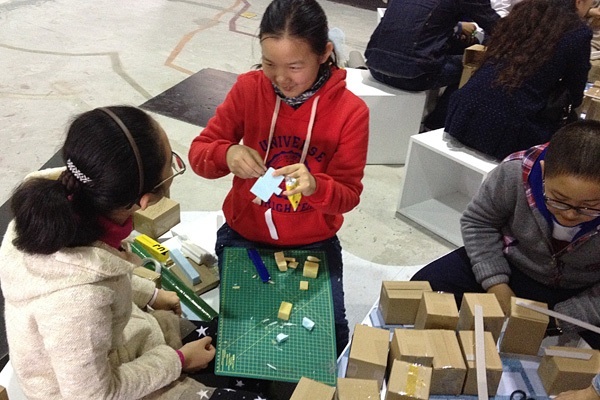
For the past two years, ATU has run the Young Architects program to teach architectural literacy through experience. They have intervened in the Baishizhou Tangtou row houses, building chairs and also built small spaces to spec, for example, a study room for one person that connects to another, but remains private. Saturday’s program was a urban renewal workshop for Baishizhou. Led by architects, Huang Jingjie and Feng Guochuan, six groups of pre- and teenagers took responsibility for one area. The requirements were, the total building area cannot change and improvements must be affordable so that rents will not increase dramatically. Each group had a professional consultant and 90 minutes to rethink urban renovation.

For over four years, Ya Ya Theatre has developed intimate performances that express unique experiences. Earlier in this year’s Biennale they produced a version of “One Person, One Story” in which members performed autobiographical and biographical monologues about a life-changing event. Lora Wang and Chen Lihua ran the two-month workshop that included exploration of Baishizhou and then developing a series of autobiographical vignettes. Sites visited included a dry swimming fountain, the Jiangnan Department Store plaza, and a video arcade.

So, the during the last official weekend of the Biennale, we had two events that developed the theme of the relationship that Shenzhen children have to Baishizhou, and by extension other urbanized villages. This in itself indicates that interest in the urbanized villages is spreading beyond commercial and academic enclaves. Moreover, we also saw community projects that assume urbanized villages as an important component of Shenzhen as an imagined community. This marks an important shift in the public awareness. Previously, urbanized villages existed outside Shenzhen representations of the city. The villages were (and to a large extent remain) glaringly absent from urban plans. Suddenly, the villages have emerged in public discussions about wither urban development and renewal?

These questions were at the heart of the post performance discussion “Learning from the Urban Villages” with Lora, Feng Guochuan and Zeng Guansheng. Audience members were not only interested in where the working class and young migrants would first settle in Shenzhen, but also in questions about the social value of street life and neighbors. This kind of conversation provided a glimpse into a larger, more general search for Shenzhen identity. This new identity reworks the version of high-speed development and red heroes that has been the previously ignored but not challenged vision of who Shenzheners are and what the city might be.

This slideshow requires JavaScript.

crumbling foundations

The first floor sinking, occupied by migrant workers. Above, several condos have been inhabited, but most floors remain empty, unused except as placeholders on accounting sheets. A section of Houhai Bin Road is being reconstructed. The chilly smog undulates.

This slideshow requires JavaScript.

crossroads: staged reading

So, yesterday afternoon we read “Crossroads” onstage at the Mizzou Jesse Wrench Memorial Auditorium. Despite snow days and ice and broken cars, the show went on and Fat Bird had a great time. “Crossroads” is an early play by Yang Qian that looks a the moral confusion and disfunction that have shaped and been shaped by Shenzhen boomtimes. Impressions, below:

This slideshow requires JavaScript.