the modern woman. . . what can’t she do?

more fun with cellphone couplets, this time about the skills of the modern woman:

现代女性“十项全能”:上得了厅堂,下得了厨房;写得了代码,查得出异常;杀得了木马,翻得了围墙;开得起好车,买得起新房;斗得过二奶,打得过流氓。

The Modern Woman’s “Ten abilities”: She can entertain guests and cook up a storm; she can write a computer program and ferret out irregularities; she can kill viral Trojan horses and scamper over the firewall; she can drive a good car and buy a new house; she can take on a second wife and defeat a hooligan.

Generation 70

Shenzhen seems suddenly filled with creative people. In part, this may be the biennale and the cultural business that has been generated. In part, it may also be the upcoming Nanshan Fringe Festival. However, in large part its also due to the fact that generation 70 is now actively making decisions about how they want to live and contribute.

Shenzhen’s current “30-something” group, Generation 70 (70后) is an interesting cohort because they are clearly not residually socialist in the manner of Generation 60 (60后), but neither do they belong to the Rich Second Generation (富二代), even when they are the second generation of their family to live in Shenzhen. Instead, Generation 70 were raised to be respectable members of the middle class, have professional careers, and move China forward in solid, sober fashion. However, after graduating from college, getting that job, and starting their one-child-families, many members of Generation 70 have found themselves bored with the lives that their parents and grandparents and spouses and friends expect them to live.

Started by two members of Generation 70, ATU观筑 exemplifies the creative second career choices that some of Shenzhen’s 30-somethings are making. ATU观筑 is a non-proffit institution that organizes salons, workshops, and public education courses to debate the meaning and direction of urbanization and urbanity in Shenzhen. The directors are 30-something and the creative team is in their mid-20s. They dress fashionably, enjoy art, and want to contribute to a more vibrant society. They speak English, travel abroad, and think of transforming Shenzhen in terms of environmental and progressive values; in short, the folks at ATU观筑, like other creative 30-somethings throughout the city and the country may be the crest of a distinctly modern and Chinese wave of creativity that many – Chinese and foreigners – have been waiting to arrive since Reform and Opening began just over thirty years ago.

yes, we’re grumbling . . . (about recent web closings and what not)

It’s been a while since I’ve translated a text message, but as those at the Center scramble for power and internet access became extremely dodgy three days ago, text messaging has become more a more reliable source of information. Sigh. Indeed, the long text that follows speaks to the dissatisfaction and resignation that often creeps into daily conversations; it certainly hints at the extent to which non-compliance and minor sabotage may characterize administrative and business life throughout Shenzhen, and Shenzhen I’m told, is one of the “easiest” places in China to achieve one’s goals in the public sphere.

中国特色“解决”大观

领导问题靠书记解决,政治问题靠经济解决,外交问题靠呼吁解决,军事问题靠和平解决,党外问题靠党内解决,思考问题靠忽悠解决,道德问题靠运动解决,文化问题靠管制解决,市场问题靠行政解决,亏空问题靠印钞解决,社会问题靠城管解决,面子问题靠盛会解决,建设问题靠强拆解决,生育问题靠计划解决,前途问题靠拼爹解决,致富问题靠中彩解决,医疗问题靠伪劣解决,饮食问题靠掺假解决,办学问题靠排污解决,科技问题靠山寨解决,学术问题靠剽窃解决,明星问题靠上床解决,军衔问题靠唱歌解决,公安问题靠黑道解决,升职问题靠买官解决,反腐问题靠贪官解决,股市问题靠圈钱解决,舆论问题靠封锁解决,疑虑问题靠“我信”解决,和谐问题靠糊弄解决,民意靠对付解决。。。保持联系靠短信解决!

Principles of “resolving the issue” Chinese style

The Secretary resolves leaders’ problems, the economy resolves political problems, appeal [to others] to resolve foreign relations, peace resolves military problems, the Party resolves non-Party problems, scams resolve problems of understanding, political movements resolve moral problems, supervision resolves cultural problems, policy implementation resolves market problems, printing money resolves the debt problem, municipal administration resolves social problems, banquets resolve face problems, forced razing resolves construction problems, planning resolves birth problems, “my father is more important than your father” resolves future problems [qiantu puns “road” and “future direction”], the lottery resolves problems of getting rich, low quality resolves the medical situation, adulteration resolves food and drink problems, discharging waste water resolves education problems, shanzhai production resolves science and technology problems, plagiarism resolves education problems, sleeping together resolves movie star problems, singing songs resolves military rank problems, gangsters resolve public safety problems, buying a political appointment resolves promotion problems, corrupt officials resolve anti-corruption problems, expropriation resolves stock market problems, blocking the internet resolves public opinion problems, “I believe” testimonials resolve doubts, muddying the waters resolves harmonious society problems, weapons of the weak resolve problems of realizing the people’s will. . . and to resolve problems of staying in touch, let’s text!
Jiujie / Nantou / Xin’an Old Town

Years ago, I published becoming hong kong, razing baoan, preserving xin’an, an academic paper on urbanization as the ideology informing the construction of the Shenzhen SEZ. Part of that paper included an analysis of Nanshan District’s decision to create a walking museum at Nantou, the County Seat of Xin’an from the Ming Dynasty until the CCP moved it to Caiwuwei, in Shenzhen Market. The museum didn’t survive into 1998 and Nantou settled back into urban village life – migrant workers renting space in handshake buildings, small scale manufacturing taking place both at home and in low tech factories, and bustling streets of vendors, shops, and open air markets.

Yesterday, I walked Nantou and discovered Universiade traces. The roads that connected the buildings in the walking museum had been paved with grey bricks and the buildings abutting those streets (well all two of them) had been given “traditional” facelifts – a faux grey brick facade and eves. Moreover, the museum buildings have been reopened to the public! So the universiade upgrade of Nantou included Shenzhen’s ongoing push to open small museums in the urban villages.

Here’s the rub: Houses and streets beyond the scope of the museum remain as they were. Also, the gate god, which used to inhabit the old Ming gate to the city has been removed. All that remains of that living tradition are two holes on either side of the gate, where incense has been stuffed in. And yes, that’s an upgraded pedestrian overpass at the entrance to what remains of the walled city. Impressions of revamped and still unvamped Nantou, below.

This slideshow requires JavaScript.

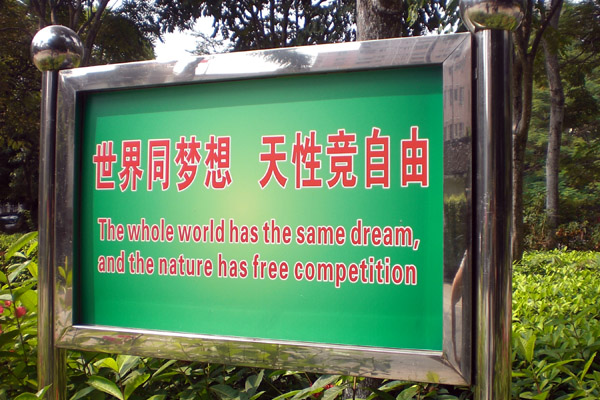
Translation question: 天性竟自由

I’m having difficulty figuring out what this sign actually means. Clearly, the English is off. My sense of the Chinese, however, is to attribute all sorts of neoliberal interpretations to the line 天性竟自由; no matter how I cut it, I come up with a slice of economic pie. Nevertheless, I recognize that there are important nuances even within forms of neoliberal essentialism. Hence my question: How would you translate this sign? Please share translation and rational.

cruising old shekou

Yesterday, a member of Generation 80 took me to the beaches and mountains of Old Shekou, where he played as a child. He remembers swimming off small docks, crabbing on the dike that used separate the Naihai Hotel from the backwash of Delta waters, and biking safely along narrow, dirt roads. Little remains from his childhood. Even the broadcast tower from Broadcast Mountain has been razed and the remaining structures converted to an upscale Cantonese restaurant. Anyway, the area he used to bike, we cruised in his sports car. Impressions, below:

This slideshow requires JavaScript.

RIP – Steve Jobs and neoliberal immortality


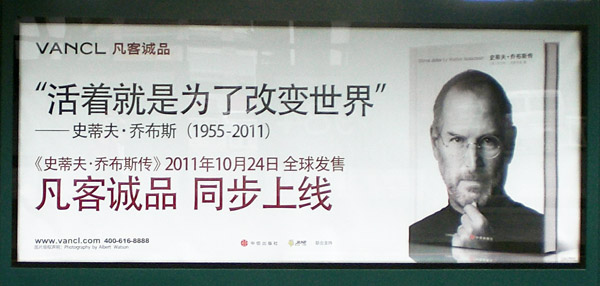
A recent advertisement for VANCL web quotes and shows a book about Steve Jobs. My first reaction was disgust: how is it possible to use someone’s death as a means of pushing goods? However, my random sampling of Chinese friends shows that there is another way of understanding this advertisement – social immortality or 不朽 (buxiu), which means that you continue to influence the world even after you have died. All agree, Steve Jobs achieved buxiu.

According to my friends, who don’t believe in an afterlife but do believe in continuing influence, Jobs achieved buxiu through three forms of social memory: 立功 (establish work),立言 (establish language),立德 (establish morality). 立 means to stand-up or to establish. 功 is a wonderfully rich character that has (at least) five meanings: merit, service, result, achievement, and accomplishment. 言 means language or speech and 德 refers to virtue. In other words, buxiu consists in setting up an institution, being cited, and setting moral standards. Steve Jobs’ accomplishment was to establish Apple, his speeches and citations now circulate on the internet and people learn from them, and his morality was to achieve brand confidence; Apple products are neither counterfeit nor substandard; their virtue as products is guaranteed quality.

Thus described, the kind of buxiu that Jobs has achieved seems classically neoliberal and begs all sorts of questions about how and why we are busy commodifying every aspect of our lives and afterlives. Indeed, we are clearly using economic metaphors to organize how we treat the living and the dead. How else to understand a world where trust can refer to forms of human relationship that have been structured by multi-generational financial arrangements? Consequently, talking about Steve Jobs and VANCL in Shenzhen reminded me of yet another cross-cultural capitalist truth; there’s as much honor and respect attached to VANCL’s use of Steve Jobs to promote online shopping, as there is when his American compatriots link the price of Apple stock to his passing.

productivity PK understanding

I have been having disturbing thoughts about compulsive productivity in the arts and academia, and yes, I know, Marx wrote eloquently about alienation, but it bears repeating: when we become cogs in whatever machine we find ourselves, we loose our humanity – our ability to empathize, to feel joy, to surrender to unhappiness, to accept responsibility for the consequences of our actions even though we cannot control how things will turn out. And that’s the rub: I keep thinking that if we gave ourselves time to ripen, our artistic and intellectual activities would bear rich harvest, rather than simply withering away as we scramble to complete the next assignment. Dust to dust, yes, but in good time.

Specifically, I’ve been wondering about how “accountability” is measured – a book every three years (tenure track jobs) or an artwork at the end of a residency (global AIR programs), and then, I recall that the words themselves show up the economic metaphors that strangle compassionate creativity. Account-able. Measure-able. Profit-able. As if our work was to make count-able objects, rather than to create more fully human lives.

Rant over.

pedestrian overpasses in the news!

If we take mega corridor roads (Binhe, Shennan, and Beihuan) as examples of urban planning in Shenzhen, the answer to the question, “Are we designing cities for people or cities for people with cars?” is “We’re designing the city for people with cars,” a frustrating thought even when I don’t have to use an overpass to cross the street. Nevertheless, Southern City Daily (南方都市报) reporter, Zhao Chongqiang (赵崇强) interviewed me about pedestrian overpasses and urban planning in Shenzhen, giving my favorite hobby horse a public airing, so I’m feeling the love (as my brother might say). Article, here.

how do we judge linguistic competence (in a foreign language)?

Yesterday, I played judge at a foreigners speak Mandarin competition. Contestants were judged on a prepared speech, fluency answering a question, and a performance of some traditional Chinese art. The contestants came from North America, Europe, Korea, and Japan and a variety of ages, ranging from two seven year old twins to folks in their late 40s, possibly early 50s.

What did I learn?

Short answer: Age and home culture matter in questions of linguistic competence in a foreign language. However, a pleasant personality and curiosity about one’s host culture will go a long way to buttressing linguistic incompetence.

Long answer: See short answer, above. Add elaborations, below: Continue reading