I recommend attending friend Debby Sou Vai Keng’s solo exhibition, “Lazy Days at Black Sands,” which opened November 11 and will be up through the 27th. Exhibition at St. Paul’s Fine Art, Macao. Video from the opening, below.
Category Archives: noted
Mulberry Child released!
Based on her eponymous memoir, friend Jennifer Kwong’s independent film, “Mulberry Child” is now complete! Jennifer tells how growing up during the Cultural Revolution shaped her relationship with her American daughter. Check out the trailer and be inspired.
so where did 1.35 million rmb go?
Yesterday, Nanfang Urban Daily (南方都市报) published an article on corruption in the renovation and upgrading of pedestrian overpasses, a topic near and dear to my heart. Reporter Zhao Yanxiong (赵炎雄) paid 300 rmb for a tip on the extent of corruption in repairing and upgrading pedestrian overpasses. The six overpasses in question are in Futian District on the Shenyan Road between the Wutong Tunnel and the Shatoujiao Bonded Area. The Shenzhen Road & Bridge Construction Group Corp got the bid. The gist:
Eastern Area Bureau of Traffic spokesperson, “Every square meter cost 400 yuan, the total price was 1.6 million. The project could not be subcontracted out. We required Shenzhen Road & Bridge to do the job themselves.”
Subcontractor, “The construction costs per square meter were 115 yuan. The total area was 2,300 square meters, bringing the project cost to 250,000 yuan. We were contracted by Female Boss Cao.” Continue reading
1995-2005: Keywords in Shenzhen real estate
Much of Shenzhen’s informal history is, unsurprisingly perhaps, being written on blogs and weibo. However, websites dedicated to real estate, ranging from analysis to agency offerings are not usually considered to be history writing. Nevertheless, these websites provide insite into the negotiation of value as people transform labor and desire into homes and family life. To give a sense of the historical content of these websites as well as how they produce knowledge about the city, I’ve translated a sampling from a real estate purchasing and rental keywords post by 王猴猴.
Just an editorial note: when reading these keywords it is important to hear what has not been said. Policy criticisms and social problems remain implicit in Wang Houhou’s explanations and evaluations. I have thus added a few exegetical notes, which do not exhaust possible interpretations, but rather point to other readings. I encourage readers to add their own interpretations and thereby enrich the keywords.
盘点1995~2005深圳地产十年关键词 Inventory of Shenzhen Real Estate Keywords, 1995-2005 (Wang Houhou)
1995 购房入户 (Buy a house, get Shenzhen hukou) In order to stimulate citizens to purchase homes and also to further economic development in a slow house market, Chinese local governments promulgated real estate development policies and measures. The prime example of these policies came in 1995, when the Shenzhen government approved a measure that allowed anyone who bought a house outside the second line [in Baoan or Longgang District] was eligible for three Shenzhen hukous. [In 1995 Baoan and Longgang were still under rural administration and the Second Line was still enforced. Consequently, this law stimulated building at Second Line checkpoints, notably Buji and Meilin, where people could buy a Shenzhen hukou and still get to work easily.] Continue reading
渔农村: border lives
Connecting the Shenzhen Metro and the Hong Kong KCR, the recently opened Futian Checkpoint has provided incentive for building higher end real estate for those who live in, on and from the Shenzhen-Hong Kong border. The area teems with residential and leisure developments that target variations of Shen Kong lives.
Yunongcun (渔农村) is one of the closest urban villages to the checkpoint; simply exit, turn right, and walk 500 meters or so. The walk from the checkpoint to the village area reveals layers of history, both in the making and the discarding. One sees, for example, a soon to be razed 90s food street and mid 90’s housing, and then buildings from roughly ten years later, including a large spa and even newer shopping mall, as well as the Shenzhen river, which is guarded and sealed off from pedestrians.
What one does not see on this walk is Yunongcun’s important place in Shenzhen’s village renovation movement (旧村改新). Over five years ago on May 22, 2006, the Shenzhen government began the movement with a nod to Shekou’s “first explosion (circa 1979),” by detonating “the first explosion” of the village renovation movement and bringing down fifteen illegal buildings all at once. Villagers had put up these buildings as part of their negotiation for a better settlement package. A kind of holdout, but at a much larger scale than the individual family because the area only became prime real estate with the completion of the checkpoint. Continue reading
Balancing Act: Notes on Translating for Future Relevance
Future Relevance / 明天,谁说了算? opened today. I translated the exhibition catalogue. Below, I’ve uploaded my thoughts (and translation of said thoughts) on the importance of learning to listen across unsaid assumptions, even when we don’t depend on a translator.
In our native languages, we speak with the expectation that we will be understood and if not, that misunderstandings can be easily fixed. Moreover, we often emphasize speaking as the sign of linguistic competence, rather than listening, reading, or writing, or more generally, an ability to navigate shared histories and cultural assumptions, political exigencies and economic conditions; in short, we take for granted all the unspoken social infrastructure that enables communication. Indeed, we are often so oblivious to the contexts of meaningful dialogue that cross-cultural exchanges often degenerate into fumbling searches for the “right word”.
Take for example a simple comparison of cultural associations with the English word, translation and its Mandarin counterpart, fanyi (翻译). Continue reading
意maging baishizhou
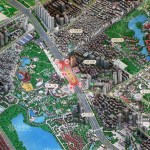
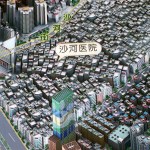
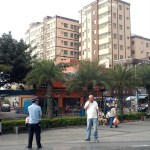
Three pictures of the northeastern corner of Baishizhou along Shennan Road. The map and detail are from a map in the Window of the World subway station, the third is a photo of the actual corner, taken from the plaza in front of 沙河世纪假日广场 (Shahe Century Holiday Plaza), the large landmark in the two maps. The contrast between the map and the territory interests me because it the ongoing (re)imagineering of Baishizhou in particular and Shenzhen more generally.
Baishizhou, as mentioned in earlier posts, is one of Shenzhen’s more “chaotic (乱)” urban villages. However, it occupies prime real estate – directly across from Window of the World and on the Line 1 Subway. Consequently, upgrading Baishizhou is an ongoing project and has included major real estate development. Tellingly, most information about Shahe Century Holiday Plaza real estate (here, here, and here, for example) emphasizes the subway convenience, views of Window of the World, and modern amenities, downplaying and often ignoring the Plaza’s neighbor, Baishizhou.
深圳原住民网 – what interests the locals?
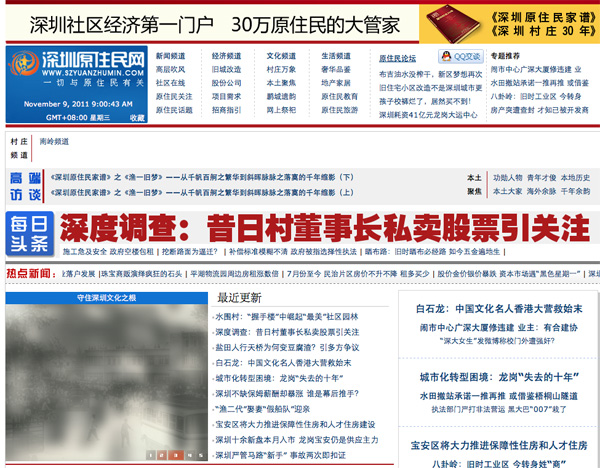
Much has been said about Shenzhen’s urban villages (城中村). Indeed I’ve made something of a career out of talking about rural urbanization and the like. However, I’ve now stumbled upon the 深圳原住民网 (Shenzhen Original Inhabitants’ Web) and it provides all sorts of information about village histories, concerns, and their understanding of what matters in contemporary Shenzhen.
I look forward to translating posts in the future and finding out more about who’s not only running the website, but also brought villagers together under a common title “original inhabitants”. Previously, most villagers represented themselves as from a particular village, rather than having anything in common with original inhabitants from other villages. So, another interesting layer added to the amalgamation that is Shenzhen identity.
That said, I’m wondering how extensively District governments are participating in maintaining and developing content for the website precisely because they are the one’s responsible for implementing old village renovation projects. Indeed, old village renovation projects partner District governments, a village corporation, and a major real estate developer to “modernize” the area in keeping with Shenzhen’s recent efforts to promote its image as a hip, modern, and international city.
Exhibit Opening
Exhibition of 6th OCAT International Art Residency– Future Relevance
“2011深圳•香港城市\建筑双城双年展”外围展
Organizer: OCT Contemporary Art Terminal of He Xiangning Art Museum
Program Manager: Wang Jing
Program Assistants: Marry Ann O’ Donnell (USA),Xu Yuntao
Curator: Paula Orrell (UK )
Artists: Frank Havermans (NL), Nika Oblak & Primoz Novak (SI), Thomas Adebahr (DE)
Opening: 5:00 pm Nov 11, 2011
Dates: Nov 11, 2011 to Jan 8, 2012
Venue: Northeast side of B10, Northern OCT LOFT, Overseas Chinese Town, Nanshan District, Shenzhen
Please join us for the opening!
perfect partnerships
The past few days, I have overheard friends comment that the spouse of a mutual friend isn’t in friend’s league. Admittedly, knocking a friend’s significant other is common enough cross-culturally, so inquiring minds might be wondering why I glommed to these moments of snark. Short answer: because I finally realized something about the social arrangements of family businesses. And yes, the social organization of these relationships seems universally neoliberal, even if (or because?) the evaluations of the roles that different spouses play varies in interesting (and gets read as) cultural difference.
Chinese power couples have an interesting division of social labor; one usually works human relationships and the other usually takes care of business. Continue reading
 Shenzhen Noted