shanghai voices of spring (updated)

Today, two videos are circulating on WeChat, one “四月之声 [April Voices]” is a delicate and relentless compilation of the Shanghai crisis through telephone calls for help that remain unanswered. As one of the voices says, “I’m sorry teacher, there’s nothing I can do.” The second, “2022 上海晚春 [Late Spring in Shanghai, 2022]” is much more direct–scenes of violence put to the nihilistic, “Cheer Up London” by the Slaves. Both videos are worth taking the time to view because although their aesthetics are very different, they make the same, chilling point: Shanghai is violently divided and the party and the government (those who should be trusted) are not backing down .

Update: yesterday, all day Shanghai people continuously re-uploaded “April Voices” and the authorities continuously took it down. I has been an ongoing 24-hour battle for the right of ordinary people to tell their stories.
The version with English subtitles has been released!!

happy cat covid story

Short but very sweet story about a friend’s cat, who is pregs with first litter–hee! Originally, my friend had planned to have the kitten neutered, but. By the time the kitten was old enough to safely undergo the procedure, friend’s building was locked down. And so, she had to wait for the lockdown to lift in order to bring her cat to the vet. Meanwhile, kitty went into heat and made a great escape into the urban village, where apparently the semi-feral community was having a good, good time. About a week later, the cat returned, much to my friend’s relief. My friend had secured her balcony (no more escapes) and settled in to wait out the outbreak. A few weeks later, however, kitty began showing. If all goes well, kitty will give birth next week.

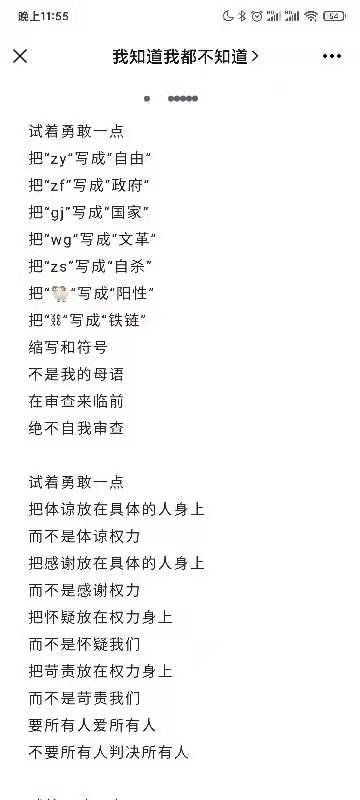
a poetic primer for understanding these times

All that we do not know haunts us. In some sense, social media has only made us more aware that our knowledge about what is happening next door or in the next city is limited. Nevertheless, we still extrapolate feelings from posts and insinuate critique into memes. This means that we require a basic lexicon to decode texts that were intentionally written to avoid censorship. Currently circulating is a poem about the courage to write directly about what’s been happening. And yes, I’m aware that the poem has circulated anonymously. Translation, below:

Continue reading

word of the day, “unwilling”

I first saw the chat record in a chat group,, dated April 16. Two days later, I saw it in my moments in a circulating WeChat post. The group leader said, “I’ve received an urgent notification from the top, everyone in the building is required to go down stairs for a corona test. Please respond with whether or not your willing to go downstairs.” He followed with his response, “unwilling.” It was followed by 50+ “unwillings.” The chat leader then said, “Thank you everyone. There have been enough responses. I’ll go negotiate with them.“ After three thank you emogis, he added. “Some leaders notified the neighborhood office at 5:45 p.m, to have us all go downstairs at 6:00. The teachers in the community office are helpless, so don’t blame them. Many of them only get 6 or 4 hours of sleep a night.” The same day that I saw the circulating WeChat post, I also saw a series of “will not participate in any more corona tests,” circulating on TikTok post, with music.

provisional governance in shanghai

It seems that a Shanghai community has established its own provisional community office because of the incompetence of the official community party secretary. The above photo is a picture of the first edition of their community bulletin, which is called “Tiandi Estate Epidemic Prevention.” The headline is, “Announcing the Establishment of the Provisional Autonomous Community Office for Phase 1 and 2 Second Tiandi Estates.” How cool is that?!

what happens in shenzhen if you need your teeth checked?

This is a serious question. During times of mass corona-testing, dental services have been closed and dentists and their assistants redeployed to people test stations. But this information hasn’t been made public. Instead, you only discover that dental services have been suspended if you need your teeth checked, can’t get an appointment, and then someone explains the situation to you. Otherwise, there’s just a black hole where the dentist used to be.

Both in China and abroad, much ink and digital text has been dedicated to extreme cases of people being unable to get emergency medical care. However, the redeployment of dental workers illustrates how regular healthcare has been (indefinitely? until further notice?) suspended in order to mobilize workers to meet the need for personal to give tests. Annual check-ups can’t be booked, for example, if your dentist is busy swabbing throats instead of filling cavities. This situation illustrates one of the challenges to navigating Shenzhen’s current management of the omicron outbreak–there have been no comprehensive announcements of how city resources have been re-deployed to achieve zero-Covid. This means that you find out what’s been closed or redeployed through unexpected encounters with a new normal that has not been formally acknowledged.

Continue reading

passing of a hero

The first party secretary and second president of Shenzhen University, Luo Zhengqi 罗征启 was one of the main figures of public life during the early Special Zone years. His vision for a post-CR intellectual culture and new roles for intellectuals not only shaped the city’s public culture and its urban form, but has also educated many of the city’s important figures. Graduates from the Shenzhen University School of Architecture have, quite literally, contributed to the design and construction of the city’s built environment, while more generally Shenzhen University graduates have played important roles in the city’s government, its companies and civil life, including its not-for-profits, volunteer organizations, and vibrant salon culture. Luo Zhengqi passed away yesterday, three months after his wife, Professor Liang Hongwen left us. Both were 88 years old. Both lived and worked in Shenzhen from 1983 to their passing this year.

Continue reading

refiguring the healthy population

Yesterday, Xinhuashe circulated #动态清零怎么看怎么干# (image below), which translates as #how to understand and implement dynamic zero-Covid. Inside the parentheses, the question is raised: “if so many countries are ‘lying down,’ #why are we persisting with dynamic zero-Covid#? The answer to the question hinges on how population governance works in China. According to the article to which the weibo tweet refers, there are over 50 million elderly Chinese who have not yet been vaccinated. They are all vulnerable to catching and dying from Covid. Anyone who doesn’t comply with current protocols is (implicitly) threatening the health of those 50 million elders. Indeed, the rhetorical power of these tweet hinges on an unspoken assumption: what is more anti-social than threatening the lives of elders? Thus, alternative opinions on how the outbreak should be handled are not simply debates about public health protocols, but also and more importantly pose a serious challenge to social stability because they are intrinsically anti-social behaviors.

In trying to think through the logic behind the connections between public debate about health protocols and social stability, re-reading Susan Greenhalgh‘s work on population governance has proven incredibly useful. Her basic point is that the politics of reproduction is a key feature of modern government, especially how we imagine embodied relationships between past and future. Population governance touches on all aspects of citizen rights and obligations, specifically access to birth control and abortion. However, during the late 20th century, population governance has expanded to include how societies organize access to healthcare, economics (workforce ratios), environmental issues (population densities) and the meaning of human life (gerontology as an expanding field of study, for example). Population governance also shows up how eugenics have shaped modern politics throughout the world. In other words, population governance has become central not only to how we imagine ourselves as belonging (or not) to society, but also to how governments justify which public health programs to pursue and how to implement them.

Continue reading

shenzhen covid update for inquiring minds

“What’s up in Shenzhen?” You and other inquiring minds want to know.

Well, for starters, we have a new conspiracy theory about how Shenzhen’s successfully prevented a massive omicron outbreak on the scale of Hong Kong and/or Shanghai.

Your curiosity gets the best of you and you impishly ask, “What’s the tea?”

I lean forward and whisper, “Apparently, the city’s zero-Covid strategy has served to cover-up the fact that Shenzhen was caught unprepared, just like Hong Kong and Shanghai. At the beginning of the outbreak, the city didn’t have enough quarantine centers to house all the positives, symptomatic and not. So instead of treating patients, they sent everyone home to wait it out, without ever releasing true statistics. The basis of this conjecture is the unstated question: how could Hong Kong and Shanghai have so many positives and Shenzhen not?”

And my voice is rising along with my excitement, “I mean, you can hear the rhetorical force of the conspiracy theory, which pivots on what the numbers mean. And let’s be real. Statistical abnormalities should be ringing our bells because so much of who we think we are is tied up in hypotheses about populations, which are in fact statistically imagined entities. So, to my mind, which is a curious mind, the reasoning behind this theory of what is actually happening is mischievous satirical impeccable. Especially, if your point of epistemological departure is that omicron spreads+government can’t be trusted. Which, who doesn’t believe?

Anyway, the post (which counts as rumor mongering within official social media, but that’s another story for another day) reads:

I finally understand, and here’s the story:
Continue reading

hallucinating in shanghai

The stories coming out of Shanghai are increasingly distressing. Thousands of people are being rounded up and forcibly moved to quarantine centers, which are still under construction. Once inside the centers, detainees are told that they are on their own until testing can be arranged because it takes two consecutive negatives to get out. Indeed, the situation is so fraught that it has brought the specters of Xinjiang and the Cultural Revolution into the conversation. Some have started commenting under pictures of the Big Whites (大白 nickname for those in hazmat suits), “the red guards have arrived!” Offline, the outraged assumption that Shanghai (SHANGHAI!) could be treated like Xinjiang is more vocal, and occasionally mentioned online. But I’ll get to that, below. There’s much to unpack in all of this, especially Xi Jinping’s fraught relationship with the CR, Xinjiang and, of course, Covid. After all, the 20th Party Congress will be held (presumably) some time in October, and Xi has hitched his coronation third term to zero-Covid. Today, however, I’m translating and commenting on a copy of a chat record that’s low key circulating on WeChat. I’ll be responding in the next post.

Continue reading