Xintang and Shang Baishizhou lie northwesterly to Tangtou within the larger Baishizhou neighborhood. Where the allies widen into roads, a vibrant, bustling urbanity hints at unexpected encounters. The Baishizhou Pedestrian Commercial Street, the Baishizhou Christian Church, and inadvertent plazas, for example, speak to the social possibilities that high density street life creates.
Author Archives: Mary Ann O'Donnell
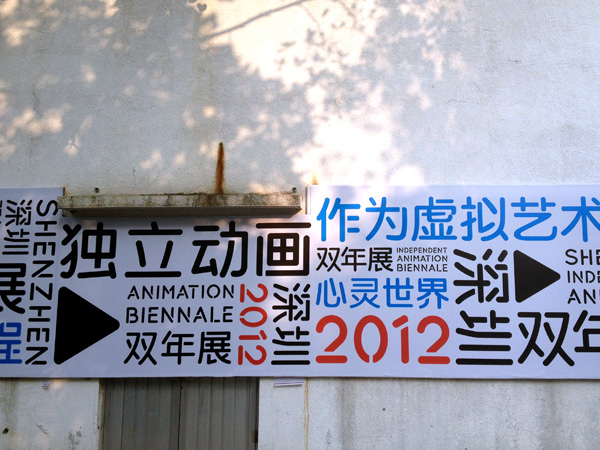
digital soul: the 2013 independent animation biennale
Actually it’s called The World of the Soul: A Virtual Art Engineering Project (心灵世界:作为虚拟艺术工程) and it’s the first Shenzhen Independent Animation Biennale. Interestingly, in addition to the usual OCAT sponsors, Southern Weekend and Youku, two leaders in China’s youth culture also contributed to the event, which includes lectures in Beijing and Guangzhou.
Curators Wang Chunchen, Zhang Ciaotao, and He Jinfang provide viewers with a smorgasbord of videos that range from short shorts through mid-length pieces to feature films. They have also selected styles that include virtual reality avatars, hand drawn characters, and experiments with Chinese ink painting. So, if you have a leisurely afternoon, a stroll through the exhibition offers much to sample. What’s more, if you decide to watch the longer pieces, you may decide to return for a second or third time.
In addition to the exhibition, the biennale offers a series of monthly lectures. On January 22, artist Lei Lei (雷磊) gave a talk on free and easy animation. Just after the Chinese New Year on February 26, artist Sun Xun (孙逊) will discuss “Animation is a Layer of Skin”. Clearly, animation is a way of life and digital soul as earnest as painterly counterparts.
Venue: B 10 Gallery, OCAT Loft North
Dates: Dec 22, 2012 through Mar 22, 2013
Time: 10:00 to 17:50 on weekdays; 10:00 to 20:00 Saturday and Sunday

the yaopi float glass factory
The Yaopi float glass factory hovers at memory’s edge, abandoned to ideology and chance encounters.
In 1987, the Shekou factory represented the highest level of float glass technology production in China. Today, it evokes nostalgia for the heroic romance of early industrial manufacturing. And that’s the rub. Even before it was built, the technology and mode of production used at the factory had been downgraded in terms of added value. In terms of global competitive advantage, Yaopi had been outdated even before it was built. Perhaps more telling of the ideological structure that ranks advanced and backward nations with respect to production capacity, the Yaopi factory elicits comparison with the Terracotta soldiers in Xi’an. This unhappy comparison relegates Shenzhen’s modernization efforts to the ancient past, even as it confers uncanny modernity on the First Qin Emperor’s army, which of course was mass produced on low-tech, but large-scale assembly lines.

orange tubes
This morning while touring an abandoned factory in Shekou, I encountered massive orange tubes. By themselves somewhat uninteresting, yet arranged beneath a banyan tree suddenly transformed into art. And that seems the way of it. As a new friend commented recently, “In a city, despite the buildings, ultimately the trees speak to the human soul.”

suzhou garden, huanggang, shenzhen
Visited the Suzhou style garden in Huanggang Village today. The Village axis runs from the arch on Fumin Road via a main street and the central plaza to the ancestral hall and temple. The garden is located behind the ancestral hall.
Also of note: in the main plaza, the village has crafted a self representation that mimics Shenzhen billboards, in which key buildings symbolize the strength and unity of the group. Nevertheless, unlike the municipal central axis, the village central axis runs east – west. Indeed, that’s the rub. If the central axis were opened up through the convention center, it would split Huanggang and plow through the garden.
Impressions, below.
more community websites
Shenzhen long since gave up on “neighborhoods (居委会)” and “villages (村)”. Instead, the ruralized urban hybrids that the SEZ has spawned are legally known as “communities (社区)”. Note du jour is simply to point out that many of the sites connect landlords and renters. Soufun or “Search for a house” web, has sites that not only include rental information, but also track real estate prices. Guloucun — literally Old Lou Village Community (古楼村小区网) and Tianmiancun or Tianmian Village Community (田面村小区网), for example.
However, some community websites are more community oriented, in addition to providing a commercial forum. For the curious, checkout these community websites:
Shangsha and Xiasha Community Website (上下沙社区网)
Baishizhou Community Website (白石洲社区网)

as shenzhen razes: the baishizhou urban renewal plan online
Shenzhen developer, Lvgem Group (绿景集团) has uploaded a video of the Urban Renewal Plan for the Five Shahe Villages in Baishizhou (白石洲沙河五村旧改专项规划).
Wow. Just wow. And not in the good way.
The current built environment of roughly 580,000 square meters will increase 10-fold, to 5.5 million square meters.
The argument for razing the current settlement and replacing it with high, high rises and skyscrapers is that Baishizhou villagers live in grungy unpleasant conditions that need to be upgraded. The proposed solution is for the developers will work with villagers in order to bring them into the urbanization process.
In a nutshell, the problem is that the video conflates the idea of “villagers” with the ruralized current residents of Baishizhou. There will be a resettlement area for “villagers”, but who counts as a villager? The actual population of Baishizhou is over 140,000, of which 120,000 do not have Shenzhen hukou. So, inquiring minds want to know: is the plan calling for ten times the space to house the 20,000 residents who do have hukou? Or does “villager” only refer to the actual members of the five villages, which means we’re talking about less than 2,000 people with resettlement rights. And if that’s the case, who will live in all this new, upgraded, hyper-modern space after the current residents have been forced to leave?
A quick visit to 58 net reveals how cheap housing in Baishizhou is relative to the surrounding area. In fact, many young office workers and professionals from neighboring Science and Technology Park (科技园) also live in Baishizhou as to designers and creative talents who work in the OCT Loft. Providing this class with livable (宜居) housing is an ongoing Shenzhen concern. Indeed, there is now an official plaque for hanging on a rental building which confirms a building’s livability.
It is estimated that over half Shenzhen’s population live in the villages, which account for roughly 10% of the area’s land. Arguably, the villages are the city, while high end housing estates and neighborhoods might be thought as wealthy suburbs, with lovely gardens and huge tracks of private spaces. Consequently, the question of who actually belongs to an “urban village” is the social, political, economic question because as Jonathan Bach has argued, the villages have been the incubators where (some of) Shenzhen’s migrant workers transform themselves into urbanites and potentially citizens.
As Shenzhen razes. Stay tuned.

xiasha plaza
This afternoon, I sat in Xiasha Plaza watching children and their caretakers. The plaza is vast and the people hug the edges, chatting in the shade. The coi pond is particularly popular.
land reform: the first SZ paper of 2013
In its first document 2013 (2013年一号文件) Shenzhen announced that its intention to finish expropriating collective lands in order to transfer land use rights for high-end development to state owned real estate developers, like China Resources and Jingji. In official parlance its know as land reform (土改), and yes, I’m starting to think I live in a post-ironic city.
The problem of Shenzhen urban villages is, of course, that they were not villages. Under Mao, they were incorporated into the state apparatus through collectivization. Villages became teams, several teams became a brigade, and groups of brigades constituted a commune. In turn, the communes were the basic administrative unit of Bao’an County, Shenzhen’s territorial predecessor. In short, the collectives had a modern bureaucracy, and did agrarian work in not quite primitive, but very rough conditions.
In 1978, led by liberalization in rural Anhui, teams and brigades throughout China began to dismantle, and Bao’an was no exception. Redeploying the administrative structure of the Maoist state, they created “new villages”, which continued to do agrarian work, but for collective profits. Traditional village relationships and historic identities facilitated this process. In Bao’an, however, the establishment of the Shenzhen SEZ meant that collectives could also invest in manufacturing and real estate development.
In 1992, Shenzhen incorporated the inner villages into the municipal apparatus and in 2004 the outer villages were incorporated. So technically, the villages, which had not been villages, were now urban neighborhoods. Except, they were also limited holding companies. And there’s the legal rub: Shenzhen urban villages were limited holding companies which owned investments that had been legally built on collective land, but now occupied state-owned land, creating a messy, grey area of compensation demands and property rights. According to Shenzhen Urban Planning Chief, Wang Youpeng (王幼鹏),
The government cannot take [the land] back, and the collectives can’t use it (政府拿不回,集体用不了).
The Municipality’s convoluted description of the villages reflects this complicated history. In the first document of 2013, the villages are called “Former Rural Village Economic Organization Work Unit (原农村集体经济组织单位)” — hee! But here’s the not-so-funny point: The 2013 paper legalizes the direct transfer of collective lands to real estate companies. Previously, the villages negotiated with the Municipality, which in turn accepted bids from real estate companies. Now, the Municipality has stepped back from this role. Instead, the villages may negotiate directly with the companies.
In terms of asset transfer, it means that villages must remove their technically illegal buildings from municipal lands. Their are two compensation packages. Either, villages sell their buildings, giving half the price of the sale to the Municipal government, or the villages sell their buildings and give 70% of the price to the Municipal government, but receive up to 20% of whatever is subsequently built on the land.
Xi Jinping has come and gone. The Shenzhen People’s Congress has met and disbanded. Exhortations to study the Spirit of the 2013 18th National People’s Congress have proliferated throughout Shenzhen. And now we know what it means – there is a new means of legalizing the transfer of property and resources from the urban villages to Shenzhen Municipality, further concentrating property and resources in the hands of whoever happens to be in charge of negotiating this process on behalf of the People Party.
That said, after a surge in the stock market, the general response has been one of confusion. It seems the paper is unclear on how the process will actually take place.
shenzhen publications
In the hope that they may be useful, I am uploading five academic papers from the dark ages of Shenzhen studies. Be aware: much has changed, although much has not. In chronological order:
1999: Path Breaking(on how gendered nationalism facilitated the construction of SZ)
2001: Becoming Hong Kong (on how Shenzhen emerged through globalizing urbanization)
2006: Cultural Supplement (on political power as a cultural value in contemporary SZ)
2006: Fox Talk (on the emergence of neo-liberal urban identities in SZ)
2008: Vexed Foundations (on cultural continuity in SZ urban villages)
 Shenzhen Noted