the party’s assets

So the investigation of the State Assets Administration Committee (国资委) Director, Jiang Jiemin (蒋洁敏) has begun. Just a day after the Bo Xilai trial ended, netizens have described Jiang Jiemin’s corruption as “unbelievable” . How much more off the top can China’s leaders go? Or are we still struggling for a vocabulary to describe the scale and scope of China’s modernization and attendent robber barons?

In point of fact, Jiang Jiemin did have access to money and resources well beyond Bo Xilai. After all, Bo Xilai only oversaw the assests of Chongqing, one city. In contrast, as Director of the State Assets Administration Committee, Jiang Jiemin oversaw , The all of China’s state-owned industries, including the country’s energy and telecommunications companies, as well as all the natural resources development companies. In everyday language, this extensive monopoly is called “the Party’s assests (党产)”.

This is the political-economic context in which Shenzhen residents speak of the city becoming more and more like the interior; as the city apparatus increases its regulatory control (through mechanisms such as the urban plan) opportunities to take advantage of the SEZ’s economic boom are increasingly monopolized by the Party State. In turn, second and third generation reds (红二代、红三代 as the children of Party leaders are called) overwhelmingly control opportunities to head these industries.

retirement plans for older migrant workers?

Yesterday, a weixin article claimed that among China’s 230 million migrant workers, the number of workers over 50 years of age could be as high as 36 million. These 36 million, of course, were the first generation of migrant workers, who left their villages in 80s and early 90s — before reforms had spread beyond the borders of special economic zones and coastal cities, to work in China’s newly opened factories.

The article raises the important and increasingly pressing social question, where will these workers retire? And what will they do in the absence of retirement plans? The journalist interviewed older workers in the northern city of Lanzhou, where there is little option but to retire to their hometowns. According to a report published in 2010 by the Chinese Elder Workers Council, 84.7% of city and town residents have a pension, averaging 1,527 yuan a month. In contrast, the percentage of rural residents with a pension is 34.6% and the average income is 74 yuan a month.

In Shenzhen, the debate over what to do with older migrant workers has been ongoing since March 1987, when the city legalized the participation of rural migrants in pension plans. Indeed, Shenzhen has been at the forefront of reforming China’s pension plans, allowing self-employed entrepreneurs to buy into pension plans (1992), and provided pension supplements for regional workers and for non-Shenzhen residents to collect pension benefits in the city (1999). In 2007, twenty years after migrant workers were permited to buy into pension plans, there was a rash of articles about Guo Jinzhao (郭锦钊), the first migrant worker to collect a monthly pension in Shenzhen (at the time of the article 1,005 yuan a month).

Over 25 years since the debate about migrant workers began and the celebratory publicity campaigns notwithstanding, the majority of Shenzhen migrant workers has not earned enough to either retire in the city or to have purchased into pension plans. In 2012, Wen Qingqiang published a photoessay on the city’s “naked old tribe (裸老族)”. The gist of the article anticipates the Tencent post: older migrant workers can not afford to stay in the city where they have lived and worked for the past several decades. Instead, their most viable retirement option is returning to their hometowns.

Note about language: In Chinese, the expression for “rural urbanization” is more specific than its English translation, highlighting both extant labor regimes and the administrative structure of the Chinese state apparatus: 农村城镇化, literally means, “agriculture villages city town transformation”, or “the transformation of agricultural villages into cities and towns. The distinction between cities and towns is relevant, of course, because within the Chinese state apparatus, cities rank higher than towns (which rank higher than villages) and are thus more eligible for state funding and preferential policies. At the level of geopolitics, then, rural urbanization has referred to the restructuring of spatial hierarchies. The transformation of rural Bao’an County to Shenzhen Municipality remains the national poster child for successful rural urbanization.

Importantly, rural urbanization has also occurred through the migration of rural residents from agricultural villages and townships to the country’s cities. In fact, these workers are literally called “farmer-workers(农民工)”, an expression that not only emphasizes rural origins, but also their role within urban hierarchies. This point bears repeating because rural migrants have not been fully integrated into urban societies, either formally (through hukou and concomitant welfare benefits) or informally (through friendships and associations that might blur the distinction between urbanites and bumpkins). Here, although Shenzhen has taken initiatives to experiment with tweaking the hukou system, nevertheless, the ideological distinction between urbanites and bumpkins continues to shape both public policy and the concomitant imaginary of just who is (and is not) a Shenzhener.

as chongqing turns: the trial of bo xilai (abridged)

Bo Xilai. Gu Kailai. Wang Lijun. These are the main characters in China’s ongoing soap opera As Chongqing Turns or “The Bo Drama (薄剧)” as it is known in Mandarin. Bo Xilai, of course is the disgraced former Party Secretary of Chongqing. Gu Kailai is his lawyer possibly crazy wife, who confessed to killing businessman, Niel Heywood and is now in prison after her death sentence was suspended. Wang Lijun was his head of security, who was in charge of Chongqing’s anti-mafia campaign and convicted of all sorts of corruption charges.

The main event trial of Bo ended yesterday. The best part? Bo Xilai was his own lawyer and so interjected throughout the prosecution’s presentation of its case. Below, a translation of the Abridged Bo Trial (审薄精简版) and yes, although fictionalized, the account rings so true. Also, I’ve tried to find online links to the Chinese text, but they seem to have been blocked:

Day 1
Prosecution: Your wife accepted money.
Defendant grunts.
Prosecution: The person who gave the money is known to you.
Defendant: Known but not really close.
Prosecution: Did you give favors to this person?
Defendant: Business is business (公事公办 literally: business done according to business principles).
Prosecution: Did you know your wife and son took people’s money?
Defendant: No.
Prosecution: She never mentioned it?
Defendant: People with taste like ours would get together and talk about money?
Prosecution: Xu Ming, Did you give the Party Secretary’s wife and son money?
Xu Ming: Yes.
Prosecution: Did he know?
Xu Ming: No.
Defendant (interrupts and says to prosecution): What did I tell you?
Prosecution: You mother-fu… Court recess!

Day 2
Prosecution: This is the evidence… (closing testimony of 10,000 characters).
Defendant: Have you closed your arguments?
Prosecution: Yes.
Defendant: Where’s the evidence?
Prosecution: Mother fucker, this isn’t evidence?!
Defendant: This is just testimony. This is what they said. Is there actual proof that I knew about the villa in France? That my son was playing around?
Prosecution: … Legal testimony that has been confirmed and supported!!! This is not enough?
Defendant: Is it? Enough? (Defendant laughs).

Day 3, morning
Prosecution to Wang: Wang, you tell us. Did he incite you to give money to his wife.
Wang: It seems that maybe…yes!
Defendant: Did I ever call my wife while you were there?
Prosecution: Yes.
Defendant: Did I ever try to find out if anyone else knew?
Wang: No.
Defendant: Mother fucker, am I a stupid cunt? Would I really not know who knew I was on the take? Who are you? Are we so intimate that I would call my wife while you were there and tell her to take a bribe?
Prosecution: If you hadn’t told your wife to take the money, how did it end up in her account? You definitely told her to do so! You said so!
Defendant: You think this investor is so poor? That the investor’s wife isn’t talented and rich? That we actually need your 5 million?
Prosecution: You definitely took bribes!
Judge: Prosecution, please remember your role…

Judge: Please continue.
Prosecution: Your wife already testified that you knew. And now you’re denying it!
Defendant: My wife… (sighs) I’ll admit to you all that… well, I stepped out of line once, so you understand that my wife took our son and went to England. what happened after that, how could I know? What’s more, my wife committed murder, if she had economic troubles, of course she’d be up shit creek. So her saying that I incited corruption is a normal response (很正常). We still care about each other and I don’t blame her for any of this…
Prosecution: What the fuck does that mean? Earlier you testified that your wife was mentally unstable. Now this?!
Defendant: I don’t mean anything by it. I’m just speaking the truth for the judge’s consideration.
Judge: (speechless)

Day 3, afternoon
Prosecution: We call General Wang Lijun.
Prosecution: General Wang, what do you have to say?
General Wang: I have so much to say! How could I not? How many years were we sworn buddies? I protected his son when he went abroad. When his wife committed murder, I was the first to tell him. I gave my life and bled for him. Him. Him. Him. And then he actually hit me on behalf of his wife! He slugged me! I bled! I’m broken hearted!
Prosecution: See! Do you see?
Defendant: You’re talking out your ass. Mother fucker, I thought you were a bosom buddy, and if my wife wanted to kill someone, you should have either stopped her or helped her. But you did nothing and let her royally fuck up. And then, you let the investigation go forward, only telling me two weeks later, “I’m a Police Chief and I have to investigate crime, your wife murdered someone. Leader, you must face reality… Sheesh… You tell me, do you deserve a beating or not?!
General Wang: I took responsibility for you!
Defendant: Your character is questionable. You’re two-faced! You directed your subordinates to go after her and then you come to me and pretend to be a loyal official!
General Wang: You! (10,000 characters deleted).
Defendant: I have nothing more to say to you. Judge, I have only one statement, everything he said is bullshit. I hit him and he hates me, so then he muddies the water. You do what you have to.
Judge: Court recessed.

steamboat mao

Reading Walter Benjamin’s Mickey Mouse fragment after the Talks at the Yan’an Forum on Literature and Art by way of the Cultural Revolution and rural urbanization in Shenzhen reminds us that the revolutionary and the subversive refers to potential here and now, not any particular artistic form or genre. Anyway, I was reminded that the Mickey Mao pun is compelling and not actually shocking: they really do go together like vinegar and oil on a global word salad. Anyway, I was playing with photoshop and mashed up Mickey and Mao and came up with Steamboat Mao, a tribute to Benjamin that plays on Mao’s status as the Great Helmsman and Mickey’s former status as the ultimate underdog:

This slideshow requires JavaScript.

The Mickey Mouse fragment comes from from a conversation among Walter Benjamin, Gustav Gluck and Kurt Weill:

Property relations in Mickey Mouse cartoons: here we see for the first time that it is possible to have one’s own arm, even one’s own body, stolen.

The route taken by Mickey Mouse is more like that of a file in an office than it is like that of a marathon runner.

In these films, mankind makes preparations to survive civilization.

Mickey Mouse proves that a creature can still survive even when it has thrown off all resemblance to a human being. He disrupts the entire hierarchy of creatures that is supposed to culminate in mankind.

These films disavow experience more radically than ever before. In such a world, it is not worthwhile to have experience.

Similarity to folk tales. Not since fairy tales have the most important and most vital events been evoked more unsymbolically and more unatmospherically. All Mickey Mouse films are founded on the motif of leaving home in order to learn what fear is.

So the explanation for the huge popularity of these films is not mechanization, their form; nor is it a misunderstanding. It is simply the fact that the public recognizes its own life in them.

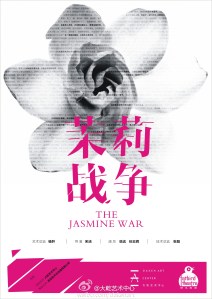
the jasmine war

The latest Fat Bird production, The Jasmine War (茉莉战争) will go up next week at the Daqian Art Center, which is located in Eco-Park OCT (深圳华侨城生态圈广场大乾艺术中心). Tickets will be available online through the art center.

Impressions from rehearsal, below:

This slideshow requires JavaScript.

poster

how chinese is weixin?

This past year, I have noticed that the age of text messages seems already over. Instead, the sarcastic couplets and stories that used to come by text, now come by weixin groups. On the face of it, it seems a case of new technology beating out a less convenient model. Afterall, weixin groups allow senders to conveniently send out targeted mass mailings.

Interestingly, Tricia Wang has suggested that their are cultural reasons for the popularity of weixin. Specifically, the “shake” and “nearby” functions, which allow young people to meet strangers through a virtual introduction. Indeed, Tricia has also translated rules for using weixin to set up a one-night stand. Tricia makes the point that

One of the most important things to understand about Chinese apps is that the successful ones make serendipitous communication with strangers really easy.

I’m wondering, however, if the cultural gap is as much generational than cultural? After all, young people who spend a great deal of time online are already habituated to virtual introductions. Moreover, I’ve seen groups of teenagers in both the United States and China, hanging out together while they chat and go through messages received on their smartphones. That said, I highly recommend visiting Tricia’s blog, Bytes of China to explore the ways in which social media and new technologies are shaping and being shaped by China.

shenzhen and china’s left behind children

The Foreign Policy series “China’s Left Behind Children,” by freelance journalists Deborah Jian Lee and Sushma Subramanian followed the migrant worker Huang Dongyan, who left her daughter back home to work in Shenzhen. Her relationship with her daughter remains fraught and teeming with unsatisfied yearnings. In response, Huang, decided to raise her son in Shenzhen instead of leaving him in the countryside with his grandmother. The two articles are well worth reading, here and here. Of note is the continued relevance of hukou in the lives of migrant workers, especially with respect to receiving an education.

national shame…

egyptApparently a Chinese tourist wrote the characters ” 丁锦昊到此一游 (Ding Jinhao arrived here)” on one of the bas-relief sculptures at the Luxor Temple in Amun, Egypt. In turn, another Chinese tourist discovered the defacement and uploaded a picture to weibo, where it was picked up by the weixin and other news outlets. Today, Epoch Times has reported that the parents of Ding Jinhao have appologized for their son’s behavior.

Unfortunately, a few clicks around the web suggest that vandalism of cultural heritage and sacred sites is common. What seems notable in this case has been the outrage of the Chinese netizens and the consensus around “national shame”. Moreover, the use of social media to bring about this public shaming reminds us of the ongoing debate about the public face of Chinese tourists. It may also be that this vandalism shocked my friends because they believe that no matter how much Chinese people disregard the law at home, once abroad they become law-abiding citizens.

life lessons

Yesterday, my friend told me a story about how her sixth grade lost the role of Maria in a short skit based on The Sound of Music.

The sixth grade is preparing a graduation celebration that includes skits, songs, speaches, and food. Parents are organizing these events, including an English teacher who wrote the Sound of Music skit. Apparently, the English teacher intended that her daughter would play Maria. However, when the daughter declined, my friend’s daughter said, “Yes!” and started preparing.

Soon after, the English teacher’s daughter sought out my friend’s daughter and said that she wanted to play the role of Maria. My friend’s daughter asked what to do. On her interpretation, she had several options: (1) cede the role to her classmate; (2) ask the teacher to decide, or; (3) audition before the class and let their classmates decide. What my friend’s daughter understood clearly, was that if a teacher’s daughter wanted the role, then their homeroom teacher would take the role away from her and reassign it to the teacher’s daughter.

My friend comforted her daughter, saying that there would be many other opportunities to perform. However, her daughter was sad and so my friend asked me what I thought. I didn’t have to think. I said that it was perfectly natural for her daughter to be upset at such blatent injustice. My friend agreed, but added that in China this was how things happened. Sometimes you could spend more time and energy only to have your work denied or the glory taken away. I concurred, but asked if it was really necessary to learn such a lesson in elementary school.

And there’s the culturally interesting question: when and how do children learn the politics of everyday life?

I remember in high school having a teacher who took a dislike to me. Once when I was not in class (I don’t actually remember the reason), said teacher held a vote, asking students to decide whether or not I should be allowed to remain in class. I was voted out of the class. So, I went to the vice principal to mediate. When I sat down with that teacher, he chronicled what a horrible student I had been — talking in class, passing notes, and not attending. All true. Thus, when he finished speaking, he stood up to leave; clearly, he thought that sitting down with me was enough to demonstrate his good faith in the process.

I actually needed the vice principal to call that teacher back to the conversation, when I had a chance to mention that this teacher made inappropriate remarks about the girls in the class. I had started making snide comments and when he addressed me, I spoke back. Once I said this, the vice principal asked the teacher if their was any truth to my story. The teacher shrugged and then offered the following compromise: I could take a study hall during history class, but receive an “A” for my work. And what did I know? I didn’t turn to my parents, but accepted the deal, leaving the vice principal and history teacher to figure out their relationship, which had suddenly been complicated.

After I told how I was bought off, my friend nodded. She said that she would advocate for her daughter to keep her role. After all, these moments of injustice — in Chinese elementary schools and US American high schools — are learning moments. Unfortunately, we more often than not first learn and then unconciously teach the unequal politics of everyday life.

prefabricated, movable dormitories

dormitory

One of the most common sights sites in Shenzhen — the prefabricated, movable dormitory. Of note, although almost half of sales are domestic, nevertheless the “Chinese standard” is being profitably exported throughout South America, Southeast Asia, Africa, Oceania, and the Middle East. It is of note du jour because I just realized that this is one of the primary housing typologies for workers. Moreover, it serves the purposes of urban rennovation without leaving housing stock for more permanent working class neighborhoods. That said, one of the other uses of prefabricated houses is building suburbanesque working class neighborhoods in the United States and Japan.