the violence of rural (re)construction (4): what gets preserved

Monday I joined the Meizhou preservationists in Enning Neighborhood Guangzhou, where we met to talk about how we could intervene in what was happening in Meizhou. There were two issues at stake. The first was straight-forward lay human rights–how do we help people keep their homes or guarrante a replacement home? The second was more abstract–what kind of buildings and spaces “ought” to be preserved for their historic value? Continue reading

the center besieged…

In several of my WeChat circles, an excerpt from the snarky classic, Fortress Besieged (围城) by Qian Zhongshu has been activated by those sympathetic to the Hong Kong students. It is however not unequivocal support, after all Fang Hongjian was not so much a hero, as a first generation off the farm urbanite caught between competing value systems, not quite at home in either China or the West. Conflicted and going about causing conflicts, intentionally and not, as he tries to live his life in Republican Shanghai. I have roughly translated the passage below: Continue reading

my white wall compulsions: paint it black (I)

On Friday, October 3 at Handshake 302, we held the first salon for My White Wall Compulsions (墙迫症), “Paint It Black”.

The artist team for the first wall comprises Liu He (刘赫) and Wu Dan (吴丹), both under 25 and both curious about art and its possible articulations with and through society. Liu He is a second generation Shenzhener, whose parents came to build the SEZ before he was born. Wu Dan came to Shenzhen last year, a first generation migrant just out of college. During their first salon, Liu He talked about his anti-inspiration for “Paint It Black”.

This past summer, Liu He took time off from work to travel to some of the less travelled neidi cities. In one of the cities, he decided to take a job at a karaoke bar in order to see what it would be like to do day work (打工). He got a job as a procurer of Karaoke Bar princesses (and at the bar where he worked, hostesses who worked private rooms were so-called). The job included a three-day training session, in which the trainer was as enthusiastic and self-determined as a multi-level marketer. And in fact it turns out that procuring worked a lot like multi-level marketing–the more young, pretty women the procurers brought in, the more money they made.

Liu He left after a few days without recruiting any young women because “he couldn’t get past the moral issue”. Of the 30+ young men who had joined him for training, 12 decided to stay and work the job. Of that twelve, three were 16 years old. According to Liu He, the trainer insisted that once he stopped worrying about ethics, he could talk to pretty women and get rich. In fact, that seems to have been the point of the training: to overcome the young men’s repugnance to pimping and replace it with self-justifying desire for money and everything it buys.

The story ignited debate about what it means to leave one’s hometown and make one’s way in the world. There were two main positions, both pulsing with anger, sadness, and faintly, despair. The younger participants wanted a more honorable way of making a living, to live in such a way that they wouldn’t have to make the kind of choice that Liu He walked away from. The older participants, especially those who had worked their way out of a rural area, expressed that young people didn’t understand what was necessary in order to secure a better life for one’s children.

These two positions took a different relationship to the young pimps. The young people saw themselves and their choices in the decision to procure princesses. The older people saw the choices they had made so that their children would be protected from making those choices. No one saw themselves as a princess, a blind spot that not only hints at how gendered inequality shapes job opportunities in China, but also how difficult it is to truly see the most oppressed. After all, the young men’s decision to pimp or not to pimp still implied some kind of agency. It would have been more difficult to focus on the conditions that make young, rural women the cheapest and most convenient labor in manufacturing and service throughout the economy, even as women are markedly absent from positions of social influence and power.

Friday, October 10 at 19:00 the conversation continues when Liu He and Wu Dan present their finished wall.

This slideshow requires JavaScript.

occupy central: confessional moment

Many of the English language news reports coming out of Hong Kong highlight the antagonism that the SAR’s Mainland residents feel about the protests. The articles draw attention to vapid consumers (usually women) distraught because barricades have made it inconvenient to go shopping and/or self-righteous colonizers (usually men) who are angry that by making students are making China look bad. The rhetorical point is straightforwardly simplistic; brainwashed Mainlanders don’t understand what everyone else in the world gets — oppressive Communist Party acts again, this time against unarmed students.

It’s easy to get hooked by this way of thinking because there are no false statements. There are Mainlanders upset because they can’t go shopping in Central. There are Mainlanders who think that Hong Kong students specifically and Hong Kong people in general should accept Mainland authority. And yes, the CCP is up to familiar tricks of the anti-democratic trade.

And yet.

The only one of these statements I would believe without asking for contextualization is that the CCP is up to its nasty, manipulative authoritarian ways and once again working with triads to achieve its ends. But even that idea eventually breaks down if examined too closely because there are factions within the Party and divisions within the government. (Unfortunately in Shenzhen I have seen that more often than not the nasty and manipulative overcome the resistance of their more progressive colleagues and steamroll society.)

I begin my thoughts on these stereotypes of discord with a confession; until the students’ protests and Occupy Central with Peace and Love’s demonstrated commitment to non-violence I didn’t like Hong Kong. I am a member of the Kwan Um School of Zen which has a temple and retreat center there. I have friends who live in Hong Kong, and some of them are from Hong Kong, and I have participated in academic art events there. But.

Over my twenty year sojourn in Shenzhen, I have repeatedly and consistently had to deal with Hong Kong contempt for Mainlanders in general and Shenzhen people in particular. This has ranged from academics asking me how I could possibly feel safe in Shenzhen to watching Hong Kong waitstaff and others in the service industry treat me (white American woman) very differently from how they treat one of my dearest friends (Beijing woman). I was once at an award ceremony for public service and one of the Hong Kong awardees took the time to lecture me (in precise UK inflected Engish) on why I should find another place to work and not waste my time and talents in Shenzhen. This ongoing prejudice coupled with the fact that Hong Kong men have set up second wives in Shenzhen, come over to pay for sex, and have often been the managers of sweat shops hasn’t made me love Hong Kong.

I offer this confession to highlight how my experience predisposed me not to take a Hong Kong protest seriously. When Mainland friends complain that Hong Kong people treat them with disdain, I believe them. When Mainland friends doubt that the SAR’s Tiananmen commemorative protests have become self-serving means of discrediting China, I don’t totally agree, but I do see their point. And when Mainland friends express concern that Beijing is influencing or will manipulate the Hong Kong students because they don’t understand the Mainland, I am sympathetic because I have engaged in similar arguments.

Here’s the point: the students’ non-violent, collective action has helped me reflect on my lazy habits of thinking about Hong Kong.

I was predisposed not to take the protests seriously because people in Shenzhen and throughout the Mainland have treated me with kindness. In contrast, although Hong Kong people have also treated me well, they have not always shown the same courtesy to my husband and friends. I took sides even before I knew anything about the situation. This point returns me to media insinuations of Mainlanders being brain-washed, and the rest of “us” seeing the situation clearly: we all participate in and collude with inaccurate and hurtful stereotyping because of conditions and experiences in our everyday lives. I suspect that many Mainlanders who might otherwise be predisposed to support the students made up their minds years ago in other situations, just as the Western reporters who continue to exacerbate Mainland-Hong Kong misunderstanding and resentment also made up their minds once upon a time in a faraway place.

It is my hope that the students’ courage not only touches the hearts of Westerners who have benefitted from Hong Kong people’s prejudices, but also softens the minds of Mainlanders who have been hurt and shamed by those prejudices. May we all see what is actually happening and not fall into mind traps and misunderstanding.

shen kong: hoodlum governments

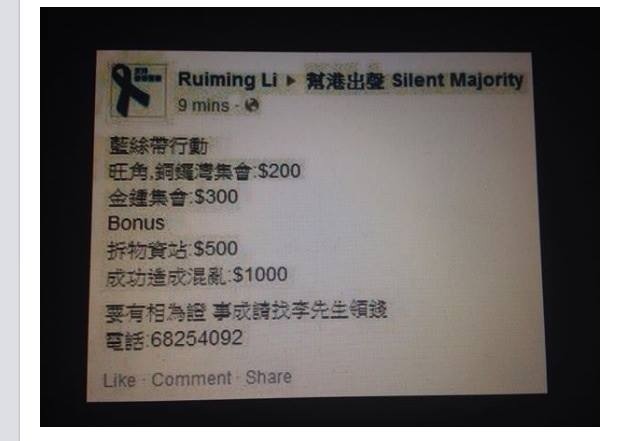
The price of a night of sanctioned thuggery: image

This post from the anti-Occupy Central Blue Ribbon Organization offers HK$ 200 to meet up in Mong Kok and Causeway Bay and HK$ 300 to meet up in Admiralty. Also on offer are HK$ 500 bonus to dismantle supply stations and HK$ 1,000 to create chaos, which presumably means “incite students to violence so police can justify retaliation”. To receive payment, there must be documented proof. Those interested in the job can call Mr. Li at the listed number.

The scale of the October 2 attacks indicate that the thuggery was not only organized, but also condoned by the Hong Kong police. Indeed, tweets, Facebook posts and next day news reports agree that Hong Kong police watched while thugs attacked students. In response, the students held their positions even as leaders urged the to leave the site and keep safe.

The government’s decision to partner up with thugs rather than meet with students to discuss their concerns reveals how unrepresentative the administration is, demonstrating an ugly lack of good faith. More generally, the decision also reveals the foundational violence of states–in choosing not to protect students from thugs, the police reminded everyone that they have the authority to both oppose and sanction violence against unarmed citizens.

In Shenzhen, the ongoing news blackout about Hong Kong protests does more than create an ignorant populace (愚民政府). The Shenzhen news blackout serves the same purpose as Hong Kong police complicity with thugs. The blackout reminds the public (who in fact know about the protests and in general support the students) that the government has unequal access to weapons (informational, economic and military).

In Shenzhen it doesn’t matter what we know to be true because the official account has been set through the blackout–nothing is happening. After all, not just the specter of Tiananmen haunts us. We also know that this show of media dominance is a statement of intent: a government that is willing to suppress information is also willing to use violence to secure its goals. Thus, although we know the official story is a deliberate lie, we do not break it, becoming complicit in the lies and violence against the Hong Kong students, even though we are also being attacked. And thus talk of support protests is effectively stymied.

The logic of informational violence is clear: Shenzhen people know about the protests, but accept the news blackout as inevitable. This acceptance is a demonstration of government power. The blackout is a deployment of informational violence against the people because it indicates that the government is willing to deploy weapons to insure compliance.

Indeed, in Shenzhen as in Hong Kong, the government is acting to isolate people from each other, creating vulnerable individuals and ultimately creating targets. As Beijing lawyer activist Bao Tong (鲍彤) pointedly asks in an opinion piece circulating on We Chat, “who exactly is responsible for blocking peaceful resolution of the universal suffrage question?”

Meanwhile, on October 1, Anonymous, a group of hacker-activists declared virtual war on the Hong Kong government, including the very scary threat to post private information of functionaries.

occupy central: impressions

This year marks the 25th anniversary of the Tiananmen Democracy movement and fateful crackdown on June 4, 1989. Annual commemoration protests have continued in Hong Kong since then. Perhaps 25 years of organized resistance to the violence of the Chinese State against unarmed protestors and commemorating student courage nurtured the soil for Occupy Central, nevertheless this year young Hong Kong people found voice and civil form for their own cause–truly democratic elections and autonomy in education, the media, and social organization. Indeed, if this level of civil disobedience is the result, all our children should grow up with the fine example of commemoration protests. And patience for our just seeds to bear fruit.

Beijing has already confirmed its support of Leung Chun Ying, the SAR’s unpopular Chief Executive, and crony of folks in Beijing. Unfortunately, the more cynical of us on this side of the border may be correct in supposing that as far as Beijing leaders are concerned what matters about the protest how it impacts Beijing.

Anyway, yesterday my husband and I crossed at Shenzhen Bay to Hong Kong, taking a bus directly to Sheung Wan. We arrived around 3 pm. The streets near the Macau Ferry Terminal drop-off point were quiet. As we followed the second floor walkway that winds from the terminal to Central and Wanchai, we passed several hundred Filipina and Indonesian maids, who occupied half the walkway. Like the students students, they sat on flattened cardboard boxes and plastic sheets, chatting, playing cards, and snacking, their umbrellas positioned to protect them from sunlight and rain. In fact, for over three decades, the guest workermaids have been occupying Hong Kong’s elevated walkways and public parks on their one day a week off. Arguably, it’s possible that the maids have taught the students something about how to make oneself at home on concrete.

The protest itself stretches about 6 kilometers. Without the cars, crowds, and noise of an open for business Central, the city’s amazing 3-dimensionality it becomes suddenly apparent. There are overpasses and walkways, underpasses and roads that split and curl into the air. The pristine glass and steel of Honk Kong’s iconic buildings shimmers into mythic forms. In the afternoon small groups of students sat on cardboard or plastic sheets chatting. Some had formed larger groups to listen to and and join conversations about the movement and the importance of securing social justice through civil disobedience. And yes, the reports are true. Hong Kong’s young people have put civility into civil disobedience.

A map of occupied area:

image

You can learn about the movement, their ideals and tactics at Occupy Central, a blog that keeps one abreast of the situation from a student perspective. You can also download the Chinese manual for peacefully occupying Central, 和平占中 which was published several days before the students began their collective action. As Sedna Popovic and Tori Porell argue in their article over at Slate, it’s the curtesy and non-violence that makes the Hong Kong protests formidable.

In solidarity with the students, impressions of an afternoon of peace and love for Hong Kong:

This slideshow requires JavaScript.

the violence of rural (re)construction (3): living genealogies

If you google “Hakka” all sorts of information comes up, ranging from Wikipedia’s Hakka People brief through the overwhelming comprehensive blog 客家风情 to more academic takes such as “The Secret History of The Hakkas: the Chinese Revolution as a Hakka Enterprise“.

These articles emphasize that the Hakka left the central plains for Southern China in a series of migrations. Hakka literally means “Guest People” and in the anthology, Down to Earth: The Territorial Bond in South China, for example, David Faure, Helen Siu and their colleagues nicely track the differentiation of Han Chinese into various ethnic groups, including the Dan (boat people not allowed on land), the Hakka, and dominant Cantonese.

image

Over time, the Hakka developed a distinct culture and history, including unique roles in the Taiping Rebellion (Hong Xiuquan was a Hakka) and subsequent Chinese Revolution; Sun Yat-Sen, the Soong sisters, and Deng Xiaoping, for example, were all Hakkas. Distinguishing features of Hakka identity include language, food, architecture, and a commitment to tradition and education that is said to exceed that of neighboring groups. Importantly, however, given the geographic range of Hakka settlements both within and outside the Chinese mainland, there is much diversity within the group. The Hakka standard is set in Meizhou, the county seat of Meixian, which brings us back to what’s at stake with the forced evictions in Meizhou.

The Hakka have lived in large compounds, where extended patrilineal families resided in organized proximity. These complexes have functioned as material genealogies with hierarchy emphasized through one’s room(s) within and location relative to the ancestral shrine, which has pride of place in any Hakka homestead. Indeed, even after compounds have been abandoned for newer buildings, often the ancestral shrine continues to host rituals and family matters, such as death memorials.

Many of the large homes that have been or are threatened with forced demolition in the Meizhou suburbs are low-income realizations of the larger ideal of bringing one family line together in one place. Overseas family members have contributed funds to build the homesteads, where several generations do live together. Importantly, those at home hold it for family members who are working either overseas or in cities like Shenzhen. Indeed, memories of and anticipated arrivals of absent family members characterize these homes. As does the cherished expectation of reunion, when the homestead will be filled and the family complete.

Also of note, many of the people standing guard over a family’s living history are women, who have married into the line and are therefore not considered part of the genealogy. So when the householder is female, she holds it for her sons, rather than explicitly for her husband. It became clear in conversation, that many of the women wanted a house for their families–children and maternal relatives, rather than explicitly to continue a particular line. Moreover, while the women told stories of their lives in these homes, the men would emphasize how these homes held a larger family together. Thus, the 5 or 6 women I spoke with were spoke of the need to keep a place for memories and future visits, while the men were more likely to demand compensation that would allow them to reproduce the building itself.

The unmaking of the multi-generational family has been one of the most obvious consequences of rural urbanization. After these homes are razed, they are replaced by smaller homes for China’s version of the nuclear family–an elder or two who take care of the only child of two working parents. In terms of traditional history, this breakdown clearly causes suffering and disorientation as family members try to make sense of a life without a shared root, even as it is also clearly that another uprooting has already taken place; the young people spoke Mandarin while their elders spoke Hakka. The results of centralized education and migrating populations contextualize the violence of rural reconstruction with respect to an ongoing state project to remake the countryside in Beijing’s image.

This slideshow requires JavaScript.

Part I/ Meizhou: The Violence of Rural (re)Construction

Part II/ Meizhou: Hoodlum Government

Part IV/ Meizhou: What Gets Preserved

Part V/ Meizhou: Lessons from Shenzhen

Meizhou VI/ Meizhou: Selected Translations

Occupy Hong Kong: A View from Shenzhen

This is a tale of two occupations–in Tin Sau Bazaar and Central, the former artistic and the later political, but both explicit calls for social justice.

On Saturday night, friends and I crossed the Shenzhen-Hong Kong border at Shenzhen Bay and took a local bus to the Tin Shui Wai (天水围) metro, where we jumped on the light rail to Tin Sau (天秀) and it’s underused bazaar.

The bazaar itself presented the symptoms of hyper planning. Isolated near the Chinese border, Tin Sau is home to low-income and chronically under employed Hong Kong residents. It is also inconveniently located with respect to the Tin Shui Wai town center. In short, visiting the market for anyone but local residents is a problem. Tin Sau hawkers and residents had set up an open and low-capital flee market in any empty lot. The flee market catered to the needs of its immediate community. However,the government decided to improve the situation by installing small stalls and kiosks that were too expensive for vendors to rent because the location only serves a low volume of local residents. Not unexpectedly the local response to hyper planning has been resentment and a lingering despair over the government’s failure not only to help the people of Tin Sau, but instead to have actively hurt them through ill considered policies.

This particular Saturday night culminated several months of community interventions with an Autumn Night’s Fair (天水秋凉祭) which had been organized by the Make a Difference program of the Hong Kong Institute of Contemporary Culture. MaD brings together young Hong Kongers aged 16-35 in order to provide fresh solutions to social problems. The Fair itself aimed to generate public interest in and support of local vendors. The Chinese name of the fair conveys the idea of autumn coolness, and indeed gentle breezes felt clean and fresh on bare arms and exposed faces. The tour of the bazaar, the art events, and karaoke area animated the area, bringing a sense of festivity to the area.

And yet. Although many people participated in the art events, fewer seemed to be shopping, which was the point of the Fair. It was clear that keeping the bazaar and this small community vibrant would require future interventions. Nevertheless, my Shenzhen friends were impressed by the social impulse behind the Fair, commenting that this was the work artists should be doing. They also expressed hope that such public benefit programs (公益) could be brought to Shenzhen in order to ameliorate injustice in the city.

Meanwhile in Central, tensions between unarmed student protestors and the police were escalating. The Occupy Central movement has embodied the social justice issue of Tin Sau–crudely, too much government high-handedness, not enough democracy–at a larger and more specifically political level. As I understand the protests, the justified complaint is that Beijing supervision of Hong Kong education and society will lead first to more restrictions on thought and action, and subsequently to a more complacent, less democratic populace.

Discussions I have seen on WeChat and Facebook indicate that Shenzheners who are talking about the issue sympathize with the students. They see a need for more openness and expressive freedom in Shenzhen. However, there have been no calls for support protests as in Taipei. Instead, the debate has reanimated questions from Tiananmen, namely: just how much opposition will the government allow before it takes punitive action? The terms of the conversation–allow, punitive action–chillingly illustrate how successful the Chinese state has been in creating fear and compliance even among people who do advocate artistic interventions like those in Tin Sau.

Indeed, my gut sense is that the vendors of Tin Sau share much in common with the Shenzhen middle class. These are people who have learned through visceral experiences that the government is no friend of ordinary citizens. I suspect this also partially explains why MaD’s efforts so moved my friends. This was hopeful action in the face of resignation to accumulated and embodied wrongs.

In contrast, the students’ actions seem more “international”, more distant from the Chinese juggernaut. These are the actions of people who do not yet act primarily out of fear, people who act in the belief that government officials will hear and respond to righteous calls. Moreover, the students’ actions remind contemporary Chinese of what was lost in 1989. These regrets permeate the Shenzhen voices I have heard. Here, there is anger that students haven’t left well enough alone and embarrassment that the students’ actions have revealed the violence of the Chinese state’s “One Government, Two Systems” policy. Clearly, if the Hong Kong police continue to harass and arrest unarmed, peaceful protestors, it is difficult to contend that the CCP can be trusted with democratic institutions and (future) protests in Taiwan. Importantly, I have also heard support for the students. The occasional voice that says, Yes! This what it means to be fully, ethically human!

All hope for the safe return of students to their families.

Below, pictures from the Tin Sau Autumn Night Fair.

This slideshow requires JavaScript.

白鼠笔记/Village Hack PDF!

After several months of hard work and time off for summer vacation, the 白薯笔记/Village Hack PDF is available for download. Wu Dan designed the layout, each of the hackers reflected on their experience, and many friends contributed images to make the PDF a wonderful introduction to Baishizhou lived otherwise. The village hack was about discovering possibilities, both one’s own and those of the urbanized village. Enjoy!

白鼠笔记

the violence of rural (re)construction (2): hoodlum government

In everyday conversation, forced evictions and demolitions are thought to be widespread.
However, except through site visits and conversations with local people it is difficult to ascertain which cities are most widely affected because there is a moratorium on reporting about actual cases. The Chinese media “reports happy things and not things that cause worry (报喜不报忧)”. In a situation like Meizhou this means that it is easy to find building plans and economic projections, but nearly impossible (except through more privatized forms of communication such as blogs and we chat) to find any reportage on actual events in real time.

The silence about the actual situation not only isolates vulnerable communities from larger social help, but also obfuscates the government’s role in the process. In a word, because there is no independent source of news, there is also no way of confidently reading a situation. Rumors fly, fear spreads, and the expression “hoodlum government (流氓政府)” is used when people know that they are being threatened in the name of a government program, but do not know if those threatening them are members of the police force, a particular government bureau, or actual thugs-for-hire.

Unfortunately, with respect to rural construction (乡建), hoodlum government is supposed to be the norm rather than the exception because we’ve stopped giving the government the benefit of the doubt.

Reported detained are: Gu Zhengqi (古正q奇) and Gu Wenchang (古文昌). Villagers barricaded the road into their village to prevent bulldozers from entering. The barricade stretched between Gu Zhengqi and Ge Wenchang’s neighboring houses.

Reports of hoodlum government in Meizhou include:

1. Threatening to have a student’s college acceptance revoked if the head of house doesn’t sign over property rights;

2. Allowing for the destruction or decay of houses because there is no compensation for unusable buildings;

3. At the same time, preventing villagers from repairing their homes;

4. Refusing to give fair compensation for property when villagers do negotiate;

5. Filling in waterways to create roads. This gives government officials and their proxies access to villages and makes it impossible to maintain rice paddies, which require regulated inundation and drainage;

6. Disrupting village elections and appointing grassroots level leaders who support government policy;

And 7. Destroying villagers’ cellphones, cameras and recorders to prevent documentation of the process, which in turn also makes reporting on the situation a “he said, she said situation”.

Below are images from our trip to Meizhou. Villagers hold pictures of detained family members and receipts for hospital care after a beating. They are standing in front of there houses or where their houses used to stand. The documents show a villager appraisal of his home and government response. The standard rebuttal, “too expensive”.

This slideshow requires JavaScript.

The other five entries in this series are:

Part I/ Meizhou: The Violence of Rural (re)Construction

Part III/ Meizhou: Living Genealogies

Part IV/ Meizhou: What Gets Preserved

Part V/ Meizhou: Lessons from Shenzhen

Meizhou VI/ Meizhou: Selected Translations