laying siege to the villages: the nantou peninsula

A five-part essay, “Laying Siege to the Villages” has been published online at Open Democracy. Here’s part two on the Nantou Peninsula.

2. Concentric Occupations: Nantou Peninsula

The built environment of Shenzhen urban villages references three historic moments – late Qing and Nationalist-era rural society, Maoist collectivization, and post Mao reforms. Spatially, this history has been expressed as concentric occupations, with the oldest sections being first appropriated and then surrounded by newer developments. In turn, older settlements have been downgraded and converted into low-income neighborhoods. Locally, this process has been called, “cities surround the countryside”, which not only resonates ironically in post Mao China, but also identifies poverty with rural status. Maoist theory and practice had identified cities with all that was foreign and reactionary, and villages with all that was truly national and revolutionary. In contrast, the elevation of Bao’an County to Shenzhen Municipality began the administrative transvaluation of the rural-urban relations, which was formalized in 1982 Chinese Constitution.

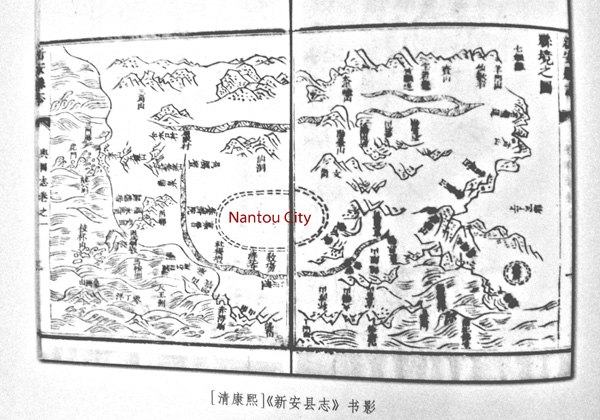
Over 1,000 years ago, salt fields were developed in the Shenzhen-Hong Kong area, and the yamen for the local salt intendant was located on the Nantou Peninsula. The area was also famous for its oyster and pearl production. The peninsula provided protected harbors and access to Guangzhou via the Pearl River. During the Ming dynasty, the Shenzhen-Hong Kong area was called Xin’an County and Nantou City was designated its County Seat. Located on the southeastern banks of the Pearl River, Xin’an was historically poorer than the counties on the eastern banks. Nevertheless, the harbors of the Pearl River’s eastern coastline were significantly deeper than those on the western coastline. Consequently, Chinese maritime access to the South China Sea traditionally went through Humen (in neighboring Dongguan) and Nantou. Indeed, Zheng He’s fleet stopped at the Tianhou Temple in Chiwan Harbor on their voyages of exploration (1405-1433), which took the Ming explorer as far as Africa. After the Ming ban on ocean travel made it possible for pirates to control the South China Sea, Guangzhou remained the southern gate to China and the ports on the eastern coast of the Pearl River became even more coveted by international traders (map 2).

nantou old city

Map 2: Xin’an County Seat in the Reign of the Kangxi Emperor (1661-1722)

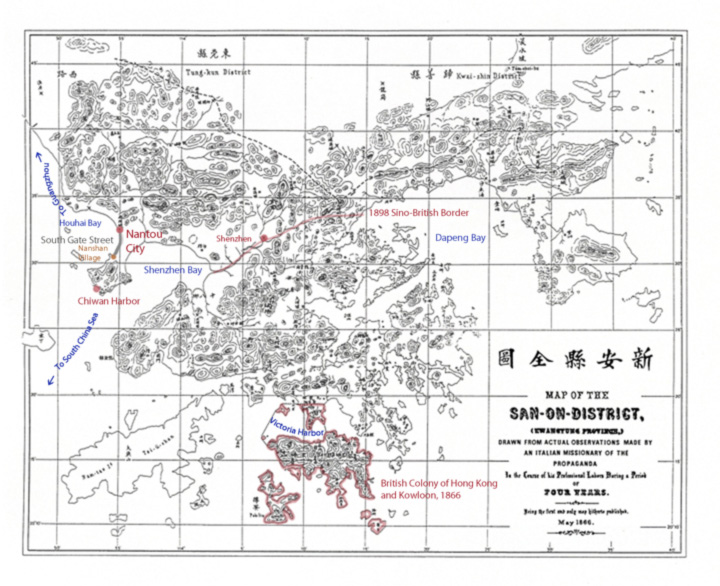
By the late 18th Century, Guangzhou had not only become and important financial center, but also the center of opium trade. The first Opium War ignited when Lin Zexu dumped the opium stocks of British traders in the Pearl River. In turn, the traders successfully pressured the British government to use military means to secure compensation for their losses. China’s defeat in the Opium Wars resulted in British colonialization of southern Xin’an, including Hong Kong Island, the Kowloon Peninsula and the New Territories. The Sino-British border was drawn along the Shenzhen River and passed just south of Shenzhen Market (map 3). The laying of the Kowloon-Canton Railway in 1913 further shifted the flow of goods and people toward Hong Kong and away from Nantou. Small-scale trade between settlements on the Pearl River continued, although Nantou no longer played a dominant role in the regional political-economy. Instead, Shenzhen Market, the first station on the Chinese side of the KCR became the political and economic center of Xin’an County, which was renamed Bao’an at the start of the Nationalist era.

incursions

Map 3: Riparian Trade Routes, Nantou City, and British Incursions

In fact, the establishment of Shenzhen explicitly invoked colonial history, making the return of Hong Kong to Chinese sovereignty one of the key political impulses behind economic liberalization. Maoist modernization of Nantou, for example, included a two-lane road (today known as New South Road), which was laid parallel to the ancient South Gate Road and connected the peninsula villages to the national railroad and highway system. In the post Mao-era, however, state investment has aimed to urbanize the area, rather than to integrate rural settlements into the state apparatus. Land reclamation of Pearl River coastline gives the clearest indication of the scale and ambition of these plans – replacing Hong Kong and possibly even Guangzhou in the global organization of South China trade.

The reform-era transformation of the Nantou Peninsula illustrates the broad contours and social contradictions that have characterized “cities surround the countryside”. During the Ming Dynasty, a pounded earth wall enclosed Nantou, but by the time of the first Opium War, the wall had crumbled into disuse and only the southern and eastern gates still stood. A road stretched from the decrepit Southern Gate and along the coast of the Pearl River to Nanshan Village, which was located at the foot of Nanshan Mountain. Between Nantou Old City and Nanshan Village six villages – Guankou, Yongxia, Tianxia, Xiangnan, Beitou, and Nanyuan – claimed land that included access to the Pearl River, a portion of South Gate Road that they identified as Village Main Street, and farmlands that extended inland. However, through land reclamation and the emplacement of a grid of four- and six-lane roads, such as Qianhai Thoroughfare, Shenzhen’s rural origins have been surrounded and isolated South Gate Street neighborhoods from the larger city (map 4).

 surrounding the countryside

Map 4: Cities Surround the Countryside: The Nantou Peninsula

laying siege to the villages: lessons from shenzhen

An essay written for Open Democracy is now online. Here’s the introduction. Over the next few days, I will put up the sections on Nantou, Luohu-Dongmen, Xixiang, and Baishizhou.

Laying Siege to the Villages: Informal Urbanization in Shenzhen

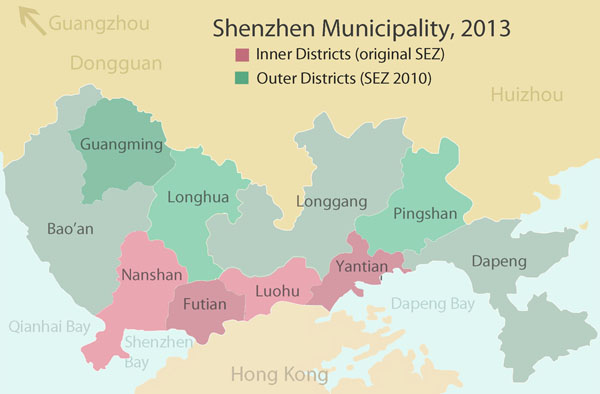
Although Shenzhen is famous for its “urban villages” or “villages in the city” (城中村 chengzhongcun), nevertheless, in 2004 Shenzhen became the first Chinese city without villages. Full stop. This fact bears repeating: legally, there are no villages in Shenzhen. As of 2007, Shenzhen Municipality had a five-tiered bureaucracy consisting of the municipality (市shi), districts (市区shiqu), new districts (新区 xinqu), sub-districts or streets (街道jiedao), and communities (社区shequ). Since 2010, the Districts have been known as the inner districts and outer districts, reflecting when they were incorporated into the Shenzhen Special Economic Zone (SEZ) (Map 1).

 Administrative_Divisions_of_Shenzhen_City

Under Mao, rural areas were China’s revolutionary heart and “villages surrounded the city (农村围绕城市)” was an explicit political, economic, and social strategy for revolutionary change. The Mandarin expression “surrounds (围绕)” can also be translated as “lays siege to”, highlighting the rural basis of the Chinese Revolution. Early Chinese Communists had followed the Russian example and entered cities to organize workers. However, when Nationalist forces led by Generalissimo Chiang Kai-shek violently suppressed Communist organizations in Chinese cities the Communists retreated to the countryside. Moreover, communists and local people identified colonial ports such as Hong Kong with the proliferation of traitors, parasitic merchants, and corrupt officials. Consequently, while Marx claimed that modern history was the urbanization of the countryside, the Chinese revolution aimed to re-occupy and purify the cities. Beginning in 1927 until the occupation of Beijing in 1949, the Communists organized rural resistance to both Japanese invaders and Nationalist hegemony, literally surrounding the cities with an estimated 5 million rural soldiers.

The establishment of Shenzhen signaled the beginning of a new era in Chinese history – “cities surround the villages (城市围绕农村)”, an expression which Shenzhen urban planners and architects have self-consciously used to describe urbanization in the city. Historically, there were legally constituted villages in Shenzhen. The present ambiguity over the status of villages and villagers is a result of contradictions between Maoist economic planning and post-Mao liberalization policies. Under Mao, the country was segregated into rural and urban areas. In rural areas, villages were designated production teams and organized into work brigades that were administered by communes. Communes had to meet agricultural production quotas that financed industrial urbanization and socialist welfare policies in cities, which were tellingly defined as “not-agrarian (非农feinong)”. Importantly, the hukou or household registration policy literally kept people in place – the allocation of food, housing, jobs, and social welfare took place through hukou status. Food and grain coupons were city-specific, for example, and a Shanghai meat coupon could not be legally exchanged in a neighboring city, let alone Beijing. In rural areas, however, communes and production brigades provided neither food coupons nor housing to members. Instead, brigade members produced their own food (usually what was leftover after production quotas had been met) and built their own homes or rural dormitories as they were known in the Maoist system.

In 1979, when the Guangdong Provincial Government elevated Bao’an County to Shenzhen Municipality, the area was rural, and the majority of its 300,000 residents had household registration in one of 21 communes, which were further organized into 207 production brigades. However, hukou status notwithstanding, the integration of brigades and teams had not been complete and members continued to identify with traditional village identities. Although the names of Shenzhen’s current districts were the names of ten of the larger communes, for example, with the exception of Guangming, they were also historically the names of large villages that had been the headquarters for communes. In 1980, the Central government further liberalized economic policy in Shenzhen by establishing the area that bordered Hong Kong as a Special Economic Zone (SEZ). This internal border was known as “the second line”, in contrast to the Sino-British border at Hong Kong or “the first line”. The re-designation legalized industrial manufacturing and foreign investment (primarily from Hong Kong) in the new SEZ. Outside the second line, Shenzhen Municipality established New Bao’an County, which was still legally rural and administered through collective institutions.

The elevation of Bao’an County to Shenzhen Municipality created an anomalous situation within Socialist China because the administrative division of Shenzhen into the SEZ and New Bao’an County only legalized new economic measures; it did not transfer traditional land rights from brigades and teams to the new municipal government. Instead, the first task of urban work units that came to the SEZ was to negotiate the equitable transfer of land rights from the collectives to the urban state apparatus. The goal was to insure that rural workers would continue to have space for housing and enough land to ensure agricultural livelihoods. And this is where historical village identities reasserted themselves. In theory, the urban work units negotiated with brigade and team leaders to transfer the administration of land from the rural to the urban sector of the state apparatus. In turn, the brigades and teams would continue to produce food for the new urban settlements. In practice, however, brigade and team leaders acted on behalf of their natal villages and co-villagers, asserting a pre-revolutionary social identity.

The legal slippage between collective identity within China’s rural state apparatus and collective identity through membership in a traditional village arose because although the Constitution and subsequent Land Law of 1986 stated that rural farmland belonged to the collective, neither document went so far as to define what a collective actually was in law. Indeed, the difference between rural and urban property rights has been the foundation for post-Mao reforms, first in Shenzhen and then throughout the country. In 1982, the amended Constitution formally outlined the different property rights under rural and urban government. According to Article 8 of the Chinese Constitution:

Rural people’s communes, agricultural producers’ co-operatives, and other forms of co- operative economy such as producers’ supply and marketing, credit and consumers co-operatives, belong to the sector of socialist economy under collective ownership by the working people. Working people who are members of rural economic collectives have the right, within the limits prescribed by law, to farm private plots of cropland and hilly land, engage in household sideline production and raise privately owned livestock. The various forms of co-operative economy in the cities and towns, such as those in the handicraft, industrial, building, transport, commercial and service trades, all belong to the sector of socialist economy under collective ownership by the working people. The state protects the lawful rights and interests of the urban and rural economic collectives and encourages, guides and helps the growth of the collective economy.[1]

In contrast, according to Article 10, land in cities is owned by the State:

Land in the rural and suburban areas is owned by collectives except for those portions which belong to the state in accordance with the law; house sites and private plots of cropland and hilly land are also owned by collectives. The state may in the public interest take over land for its use in accordance with the law. No organization or individual may appropriate, buy, sell or lease land, or unlawfully transfer land in other ways. All organizations and individuals who use land must make rational use of the land.[2]

The contradiction between the fact that villages no longer have legal status in Shenzhen and their traditional claims to land rights and social status – both of which are recognized by Shenzhen officials and residents – has constituted a serious political challenge for Shenzhen officials, who have viewed the villages as impediments to “normal (正常)” urbanization. Officials have defined “normal” urbanization with respect to the Shenzhen’s Comprehensive Urban Plan, which has already gone through four editions (1982, 1986, 1996, and 2010). In other words, “normal” urbanization has referred either to formal urbanization or informal urbanization that has secured legal recognition. In contrast, Shenzhen’s urban villages emerged informally as local residents not only built rental properties to house the city’s booming migrant population, but also developed corporate industrial parks, commercial recreational and entertainment centers, and shopping streets. As of January 2013, for example, it was estimated that half of Shenzhen’s 15 million registered inhabitants lived in the villages. Moreover, these densely inhabited settlements also provided the physical infrastructure that has sustained the city’s extensive grey economy, including piecework manufacturing, spas and massage parlors, and cheap consumer goods.

In Shenzhen, urban villages have been the architectural form through which migrants and low-status citizens have claimed rights to the city. Importantly, informal urbanization in the villages has occurred both in dialogue with and in opposition to formally planned urbanization. On the one hand, informal urbanization in Shenzhen urban villages has ameliorated many of the more serious manifestations of urban blight that plague other boomtowns. Unlike Brazilian favelas, for example, Shenzhen urban villages are not located at the edge of the city, but rather distributed throughout the entire city and many urban villages occupy prime real estate. Consequently, Shenzhen’s urban villages have been integrated into the city’s infrastructure grid and receive water, electricity, and also have access to cheap and convenient public transportation. Moreover, as Shenzhen has liberalized its hukou laws, urban villages have also been where migrants have access to social services, including schools and medical clinics. Thus, Shenzhen’s urban villages have provided informal solutions to boomtown conditions. On the other hand, the lack of formal legal status of urban villages and by extension the residents of urban villages has allowed the Municipality to ignore residents’ rights to the city via the convenience of centrally located low-income neighborhoods. In fact, the ambiguous status of urban villages became even more vexed in 2007, when the Shenzhen government initiated a plan to renovate urban villages. It has been widely assumed that the government promulgated the new plan in order to benefit from the real estate value of urban village settlements. Critically, the Municipality’s plans for urban renovation compensated original villagers while ignoring the resettlement needs of migrant residents. Thus, the status of at least half of Shenzhen’s population suddenly entered into public discourse as it has become apparent that although the urban villages resulted from informal practices, nevertheless, they have been the basis for the city’s boom.

Ruralization: The Ideology of Global Inequality

Each of the sections in this essay explores the social antagonisms that have emerged through the transformation of Bao’an County into Shenzhen Municipality via informal urbanization in the villages. The point is that Shenzhen’s so-called urban villages are in fact urban neighborhoods that grew out of previous rural settlements through rapid industrial urbanization. Nevertheless, the designation of “rural” or “village” still clings to these neighborhoods, making them the target of renovation projects and ongoing calls for upgrades. In turn, these calls justify razing neighborhoods and displacing the working poor with upper and upper middle class residential and commercial areas. Recently, Caiwuwei was razed and rebuilt as the KK 100 Mall, while Dachong was razed and as of 2013 a new development under construction. Hubei, the old commercial center in Luohu has been designated as the next major area to be razed, while in late 2012, the Shenzhen Government and Lujing Developers announced their intention to raze and rebuild Baishizhou as a centrally located luxury development.

In Shenzhen, ruralization is primarily an ideological practice through which neighborhoods for the working poor and low-income families have been created by denying the urbanity of these neighborhoods and their residents. In this practice, the city’s rural history is invoked to demonstrate that neighborhoods which grew out of villages are continuations of the village, rather than the results of informal urbanization. Indeed, there are few actual remains of Shenzhen’s rural past. Instead, the target of official rural renovation projects are in fact the informal housing and industrial parks that were built roughly between the mid 1980s through 2004/5, when the municipal government began actively preventing informal construction.

In addition, I have included annotated maps and photographs that illustrate the spatial and social forms of these different contradictions have taken. With respect to recent Chinese history, this level of specificity aims to make salient how Shenzhen enabled national leaders to reform Mao’s rural revolution. With respect to contemporary research on mega-cities, this essay draws attention to the ways in which architectural forms have facilitated neoliberal urbanisms that exclude the poor from desired futures.

[1] Constitution of the People’s Republic of China (adopted on December 4, 1982), accessed at http://english.people.com.cn/constitution/constitution.html on February 26, 2013.

[2] Ibid.

shenzhen beggars

Several days ago on the subway, a man approached me. His speech was slow, his eyes empty, and he showed me a ripped pocket where he claimed his money had been stolen. I asked him his story and he said he had been robbed and that he didn’t want to bother his parents. He said he had a job tomorrow and all he wanted to do was eat. After I gave him some money, he shuffled off the car at the next stop. My friend said that the beggar had targeted us, that he had watched me for several minutes, heard me speaking Mandarin and then decided to approach me. The implication, of course, was that I had been cheated, tricked into giving money to someone undeserving of that handout.

Here’s the rub: I don’t know what made him undeserving — the fact that he [may have] tricked me or the fact that he was working as a beggar, rather than at a “real” job, like part time journal editor, such as myself. I do know that I had a visceral response to my friend’s comment — I wanted to prove that I could tell the difference between those deserving and those undeserving of charity.

Financially, it wasn’t as if the money I gave him could actually buy all that much. As I pointed out to my friend, if I were to forego one 500 rmb meal a month, I could give 2 rmb to every beggar I encounter and still save money each month. What’s more, when I take the time to prepare a pocketful of 1 rmb coins and bills, giving to beggars is a straightforward opportunity to practice generosity in my daily life. So why the resistance to giving?

At the time my friend pointed out that I had probably been targeted, I felt ashamed and tried to defend myself. I argued that I would rather risk being tricked by 99 rather than missing the chance to help the one in need. But, I didn’t give enough to actually change the beggar’s life — only he could do that. In retrospect, I’m wondering about my responses –first to the beggar (I wanted to give) and then to my friend (I didn’t want to appear a dupe). I have realized that I made the encounter all about me, rather than trying to figure out what might be an appropriate response.

Almost twenty years now, I have watched the Shenzhen poor grow both relatively and absolutely poorer. On the one hand, most people in Shenzhen have access to jobs and living conditions that they would not have in neidi cities and rural areas. On the other hand, economic polarization grows as quickly as the city. And many businessmen complain that monthly factory wages have risen to “as much” as 2,500 rmb (approximately $US 400.00), which is less than the price of most high-end electronics. And this change has left moral confusion and self-doubt in its wake: what if there isn’t an appropriate response to poverty that is a result of the change? What if all that remains is witnessing the fallout, both socially and in one’s heart?

carry the purse, gentlemen!

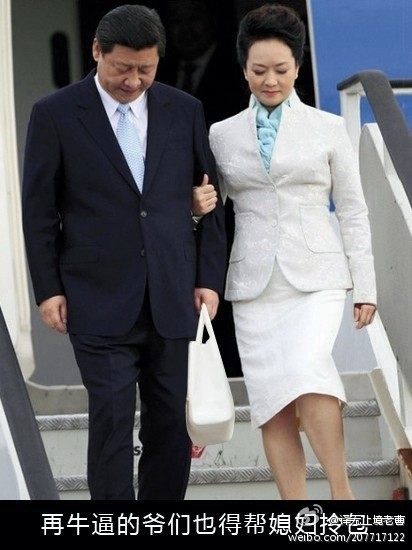
5198cc4ejw1e326t05m2gjMeme du jour: Even the most impressive have to carry their wife’s purse (在牛逼的爷们也得帮媳妇拎包).

Yes, it’s true. Xi Jinping carryies wife, Peng Liyuan (彭丽媛)’s purse and the Chinese internet is gleefully sharing the news. I know that many westerners-in-China have been disconcerted by the fact during a Chinese courtship, men carry their girlfriend’s purse. After marriage,  many men — especially those “caring alpha” types — carry their wife’s purse. And now Xi Jinping and Peng Liyuan have brought this bit of intimacy to the international scene.

My friends have been thrilled by Peng Liyuan’s performance as China’s First Lady. Now, they’re ecstatic that she’s reminding their menfolk about what it means to be a gentleman.

dongjiaotou: vanishing edges

This afternoon, the old coast that was Dongjiaotou Port abruptly became visible. Until as recently as 10 years ago, Dongjiaotou had been a small port for shipping building materials — sand and bricks and tiles — from other Delta cities to western Shenzhen. However, land reclamation has overtaken the area behind the small mountain. Along the new coastal sidewalk, fishermen and their wives held a remnant market and then, suddenly, the road turns onto Nanshan District’s upscale neighborhoods. Impressions of a shifting landscape, below.

This slideshow requires JavaScript.

what kind of pig are you?

This is one of those unscientific “he said, she said” illustrations of just how difficult it is to know what’s happening in China, or anywhere for that matter. The story also indicates that the US and Chinese social media are not as autonomous as we might think. Indeed, anonymous sourced information that circulates in either the US or Chinese social media seems to increasingly show up in other networks, much like pig carcasses that wash up on unexpected shores. More to the point, the chronology through which we experience the overlaps between US and Chinese social media networks creates stories that read as magic realism in which you, gentle reader, must ask yourself, “what kind of a pig am I?”

Here is the timeline through which I have experienced the pig story.

Two weeks ago, several hundred dead pigs were found floating in the Jiaxing River, a tributary of Shanghai’s Huangpu River.

Last week, an American friend uploaded this photo Pigs Swimming in Mud Cake to Facebook.pigs swimming in mudcake

Yesterday, a friend in Hong Kong, uploaded the same picture and what followed were a series of jokes about not eating pigs and pork products. The apparent prompt for forwarding the picture was another message that was also circulating:

 I don’t know if this is true or false, but it must be forwarded: eat less pork! Shanghai has claimed that over 8,000 pigs froze to death! In the middle of a bright South China Spring! I’m begging the relevant ministries – can’t you exert your brains and come up with a more believable reason? Don’t treat the people as if we were three year olds. One dead pig is a random occurrence. Two dead pigs is a random occurrence. But over 8,000 pigs dead is random? There must be a reason! Today, the truth has finally been revealed! – Where is the future of the Chinese People? We’re digging our own graves and anhilating our people! [Forwarded message: according to a pig farmer, there’s a chemical called 机砷. In ordinary language that’s 砒霜 or arsenic! This chemical is used in pig feed like “四月肥” [literally “Fat in April”- MA] that accelerate the maturation of pig and make their skin shiny, increasing profits from selling pigs. The downside to the process is that the arsenic accumulates in the pigs’ bodies, which have no way of breaking down the poison. The poison causes the pigs’ internal organs to rot, and after four or five months eating this pig feed, most pigs die. Consequently, farmers only use this pig feed three or four months before bringing their pigs to market. As long as the pigs are slaughtered immediately, there’s no problem. But this Chinese New Year’s season, it was mandated that there could be no more government feasting and banqueting. Suddenly, the bottom dropped out of the pork market. Pig farmers were forced to continue raising pigs that had already been eating contaminated pig feed for four months. A month or two later, a massive die-off of the pigs that had been prepared to sell during the New Year’s season started. This story couldn’t be revealed. However, no one dared to bring already dead pig meat to market [instead of living pigs that would be slaughtered onsite to guarantee freshness – MA]. Consequently, the pig carcasses were tossed into tributaries of the Huangpu River. Clearly, the problem was caused because on the one hand, too many pig farmers are using pig feed to accelerate maturation and on the other hand, the banquet ban was too effective. The floating carcasses were discovered by the media. So maybe a thousand, maybe more pig carcasses are drifting silently in the Huangpu River. This is the horrific story that they are telling.

In contrast, yesterday The Guardian posted an article that mentioned that the pig carcass total had breached 16,000, and attributed the reason to a crackdown on selling dead pig meat in markets. In turn, The Guardian was citing (circulating?) a story from Southern Weekly (of the China Dream censorship fiasco):

The state-controlled Southern Weekly newspaper, citing court documents, said three men were sentenced to life in prison in Jiaxing last November for procuring dead pigs to sell their meat. It says the men and their group bought 77,000 dead pigs in a period of more than two years.

So, reflective moment du jour: Who are you? A pig happily swimming in a mud cake, anticipating sugar highs? Or a pig drifiting in dark waters, fearful about what the Chinese government might be hiding and how this silence kills? Of course, it’s all evidence that China and the US are the same country. After all, processed white sugar may also be toxic.

Text of the Chinese weixin that I received:

不知是真是假,但是不得不转: 少吃猪肉吧】上海8千多头死猪死因公布了一一居然是冻死的! 在春花灿烂的江南三月! 拜托了有关部门,能否多动动脑子找个更可信点的理由,不要把民众当三岁小孩哄。一头死了是偶然,二头死了是偶然,8千多头是偶然事件?一定有其必然的原 因! 现在,真相终于大白天下了! 一一一中国人的未来在哪里??我们在自掘坟墓,灭绝民族! 【转:据猪农说,有种制剂叫有机砷,砷就是砒霜啦,用在四月肥之类的猪饲料添加剂里,可以促进猪性腺发育和毛皮红亮,改进卖相有利于卖个好价钱。 但副作用是有 机砷蓄积在猪体内会部分分解为无机砷,喂食四五个月后会大幅增加猪的内脏腐蚀、大批死亡的概率。所以一般是在预备出栏前三四个月开始用,反正负作用还没出 来猪就宰了出栏,规避了有机砷的风险。 然而熹兴年底眼看通胀要升腾,赶紧猛刹车大力禁绝国企和机关摆酒席过年,导致大量酒席突然被取消,相应 地酒席用肉也大幅低于预期。猪农已经喂好四月肥准备出栏宰杀的猪也被迫继续在栏里养着。可是有机砷已经用了,本来马上宰杀负作用还不会出来,现在拖了一两 个月还没卖出去,有机砷的副作用 上来了,猪们纷纷内脏腐烂而死。这死因见不得光,又不敢拿去市场上卖这样的死猪肉,养殖户只好打落牙往肚里咽,抛到河里了 事。孰料这么投有机砷的养猪户太多,年末禁酒席的影响又太普遍,大家都往河里一丢,猪尸们就在黄浦江大游行了,被媒体发现了。 成千上万的猪尸在阴冷的黄浦江上默默地飘荡,它们在讲述着这样一个可怕的故事。

more from jonathan bach

Open Democracy’s Cities in Conflict project has a posted “Shenzhen: Constructing the City, Reconstructing Subjects” by Jonathan Bach, a scholar who crafts elegant and insightful essays on Shenzhen. Here’s a taste:

Premised on exports and experiment, Shenzhen is a city stretched between high expectations and the unintended consequences of constant expansion. Great expectations lie in its DNA; from Deng Xiaoping’s conviction that the creation of Shenzhen in 1979 would spur China’s reform and opening, to his prodding in 1992 that the city not “act as women with bound feet,” to current leader Xi Jinping’s symbolic choice of Shenzhen for his first official visit in December 2012 to signal his reform agenda. Shenzhen did meet expectations, and then some. As one of our greatest contemporary urban experiments, the staggering growth that made Shenzhen synonymous with the rise of “Made in China” must be regarded as much as the result of massive improvisation as of master planning. And today, what started as a city of exception is a site of an ongoing struggle to define the rule.

Visit Open Democracy not only to read this essay, but also to contextualize what’s happening in Shenzhen with respect to other mega-city projects worldwide.

more about oysters

Anyone who has crossed from Shekou to Tun Mun via the Shenzhen Bay Western Corridor Bridge has seen the clear line that demarcates the Shenzhen-Hong Kong borridor. South of the border are floating oyster beds. North of the border, it has been illegal to raise oysters since 2006. However, at the remnants of what was once Shenzhen Harbor, those oysters are sold by the men and women who raise them — all of whom live in Shenzhen. Today’s impressions from a walk that stretches from the upscale neighborhoods of the Peninsula Estates and the Shenzhen Bay Park to the impromptu docks, where oysters were being unloaded and sold, along with a yellow fish.

This slideshow requires JavaScript.

long ago and far away

The OCT Dongfang Garden villas were built in the 1980s before the age of theme parks and land reclamation. A glance at the relevant OCT real estate webpage indicates how close the villas were built to Shenzhen Bay as well as the basic suburban layout of free standing homes. Over the past decades, the area was forgotten and is in the midst of being re-gentrified by a second generation of homeowners. Nevertheless, the neighborhood still feels abandoned despite being nestled between the Splendid China and Windows of the World. Impressions below.

This slideshow requires JavaScript.

what is the price of a human life?

If my friends are to be believed, doctors occupy the same hated position in China that lawyers occupy in the United States; they are the white-collar workers who represent all that is wrong with the system.

Indeed, the similarities between stereotypes are striking: Chinese doctors are said to be only working for money; if you go to a public doctor, you can expect substandard care, and; the purpose of medicine is to keep you in the system, paying for unnecessary tests and medicines. Good doctors are few; they work against a system that is stacked against them, and the common people suffer for the greed of the majority of bad doctors. Similarly, not a few Americans hold the same ideas, albeit about lawyers. Private attorneys are only in it for the money; if you have a public attorney you can expect to lose your case, and; the purpose of legal advice is to keep you in the system, paying for unnecessary hours and court appearance. Good lawyers are few; they work against a system that is stacked against them, and the common people suffer for the greed of the majority of bad doctors.

Not unsurprisingly, there are all sorts of Chinese doctor shows — both for entertainment and self-help, just as there all sorts of US American lawyer shows and call-in programs. A popular trope in both countries is the renegade who addresses the injustice of the system, dispensing healthcare and legal aid without thought for his or her personal gain. In these shows, lives are at stake and doctors and lawyers save the day in happy endings and loose the day in tragedies. Likewise, an assortment of hacks lurk in these programs and take advantage of unsuspecting or desperate folk, who have nowhere else to turn. Moreover,there is generally an implied moral entitlement: good characters should receive top medical care in China or the very best representation (in the US).

Interestingly, the contempt that common Chinese and ordinary Americans feel for their doctors and lawyers, respectively, is directly related to the fact that (unlike other white-collar workers), doctors and lawyers represent the highest political values in their country. The purpose of government in China, for example, is to provide for the wellbeing of the population. This care includes healthy food, affordable homes, and timely medical care. Indeed, it is remarkable the outrage and press coverage that these three issues consistently generate in the Chinese press, online, and now through weixin (Tencent’s We Chat app).  In the US, we hold our government accountable to protect our rights, both from each other and against corporations. In China, doctors are the last line of defence in securing wellbeing. Likewise, in the US, we turn to lawyers to secure our rights. And yes, those who break the law and get away with it repeatedly show up in the headlines, while taking on the legal system and calls for particular uses there of can turn mere pundits into talk show personalities and ordinary people into national heroes.

Speculation du jour: Chinese doctors and US American lawyers have been cast as villians and heroes in national dramas because neither system is providing the “good life” for its people. In China, wellbeing is the highest value and doctors exist to maintain this wellbeing. In the US, fairness is the highest value and lawyers exist to ensure a level playing field. However, in both countries, those in most need of healthcare or legal aid are most likely not to receive it. Moreover, Chinese doctors often can’t provide adequete healthcare without bankrupting patients, just as UA lawyers can’t provide decent representation without bankrupting clients. In both cases, systemic breakdowns break ordinary lives. Nevertheless, public anger has not (yet) led for widespread calls to change either the Chinese or American systems, but rather nasty jokes about and threats against doctors and lawyers, respectively.

Sigh.