as if it never happened…

So, after a long silence, I return to The Great Transformation (沧海桑田:深圳村庄30年) and the ongoing composition of an official history for Shenzhen’s villages.

This official history begins with poetry. Located on Shenzhen Bay coastline, Shazui Village was established over 900 years ago. Villagers were surnamed Ou and their ancestors immigrated from Pingyang, Shaanxi via Shaoguan in northern Guangdong. At first, Shazui specialized in harvesting sea salt. However, over time the water became sweeter and it was no longer possible to making a living harvesting sea salt. According to Shazui oral history, village ancestors then started fishing and expanded village holdings inland, planting lychee orchards and rice paddies. The village’s history was recorded in poetry and couplets that villagers transmitted orally. For example, a seven-line poem that traced the history of the migration guaranteed hospitality between communities that shared the Ou surname.

金陵被乱始南辕    Chaos during the Jinling era forced the southern migration

唯有祯昌百代传    Only luck has been inherited by a hundred generations

一举汀州二细滘    The first stop was Dingzhou, the second Xijiao

三子石壁四陈村    The third stop was Shibi, the forth Chen Village

自从棉圃而交广    Leaving northern cotton fields, they entered Guangdong

世起堂梁厉宗元    The ancestor re-established the family

支派不拘分欠别    And new branches were established

明溪桥内祖根源    The ancestral well is by the Ming Creek bridge

In 1943, over 40 of Shazui’s less than 400 villagers died during a drought. This history was recorded in the following verse, “Thousands remember, ten thousands remember that in the 33rd year of the Nationalist era, a dollar bought 10 grams of rice (千记万记,记得民国三十三,一元买米三钱二).”

Subsequently, the official history of the transformation from socialist to capitalist collective begins with creative appropriation of the household responsibility system. In 1978, Shazui took advantage of easing policies to introduce a hybrid form of collective production, selling surplus vegetables and fish both in Shenzhen and in Hong Kong. One person from each family could join a voluntary association of 10 people. Each group gave 100,000 rmb to the collective, and then divided the profits amongst association members. Leaders were not permitted to join an association, however, any laborer could join an association. Within five years, many Shazui villagers had become rich and by 1983, Shazui villagers had put up new homes on their 30 m2 Mao-era plats. The villagers then decided to plan Shazui New Village, putting up handshakes as well as collective property, including factories.

Building the factories further transformed village organization, as the village secretly formed a limited stock-holding company. In 1984, Shazui leaders asked each villager to invest 10,000 into the factory zone. At first, villagers refused and leaders hoped to borrow 5 million from a bank. However, at the time, banking restrictions were strict and villages did not have an opportunity to secure finance capital. Instead, village leaders went back to the village with the following proposal: each villager would invest 10,000. Over the next three years, the village could use this capital to grow its industry. Beginning in the 4th year, the village organization and village investors would split profits 40-60. In the eleventh year of operation, the percentage would reverse, with the collective receiving 60% of the profits and villagers sharing 40%. At the end of this second decade, all profits from the collective enterprise would go to the village.

As of 1985, the new village occupied an area of 6.3 km2 and had earned commendations from Shenzhen Party Secretary and Mayor, Liang Xiang. Many villagers secured plats (宅基地) of 300 m2, three times larger than the area that would be formally recognized by the Shenzhen Government in later years. Moreover, the village also had to put in roads that would be wide enough to connect the village factories to cross-border shipping points at Wenjingdu. Indeed, although Shazui was only five kilometers from the Luohu border, until the new roads were laid, it took one hour to travel from Shazui to the Luohu. And this is where the official story ends until it jumps twenty years to a village cleanup and environmental upgrade.

What happened during the twenty years that the official story skips? In the years between 1985 well into the new millennium, Shazui went from being an enterprising village to Shenzhen’s most infamous second wife village. Village investment in planning and construction meant that relative to the surrounding area, Shazui New Village was a cheap, convenient, and comfortable place to live. Investors and visitors took up residence in Shazui and villagers opened restaurants, discos and bars. By the early 1990s, the collective was itself promoting the shift to a sex-based economy building hotels, restaurants, rental properties, and spas. This history cumulated with the infamous public shaming of Shazui prostitutes in 2008.

And there’s the rub: if we are to talk about the transformation of Shenzhen’s villages from poor rural settlements into neighborhoods for the working poor, we aren’t actually talking about what the villagers alone were up to. We’re actually writing the history of global capitalism and its rebranding by ambitious governments. Suddenly, Shenzhen’s villages become the quintessential rags to riches story. Or to quote Mark Ravenhill’s observation in Shopping and Fucking: Making money is barbarous, but having money is civilization.

…a village by any other name…

Huaxin Village is not a village. Located at the intersection of Huaqiang and Hongli Roads, Huaxin was one of the earliest residential areas built in Shenzhen. It boasted 30 lowrise apartment buildings, a business office, and an office for neighborhood offices. In total, the neighborhood had 1007 homes. Walking west, the neigborhood abutted Fuhua Village and then opened into the northern section of Shenzhen’s Central Park.

To walk this area is to get a sense of the excitement and utopian discourse that permeated early Shenzhen. Huaxin literally means “China New (华新)”, Fuhua means “Prosperous China (福华)”, and Huaqiang means “China Strong (华强)”. Moreover, in the 1980s, the area north of Hongli Road was considered suburban with respect to the Dongmen and Luohu areas near the train station. Consequently, planning in this area primarily included factories and residential neighborhoods, such as Huaxin.

The layout of Huaxin  illustrates early understandings of public space and semi-public spaces. In addition to a public garden, the residential area also had a soccer field and areas for sitting and chatting. Moreover, along walkways, designers had included planters. When Huaxin housed the young SEZ’s managerial class, the ornamentals filled the planters. Over the past decade, the value of the housing stock has declined, even as property values have increased dramatically leading to a typical “urban village” phenomena: the owners have moved out and rented their homes to working families. In turn, these farmer-migrants have converted the planters to urban vegetable gardens, while first floor homes have been repurposed as shops.

Despite the value of the land, it’s not easy to raze rennovate these old, centrally located neighborhoods because the housing belongs to old Shenzheners, who — again like local villagers — are in negotiation with developers and the city to transfer the property rights. Again, compensation buy-outs are figured by square meter of housing. As early as April 15, 2009 — almost four years ago — there was news that Huaxin would be razed and the area upgraded. By 2011, DZT had published a feasibility study of how to upgrade the area inline with its position next to Shenzhen’s large electronics market, Huaqiangbei.

Of note du jour, in order to make these plans profitable, the new plans cannot include the same amount of space for urban gardening and semi-public gathering. Impressions of yesterdays walk from China Strong through China New past Prosperous China and into the northern section of Central Park, from where skyline views suggest the contours of thirty years of architectural and urban planning.

This slideshow requires JavaScript.

the shenzhen gospel

Swedish missionary, Theodore Hamberg arrived in Hong Kong on March 19, 1846. The following year, he joined what became known as the Basel Mission, focusing on converting Hakka communities to Christianity. Indeed, Hamberg was the first to draft a dictionary of Hakka into a western language. Hamberg died in Hong Kong in 1854, however, his efforts to bring the gospel to Hakka people prospered. Located in Langkou Village, Dalang Street, Bao’an District, Shenzhen — and yes, I do enjoy the dense specificity of Chinese place names — the Langkou Gospel Hall (or Church) was built twenty years after Hamberg first arrived in 1866.

The first pastor of the Langkou Gospel Hall was Charles Piton, who served the congregation from 1866 through 1884. The next few years, there was no foreign pastor at the Church. However, in 1891, the German missionary 骆润滋 (and if you know his Western name, please let me know) came to Langkou from the Hong Kong Mission. That same year, the mission also established the “Devout and Chaste” Girls School (虔贞学校), moving from Hong Kong further inland.

During the Mao era, the church and school buildings were used as schools and administrative centers. In 1984, the central government allowed for religious services and the Langkou Gospel Hall reopened as a church. In 2003, the community broke ground to build a new church on neighboring land. The school building was used until 1986 and then abandoned to squatters until recently, when the Dalang Street government decided to restore the school and church as historic buildings. Presumably construction will begin in several months and early next year, the school and former Gospel Hall will reopen as public cultural centers. The Church will continue its mission, including exhibitions that document the history of Christianity in Guangdong generally, but amongst Hakka communities specifically.

Below, impressions of a visit to pre-restored Devout and Chaste Girls School and Langkou Gospel Hall, which is currently occupied by a migrant worker family, who earn their living doing piecework for a nearby factory.

This slideshow requires JavaScript.

walls and sun

Today I walked the OCT Eastern Group buildings between meetings.

This slideshow requires JavaScript.


milk theory

Recent limitations on the quantity of milk powder that Chinese citizens can purchase in Hong Kong and bring back to Shenzhen have given rise to “milk theory”. As with the satiric pronounciations of China in the previous post, the humor of milk theory turns on a pun. Here 奶 can mean wife, mother, milk, or breasts, depending on context.

Milk Theory:

1)      Second wives can be found anywhere, but you can only bring two cans of powdered milk. 2) The meaning of one country two systems, is one country two breasts.  The greastest distance in the world is between the child one holds and the milk powder on the other coast. 3) You have high quality milk powder, we have high quality second wives. The quality of milk powder is in inverse proportion to the number of second wives. 4) Previously, we knew it was against the law to carry white powder, but only recently have we found out its also against the law to carry milk powder. 5) Milk, is a problem the government can’t solve; housing is another problem the government can’t solve. However, the government does have the means to deal with dairies [rufang also puns with a woman’s chest]. 6. Those who created poisonous milk powder never did jail time. Those who sold poisonous milk powder never did jail time. But people who bought safe milk powder are going to jail.

奶论

1)  二奶到处可以找,奶粉只能带二罐。2)一国两制的意思,就是一国两奶。这个世界最远的距离,使孩子在怀里,奶粉却在对岸。3)你有优质奶粉,我有优质二奶。奶粉的质量,跟二奶的数量成反比。4)以前知道带白粉犯法,现在才知带奶粉也犯法。5)乳,是政府解决不了的问题;房,更是政府解决不了的问题。至于乳房,政府官员有办法解决。6)做毒奶粉的不坐牢,卖毒奶粉的不坐牢,买无毒奶粉的却坐牢。

what does china mean to you?

 Currently circulating on we chat, another of those punny jokes that do political analysis so well:

How do you pronounce the English word “China”? The single man says “Where’s my wife?” The lover says, “Where’s my sweetheart?” The beggar says, “Where’re to?” The poor man says, “Where’s the money?” The doctor says, “Where should we cut?” The businessman says, “Where’s the scam?” The official says, “Where’s the power?” The thief says, “Where’s the mark?” The developer says, “Where’s the site?” The government says, “Where do we raze?” And the lower class says, “Where do we migrate to?”

光棍念“妻哪?”,恋人念“亲哪?”,乞丐念“去哪?”,穷人念“钱哪?”,医生念“切哪?”,商人念“欺哪?”,官员念“权哪?”,强盗念“窃哪?”,开发商念“圈哪?”,政府念“拆哪?”,贫民念“迁哪?”

two child style

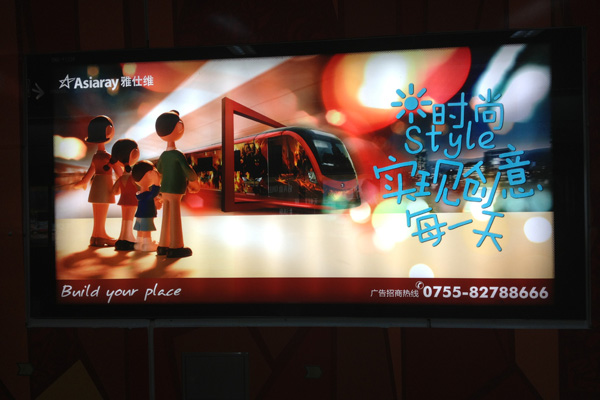
IMG_1920

The above advertisement is for the Shenzhen office of Asiaray, a Hong Kong company that specializes in providing outdoor advertising throughout the Mainland. Three related comments:

1) This particular advertisement caught my eye because of its representation of a two-child family. Just who is the intended audience of this advertisement? Families who have paid fines for their second child? Only children couples who are permitted to have two children? Or is it another sign that China may relax the one child policy, as discussed on Reuters?

2) Cultural turning. The copy literally translates as “Fashion Style — Realize Creativity Everyday”. It may be thanks to Psy the English word “style” is now showing up in advertisements all over the city. However, the official translation of 宣传部(文体局) on the Nanshan District Government website is Propaganda Department (Style Council).

3) Backlit billboards are particularly common in the Shenzhen subway and at bus stops. Indeed, outdoor advertising is the most common form of public art in Shenzhen. Recent research suggests that how we feel can impact our actions — just not in the way we think. This particular advertisement, for example, may not stimulate people to buy backlit billboards from Asiaray. Nevertheless, it does promote both the two-child family and fashion as the means for crossing a threshold into a better future.

Thought du jour: We know that Asiaray and other agencies (including Municipal Style Councils) sell wish fulfillment, using our desires against us. And maybe that’s the point. Maybe what we want is to be caught up in a daydream, all four of us, hand-in-hand on a fashionable rush to the future … until we loop back and repeat the experience, all four of us, hand-in-hand on a fashionalble rush to the future.