The process of uprooting the northern section of Baishizhou has begun through withering practices–the removal of social nutrients in order to promote razing and evacuations as inevitable, necessary, desired. Continue reading

The process of uprooting the northern section of Baishizhou has begun through withering practices–the removal of social nutrients in order to promote razing and evacuations as inevitable, necessary, desired. Continue reading

So this week is going by in a raze of urban village sections (片区). It seems that given the flat out difficulty of achieving 100% sign-off on property transfer and compensation packages, government planners and their developer agents are targeting sections of urban village for urban renewal (instead of entire villages). These sections (a) border major traffic arteries and (b) have relatively simple property relations. I also heard yesterday that in Gangxia, for example, the village was subdivided into six sections and once there was 100% sign-off in a section, it went. This would in part explain the protracted raze-scape that characterized Gangxia for several years. Continue reading
Images from a recent trip to one of the earliest (circa mid 1990s) factory areas in Dalang. I had a déjà vu moment because when I came to Shenzhen, these factories could be found throughout within the second line (guannei) churning out all sorts of goodies for export.
The point of interest? Although still a functioning industrial park, this area is already consciously “historic”. The Dalang New District Government is in process of a “love the cage, change the bird (疼笼换鸟”” redevelopment. The area surrounding the park includes the Dalang Fashion Valley and a piece of land recently purchased by Vanke for another gated community. These comparatively quaint factories will be renovated for cultural production.
So a few before pictures as the transition to after begins.
Yesterday, the Shenzhen Government online portal announced that Baishizhou is on the list of areas designated for urban renewal.
The plan to renew “the five Shahe villages” was submitted by the Shenzhen Baishizhou Investment Company Ltd. It calls for razing 459,000 square meters of built area. The area has been zoned for residential and commerce, with at least 135,857 square meters of public space.
Baishizhou is one of 18 projects announced. All plans take place at the street level, and all target communities and/or early industrial areas. All emphasize the planned public area, but do not mention plans for evicted residents or scheduled construction.
Of note, the urban renewal announcements were tucked away in the Bureau of Land, but the announcement of Shenzhen’s plans for its first village preservation project, Shayu (沙鱼涌古村保护项目) made the front page.

Only eleven houses remain occupied in Baishizhou’s Tangtou row houses.
Nanshan District tacitly condemned these houses several years ago, but did not become serious about evictions until the Universidade (Summer 2011). As inhabitants were evicted, the District padlocked the doors, so that the buildings could not be reoccupied. However, as the saying goes, “Those on top have policies, those on the bottom have countermeasures (上有政策,下有对策)”. When houses weren’t immediately padlocked, another family or worker or group of friends moved in. The owners continued to collect rent. When enforcers from the Urban Management Bureau (城管) came by either the inhabitants moved, or made friends with them and stayed, waiting for the final eviction.
This wait and see attitude has been much more successful for inhabitants of houses where the landlord is either in Hong Kong or further abroad. As a 4-year resident said, “Property managers don’t care what we do because the absent landlords are legally responsible. All they have to do is collect rents and their paychecks. I’m polite to urban management and they leave me alone. We’re all human, and when it’s time to move, they’ll tell me.”
Nanshan District has decided to close down the area completely because the summer rains further weakened the structures. These buildings from rural collectivism are no longer simply considered an eyesore, but also dangerously unsound. The vanishing of Maoist economic legacies was, of course, one of Shenzhen’s raison d’etre. However, Maoism lingered in the nooks and crannies of previously built spaces, such as Tangtou. Indeed, the Tangtou row houses are one of the few remaining examples of Maoist architecture in Shenzhen’s inner districts and once they have been razed, Maoism will become more of a spectre than it already is.
Thought du jour: in Shenzhen, even crumbling, Maoist dormitories can no longer safely shelter the city’s poorest workers and their families. Wither the left, indeed.
Impressions of Tangtou wet and sunny, and still occupied interior.
One of the ongoing questions of urban planning is: what are the material conditions that support community life? To answer this question, we can’t simply look around and see what has been built, but rather have to reflect on what makes human life interesting, lively and fresh.
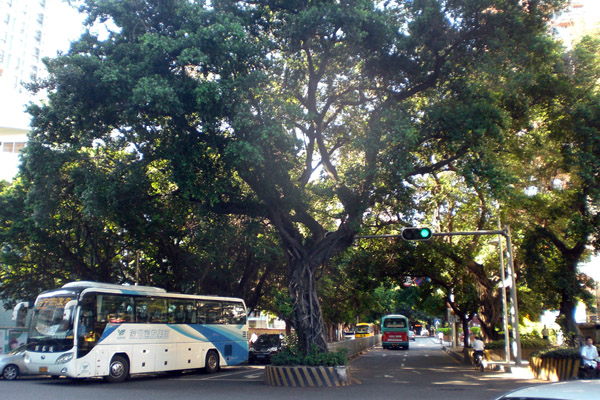
This morning I wandered Shekou Industrial Road 7 (蛇口工业7路) and realized that one of the reasons I enjoy this street is not simply the mix of residential, commercial, and industrial spaces, but also the expanse of public space and schoolyards. This public space has been created through the designation of Sihai Park and neighboring sports center, and also because the road is only two-lanes wide, with banyan trees that provide shade. Importantly, one stretch of Industrial Road 7 abuts Wanxia Village, where handshakes line-up in neat rows along one-lane roads and narrow alleys and give way to bustling urban village life.
Street life on Industrial Road 7 manifests the Chinese virtue of renqi (人气), which literally means “human air” and might be translated as “active” or “popular”. Hawkers set up stands under the trees, while elderly men practice water calligraphy on the sidewalk and pre-school children snack on steamed buns and soymilk. Window shopping (逛街) is thoroughly social as neighbors bump into each other on their way to preferred shops, or see each other’s children on their way to school. In the evening, once the sun has set and dinner bowls washed, the area becomes even more lively with families strolling and teenagers hanging out.
Admittedly, there is not much public space on Industrial Road 7. Significantly, however, many of the streets private spaces were built in the early 80s. Landscaping within residential compounds is a continuation of street landscaping, rather than planted with imported topiary that signal the end of the street and the beginning of elite consumption. More tellingly, guards do not actively prevent pedestrians from entering what are now considered low-income housing areas. Likewise, da pai dang (al fresco) mom and pop restaurants also integrate consumption into public life.
In The Death and Life of Great American Cities, Jane Jacobs documented and lamented how middle class flight from American cities to the suburbs contributed to the polarization and decay of our inner cities. In contemporary Shenzhen, a similar process is underway as the city’s middle class consolidates its identity and class consciousness through urban renewal projects and gentrification that not only result in clear razing urban villages, but also the construction of expensive malls and gated communities. The movement of people is different — the US middle class abandoned urban cores, and Shenzhen’s middle class is occupying the urban core and pushing the majority low income residents further to the periphery — but the result is the same. The unremitting blandness of these spaces announces and maintains social distinctions between the middle class and working poor, even as they homogenize differences between members of Shenzhen’s rising elite, creating an identifiable “Shenzhen” identity.
Over fifty years ago, Jacobs maintained that people like to live neighborhoods like Industrial Road 7. Moreover, she held that youngster and elders alike need accessible areas of mixed activities, cross-use of land, short blocks, mingle buildings of varying size, type and condition, and encourage dense concentrations of people. The point is to nurture marginal activities and small businesses, little restaurants and bars, as well as everything deviant, bohemian, intellectual or bizarre that make an area charming and vigorous.
I agree.
I also believe that this diversity humanizes us to the extent that we recognize ourselves in someone else’s life and consequently the wider our experience of difference, the more human we may become. In contrast, when we lay 4-lane roads without shade trees, build gated communities that isolate themselves from the street, and decide that malls, rather than parks better serve the public interest, we have proclaimed that to be human in the early 21st century is to aspire to life as a high-end mallrat.
Impressions of morning walk along Shekou Industrial Road 7, from Houhai Road west to Yanshan Road.

yang qian teaches acting to dance students at the baoan district art center; saturday i went with him. while he taught, i tracked new and improving baoan, which lives very differently from “shenzhen”, or the area that is still technically the sez, even though the second line no longer functions. basically, the district is razing the remnants of factory areas and old villages, to be replaced by upscale housing developments. pictures of the rubble, here.
 Shenzhen Noted