What’s the difference between Shenzhen and a 直辖市?

直辖市 means “directly governed city”. There are four directly governed cities in China — Beijing, Tianjin, Shanghai, and Chongqing. The difference between a directly governed city and a special zone (特区) like Shenzhen is political ranking. Directly governed cities have the same political rank as a province. This means that directly governed cities have access to resources and policies that other cities do not.

Shenzhen is a sub-provincial city, which means it is subordinate to Guangdong Province. As a Special Zone, Shenzhen has some economic exceptions, however, in terms of political planning and any kind of social innovation, Shenzhen must operate within the purview of Guangzhou. Consequently, the SEZ has repeatedly chosen to frame any kind of social transformation in terms of “economic” reform.

From the outside looking in, Shenzhen seems different, certainly the most neoliberal of China’s large cities. But from the inside, Shenzhen just seems nouveau riche, a better version of the country’s second tier cities, but not a first tier city like Beijing or Shanghai. Or even Guangzhou. Continue reading

learning from shenzhen?

Long time friend, Josh Kilroy directed me to a recent blog post by William Pesek, who argues that if Japan wants to fix the country’s economy, it should learn from China, or at least Shenzhen and set up a special economic zone. Pesek claims,

In 1980, Deng Xiaoping started China’s first special-economic zone in a coastal village that was nothing to look at. Today, Shenzhen is a teeming collage of huge skyscrapers, thriving industrial parks, 10 million people, one of the world’s busiest ports, and some of the biggest manufacturing and outsourcing industries anywhere…It’s the center of Chinese experimentation. There, officials can test what works and what doesn’t: which corporate tax rates offer the best balance of attracting foreign investment while filling government coffers in Beijing, which labor standards make the most sense, which corporate-governance standards are most advantageous, which immigration procedures are optimal, which regulations stay or go.

Why does this article distress me? In a nutshell, it distresses me because there is nothing in this statement that did not come directly from the propaganda that the SEZ churns out about itself and, even with that caveat, it teems (if I may) with errors: Continue reading

suddenly smog…

Yesterday, blue skies, today notably grey, so I asked a cabbie what he thought was the reason. Many cars. More than yesterday? Well, he said, in the north they call it mist, but here we call it smog. He nodded. That’s why visibility is so poor today. Too many cars.

Awkward Encounters: Urban Planning, Historic Preservation, and the Persistence of Rural Forms in Shenzhen

I participated in the “Learning from Shenzhen” Symposium on Dec 10, 2011, which was part of the biennale. For the curious, I’ve uploaded o’donnell-awkward encounters, a pdf file of images and arguments from the paper I gave.

nitty gritty shenzhen – the photography of Sarah Li Cain

Sarah Li Cain does what I want to do; she takes consistently real photographs of Shenzhen gritty, but with an eye to how we live despite our situation. Her subjects include migrant children, sleeping old men, and straggly, germy kittens, which (as in the picture above) nevertheless shimmer through surrounding grime. I wax Oscar Wildesque – gutter, stars, and what not.

Sarah’s work is currently on display at The Kitchen Futian. If you find yourself in Cocopark over the next few weeks, step in and see Shenzhen through her eyes.

so where did 1.35 million rmb go?

Yesterday, Nanfang Urban Daily (南方都市报) published an article on corruption in the renovation and upgrading of pedestrian overpasses, a topic near and dear to my heart. Reporter Zhao Yanxiong (赵炎雄) paid 300 rmb for a tip on the extent of corruption in repairing and upgrading pedestrian overpasses. The six overpasses in question are in Futian District on the Shenyan Road between the Wutong Tunnel and the Shatoujiao Bonded Area.  The Shenzhen Road & Bridge Construction Group Corp got the bid. The gist:

Eastern Area Bureau of Traffic spokesperson, “Every square meter cost 400 yuan, the total price was 1.6 million. The project could not be subcontracted out. We required Shenzhen Road & Bridge to do the job themselves.”

Subcontractor, “The construction costs per square meter were 115 yuan. The total area was 2,300 square meters, bringing the project cost to 250,000 yuan. We were contracted by Female Boss Cao.” Continue reading

pedestrian overpasses in the news!

If we take mega corridor roads (Binhe, Shennan, and Beihuan) as examples of urban planning in Shenzhen, the answer to the question, “Are we designing cities for people or cities for people with cars?” is “We’re designing the city for people with cars,” a frustrating thought even when I don’t have to use an overpass to cross the street. Nevertheless, Southern City Daily (南方都市报) reporter, Zhao Chongqiang (赵崇强) interviewed me about pedestrian overpasses and urban planning in Shenzhen, giving my favorite hobby horse a public airing, so I’m feeling the love (as my brother might say). Article, here.

nasa flicks, again

Several years ago, I posted a link to the nasa animation of land reclamation in houhai, one of my obsessions. I repost because the flick rewards – in that i can’t stop watching – repeat viewings. I’m also hoping that at some point the movie will be updated to include the past ten years. Also of note, G Burak and Karen C Seto (2008) have analyzed the environmental effects of urbanization, using Shenzhen as their case study. All scary, but unfortunately not unique. Shenzhen is merely a useful baseline for evaluating urbanization as a geological process because thirty years ago the area had not been industrialized. To see how New York has remade the world, for example, we close our eyes and imagine Mannahatta.

What is a boomtown?

Many readers are no doubt aware that Shenzhen’s sister cities are all (more or less) boomtowns. Two of the most famous are Brisbane, Australia and Houston, Texas. Both Brisbane and Houston, like Shenzhen have seen major demographic changes over the past thirty years, both have also profited from restructuring to the global economy.

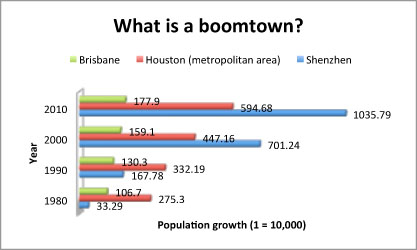
To get a sense of the scale of Shenzhen’s population boom, I created the following chart, which compares census statistics from Brisbane, Houston and Shenzhen from 1980 through 2010.

What this simple chart clarifies is the extent to which we (westerners) need to reconceptualize “booms” in order to think about the kinds of demographic, social, and political change that is happening not only in Shenzhen, but throughout China. In a smaller nutshell than even an excell chart, what we see is that Shenzhen blew past Brisbane in 10 years and then past Houston in under 20. Final tally: Brisbane – 1,779,000; Houston (metropolitan area) – 5,946,800, and; Shenzhen – 10,357,900 (plus undocumented inhabitants), begging the question: how do we, who share the planet and this worldwide political economic system talk about and across disparate experiences of urbanization without giving over to either Chinese exceptionalism (as in, that’s just China) or ethnocentrism (as in, why is China acting like us?)

And yes, for practical purposes I’m still using 1 = 10,000 to count.

Utopian Shenzhen, 1978-1982

Below I summarize thoughts about the importance of Shenzhen in shaping China’s post Mao utopianism.

In the heady rush of hyperbole, it is tempting to describe the SEZ’s first thiry years as the – Unprecidented! Miraculous! Epic! – jump of a lowly county from the lowest escholon in the state apparatus to one of the highest. More prosaically, the systemic re-invention of Baoan County as Shenzhen Municipality took place over a series of administrative adjustments and concomitant reallocation of authority, responsibilities, and fundamentally, rights to the national allocation of people, services, and goods. From 1978-1982, the Central Government and/or Guangdong Province restructured Baoan County four times. Each restructuring had a different ideological meaning and aimed to created a different form of post Mao utopia. These ideological differences – more precisely different understandings of the utopian content of modernization – continue to vex the development of Shenzhen.

Continue reading