the politics of backbiting

By now you have probably read that Shenzhen passed a new law that makes it more difficult to avoid the one-child policy by giving birth to a second child outside the country.

Between 2000-2009, it is estimated that the number of Chinese citizens having children in Hong Kong went from 709 to 29,766 annually and was still rising in 2010 and 2011. Indeed, some claim that today almost half of the children born in Hong Kong are born to Mainland families. Of this total, over 25% had Shenzhen hukou. Their children have Hong Kong identity cards, and although the parents must pay extra fees for schooling and medical care, nevertheless, they have avoided “second child fines (二胎罚款)” and other more drastic measures of enforcing the one child policy.

As of January 1, 2013, Shenzhen parents who have a second child abroad and then bring the child back to Shenzhen to raise for more than 1.5 years will be fined up to 219,000 rmb (US $35,000), which is roughly the current fine for second children born to parents with Shenzhen hukou. The fine is set each year by multiplying the average annual salary of the year before by 6 to 8 times. In 2011, the average salary was 36,505 rmb. This means that the 2012 Shenzhen penalties for second children are between 219,030 to 438,060 rmb.

This past spring, the Chinese news was full of speculation about how the government would handle the case of Olympic gold medalist Tian Liang, whose wife gave birth to a second child in Hong Kong. People wondered if Tian Liang would be fined as much as 2 million rmb and, more to the point, if he would loose his job, which is representing China in international track and field events. After all, ordinary government workers are not only fined for having a second child, but also loose their jobs. Thus, the Tian Liang case illuminated how it was possible for the wealthy and influential to avoid the consequences meted out to “common people” who gave birth to a second child in the Mainland.

Today, a friend told me about this new law as an example of the politics of backbiting, after all, it has been the rich and powerful who have taken advantage of Hong Kong hospitals to give birth to second children. Moreover, these are precisely the people who are targeted by ambitious underlings. He asked me to imagine how someone advanced within the government bureaucracy. Not on talent, but guanxi. However, when guanxi failed, it was possible to hire a private detective for 20,000 rmb to follow someone and document when and how they broke a law. He estimated that the first half of 2013 would be interesting to see how the newly pregnant rich and powerful handled the births of their second children; ordinary families became pregnant already prepared to pay second child fines.

Clearly my friend moves in nervous circles, where the law is used as a weapon of political infighting. This was, in fact, his point. Human rights and rule of law will not be established in China, he concluded, as long as careers were advanced and derailed through guanxi and/or backbiting.

“But people still accept this situation,” I commented.

He sighed, before saying, “China isn’t yet so corrupt that the people will risk their lives to overthrow the Party. There are still enough talented people in the government that society works. At some point, the balance will tip and we’ll be in revolt.”

“But now?”

“Now I’m just frustrated. I want out. But there’s nowhere to go.”

A catch-22, in fact. My friend plans to send his daughter to school abroad with the understanding that she not come back, unless it is to work for a foreign company; he believes she will be happier abroad than she could be in Shenzhen. He is not jumping, however, because he also knows the only place to earn the money necessary to launch his daughter abroad is his current, relatively high ranking position within a work unit of trusted guanxi and potential backbiters.
shenzhen government online

Many readers come to this site looking for resources to learn about Shenzhen. In fact, as part of its efforts to make government more transparent, the Municipality has uploaded many of the key documents, which can be downloaded. The government’s main site is 深圳政府在线. Two of the sites that I find useful are:

深圳市规划和国土资源委员会 (for urban plans, including city and district level)

深圳统计局 (for statistics)

Also, to get a sense of what’s happening closer to ground level, the District governments all have virtual portals, which are differently helpful.

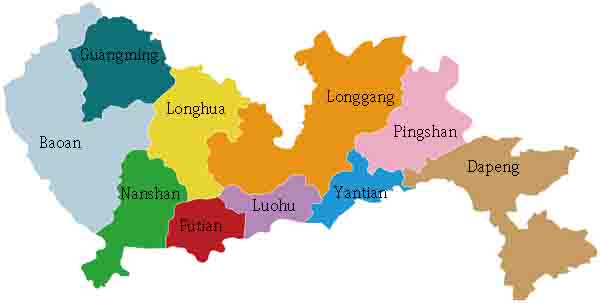
The six districts are: 盐田罗湖福田南山龙岗、and 宝安. The new districts (defined) are 大鹏坪山龙华、and 光明.

And a map of the territory:

foxconn + walmart = shenzhen, or globalization after mao

China Labor Watch has reported another Foxconn strike, this time at the Zhengzhou campus. According to the report, the shortage of iPhones led to increased demands on Foxconn workers, who were required to work over the holiday, for longer hours, at jobs that they did not have the skills to perform. Moreover, quality control inspectors also joined line workers in the strike for more reasonable work conditions. From the report:

(New York) China Labor Watch (CLW) announced that at 1:00PM on October 5 (Beijing time), a strike occurred at Foxconn’s Zhengzhou factory that, according to workers, involved three to four thousand production workers. In addition to demanding that workers work during the holiday, Foxconn raised overly strict demands on product quality without providing worker training for the corresponding skills. This led to workers turning out products that did not meet standards and ultimately put a tremendous amount of pressure on workers. Additionally, quality control inspectors fell into to conflicts with workers and were beat up multiple times by workers. Factory management turned a deaf ear to complaints about these conflicts and took no corrective measures. The result of both of these circumstances was a widespread work stoppage on the factory floor among workers and inspectors.

Ironically, on the same day, Salon dot com reported that workers at Wal-mart also went on strike for the first time in the company’s notoriously anti-union history. As at Foxconn, Wal-mart workers are striking in large part because they are being to asked to do the impossible — do the jobs of several people. From the article:

I’m excited, I’m nervous, I’m scared…” Pico Rivera Wal-Mart employee Evelin Cruz told Salon yesterday about her decision to join today’s strike. “But I think the time has come, so they take notice that these associates are tired of all the issues in the stores, all the management retaliating against you.” Rivera, a department manager, said her store is chronically understaffed: “They expect the work to be done, without having the people to do the job.

News of these two labor strikes resonate ironically in Shenzhen because Foxconn (鸿海科技集团) and Walmart were two of the first multi-nationals to benefit from Shenzhen’s establishment in 1979.

Foxconn has 13 factories in China, but its oldest and largest is the Shenzhen Longhua Campus, which has an estimated population of 250,000 workers and managerial staff. Moreover, the Shenzhen Campus is the location of Foxconn China’s headquarters and represents over 1/4 of the Company’s global workforce. Foxconn is the worlds largest contract provider of computer, communication and consumer electronics products. In addition to Apple, Foxconn partners with Acer Inc, Amazon, Cisco, Dell, Hewlett-Packard, Intel, Microsoft, Motorola, Nintendo, Nokia, Sony, Toshiba, and Vizio. In other words, Foxconn employees also make Kindles, PlayStations, and Xboxes in addition to iPhones, so if you’re using any kind of high-end electronic product — especially a smartphone — odds are it was made in one of Foxconn’s Chinese factories. Foxconn posted net profit of US$ 102.74 billion in 2011.

Similarly, as Walmart’s world buying headquarters, Shenzhen is a critical site in the multinational’s chains of production and consumption. Walmart reportedly sources 70% of its merchandise from China, and many of its earliest subcontractors were located in Shenzhen. Importantly, the level of worker exploitation at Foxconn Longhua and Zhengzhou cannot be understood outside the context of Walmart in China. With a global workforce of over 2 million people (or two Foxconns), Walmart is the world’s largest private employer and shapes daily life at the level of both supply and demand. By 2005, Walmart had become China’s sixth largest export market–just behind Germany–making it a larger trader partner than many countries. Indeed, Anita Chan argues that “When the two giants Walmart and China established a stable symbiotic relationsip at the turn of the millennium, and as Walmartization of the supply chain took root on Chinese soil, Walmart’s competitors had to use the same sourcing techniques to survive.” Walmart reported US$ 15.4 billion net revenue in 2011 (or roughly 15% of Foxconn’s net revenue for the same period).

As Walmart is to commercial products, so Foxconn is to high-end electronics. Given their global dominance in their respective niches, both companies are in a position to squeeze more labor out of their workers, demanding (as on Foxconn Zhengzhou’s iPhone 5 production lines) overtime work that effectively pushes wages down below even locally acceptable wage levels. Here, “forced overtime” can be understood in two ways. 1. As in Foxconn Zhengzhou, where workers are expected to put in extra hours to meet orders. And 2. as in South California Walmarts, where one worker does the job of several, so that even when working a “forty-hour” week, they may have put in 60 hours worth of labor.

Here’s the Shenzhen connection to new forms of labor exploitation. During the 1980s and through the 1990s, but especially during the pre-1992 Southern Tour years, Shenzhen business offered Chinese citizens an opportunity to opt out of the planned economy, in both cities and rural areas. The lure, of course, was a salary that was based on market demands, rather than fixed by the central government plan. Indeed, in 1988, the Shekou Tempest began when visiting Beijing officials accused local workers of being nothing more than gold diggers, who were motivated by greed, rather than by nobler sentiments, such as patriotism to modernize the national economy.

Shenzhen is not the first city to boom through low wage production. In fact, many of the earliest companies that set up factories in Shenzhen simply relocated from nearby Hong Kong and Taiwan. However, in retrospect, it is clear how small the 1970s Asian miracle actually was. With the establishment of Shenzhen, the world’s largest corporations suddenly had access to the world’s largest workforce — a workforce, moreover, that was trained, disciplined, and  eager to work for wages, making forced overtime a globally viable corporate strategy. Today, forced overtime has become one of the most effective means of labor management, not only because it results in higher profit margins, but also because exhausted workers are more docile.

Even as China debates pushing forward the Shenzhen model of production, it’s clear that this model has already gone global. Consequently, Shenzhen may be the key to understanding globalization in the post Mao era. In fact, Shenzhen has become the city that US Americans would recognize as “middle class” in both practice and ideology. Most residents are migrants, who came to Shenzhen to make their fortune. Moreover, they believe that individuals need to work hard in order to get ahead; Shenzhen espouses individual effort, transparency in business deals, and home ownership as simultaneously being the means and ends of the good society. As in the United States, Shenzhen residents talk on their iPhones while shopping at Walmart. As in the United States, this standard of living has not spread throughout the general population because it depends upon increasing levels of exploitation. Thus also as in the United States, now that the factories have moved to Zhengzhou and Vietnam, the squeezing of service industry labor has intensified, which leaves enquiring minds to wonder: when will workers in Shenzhen’s 12 Walmarts strike?

afternoon tea

Playing bridge at a late 80s teahouse in Shekou’s Sihai Park is a welcome alternative to hanging at a coffee chain or one of Shenzhen’s luxury teahouses, if for no other reason than because there is enough room between the tables to create a sense of privacy. For those interested in social history, however, the teahouse also provides visceral insight into how consumption standards have changed in Shenzhen. Nostalgic impressions, below:

This slideshow requires JavaScript.

the contempt factor

The other day, while showing a group of visitors the Goodbye, Urban Villages (再见,城中村) exhibition, one asked, “Well what will they do about it?” meaning what will the residents do to prevent the forced evictions?

He, from Western Europe, was grappling with the question of democracy (or not) in China. She, from Hong Kong answered saying, “They don’t do anything because they can’t. That’s what it’s like here.”

Our visitors seemed to have settled on a variant of the local intellectual script, A Hong Kong Resident Explains Shenzhen to a Westerner, so I found relief speaking with someone from Beijing.

He commented, “The artists in Shenzhen seem really pure.” I laughed and answered, “That’s because there’s no market for art in Shenzhen; it has to be a hobby (爱好) [literally something done from love].” He smiled, “All we have in Beijing are markets because everything’s for sale.”

As a group, we then moved on to the Kojève exhibition, which is a bit too pure art for my taste, but nevertheless provided enough common ground that the conversation turned to light and pleasant topics.

In retrospect, I have realized that what irritated me about the visitors’ response to Goodbye, Urban Villages was that it had been a variation on a constant theme — contempt for Shenzhen and by extension for those of us who live here.

Intellectual Westerners, who dabble in romance languages, but have never heard of Shenzhen will ask me, “Will you live here, forever?” the unsubtle emphasis underscoring the fact that migrants and their displaced families will not stop the united forces of government and state-owned real estate developers from razing the handshake homesteads, low end eateries, and improvised bicycle repair shops that flourish on the sidewalk. I understand that elsewhere these might appear as insurmountable contradictions, but… and here I pause rather than answer a question that has set me up either to defend what I clearly oppose or to agree with the unspoken contempt in the question. Instead, I point out that no one lives forever.

Likewise, young Hong Kong students who do not cross the border except to purchase books and older aunties who come for sauna and massage will ask me, “How can you live there, is it safe?” and then advise me to move to Hong Kong. Yet others lecture me on the truth about Shenzhen — it is dirty and corrupt and teeming with mafia types who cannot be arrested because they’re in cahoots with governments — this they have learned in Hong Kong newspapers and from their Hong Kong relatives. I understand that many of their foreign friends may have just recently heard of Shenzhen, but… and here I pause rather than answer a question that has set me up either to play the innocent foreigner abroad or to instruct Hong Kong Chinese on what it means to be Mainland Chinese. Instead, I point out that I am still alive.

And there’s the rub: These pauses are difficult to cultivate. On bad days, find myself skeptical of good intentions so poorly phrased that the tone of my response may range from biting to sarcastic, amplifying the contempt with my own. On good days, I treat these questions as possible moments of mutual enlightenment, taking this speech at face value: they do not know and want to learn. Most days, however, I turn pedantic and finish my sentences, trying to make my interlocutor see — not just the political mess and entrenched despair, but also to observe the efforts some are making, and the care that some have brought to what is a vast and tumultuous and often unimaginable transformation.

good bye urban village, hello middle class

The ideological consolidation of Shenzhen’s middle class identity continues. Of note is the subtle repositioning of urban villages as sites of upward mobility that have outlived their social usefulness, rather than as the home village of local people. This is particularly interesting because efforts to map Shenzhen’s cultural heritage through the history of local villages have also intensified.

At the OCT B10 Gallery, for example, the Zeus Cultural Communication Group has installed a photography exhibition “Goodbye Urban Village (再见城中村)”, which was part of ceremony to celebrate the commencement of production on an eponymous film. As a company, Zeus specializes in filming large-scale documentary films and documenting engineering projects and “Goodbye Urban Village” will document urban renewal projects in several Shenzhen urban villages.

The images have been mounted in various formats — actual printed photographs, large wall posters, and backlit windows. The content of the images, however, is consistent: the daily life of urban migrants. In the forward to the exhibition catalogue, Zeus CEO Zuo Li provides the ideological gloss for exhibition visitors, “The truest moment in any urban village is that everyone who has made the leap here – man or woman, elder or child, is arduously struggling for a better tomorrow (城中村里最真切的落点,是每一个跃动在这里的身影--男女老少都在为明天艰辛地努力着)”.

Zuo Li’s gloss highlights two sites — migrant bodies and architecture — where new discourse about urban villages semiotically parses them into two, distinct elements of Shenzhen identity — rural migrants and local heritage.

With respect to the representation and ideological construction of a stereotypical urban villager, urban village residents are identified as migrants, who have come to pursue the Shenzhen dream of a better life. A series of portraits literalizes this understanding as young workers pose next to a sign in which they have written their job, salary, length of time in Shenzhen, and dream. These scenes of everyday life relentlessly publicize what in middle class homes are kept private. We see, for example, people sleeping and eating, children playing and urinating, friends playing cards, local security apprehending someone, and prostitutes resting.

Concomitant with this fascination with the display of “real life” in the urban villages is the marked absence of images of Shenzhen locals. This absence is particularly glaring when we remember that as recently as five years ago, photographers still took pictures of village holidays, ceremonies, and festivals to include in discussions about urban village life. Today, those images have been naturalized as local heritage and appear in magazines, travel blogs, and, of course, the Shenzhen Museum.

With respect to the representation of urban villages as human settlements, the urban village environments that are presented are decrepit and dank, and the images overwhelmingly dark, except for moments of muted color. Indeed, many of the pictures frame the human subject with handshake building walls and the garbage that hangs from overhead wires. Again, absent from these images are recent renovations, such as those at Xiasha or Huanggang, where village ancestral halls, temples, small parks, and plazas provide the historical links between contemporary Shenzhen and “ancient” or “traditional” China.

Extant urban villages place middle class Shenzheners in an ideological conundrum: on the one hand, Shenzhen’s rise continues to represent the fulfillment of rags-to-riches dreams. On the other hand, many of those who are now rich want to take the rags out with the trash, cleaning up the environment. The social justice question, of course, remains does cleaning up the environment mean making urban villages sites of clean, convenient and affordable housing? Or, does cleaning up the environment mean transferring urban village land rights to real estate developers and forcing residents to less convenient sites outside the downtown area?

The representational choices made in the Goodbye Shenzhen photography exhibition ellide the important question of the place of (or a place for?) urban poverty in Shenzhen. Instead, they reframe migrant dreams of a better life as being already realized in the anticipated jump from neighborhoods of handshake buildings to those of glass and steel.

In keeping with the theme of exploring the ongoing rise of Shenzhen’s middle class identity, it is interesting to view this show along with the Kojève exhibition in the OCAT Contemporary Art Center. The most obvious difference is the respective intended audiences (OCAT has translated its program into English, while Urban Villages has not). However, at the level of content, the two shows are uncannily similar. OCAT offers Kojève’s photographs/postcards of post-historical spaces and Urban Villages provide realist documentary of Shenzhen’s anticipated past. In both exhibitions, we find ourselves positioned to look at what no longer exists.

The urban village photography exhibition will be up through Saturday September 29. Kojève will be up through November 16.

getting things done in shenzhen

This past year, I have increasingly collaborated with foreign artists, filmmakers, and scholars to create projects in Shenzhen. Often at stake in these projects is the form and breadth of necessary support. For example, to do any kind of project in a public site (performance, filming, showing an art film), you do and do not need papers to show guards. What does this mean?

If the project looks like a group of friends just talking or filming, or if you’re performing / filming in a private house or shop, no one will ask questions. Hence, the proliferation of coffee shop and bar events with sympathetic owners. However, if you set up a large set, have many people involved, and a crowd gathers to watch, then any local guard can stop you and ask to see your papers. And every building has employed guards, so you will encounter them. In urban villages, where there might not be building guards, there are neighborhood civil police, who will know you are in the area within about five minutes and show up (or at least that was Fat Bird’s experience when we did guerilla performances in Huangbeiling and Dongmen 1 and 2).

If you don’t produce performance permits, the guards will send you away. Sometimes, even when you have papers, if the area has a special event going on, the guards will work to send you away. This happened several times during the 6 > 60 bus film screenings, when guards who knew us and were used to our project became nervous because a leader was visiting that day and thus asked us to leave as a favor to them. This indicates how seriously onsite guards take enforcement because 6 > 60 was part of the Biennale and therefore a municipal level project. Nevertheless, guards took the attitude “one less concern is better than one more  (多一事不如少一事)”. Likewise, at a recent Shenzhen University event, a dormitory guard tried to shut down an approved project because approval had only taken the form of spoken agreement. When the project organizer went to confront the approving official, he denied that he had ever heard of the project.

When organizing a project in China, it bears remembering that upper level officials may agree to help (and often support a project in principle), but if they do not write a letter of support, sign papers or issue permits, their support is practically useless because enforcement takes place onsite. Moreover, in most cases the leaders that can approve a project and the offices that issue permits are separate. This means, of course, that what needs to happen is project directors need to work with leaders who are willing to call the people who do issue permits on their behalf.

The whole question of corruption happens at this overlap between needing political support to obtain permits and the fact that enforcement happens elsewhere. After all, why should an official make a phone call or pursue permit issuing officials for you? What’s in it for them? Likewise, permit issuing officials sometimes become a third site of obstruction, depending on the relative status of the caller — immediate leaders are very helpful in pushing permits through, but their office is usually not high enough to approve a project.

And so point du jour: getting things done in Shenzhen means being able to network as many levels as possible to get the permits necessary to make an onsite intervention. That done, you need to then work with or against onsite guards. One time events can usually be accomplished by arguing with guards, however long term projects require onsite negotiations with guards, and often their leaders, who are responsible to a different chain-of-command than the one that pushed through the permits, which in turn requires another round of explaining and securing agreement.

That said, sometimes bravado will get the same or better results, but it’s a gamble.

entitled: the demise of comrade and ritualization of inequality

The other evening northern friends of a certain age lamented the demise of “comrade (同志)” as a form of address. They weren’t so much distressed by the Cantonese queering of the term, as they were by the fact that Chinese forms of address no longer assumed (or aspired to) equality between comrades. Instead, etiquette now demanded that social fields be charted and hierarchical relations marked. Officials, for example, are called by their bureaucratic position. Not surprising in the case of higher ranking officials — the City Party Secretary and Mayor, for example — but somewhat excessive in the case of neighborhood heads.

Even if they chafe at the ritual acknowledgement of political hierarchy and concomitant social inequality, nevertheless, they also remarked that official status does simplify the question of how to address someone. In contrast, they noted that the real awkwardness lay in deciding how to address someone without either a clear social role or a defined relationship to the self. They addressed professionals by their job (Lawyer Chen, Teacher Dong, Doctor An, Theatre Director Yang, and Engineer Liang come to mind), but often blanched at calling rich acquaintances “boss (老板)” or the more refined “executive (总)”. Friends were addressed by nicknames and fictive kin terms, while new friends could be called “Mr. (先生)” or “Ms. (小姐)”, but workers, including waitstaff and other service workers posed a problem because they could also be hailed as fictive kin or just young people. Moreover, gender and age play an important role, and in conversation my friends often call working men “craft master (师傅)” or “boy (小伙子)” and working women “auntie (阿姨)” or “younger sister (小妹)”.

In anticipation of the 18th National People’s Congress and to give a sense of just how complicated is the system of Chinese bureaucracy and relevant titles, I have translated the fifteen official levels of government from a Baidu entry. Positions are listed in order of ranking within a category. Hence, the General Secretary ranks higher than the President, who in turn ranks higher than the Chair of the Military Commission. When making introductions, most people will qualify a title with the appropriate administrative status, as in City Level Vice Mayor, after which however, they will use the full title “Mayor” unless the actual Mayor is around. These rankings also matter because they map the bureaucratic journey that ambitious functionaries must make. Shenzhen is a sub-provincial level city, for example, and so its Mayor cannot be directly considered for a national post, but must first obtain a provincial or ministerial position. In contrast, a the same position in an independent city, like Beijing or a full provincial ranking, would be a rank higher, placing the office holder in contention for national assignments.

Should your eyes not glaze as you read the list, you’ll get the hang of assigning rank and how using titles has ritualized inequality by reiterating the Chinese bureaucratic system from the General Secretary all the way down to a functionary in a community or village office.

First level, national level (国家一级):General Secretary, President, Chair of the Military Commission, Chair of the National People’s Congress, State Council Premier, Vice General Secretary, Standing Member of the Political Bureau of the CPC Central Committee.

Second and third level, national government (国家二至三级):Member of the Political Bureau of the CPC Central Committee, Alternative Member of the Political Bureau of the CPC Central Committee, Secretary for the Central Disciplinary Commission, Vice Chair of the NPC Standing Committee, Vice Premier of the State Council, State Council Member, President of the Supreme People’s Court, Vice Chair of the CPPCC National Committee.

Third and fourth level, national ministries and provincial government (部级正职、省级正职三至四级): Provincial governor, Vice Secretary for the Central Disciplinary Commission, Standing Member NPC, Secretary of State, all sub-national administrative chiefs and enterprise heads (including Party organizations), leaders of all People’s organizations (including Party organizations) at the provincial, autonomous region, independent city level. These organizations include Party Committees, People’s Congresses, Government, and Chinese People’s Political Consultative Conference. Exceptions can be made to give provincial rank to leaders of sub-provincial organizations;

Fourth and fifth level, vice ministries and sub-provincial government (部级副职、省级副职四至五级): Vice Governor, Members of the Central Disciplinary Commission, all sub-provincial administrative chiefs and enterprise heads (including Party organizations), leaders of all People’s organizations (including Party organizations) at the sub-provincialand sub-autonomous region. These organizations include Party Committees, People’s Congresses, Government, and Chinese People’s Political Consultative Conference. Exceptions can be made to give sub-provincial rank to leaders of Office of the Council or Regional organizations [Shenzhen Municipality];

Fifth through seventh level, Council Heads, Regional Chiefs and Counsels (司级正职、厅级正职、巡视员五至七级);

Sixth through eighth level, Vice Council Heads, Sub-regional Offices and Assistant Counsels (司级副职、厅级副职、助理巡视员六至八级) [Shenzhen Districts];

Seventh through tenth level, Department Heads, County Commissioner and  Investigators (处级正职、县级正职、调研员七至十级);

Eighth through eleventh level, Vice Department Heads, Vice County Commissioners, and Assistant Investigators (处级副职、县级副职、助理调研员八至十一级) [Shenzhen Precincts];

Ninth through twelvth level, Section Heads, Xiang Heads and Chief of Staff (科级正职、乡级正职、主任科员九至十二级);

Ninth through thirteenth level, Vice Section Heads, Vice Xiang Heads, and Vice Chief of Staff (科级副职、乡级副职、副主任科员九至十三级) [Shenzhen Communities/Neighborhoods];

Ninth through fourteenth level, Staff Members (科员:九至十四级);

Tenth through fifteenth level, Office Workers (办事员:十至十五级).

Camera download and what appeared

This past week, my path has taken me from Shekou through Hong Kong to Taichung. Some of the spaces and details that caught my attention, below. And yes, the headline in the pictured article really does read, “After the seizure of toxic salted eggs, one ton goes missing”:

This slideshow requires JavaScript.

union elections in shenzhen

In keeping with Shenzhen’s place at the core of Guangdong reforms, Shenzhen has announced that 163 companies with more than 1,000 employees will introduce elections for union leaders. These elected representatives will then work with the City, District and Precinct level union organizations in order to represent worker rights in negotiations with company management. According to Southern Daily, the impetus for this move has been ongoing independent worker demands for better wages and benefits. Indeed, the first company to implement the election system was OMO, a German company with a plant at Bantian. The article notes that holding union representative elections seemed to have dispelled worker dissatisfaction.

I’m not sure how to interpret this development other than to note that provincial Party Secretary, Wang Yang is actively promoting this reform. Indeed, as we approach the Two Conferences season, Wang Yang has been very active promoting “Happy Guangdong (幸福广东)” and its recognizably middle class values. It is also worth mentioning that the targeted 163 companies are large and many are foreign. Hopefully progressive change at larger plants will help less protected members of the workforce. The problem, of course, is that like the US American workforce, the Chinese workforce is fragmented into segments that receive more and less protection depending not only on worker skills, but also public visibility. Large, international companies are monitored not only by Chinese unions and news media, but also to some degree by foreign groups and media. In contrast, a large segment of the population works under unseen conditions in smaller factories, restaurants, and services or does piecework at home.

But still. One hopes.