This past week has been a rush, with little time for organized thinking, let alone putting those thoughts together in written form. Nevertheless, while waiting for my noodles at the shop below Handshake 302, I watched the interactions of the proprietor and a local beggar. He sat at the table, silently, staring out at the road. She cleared tables, made noodles, and then graciously served him a bowl. He didn’t acknowledge her and ate. She returned to her work.
Tag Archives: shenzhen identity
sunday afternoon in dafen
Dafen is now a destination, with artists posing as painters, and visitors posing with paintings. Meanwhile, the subway is open and many of the new developments are opening and real estate is booming, so that it’s now difficult to find the painting village–it’s a sinkhole in the midst of rising towers. Impressions, below:
gentrification in baishizhou
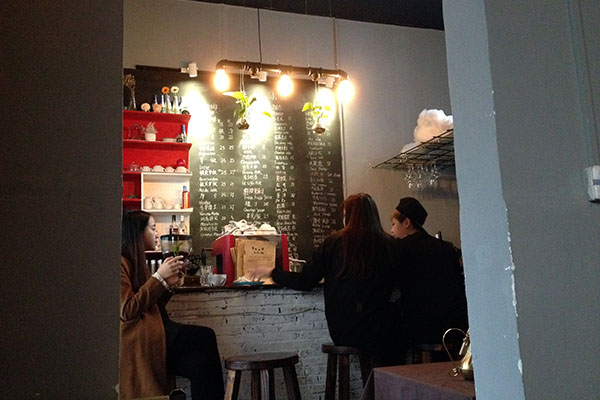
Here’s the thing about urban renewal in Shenzhen; it takes time. Consequently, although withering practices can be sensed in Baishizhou, nevertheless, day-to-day it all seems like the hustle and bustle hasn’t changed. Indeed, the neighborhood continues to experience low-level gentrification. There is, for example, now an independent coffee shop in Baishizhou, while outside on Shahe Road, individual upgrades continue. So photos from the coffee shop and ongoing upgrades suggest that even if young people in Baishizhou aren’t exactly hanging out and playing sports, nevertheless, there even low-income residents engage in leisure activities and consumption, which in turn points to the complexity of Baishizhou’s demographics and ongoing construction of Shenzhen’s youth culture.
an interim project at handshake 302: 隐于城
Liu He is one of the more active curators at Handshake 302. While we are waiting for the students to prepare their “Shake Hands with the Future”exhibition, he is using the space as a refuge for people who want 8 hours alone, without their phone. The project, “Hidden in the City” is simple. At 9:30, Liu He meets the participant at Handshake 302, makes sure they have water and understand how the toilet works (and often doesn’t) and then takes their phone. At 10:00 a.m., the participant is “on the clock”, on retreat from the city for the next 8 hours, coming off at 6:00, when the cell phone will be returned, a dinner served along with a 302 salon/ discussion about what it all means. Below a translation of Liu He’s curatorial statement for “Hidden in the City”; the Chinese version follows. Continue reading
Chinese Tourists and Six Uncivil Behaviors – 文明
Uncivil tourists and a call to post “act civilized” announcements in Chinese outside of China. The post has me thinking about 文明 both as a technology of regulating relationships between strangers and as Ann Anagnost’s early work on “civilization” as a means of regulating the bodies of peasants so that they might be mobilized more easily for post-Mao politics (see the prescient National Past-Times: Narrative, Representation, and Power in Modern China, an anthology of essays published during the early and mid 1990s), begging the question: just who benefits from 文明?


These days, Chinese tourists have developed a bad reputation, not only abroad. Chinese people are also tired of Chinese tourists. “东方卫报” (dōngfāng wèibào – “The Eastern Guardian”), a Nanjing based daily newspaper, published the following article on their front page on Tuesday April 7, 2015:

The heading translates to “Take it Easy on Your Outings: Six Kinds of Uncivil Behavior to Take Note Of.” The six uncivil behaviors are listed below:
违规吸烟 (wéi guī xīyān) – smoking illegally
随地吐痰 (suídì tù tán) – spitting phlegm everywhere
争抢座位 (zhēngqiǎng zuòwèi) – to scramble for the seats
乱扔垃圾 (luànrēng lājī) – to litter garbage
大声喧哗 (dàshēng xuānhuá) – to be noisy and to make a racket
推挤插队 (tuī jǐ chāduì) – to push, shove and cut in line
Examples of the behavior:


 Failed System
The incidents including Chinese tourists within China and abroad are too numerous to count, but one thing is…
View original post 393 more words
礼貌 and 文明, thoughts
The difference between 礼貌 and 文明 matters because I bumped into a group in the Shekou Sihai park. They were members of 荣格 (RGLove). the charitable fund of the Shenzhen based high-tech company, 荣格科技集团. RGLove had brought in people from all over the country to explore and develop their civilization levels through Confucian studies. The goal, of course, is to intervene in the world by expressing correct relationships, that of course included 礼 which maybe 礼貌, but I’m not for sure. Meanwhile, inquiring minds want to know: just what does all this mean? Continue reading
shenzhen place name website
So yes, there’s a website dedicated to Shenzhen place names as well as associated re/developments. Check it out at 深圳地名网.

dachan: just where is the village anyway?
Those of you following the construction of Qianhai, may or may not be aware that it’s cultural geography includes many, many fish (now buried) and Dachan Island, once upon a time home to Dachan Village. Inquiring minds want to know: just where is Dachan Village, today? Continue reading

can shenzhen evolve from “suck it up theory” to creativity?
I have come to think of “theories” in Chinese political culture to function like guidelines to acceptable behavior. The difficulty for folks in Shenzhen arise from contradictions between extant theories and changing social condititions, or what might be called “double bind theory”; General Secretary Xi Jinping has tightened the space of critical thinking and debate, even as his government, especially Premier Li Keqiang is exhorting people to be creative. But there’s the rub; people need to take critical stances in order to create new solutions to entrenched problems and critical stances have been routinely discouraged throughout the Reform and Opening era, begging the question: can Shenzhen evolve from “suck it up theory” to creativity? Continue reading
upgrading shenzhen’s new technologies
So, Huaqiangbei is the heart of Shenzhen’s maker culture. However, China Merchants Shekou has upped the production ante, establishing “net valley (网谷)”, a company slash investment strategy to produce and deploy the latest in digital gadgetry. Friday morning, we visited their showroom in order to learn about techno-possibilities and brainstorm events for the May cultural industries fair. The point of all this investment is to stimulate creativity (创新). And yet. I kept thinking how the form of contact–a tour and a meeting–made it all seem ordinary, despite the fact that we held our meeting in a room that went from being a library to a bird’s eye view of mountain tops. If my impressions of banal sci-fi seem familiar, it’s because much of this technology was first exhibited at the Shenzhen New Media Exhibition.
 Shenzhen Noted