an apparatus of integration 2: the shen kong border, wutongshan south to liantang

Yesterday had a wonderful time with good friend Denise exploring Shatoujiao and then the land border from Wutongshan South to Liantang subway stations (Shekou Line). Three observations (with illustrations!) and unsubstantiated speculation, below:

Continue reading

what’s on display and who can see it?

This past week, in addition to participating in large public culture events, I also had the opportunity to visit two privately organized cultural spaces. The first was a private collection of shoushan stone carvings (寿山石) and the second was a community museum.

So some preliminary thoughts about what these spaces suggest about post COVID culture in Shenzhen.

Continue reading

material and spiritual traditions. thoughts?

Long ago and far away, I wondered when History would enter Shenzhen’s bildungsroman. And now that it has, it’s interesting to see how deeper settlements have emerged as roots for contemporary Shenzheners. The original SEZ–now the inner districts (关内)–especially Luohu (Dongmen) has become the city’s connection to Hong Kong. Indeed, it is still where you go if you want to speak Hong Kong Cantonese and eat delicious Cantonese and Chao-Shan style foods. In the outer districts, “Longgang” (and I’m using it in its circa 1990 designation, rather than picking through the new districts) is home to Hakka traditions, which are housed in the area’s great compounds (围屋、世居). In Bao’an (and yes, as a cultural homeland, we’re talking about the sliver of villages that stretch north-south between the reclaimed west coast (now Qianhai) and Bao’an Boulevard), ancestral halls are flourishing and traditions like lion dancing have been elevated to national immaterial culture status (上川黄连胜星狮舞). The Huang alliance comprises eight troups, extending from Shanghe to Fuyong.

What I’ve noticed is that this geographic distribution assumes different historical subjects which are all mushed together into some kind of “Shenzhen” identity. The implicit subject of history in Luohu, for example, are the cross-border entrepreneurs (个体户 mainly from Chao-Shan area) and their Hong Kong clientele (many who also originally hail from Chao-Shan). This first generation came in the early 1980s and transformed the old market into a gritty cross-border playground a la Tijuana. In Bao’an, the villages (now communities under a street office) have cultivated and paid for the continuation of their traditions, including pencai (盆菜) banquets, the birthdays of divinities and founding fathers, and celebrations at various scale. In contrast, in the Hakka areas, various levels of government have assumed responsibility for the compounds and are using them to promote new kinds of high culture. Pingshan Art Musuem, for example, includes the Dawan Compound (大万世居) as a satellite exhibition hall, while Longgang District has transformed the Hehu Compound (鹤湖新居) into the base of its cultural think tank, hosting outdoor lectures underneath shade trees.

So, thoughts du jour are more random associations that still make a kind of sense. Shenzhen’s culture and history are being reworked in ways that both deploy local cultural geographies and map along the city’s historic interest in establishing a new material and spiritual culture. In Luohu, the early Special Zone is re-emerging in new forms of (admittedly cleaned up) cross-border consumption; Bao’an is emerging as the locus of South China Sea diaspora connections (the lion dance, for example, is a major competition in the region), and Longgang compounds form a material platform for high end civilization, where the city’s “new guests” can strut their cultural stuff.

luohu landmarks: the border as an apparatus of integration

The Shenzhen-Hong Kong border at Luohu manifests the contradictions and aspirations of integrating the two cities. On the one hand, the border has been solidified with concrete and barbed wire, while on the other, the border is presented as an easily accessible gateway to a modern shopping experience. Indeed, the concrete and barbed wire fence that lies parallel to the border is located directly behind Luohu Plaza, as seen in the pictures below.

Continue reading

so…luohu commercial city

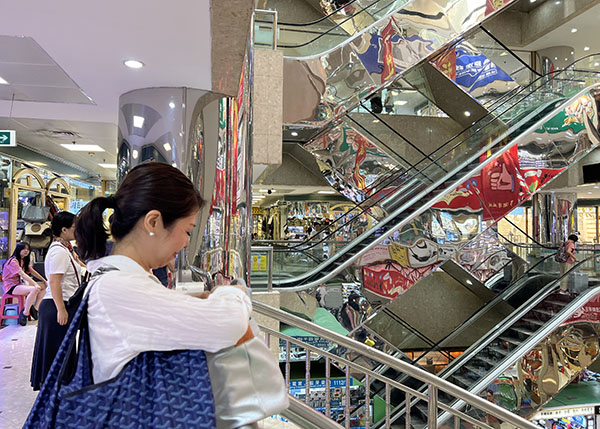
Hong Kong day-trippers are–if we chat posts are to be believed–shopping again in Shenzhen. There seem to be generational differences. The young and hip are in the malls, while the old and once-upon-a-time hip are revisiting their former haunts, like Luohu Commercial City. Maybe? Anyway, I went back to Luohu Commercial City and realized that the more things change, blah blah still the same. Or is it?

One of the things that I like about Commercial City is the 90s-naughties vibe. The entrepreneurs rent their spaces and then sell what they like. Now, admittedly, they only sell a few types of goods–glasses, dance costumes, fashion, watches, scarves and haute fake fashion–and only offer a few services–mani-pedis, massages, tooth care. But. Within these categories of pampering commodities, they sell what they like. This means that unlike the malls and many commercial streets where stores are all selling the same goods, in Commercial City, every store is a curated experience of what the vendor thinks is fashionable. And. It’s still possible to haggle. So. Fun.

how do shenzheners map covid elsewhere?

A friend from northern China once said (and I’m paraphrasing a long ago memory of Shenzhen, circa 1995), “If you want to see Chinese culture, go to Beijing, Xi’an or Shanghai. Even Tibet has more culture than Shenzhen.”

Her pointed point was: if you’re doing cultural anthropology (and I was!), go to a Chinese city with actual culture. Even the ethnic minorities have culture. Shenzhen, not so much. In fact, she also explained that Taiwan felt more ‘Chinese’ than Shenzhen did. When asked to elaborate, she explained that in Taipei, she had been able to speak Mandarin. In contrast, in Guangdong it was difficult to find people who willingly spoke Mandarin, let alone fluently.

Of course, nearly thirty years (!!!) later, Shenzhen has come to represent China in ways that Beijing, Xi’an and Shanghai do not. Moreover, Shenzhen is often held up as the most open of the first-tier four (Beijing, Shanghai, Guangzhou and Shenzhen). Shenzhen isn’t China’s past, my friends assure me, but its future, which is why, Shenzhen’s response to Covid-elsewhere is worth noting. How are Shenzheners positioning themselves and their city vis-a-vis perceived failures of Covid management in Shanghai?

Continue reading

signs of conflicted times

Borders are breached, daily. Breached despite guards, despite fences, despite and through raging anger, which accumulates like garbage, no longer hidden from sight. Stupid plastic bottles, we scream, 打!As if the bottle we threw away yesterday was the cause of our suffering.

Anyway, images from a Shenzhen, where some imagine themselves as under siege, and others find themselves working even harder (yes, the city is involuted) to keep the boat steady.

Continue reading

where’s your battle?

The 2022 Beijing Winter Olympics have come and gone with neither a bang, nor even a whisper. Whatever officials hoped to gain from the spectacle of Chinese athletes winning gold on snow and ice didn’t manifest. Even in my more nationalistic we chat groups, I saw few posts about the Olympics even during the games, and now that they’re over, no one has mentioned them. Instead, three topics obsess people across my we chat groups–the upsurge of Covid in Shenzhen, the Xuzhou mother, and the Russian invasion of the Ukraine. Moreover, as the above cartoon illustrates, how these issues are stitched together reveals social fault lines.

Continue reading

cross-border covid

From February 4 to yesterday, February 23, 2022, 147 cross-border truck drivers have tested positive Covid-19. Cross-border truck drivers are key links both to maintaining Hong Kong’s fresh food supply and to exporting products from the PRD to the rest of the world via the port of Hong Kong. This means that the pandemic has not only made visible just how fragile the membrane between Mainland health (on the one side of the border) and Hong Kong nutrition (on the other side) is, but also how modern systems rely on the human body to function.

The cross-border delivery chain is managed by geographic section, rather than by truck. When a truck hauling a cross-border delivery arrives at a designated transfer site, a cross-border driver takes the wheel and the other driver is deployed to another pick-up. As most deliveries are from the mainland to Hong Kong, many of the drivers are based in Shenzhen. Consequently, Shenzhen has become responsible for maintaining a Covid Zero delivery chain, implementing the “three points one line 三点一线” protocol, which restricts the movement of drivers to three points (designated cross-border checkpoint, transfer station, quarantine hotel and their route). And yes, this is as restrictive as it sounds. And also yes, this protocol has been in place since the pandemic began in early 2020, which means many drivers haven’t been reunited with their families in two years, while others have quit in order to be with them. Not surprisingly, Mainland reports have emphasized the heroism of drivers who “will work as long as they can.”

covid-19 schadenfreude

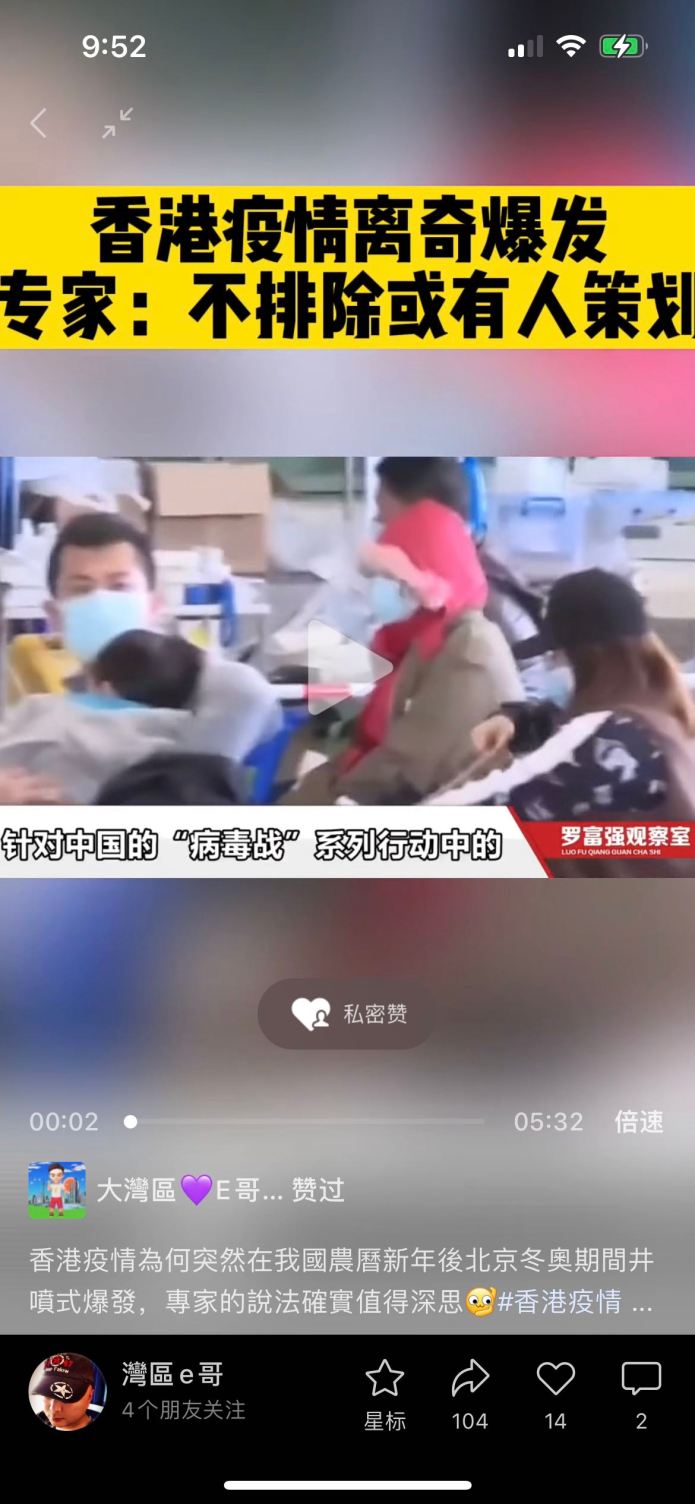
The images circulating on Shenzhen-based WeChat groups are uncannily familiar: people being stopped by guards as the try to sneak across the Shenzhen-Hong Kong border. Only this time, the flight is from Hong Kong to Shenzhen (and/or Hong Kong to Zhuhai). A certain schadenfreude infuses these posts, as if Hong Kong’s current problems demonstrate not only the superiority of the Mainland, but also “just desserts” for implied past actions. There are also reports that the governments of coastal cities are offering rewards to anyone who reports illegal immigrants, and claims that these illegal returnees have “evil intentions 恶意” because as Chinese citizens, they can legally enter the Mainland at designated checkpoints.

Continue reading