land reform, again.

An Old Shenzhener once complained to me that since the 1989 Crackdown, in Shenzhen “reform” has been too often interpreted to mean “refining the state system”, rather than actually reforming society. His point was simple. During the first decade of Reform, people had an opportunity to participate in and even direct the direction of development in Shenzhen. The fact of widespread participation made Shenzhen “special”. In contrast, after June 4th, Shenzhen became increasingly bureaucratized – like Beijing – and participating in social transformation was no longer possible for the common people. Instead, the Government had become the key social force and thus, social agency meant “works under the guidance of government bureaus” for the benefit of government officials and their cronies.

The Municipality’s latest “land reform (土改)” program illustrates the problem that aggrieved my friend. Last week, the government released three documents that legislate the scope and direction of land reform: The Comprehensive Plan to Reform Shenzhen Land Administration (深圳市土地管理制度改革总体方案), The Immediate Short Term Plan (2012-2015) of the Comprehensive Plan to Reform Shenzhen Land Administration, (〈深圳市土地管理制度改革总体方案〉近期实施方案(2012~2015年), and Notification of the Establishment of the Shenzhen Land Administration Reform Guiding Committee (关于成立深圳市土地管理制度改革领导小组的通知). Together these documents determine the target of reform, the method of reform, and the people who will interpret and implement land reform. Moreover, even a cursory reading the documents indicates that at stake in these documents is (1) finalizing the transfer of outstanding land rights from village holdings to the Municipality and (2) determining the status of informal property rights in urban villages so that (3) developers can more easily realize the goals outlined in the Municipality’s Comprehensive Master Plan, 2010-2020.

And there’s the rub: During the 1980s, villagers and various entrepreneurs collaborated to build the urban villages. My friend understood this situation be “true” or “ideal” reform because ordinary people could realize projects outside the purview of government plans. At the time, none of those projects were “informal” or “illegal” because the villages held legal land rights. He also thought that this freedom to develop land was the precondition for true social reform. He didn’t think that all villages had done a good job with the opportunity, but nevertheless believed that the idea of small-scale development and common participation was the point of reform. However, once the villages had been incorporated into the Municipal apparatus, that first round of development could be reinterpreted in terms of illegal buildings and informal property rights, alienating villagers and unofficial developers from participating in future development projects except as recipients of compensation packages.

Shenzhen property rights are a muddle that the Government needs to handle carefully to avoid aggravating extant (and growing) inequality. On the one hand, by incorporating village lands into the state apparatus and compensating villagers and independent landlords for their extant holdings, the Government creates ill will on two counts. First, people without hereditary land rights or informal property rights have no chance to benefit from this process. Second, with the exception of farmers, the process enriches government officials and corporate executives, which is the common sense definition of “corruption”. On the one hand, if the government were to reform property laws to allow for individuals to develop land, this would mean completely restructuring the state apparatus and concomitant property rights. This is what my friend would like to see – capitalist opportunities for individuals, rather than for government officials and large corporations. But this seems more a definition of “revolution” than “land reform” as it would mean redistributing rights to high-rises, shopping malls, neighborhoods, housing estates, and industrial areas.

Guanwai village lands were not only extensive, but also remain underdeveloped. Consequently, the experimental target of overall land reform in the 2012-2015 short term plan is Pingshan New District, while the experimental targets of “second round development (第二次开发)” are be Gonghe Community, Shajing Precinct, Baoan and Shanxia Community, Pinghu Precinct, Longgang.

reforming rhetoric 1: 摸论

“Feeling stones to cross the river” is one of the more famous sayings of early reform. Western pundits often interpret this phrase as a straight forward description of the uncertainties inherent in reforming the Maoist system and concomitant trepidation about moving toward – what? – xiaokang with capitalist features? However, this expression belongs to a rhetorical form called 歇后语 or two-part analogy, in which the first part is spoken and the speaker’s intended – and often critical – meaning is left unspoken. Paying attention to the unspoken response highlights how conflict and disagreement was handled within Party debate over the direction and scope of reform.

Chen Yun first raised “Feel theory (摸论)” as it became known during a Central Working Conference in December 1980. Importantly, Chen Yun used the two-part analogy to conclude an opinion on how to reform the Maoist apparatus, “…[I]n other words, we need to ‘Feel stones to cross the river’ (也就是要‘摸着石头过河《陈云文选》第3卷第279页)”. In conventional Mandarin, the unspoken critique in this analogy is “tread carefully (步步稳当)”. Later during the Conference, although Deng Xiaoping agreed with Chen’s unvoiced but present call for a more conservative approach to reform and opening, nevertheless, he shifted the discussion by emphasizing pragmatic action.

With “Cat theory (猫论)” and “Don’t debate theory (不争论)”, “Feel theory” became one of the three main principles guiding early reform.

the wanfeng model and its demise

Today, episode 10 from The Transformation of Shenzhen Villages (沧海桑田深圳村庄三十年): “Lonely Wanfeng”.

In 1957 at the height of collectivization, Wanjialang (万家郎) was changed to Wanfeng Village. Located on the eastern banks of the Pearl River, Wanjialang had been settled for over 600 years, and was part of the larger Shajing xiang or village federation. As narrated in the documentary, the rise of Wanfeng Village was inseparable from Village Secretary, Pan Qiang’en (潘强恩), who in 1981 made a pre-emptive decision to raze village agricultural land and build factories despite the fact that Wanfeng was located in New Bao’an District and thus, technically, still a commune.

Pan Qiang’en based the design of Wanfeng’s industrial zone on the Shekou Industrial Zone, which had been designated only three years previously. Also, like Yuan Geng at China Merchants, Pan Qiang’en mobilized Hong Kong capital for initial investments. Also, like Yuan Geng, who deployed official networks to raise investment capital, Pan Qiang’en took advantage of opportunities created through his position as a local cadre. Indeed, it was in his role as a Wanfeng cadre that he would have had opportunities to visit Shekou and meet with Yuan Geng.

The critical difference between Wanfeng and Shekou, of course, was and remains, status within the state apparatus. China Merchants developed Shekou as a Ministry work unit with a national ranking. This meant that China Merchants developed Shekou as a direct expression of national policy, and Yuan Geng could hire and deploy an educated workforce, as well as negotiate legally binding contracts. In contrast, Wanfeng was a village with traditional land rights, but limited appeal to urban educated intellectuals and limited knowledge of international business practices. Nevertheless, Wanfeng Village boomed, with 145 companies opening factories in village industrial parks and when the documentary was made, village fixed assets were estimated to be over 20 yi yuan or 316.5 million US dollars (based on today’s exchange rate), earning Wanfeng the nickname, “the first village in the South (南国第一村)”.

In 1985, Pan Qiang’en spearheaded the transformation of Wanfeng from a hybrid village-brigade into a stock-holding corporation in which stock and property rights were determined by one’s status as both a villager and a worker in the collective. Pan Qiang’en did not call his experiment a stock holding company, instead, he referred to it as “socialist collective holding system (社会主义公有制)”.

According to the blog 中国法制 (China’s Legal System), the Wanfeng Model had three distinguishing characteristics:

  1. The means of production belong to all villagers. The model has five kinds of stock options — state holdings, enterprise holdings, legal person holdings, workers’ holdings, and personal holdings. The first three stock options are collective and the final two are private;
  2. Government and enterprise are completely separate, specifically, the enterprise is completely responsible for economic losses, and thus enjoys all rights to profit. Government administration is based on a different budget and thus the government has no right to interfere with economic decisions made by the enterprise;
  3. Villagers stock holdings were based on three considerations: their salary as a worker in the collective; their status as an owner of collective property; and, their rights to social welfare.

In 1990, the Chinese Academy of Social Sciences held a conference on the Wanfeng Model (万丰模式) and in 1992, the president of the Academy came to Wanfeng, declaring that the Village had out urbanized urban areas. Wanfeng’s national influence reached its highest point in 1993, when the People’s Daily published,”The Wanfeng Model: On the Farmer and Social Philosopher Pan Qiang’en and His Social Praxis (万封模式--记农民社科理论家潘强恩和他的实践). Subsequently, village leaders from throughout the country came to learn from Wanfeng.

However, in 2001, when Pan Qiang’en decided to stop paying dividends in order to finance the village’s expanding enterprises, opposition to his leadership became increasingly widespread. By 2006, he was openly opposed as a “village tyrant (村霸)” and he stepped down from power in favor of his son. The documentary ends here, speculating on the relationship between individual effort and historic transformation.

However, an important footnote follows. Also in 2006, Shenzhen nationalized all land within the city borders, taking away villagers’ absolute right to the land. Henceforth, the city and district governments also shared in the profits generated by village land sales. This would have critical consequences for Wanfeng, where Pan Qiang’en’s son and government cronies sold village lands without either notifying villagers or distributing dividends, generating huge profits for those involved in the sales. Consequently, in 2012, Wanfeng Village “learned from Wukan” and brought down the Pan Qiang’en’s son, and elected a new village head to investigate how much of “collective holdings” had been expropriated by Pan Qiang’en, his immediate family, and corrupt officials.

the social media production of mutual assured cross-cultural contempt in the US and China

By now, most have heard that Global Times, the Party’s international mouthpiece printed an editorial which called for the Chinese public to permit a moderate amount of corruption; if you haven’t jump over to Fauna’s piece at ChinaSmack for translation of the article and web responses. The self-justifying rhetoric and virulent counter-attacks illuminate the cynicism and anger that increasingly characterize public debate in the PRC micro/ blogosphere. Moreover, the virulence and smugness of English language responses to the post need to be analyzed in terms that explain the ongoing social media production of mutual assured cross-cultural contempt in both the US and China.

In many ways, the cynicism of the exchanges remind me of populist diatribes in the US; I actually can hear Mitt Romney and other anti-gay or anti-black or anti-women or anti-child advocates calling for “moderate levels of discrimination” and exhorting the country to “understand” the necessity of continued legal inequality because there are so many incompatible definitions of discrimination and we need to respect everyone’s traditions. The pseudo-rational justifications for continued discrimination understandably anger those who directly suffer the consequences of said laws and customs.

Just how closely does the tone and rhetorical form of US and Chinese popular debate mirror each other? Below, I have copied the Chinese editorial and substituted the following keywords, underlining the substitutions in text:

  • discrimination for corruption
  • prejudiced for corrupt
  • strong economy for development
  • prejudice for income
  • America for China
  • Western for Asian
  • Presidential Candidate Mitt Romney for Railway Minister and Party Secretary Liu Zhijun (and yes, in both countries we keep pandering to our lowest acceptable prejudices and greed, respectively)

I have made these substitutions to make a simple point; although the effects of economic globalization and political inequality are different in the PRC and the USA, nevertheless the turn to cultural justification and excuse-mongering is similar. Moreover, tone of the debate transcends relative levels of legal freedom of expression. The anger and absurdity of debate in the Chinese micro/ blogosphere is matched by the anger and absurdity of debate in American television and radio programs (Hello, weibo and Fox News).

The implications of this point, however, are far from simple when our respective national debates end up in our interlocutor’s public sphere. For US citizens, for example, it is difficult to understand the prevalence of and popular resignation to Chinese corruption. Likewise, most Chinese see US concerns about gay marriage and reproductive freedom to be a cases of privileged angst. In the worst case scenario, we focus on the other’s words to explain/ justify our inability to reach mutual understanding because, it seems so obvious, that our interlocutor has such fuck-up values. As a result, in both both countries, we end up focused on the cultural content of public debate, rather than on a shared political-economic structure that has created what are in both the PRC and USA, untenable situations.

So, another call for creative rethinking of what forms cross-cultural understanding and dialogue might assume when translation might do more cross-cultural harm than good.

The modified text begins below:

The American Public Should Permit a Moderate Amount of Discrimination

It was announced yesterday that Presidential Candidate Mitt Romney won the Texan nomination. This piece of news once again touched the public’s most sensitive nerve, that dealing with discrimination. From a national perspective, there is indeed continuous news of discriminatory officials being elected, which does give people the feeling that discrimination is “unending/overwhelming”. They aren’t catching/arresting less, it’s that you can never catch them all [never finish catching them all]. Just what is going on?

America obviously has a high incidence of discrimination, and the conditions for completely eliminating discrimination do not exist at present. Some people say, as long as we have “democracy”, the problem of discrimination can be easily solved. However, this kind of view is naive. The West has many “democratic countries”, such as Indonesia, the Philippines, India, etc. where discrimination are all much more severe than America. But America may very likely be the Western country with the most pronounced sense of “resentment towards discrimination”.

This is related to America’s “serve the people!” official political morals having deeply been engrained in the people’s heart throughout society. However, the reality is that the market economy has attacked its practicality/feasibility, resulting in government officials who half-heartedly observe it or have even betrayed it constantly slipping through various cracks in the system. America is a country that has been deeply penetrated by globalization and the high standards of integrity of developed countries is already known by the American public, and with information coming from different periods and different circumstances being forcible stuffed into America’s sphere of public opinion, bitterness and consternation can find no relief.

Discrimination in any country is unable to be permanently controlled/cured, so the key is to control what the degree that the people will permit/allow. However, to do this is particularly difficult for America.

Singapore and China’s Hong Kong institute a policy of high pay to discourage discrimination. Many Chinese political candidates are wealthy, and normally when someone becomes a government official there, they accumulate renown and connections. After office, they can use then various “revolving doors” to change all they have accumulated into financial return. However, these options and possibilities are not available in America.

Giving government officials power to discriminate is something American public opinion cannot accept. Allowing government officials to step down and use their influence and connections to discriminate against groups is something the system does not allow. Allowing the prejudiced to become government officials is something that people find even more unpalatable. The legal prejudice of America’s government officials is very low, and the compensation for officials of some places is often realized through “unwritten rules”.

All of American society now has some “unwritten rules”. In industries that involve the public welfare such as doctors and teachers, “unwritten rules” have also become popular. Many people’s statutory prejudice isn’t high, but they have “gray prejudice”.

What are the boundaries for “unwritten rules”? This isn’t clear. This is also one of the reason for why there are relatively many discrimination cases now, with some even being “cases of a community of discrimination”. Amongst the people, there is the popular saying that “what is commonplace amongst the people cannot be punished by the law”, and the moment government officials believe this saying while believing “others are the same as me”, then he is already in danger [of becoming prejudiced].

Those who engage in discrimination must be strictly investigated, and not to be tolerated, as this would greatly increase the risk and cost of discrimination, creating the requisite deterrent effect. The government must make the reduction of discrimination the biggest objective of their governance.

The people must resolutely increase supervision through public opinion, pushing the government to fight discrimination. However, the people must also reasonably understand the reality and objective fact that America is unable at its present stage to thoroughly suppress the discrimination, and not sink the entire country into despair.

Writing this definitely does not mean we believe fighting discrimination is not important or should be put off. Quite the opposite, we believe fighting discrimination indeed is the number one problem that must be solved for the reform of America’s political system, and it is also the common demand of the entire country.

However, we believe that fighting discrimination is not something that can be completely “fought” nor completely “reformed” because at the same time, it needs “strong economy” to help solve it. It is a problem of the individual prejudiced officials as well as the system, but that’s not all. It is also a problem of the American society’s “overall level of strong economy”.

Fighting discrimination is a difficult/entrenched battle in the strong economy of American society, but its victory at the same time hinges upon the clearing of various obstacles on other battlefields. America can never be a country where other aspects are very backward and only its government officials are egalitarian. Even if it is for a time, it won’t last long. Eliminating discrimination would be a breakthrough/turning point for America, but this country ultimately can only “advance overall” [any specific progress requires overall progress/strong economy].

union elections in shenzhen

In keeping with Shenzhen’s place at the core of Guangdong reforms, Shenzhen has announced that 163 companies with more than 1,000 employees will introduce elections for union leaders. These elected representatives will then work with the City, District and Precinct level union organizations in order to represent worker rights in negotiations with company management. According to Southern Daily, the impetus for this move has been ongoing independent worker demands for better wages and benefits. Indeed, the first company to implement the election system was OMO, a German company with a plant at Bantian. The article notes that holding union representative elections seemed to have dispelled worker dissatisfaction.

I’m not sure how to interpret this development other than to note that provincial Party Secretary, Wang Yang is actively promoting this reform. Indeed, as we approach the Two Conferences season, Wang Yang has been very active promoting “Happy Guangdong (幸福广东)” and its recognizably middle class values. It is also worth mentioning that the targeted 163 companies are large and many are foreign. Hopefully progressive change at larger plants will help less protected members of the workforce. The problem, of course, is that like the US American workforce, the Chinese workforce is fragmented into segments that receive more and less protection depending not only on worker skills, but also public visibility. Large, international companies are monitored not only by Chinese unions and news media, but also to some degree by foreign groups and media. In contrast, a large segment of the population works under unseen conditions in smaller factories, restaurants, and services or does piecework at home.

But still. One hopes.

just what is china studies anyway?

These past few days I have been reading essays on the social organization of power in the PRC. Most of these essays were written by political scientists and economists, but the odd anthropologist makes an appearance as does the occasional historian.

Here’s the rub: I can’t really tell the difference between this kind of scholarship and everyday gossip in Shenzhen.

Our gossip tends to be about people we know, but importantly also about people with power to make decisions that directly affect our well-being. We see someone do something and then speculate about how and why it happened. We try to anticipate what they will do and how we might get them on our side. But this data gathering and analysis is all tenuous and shaky, and often leaves me feeling both convinced I know what’s happening (vaguely), but also unwilling to make definitive statements because I don’t actually know. Instead, I have a residual belief that someone somewhere can explain what is happening; there is, we maintain, a position of knowing, just not with me, here.

Now it’s not as if this tendency to conflate gossipy analysis with research has gone unnoticed within scholarly circles. Consider, for example, the following 1995 quote from Frederick C Teiwes (Paradoxical Post-Mao Transition: From Obeying the Leader to Normal Politics):

Despite the unprecedented openness of the 1980s and a surfeit of purported inside information, in crucial respects we know less about politics at the top today than we do for the Maoist era. Given the secretive nature of the top leadership, it is hardly surprising that participants in the system often express the view that ‘nobody knows’ what goes on ‘up there’. … Even highly placed figures, including those with personal knowledge of the very top leaders, feel limited in what they know, and their assessments sometimes are at variance in significant ways with those of younger, more middle-level officials either in China or living in exile. Given these limitations, scholarship has unfortunately relied extensively and often indiscriminately on suspect Hong Kong sources to fill the gap. As Lyman Miller has observed, the Hong Kong press has recorded ‘a flood of reports, stories, rumors, and sometimes speculations and fantasies about political events in China’.

My speculative sense du jour is that 15 years after Teiwes cautioned us about how much could actually be known and methodologies for securing some kind of confidence in what we think we have learned about China’s highest ranking leaders, weibo may have allowed this unstable situation to perfect itself. The yearning to know, the speculation and furtive analysis. The 140 character limit, the anonymity, the instant forwarding of unconfirmed posts has blossomed in China not only because its fun, but also because it is parasitic upon and supplements the extant situation — what we know, we glean and extrapolate from conversations, incomplete news articles, and our experience of acting within and against everyday life, whether in China or abroad. Thus, I read caveats about how information and conclusions about China’s ruling elite might be and think, yup that tallies. Not just with my experience of unbridgeable distance between moi and the Center, but also with my experience trying to navigate office politics in Shenzhen unreliable and listening to my friends talk about their experiences trying to navigate even more complicated office politics.

So what?

I’m thinking that there’s a kind of cross-cultural overdetermination in the popularity of weibo and its increasing importance as a subject and source of academic knowledge about Chinese political culture. Chinese people use weibo to create public spaces and then scholars speculate on what it means about Chinese society because in large states, like China but also like the United States for that matter, none of us, even those of us in power actually know what’s happening. We live by creating networks of trust and when public trust falters, we turn elsewhere. Recently, Professor Zhao Dingxin (joint appointments at Chicago and Fudan) gave a talk on”Weibo, Political Public Space and Chinese Development” and Owen Lam has translated portions of the transcript and netizen responses to the talk. Zhao Dingxin asserted provocatively:

Weibo is an absolutely democratic but highly manipulative mode of communication. It is democratic in the sense that the user only need to write a few sentences. Once a person knows how to login, s/he can start writing regardless of the quality. It is manipulative in the sense that each voice does not register the character of an equal vote… If a person controls a lot of money or certain technology, s/he can hire an online army to magnify their voice and create fake public opinion. The space for manipulation is huge.

And my immediate response is, well, yes because within any human relationship the space for manipulation grows with levels of distrust and competing desires. But that space is within each of us and not simply the product of technology. Clearly, the kind of speculative practice that thrives on weibo pre-dated the invention of social technologies. Perhaps instead of an exclusive focus on technology, it might be helpful to ask what about human nature makes weibo so attractive? What fears and desires leave us open to manipulation by digital phrases? The Chinese government is trying to contain the effects of rampant rumors and gossip-mongering by instituting the real name registration system (实名制). I wonder if it wouldn’t be more useful to think creatively about how to rebuild public trust, knowing that this is itself the work of a lifetime.

the 5.12 beichuan incident, nuclear war games, and why the party fears religious organizations

The Party’s refusal to either share power or make political decision making transparent and open to public debate creates mistrust: just what have they got to hide anyway, inquiring minds want to know. In addition, through its control of cultural resources, including the arts and the right to convene, the Party has demonstrated a refusal to acknowledge any viewpoints other than those that shore up the influence of high-ranking officials.

Neitizens and western journalists have responded to Party control over and access to information with reports that (more often than not) conflate conspiracy theories with the “truth”. Not unexpectedly, citizens spend an inordinate of time trying to piece together a big picture out of rumors, veiled allusions and gut feelings. Sadly, the more the Party doesn’t say about Beichuan or Bo Xilai or Chen Guangchen, for example, the more accusatory rumors circulate via the net, weibo, and text messages and with them the festering anxiety that no one can be trusted to speak truthfully. Thus, in today’s China, common sense has it that Party members don’t tell the truth because the truth would harm them politically, while the rest of us are incapable of telling the truth because we don’t know it.

Keywords of the day – trust (信任), good faith (诚意), and loyalty (忠诚) – pivot on the relationship between a healthy society and how good our word might be. The characters for person (人) and word (言), for example constitute 信, the first character in the compound for trust. The character word (言) also appears in sincerity (诚, literally “word” “is realized”), which is an element of the expression good faith (literally “sincere meaning”) and loyalty (faithful sincerity). Moreover, the question of belief (信仰, literally a person who trusted and admired) resonates throughout all levels of society and the most trusted forms of organized alternative to Party disinformation and rumor mongering tend to be religious – Tibetan Buddhism, Xinjiang Islam, and popular Buddhism, Falungong, Christianity in Han communities.

“A Report on and Lessons from the 5.12 Underground Nuclear Explosion at Longmen Mountain, Beichuan,” a recent Epoch Times (大纪元) article illustrates the co-dependent relationship between belief, opposition, and efforts to figure out the truth. The Epoch Times, of course, is the official Falungong news outlet and the article author Lu Deng is the spokesperson for the Chinese Christian Democratic Party. The gist of the article is that the Party used the 5.12 Wenchuan earthquake to cover-up the fact that on the same day, it detonated a nuclear devise at Beichuan, destroying an entire region. Based on a few facts, knowledge of how the Party operates, and deductive reasoning, the argument is compelling and compellingly legal:

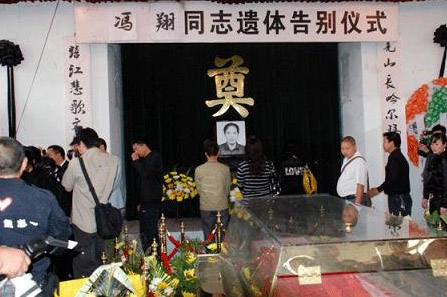
The article reconstructs the events of May 12, 2008 by giving a quote from Feng Xiang’s decidedly poetic and vague blog and then re-interpreting it in terms of a nuclear blast. For example, in February 6, 2009 post, Feng Xiang wrote, “In 80 seconds, the mountain collapsed, the ground split open, the mountains shook and the earth moved, the river changed its course. The green mountain lost its color, and all I see is disaster. This was Beichuan’s most devastating moment. A level 8 earthquake, with level 11 destruction”. According to Lu Dong, the phrase “the green mountain lost its color” refers to the fact that all the mountain foliage was burned. Lu Deng also analyzes sections where he asserts that Feng Xiang’s original text, including references to a Chief Pan of the Anti-Chemical Corps of the Second Artillery (二炮防防化部隊隊長番号) have been changed.

As an opening witness, Feng Xiang  (冯翔) is a compelling figure because his position within the Party hierarchy placed in a position to learn the truth, while his loss as a father and a teacher gave him moral authority. Feng Xiang was a teacher and then a vice minister in the Qiang Minority Autonomous County, Beichuan Ministry of Information (北川羌族自治县宣传部). His eight-year old daughter died in the Wenchuan earthquake. Subsequently, his efforts to uncover the truth about her death led to charges that an underground nuclear explosion rather than the Wenchuan earthquake caused the Beichuan disaster. The truth of his position was confirmed through allegations that Feng Xiang was harassed into committing suicide when he attempted to bring this story to the public.

Lu Dong then moves on to analyze corroborating evidence from other sources; it is an “open secret (公开秘密)” that the damage at Wenchuan was minimal and the strength of the quake insufficient to have destroyed Beichuan. In his book “The Epicenter was in Human Hearts (震中在人心)” Mainland author, Li Ming claimed that the Wenchuan quake gave Party officials an excuse to cover-up the real disaster at Beichuan. Web reports suggest the same pattern of information: Wenchuan was serious, but not a disaster and certainly not enough to have decimated Beichuan. Moreover, web posts included reports that indeed anti-chemical corps had gone into the Longmen Mountain Nuclear facility. In addition, local eyewitnesses said that the heat from the blast burned off the skin of water buffalo. Blogger Xiong Furong said, “The geologists may have different explanations for what happened here, but for us ordinary people, we know it was a detonation (熊芙蓉說,“地質專家對此可能有各種不同說法,但對我們普遍人來講,這就是爆炸。)”

Examples from media reports are brought in: a video on youtube; reports from 21st Century Economic Report (21世紀經濟報導) that the mountain continued to reverberate through the night; Southern Weekend (南方週末) reported that the tremors were so strong that villagers clung to each other to keep themselves from falling into the sinkholes; Western China News (華西都市報) reported that in the Green tablets river basin, there were nearly 10 kilometers of cracks in the mountain, some of which were 42 centimeters deep; and even Party media acknowledged the extent and scale of Beichuan exceeded that of Wenchuan. Beichuan TV broadcast, “The entire 2869 km2 County Area was destroyed, 10s of thousands of buildings were destroyed in mudslides. Over one million square meters collapsed and over 100 areas effected by mud. (北川電 「全縣境內2869平方公里受災,出現了數萬處塌方,泥不流和大滑坡。垮塌百萬立方的特大滑坡達100多處.)” A quote from an elderly gentlemen summarizes and ends this section, “The earthquake had the force of the nuclear explosion at Hiroshima (能量相當干400顆廣島原子彈.)”

Lu Dong is relentless in his case. He notes differences between the pattern of damage at Wenchuan, which fell away from an epicenter and Beichuan, which fell in a different pattern, away from Longmen Mountain. Evidence from the Tangshan earthquake is brought in. Even at Tangshan, after the quake subsided there were some buildings and trees standing. In contrast, at Beichuan everything collapsed: 498 kilometers of highway, 6066 kilometers of ordinary roads, 1503 bridges, 131 power stations, 8,944 kilometers of electrical transmission lines, 26,000 kilometers of fiber optic cables, 597 water reservoirs, 9,416 kilometers of channels, 282 broadcast stations, and 2,432 different sites of geological disaster.

Even more disturbingly, after the 5.12 Beichuan disaster, doctors from Sichuan Medical University, the University of Illinois, and Imperial College released studies documenting that many people and animals in the disaster area suffered from radiation poisoning. In addition, specialists suggested that iodine 131 is a radioactive isotope that could have caused spontaneous abortions similar to those seen at Beichuan. However, the Sichuan Party Secretary ordered a blackout on all reports on over 100 fetuses that had died in utero.

If all this wasn’t enough, the Japan Aerospace Exploration Agency reported that an earthquake did not adequately explain the yellow color and condition of vegetation in Beichuan. Lu Dong ominously concludes, however, that these conditions were consistent with the effects of a nuclear blast. And yes, ongoing Party inspection tours and scientific reports from Beichuan seem consistent with the after effects of a nuclear blast and not an area healing from a natural earthquake.

Clearly, Lu Dong believes that there were underground nuclear experiments at the Longmen Mountain Facility and that an accident occurred. He is a compelling rhetorician, concluding his argument with the reminder that Hawkish General Zhu Chenghu (朱成虎) has threatened to use nuclear weapons to destroy the United States if the country should ever help Taiwan and calling for the Party to meet face these accusations in court.

And there it is. The reason that the Party fears religious organizations.  The unstable situation of chronic Party secrecy and corrosive public suspicions has created an environment in which many people “don’t feel safe (没有安全感)”. However, religious groups continue to investigate and make public charges (if even from abroad), rather than hiding behind anonymous weibos and innuendo. The Chinese Christian Democratic Party has thrown down a political gauntlet in a Falungong newspaper, which also publishes pieces that support the Dalai Lama, forcing those of us living in murky half-truths and deliberate cover-ups: when all is said and done, who do you believe?

because not all villagers were created equal…

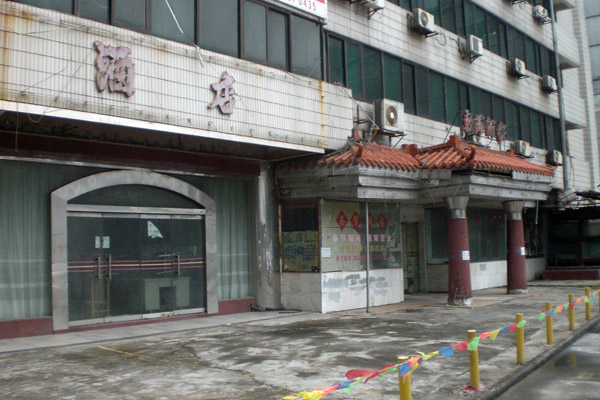
The stereotype of the second generation of Shenzhen villagers being “rich, lazy, mah johng playing, playboys (who might also do drugs)” is not only predicated on the idea that all of Shenzhen’s original inhabitants are rich, but also that their children have grown up aimless. However, Bao’an County’s original 300,000 residents and their children were not all created equal. What’s more, they increasingly find themselves belonging to antagonistic economic classes, while their children come of age grappling with problems that none of their parents imagined facing. Some second generation SZ farmers must look for wage labor in factories that (rumor has it) do not hire locals, preferring instead to hire migrant workers, even as other second generation SZ farmers are the first in their family to gone to college, and still others are, yes, struggling with too much wealth.

The inequality among locals has been created through reform era legislation and urban development projects, which have built upon and elaborated historical inequalities and traditional norms. In an earlier post, I charted the borders and corridors that have shaped economic possibility and subsequent patterns of urbanization in the SEZ, arguing that three borders have enabled urbanization in Shenzhen: the border with Hong Kong, the second line, and the city limits, which abut Dongguan in the northwest and Huizhou in the northeast. Two economic corridors have facilitated Shenzhen’s growth: the Guangshen highway corridor and the Kowloon-Canton Railway. The Guangshen highway corridor parallels the area’s riparian trade routes, which were the means of Han expansion from Guangzhou southwardly on the Pearl River and its tributaries. The KCR, of course, was the British attempt to preempt and redirect the PRD’s extensive trade network.

Not unexpectedly, proximity to a border or corridor has been a condition of reform era riches. Villages near the nexus of these borders and corridors have had disproportional opportunities to build and manage industrial parks and real estate developments. The earliest villages to get rich, for example, were all located along the Shenzhen-Hong Kong border at corridor checkpoints — Shekou (Fishing 1 and Wanxia) and Luohu (Hubei), first, but then Huanggang (Huanggang, Shuiwei, Xiasha, and Shangsha). However, guanwai villages retained land rights a full 12 years longer than did guannei villagers, with the result that largest and wealthiest village joint stock companies are now primarily located along the Pearl River Delta (Shajing and Huaide) and KCR corridors (Nanling near Buji). Consequently, many villages have remained “stuck” in between these two different modes of production, neither farming nor investing in manufacturing, let alone transitioning to the new creative economy. Areas of relative poverty include many Longgang District Villages as well as villages in Gongming and Guangming.

However, proximity to the borders and corridors has not in itself created the conditions for villages to transition from lives based on rural production to lives based on urban industrial manufacturing. In addition to the construction of infrastructure, differences in Mao-era administrative designation have also shaped current inequalities among villagers. First, successful villages have operated as collectives, rather than relying on individual efforts. These villages not only inherited Maoist organization, including management experience, but also inherited common ancestry. Thus, single surname (一姓) villages, which have renovated ancestral halls and promoted traditional rituals have generally been more organized than random surname (杂姓) villages, which were created during the Maoist era for production purposes. Second, successful villages have had traditional land rights, which were extensive. Indeed, most traditional villages have made their fortune through land deals. In contrast, fishing villages (渔村) and overseas Chinese villages (桥村) had foundation rights (宅地), but not land development rights. This meant individual villagers could build private homes, but that villages could not collectively invest in industrial parks or real estate developments. Moreover, villages did not benefit from compensation deals between developers and nearby traditional villages. Third, as recent events in Wanfeng demonstrate, some village heads have been less corrupt than others, while the success of Huaide, Nanling, Huanggang, and Xiasha Villages has been directly attributed to the foresight of the incumbent leader.

It is an open secret that legislation has been the source of Shenzhen’s competitive advantage, both for outside investors and for indigenous Bao’an villagers. What’s more, this legislation did provide the framework for many local villages and individual villagers to become rich. Indeed, when Deng Xiaoping died in February 1997, Shenzhen villagers openly wept and brought funeral wreathes to the statue at Lianhua Park and his Shennan Road billboard. Nevertheless, the emergence of class differences within and between villages directs our attention to the ways in which Shenzhen has displaced Bao’an as “the local”. Within this new locale, hometown status no longer provides a viable identity because locals have been segregated into urban classes that have disrupted traditional rural relations, even as they learn to navigate a hometown that is no longer theirs, assimilate the mores and customs of urbanites, and speak standard Mandarin, rather than local Cantonese or Hakka dialect. And in this new world ordering, poor Baoan locals embody a poignant form of global tragedy.

the secret to happiness…

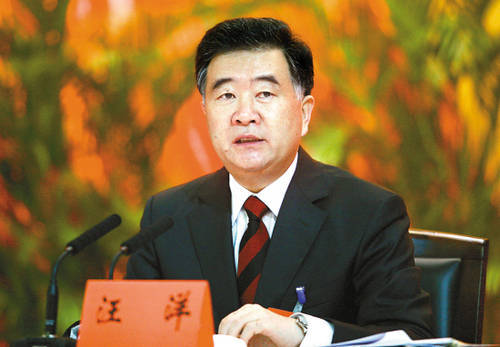
Yesterday, Guangdong Party Secretary Wang Yang (汪洋) addressed the 11th Guangdong Provincial Congress of Party Representatives, making five statements which have set him apart from other high-ranking leaders. Once a rival of Bo Xilai for a place in the 18th Naptional People’s Congress appointments, Wang Yang has also made his gesture to gain the support of the people. However, where Bo Xilai went poor populist, Wang Yang’s speech has me remembering the Province’s historic role in the 1911 Xinhai Revolution, when 100 years ago, with its links to overseas Chinese and relatively advanced economy, Guangdong was the cradle of China’s bourgeois revolution, in contrast to the rural uprising that Mao Zedong transformed into a socialist revolution. Wang Yang is a leader for China’s emergent and increasingly vocal middle class. And yes, many of them live in the Pearl River Delta.

Wang Yang’s Five Statements

1. The People are the agent that makes history, as well as the agent that constructs and enjoys Happy Guangdong. The people have the right to pursue happiness; it is the responsibility of the Party and the government to benefit the People. We must discard the mistaken idea that the People’s happiness is a result of the Party and government’s benevolence. (人民群众是创造历史的主体,也是建设和享有幸福广东的主体。追求幸福,是人民的权利;造福人民,是党和政府的责任。我们必须破除人民幸福是党和政府恩赐的错误认识.)

2. We need to discard unwritten rules and bad habits, creating a just, lively, and orderly social environment, where those who follow the rules don’t suffer, where talented people can take the lead, and can pursue and create their own happy life to the best of their ability. (破除潜规则陋习,创造公平公正、活力有序的社会环境,让守规矩的人不吃亏,让有本事的人有奔头,各尽所能地追求和创造自己的幸福生活.)

3. The greatest threat to the Party’s long-term political control is becoming too far from the masses. Our Party can only achieve eternal success to the extent that it comes from the People, is rooted in the People, and serves the People. (党长期执政的最大危险是脱离群众。只有始终坚持来自人民、植根人民、服务人民,我们党才能永远立于不败之地.)

4. We need the courage to use personal revolution to firmly destroy the interests that have turned their backs on socialist market economic reforms in order to resolve problems of government agents exceeding their function, absenting their function, and mistaking their function, making government into a provider of public goods and services. (我们要以自我革命的勇气,坚决打破背离社会主义市场经济改革方向的利益格局,解决政府职能越位、缺位、错位等问题,使政府真正成为公共产品和公共服务的提供者.)

5. Guangdong’s market society has already begun to change… If we take hold of this opportunity, we can breakthrough many difficulties and problems on the road ahead of us, smoothly entering the ranks of more modern areas; if we don’t take hold of this opportunity, we may be unable to escape “the middle income trap”, stagnating and retreating, and the advances we have already made could be lost.  (广东经济社会已经步入转型期……把握得好,我们就能破解前进道路上的各种困难和问题,顺利步入比较发达的现代化地区行列;把握得不好,我们就有可能跨不过‘中等收入陷阱’,出现停滞和倒退,已经取得的发展成果也有可能断送.)

guagua has vanished, but his older half-brother splashes across the chinese media

At this point in As Chongqing Turns, Guagua has vanished, but intrepid journalists have reported that his famously low key older half-brother, Li Wangzhi (李望知 Brandon Li) is in business with a Japanese chain selling high quality black angus steaks. More to the gossipy point of our story, Li Wangzhi gave his investment company a snarky classical name and his mother, Bo Xilai’s first wife, Li Danyu is throwing operatic slurs!

Flashback: In the rough and tumble years of the Cultural Revolution, the Bo family was out in the political cold with the rest of the 8 elders. Nevertheless, their children were intermarrying, consolidating alliances, and falling in and out of bad romance.

In 1976, Bo Xilai married Li Danyu (李丹宇), the princess daughter of the high-ranking cadre, Li Xuefeng (李雪峰), who in 1960 became the first political commissar of the Beijing Military Region and subsequently took control of the Beijing party organization after the purge of Peng Zhen in 1966. His political star fell when he supported Chen Boda during the 1971 Lushan Conference named him a Lin Biao supporter. In 1976, when his daughter married Bo Xilai, Li Xuefeng still faced another 3 years of  internal exile in Anhui province and would not be rehabilitated until 1982.

Bo Xilai was working as a manual laborer at the Bejing Number 5 Machine Repair Factory when he and Li Danyu married and had a son, Bo Wangzhi. In 1978, the college entrance exam system was re-instated and Bo Xilai was admitted to the Law Department of Beijing University where he met Gu Kailai. Princeling preferences for marrying within red circles being what they were, there were no degrees of separation between the young lovers — Li Danyu’s older brother was married to Gu Kailai’s third older sister, making Bo Xilai and Gu Kailai in-laws by marriage.

Even as Bo Xilai and Gu Kailai’s romance escalated, Li Danyu publicly accused her husband of being Chen Shimei (陈世美), the infamous adulterer from the eponymous Beijing opera. Li Danyu also tried to have Gu Kailai convicted on the “Destroying a Military Marriage” law. Nevertheless, Bo and Gu persevered and were married in 1984, when (it is said), the scorned ex-wife’s father was instrumental in having the couple run out of Beijing to Jin County, Dalian, where Bo Xilai’s political career began a Vice Secretary. Indeed, until 2003 when Li Xuefeng died and his influence over the Beijing political apparatus finally ended, Bo Xilai was unable to find a political position in the capital.

After her divorce from Bo Xilai, Li Danyu had their son change his surname from Bo to Li. Over the years, Li Danyu made sure that everyone knew of Bo and Gu’s lack of virtue, making sure that the story followed Bo wherever he was assigned.

Flash forward: Li Wangzhi grew up, graduated from Beijing University’s School of Law in 1996 and went on for a Master’s in Finance from Columbia in 2001. On returning to Beijing, Li Wangzhi set up a company called Chong’er Investment Consulting Ltd (重耳投资咨询有限公司). Inquiring minds want to know — what’s the story?

During the Spring and Autumn period, Chong’er (重耳) was the given name of Duke Jin Wen, son of Duke Jin Xian. Duke Jin Xian’s concubine, Li Pei had a child, Chong’er’s younger half-brother, Xi Qi. In order to secure Xi Qi’s future, Li Pei hatched a plot to kill Chong’er, who fled for his life. But in a what goes around comes around moment, Li Pei and Xi Qi died in court infighting and Chong’er triumphantly returned to take power.

Today, as Guagua hides and his parents remain hidden, Li Wangzhi moves forward (under the pseudonym Li Xiaobai) with his beef export business, which supplies Japanese steak aficionados with tasty, massaged Snow Dragon black angus steaks at $US 600 a kilo from ranches in — yes, its true — Dalian (雪龙黑牛股份公司).