Leaves of Book – The Work of Charles La Belle

I was privileged to speak at the Dec 11, book launch for Charles La Belle‘s Corpus and Guilty. To see the show, go to Saamlung Gallery in Hong Kong. To buy a copy in Shenzhen, visit the Old Heaven Bookstore in OCT. Response, below:
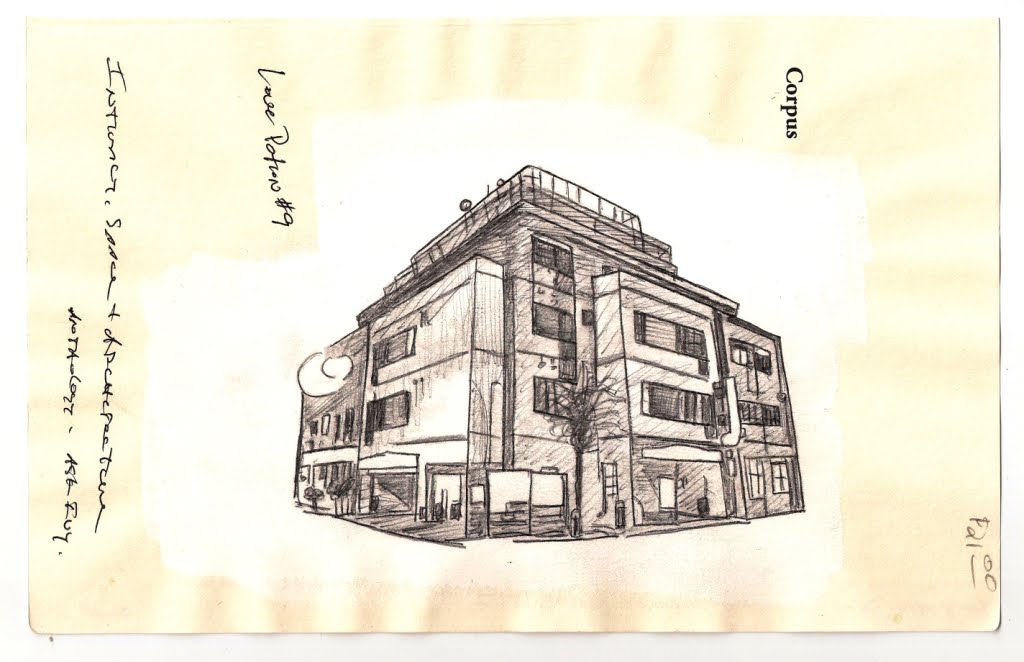
Charles La Belle’s artistic process of layering time and experience in a book that is simultaneously reread and rewritten reminded me of how Walt Wittman lived and in living wrote and rewrote, Leaves of Grass. Between 1855 and 1892, Wittman quite famously published no fewer than nine different editions of Leaves; over the past fourteen years, La Belle has published two volumes that relate to one ongoing project. This intellectual ebb and flow, the sentimental return and reevaluation, self-promotion and in-your-face jouissance enabled Wittman to voice and in voicing inhabit the expanding, teeming, writhing, and destabilizing emergence of a uniquely American identity. Likewise, La Belle also performs an artistic stutter-step to more fully inhabit the unruly emergence of post Cold War, post socialist, post modern, post industrial globalizing and globalized urban identities.

“Buildings Entered,” La Belle’s life work is best aligned with Wittman’s spiritual wandering at the level of process. Like Wittman, La Belle has chosen one medium and one theme to which he constantly returns; like Wittman, La Belle grapples with the problem of transforming mere being into the well-lived – and yes, this is the ethically well-lived – life; like Wittman, La Belle accepts the immanent mysticism of ordinary human lives. The building first entered, like the open road invites each of us to inhabit the unknown.

In terms of content, however, over a century of industrial expansion and relentless capitalist urbanization separate Wittman from La Belle. Continue reading

The Fishing Village that Became a World Symbol: 渔民村

So, I have been catching up on the Shenzhen documentary, 沧海桑田:深圳村庄30年. After setting the historic stage with rural poverty and economic immigration / cold war defection (episode 1) and then national policy (episode 2), the documentary turns to specific villages both to illustrate general trends in SEZ history and to introduce the players. So today, 渔民村 (Yumin Village – episode 3), at the heart of the earliest reforms.

Yumin Village has an important place in both national Chinese and local Shenzhen symbolic geography for three reasons, but most importantly for revealing the prejudices built into the landscape, locally, nationally, and internationally. Continue reading

沧海桑田:The transformation of Shenzhen Villages

For those wondering, is there a documentary on Shenzhen villages out there? The answer is yes and its 15 hours long! CCTV and SZTV produced 沧海桑田:深圳村庄30年,  a 30-episode television documentary to commemorate the SEZ’s 30th anniversary.

Not unexpectedly, the documentary’s ultimate happy end is urbane Shenzhen. Nevertheless, each of the 30 episodes does raise issues worth talking about and also gives current Party takes on these issues, which is always useful information. In fact, that take may be the point; the commemoration of the SEZ’s 30th Anniversary included a more inclusive and nuanced understanding of pre-reform Baoan society and history, reminding us that the villages no longer exist as such. What remains are ideological and economic struggles over the properties held by [former village] stock-holding corporations that have not yet been fully integrated into the Municipality’s urban apparatus.

That said, however, there is also the question of what a truly integrated Shenzhen society might look like. And consequently it is interesting and hopeful to think that the economic questions may also force re-evalution of who belongs in the city.

So, how are those ideological battles being waged in the contemporary SEZ?

Continue reading

Translation question: 天性竟自由

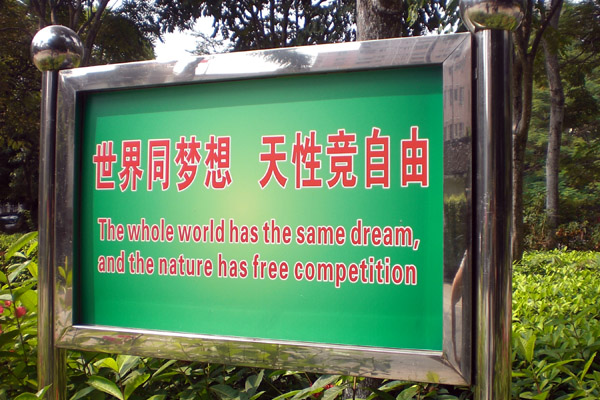
I’m having difficulty figuring out what this sign actually means. Clearly, the English is off. My sense of the Chinese, however, is to attribute all sorts of neoliberal interpretations to the line 天性竟自由; no matter how I cut it, I come up with a slice of economic pie. Nevertheless, I recognize that there are important nuances even within forms of neoliberal essentialism. Hence my question: How would you translate this sign? Please share translation and rational.

RIP – Steve Jobs and neoliberal immortality


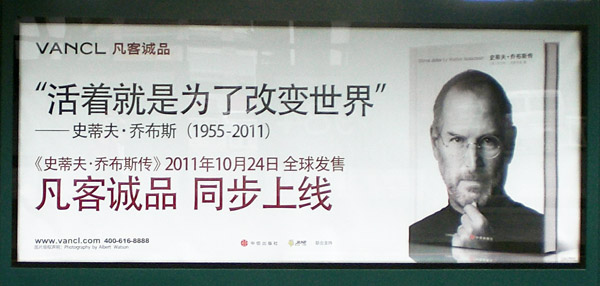
A recent advertisement for VANCL web quotes and shows a book about Steve Jobs. My first reaction was disgust: how is it possible to use someone’s death as a means of pushing goods? However, my random sampling of Chinese friends shows that there is another way of understanding this advertisement – social immortality or 不朽 (buxiu), which means that you continue to influence the world even after you have died. All agree, Steve Jobs achieved buxiu.

According to my friends, who don’t believe in an afterlife but do believe in continuing influence, Jobs achieved buxiu through three forms of social memory: 立功 (establish work),立言 (establish language),立德 (establish morality). 立 means to stand-up or to establish. 功 is a wonderfully rich character that has (at least) five meanings: merit, service, result, achievement, and accomplishment. 言 means language or speech and 德 refers to virtue. In other words, buxiu consists in setting up an institution, being cited, and setting moral standards. Steve Jobs’ accomplishment was to establish Apple, his speeches and citations now circulate on the internet and people learn from them, and his morality was to achieve brand confidence; Apple products are neither counterfeit nor substandard; their virtue as products is guaranteed quality.

Thus described, the kind of buxiu that Jobs has achieved seems classically neoliberal and begs all sorts of questions about how and why we are busy commodifying every aspect of our lives and afterlives. Indeed, we are clearly using economic metaphors to organize how we treat the living and the dead. How else to understand a world where trust can refer to forms of human relationship that have been structured by multi-generational financial arrangements? Consequently, talking about Steve Jobs and VANCL in Shenzhen reminded me of yet another cross-cultural capitalist truth; there’s as much honor and respect attached to VANCL’s use of Steve Jobs to promote online shopping, as there is when his American compatriots link the price of Apple stock to his passing.

突破:what is a break through?

Lately, I have been thinking about how each of Shenzhen’s six officially lauded break throughs appears as an instance of slogan warfare. Concomitantly, I have thinking about creative destruction, both Marxist and neo-liberal variants. Roughly speaking, Marx defined creative destruction as the necessary destruction of property and means of production (including social relations) so that new wealth could be generated. In contrast, neo-liberal economists like Joseph Schumpeter have tended to define creative destruction in terms of innovation. A question of emphasis that also beats at the heart of moral value: Marx witnessed destruction and its fallout; Schumpeter saw innovation and its benefits.

So below, a brief survey of Shenzhen breakthroughs to track the shift from socialist to neoliberal political morality. As Marx and Schumpeter indicate, none of these break throughs have been morally neutral, legitimating both new forms of inequality and opportunity. Continue reading

rumors of excess: the shenzhen universiade

I’ve been talking to people about how much Shenzhen spent on the Universiade and the rumors are flying.

According to a report from the Expenditures Department, Shenzhen Municipality budgeted 17.39 亿元 (272 million USD according to my online currency converter), or roughly 36.4% of the 2010 expenditure budget. In 2011, there were two adjustments to the budget, bringing the official total spent on the universiade to 29.15 亿元 (457 million USD). So yes, I’m trying to imagine the “difficulties” that the center overcame to insure the smooth opening of the Universiade (克服各种困难,助力大运顺利召开), after which there were no more universiade expenditures. So how much is roughly 457 million USD? One answer is, Shenzhen spent 92% of the first quarter total trade between China and Cambodia (498 million USD) on a collegiate sporting event.

But it’s unclear what this money was actually spent on and whether or not, for example, they include infrastructure upgrades or just money spent on flower arrangements and strategically placed sculptures. Continue reading

imported greenspace, clear skies, and sun

clear skies have returned and shenzhen shimmers, entices actually. when the horizon opens, walking settles the heart and has me thinking that we need sustainable worlds for no other reason than the joy they bring; smog discourages in all senses of the word.

yesterday, i wandered through some of the universiade greenspace/ coverage to prevent visitors from seeing nearby construction sites and noticed, once again, the extent to which the city and developers have taken to importing foliage to create beautiful spaces. the (malaysian, i believe – if you know please tell me) trees grow here. and yet. bringing this foliage requires uprooting other landscapes, burning fossil fuels, and (in houhai) filling in coastal waters with imported soil. moreover, these high end landscapes do not flourish without extensive care, so that this beauty remains entangled not only in unnecessary, but also unsustainable inequalities.

shenzhen is not the only city importing foliage in order to make a more perfect world. certainly los angeles and las vegas have set the global standard for transplanting eden. and perhaps that’s the point. in our rush to build a perfect world, we fail to realize we’re already there.

This slideshow requires JavaScript.

exhibitionism

Yesterday, I went to the OCAT Contemporary Art Space opening, 小运动:当代艺术中的自我实践(Little Movements: Self Practice in Contemporary Art). I saw many friends and we chatted about what we are doing. Yes, this is the point: the Little Movements exhibition formally presents videos, writings, and photos of artists talking about being artists. And at this level, I like the idea of examining how we make art through day to day encounters. So, if you are interested in this history, the exhibition is well worth the trip. If, however, you want to know what young Chinese artists are doing, visit He Xiangning, the Art Space’s mother organization to checkout the Fresh Eyes exhibit.

constructing the semi-public sphere – ocat renovations

i have noticed that many of the shenzhen spaces that i enjoy might be defined as semi-public. small scale spaces designed with particular publics in mind, these spaces repurpose the clunky mass architecture of most of shenzhen into interesting nooks for conversation and debate, without falling into the normative excesses of so many private homes. indeed, recently, ocat loft has extended its conversion of industrial manufacturing zones into creative cultural spaces.  the newer area will be the site of the 2011 shenzhen-hong kong biannale.

importantly, cultural consumption and the gentrification of working class spaces have predicated the creation of this semi-public sphere, where individualized desires blunt the the progressive edge of public debate. and yet, if no one shops in these stores, hangs in the coffee houses, and attends gallery openings, the area will collapse and conversations displaced. such are the paradoxes of contemporary urbanization, images below.

This slideshow requires JavaScript.