tantou: these are not mcmansions

This past week, I joined members of ATU on a research trip to Kaihua County, Zhejiang. ATU is a Shenzhen-based NGO, and their mission is to bring critical attention to architecture and urban planning practices. Most recently, they have decided to intervene in rural development in order to ameliorate the problems of bringing urban planning and its ideologies into rural areas. Continue reading

glass factory pictures

Walked the old float glass factory yesterday. Less than a year ago it hosted the Biennial of Architecture and Urbanism. Today it stands empty, but magnificently so. The fearless waste of high modernism and steely industrialization. We take our temples where and as we find them. Continue reading

the birth of territory and feminist geography, explained

The problem with an issue like APEC blue is that it reads as if an authoritarian government can clean up the skies to impress visiting dignities by inconveniencing working class Beijingers and not be bothered to actually work for sustainable options. As such, this whole cleanup/mess easily slips into cultural mudslinging as if we were not talking a global economic system in which environmental quality is one of the perks of status. In such a system it makes sense that what is a “right” in one part of the system, becomes a luxury and political tool in another. Nevertheless, today I’m feeling hopeful because when we do turn off our factories and stop driving, the world heals. We just need sustainable reasons to do so. Continue reading

of theme parks and the contemporary state

I have been showing my 12-year old niece the sites in Beijing, including the Great Wall. As we wander, I have free associated between these experiences and previous theme park experiences, most recently in Ocean Park, Hong Kong, but before that the original Disneyland in Southern California, the iconic Knott’s Berry Farm, the Jersey shore, its boardwalks and miniature golf courses, as well as several Six Flags and Disneys elsewhere. (Years ago I even visited the uncomfortably super-mini Disney in Hong Kong.)

There are, of course, perhaps more explicit connections to be made with Williamsburg, Jockey Hollow, and other historic sites that I have visited (and actually in Shenzhen I have been involved in promoting historical preservation of local sites), but.  In terms of pageantry and intent to re-present the world, my mind keeps returning to Disney. Continue reading

occupy central: it’s not what you think

The US press, like many of my Chinese friends have focused on what the Hong Kong protestors won’t accomplish. This focus on future violence against students completely ignores the courageous possibilities that are offered in the present. Continue reading

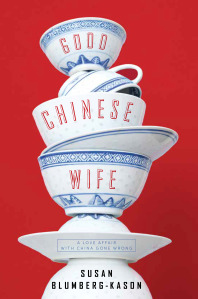
Book Review: Good Chinese Wife

A fellow Shenzhen expat has reviewed Susan Blumberg-Kason’s memoir, Good Chinese Wife. I am also a 中国媳妇 and find myself distressed by the suffering and self doubt that characterized her relationship with her ex-husband. In fact, Blumberg-Kason’s anxieties and willingness to give her husband the benefit of the cultural doubt resonated uncomfortably. I believe that one of the biggest challenges for women abroad is to find the confidence to trust our experience and say, “No more of this shit.” Another Shenzhen expat, Rose writes about her experiences navigating the gendered cultural divide is , who blogs at China Elevator Stories.

Ray's avatarRay-Comics

 Cover

szdaily.sznews.com/html/2014-09/16/content_3005971.htm

“GOOD Chinese Wife” is a new memoir published by Sourcebooks, and is a poignant tale expats should enjoy about the overlap of China and the West. Susan Blumberg-Kason details her unfortunate marriage to a Chinese music scholar, as they meet while studying in Hong Kong and then travel to his hometown in Hubei Province before eventually settling in San Francisco, California.

The central question posed by their troubled relationship is whether their differences were due to culture or personality. Interracial marriages may have some problems, but are certain individual defects masked by the excuse of culture?

As their relationship begins, Blumberg-Kason appreciates her future husband’s background. She studies Mandarin as a postgraduate in Hong Kong in the early 1990s, and stays there through the time of the handover in 1997, and for a reader familiar with South China it can be very interesting to compare that time with…

View original post 559 more words

distracted

image

Came across this advertisement: in the future your body will be in a meeting your mind will be in the front row of a fashion show

How to think about this figuring (and I use the word deliberately) of body/mind split?

I have, of course, attended meetings where the point is to show one’s face rather than to actually participate in organized discussion aimed at coordinating action toward some shared goal. In fact, most meetings veer into the irrelevant for all too many participants. I have also watched participants answer their phones during a meeting. That said, however, this is the first time I have seen an advertisement that advocates overcoming the inevitability of meetings through better virtual connections someplace else. After all, I assume that the mind at the catwalk is fantastically dressed, rather than actually clothed in haute couture.

Today, I’m distressed by the idea that distraction is presented as an acceptable way of supplementing/ making bearable the gendered division of labor. Let me count the ways:

1) distraction okay because female admins not part of the meeting;

2) distraction inevitable because there are no alternatives to shaping meeting attendance and participation offered;

3) distraction defined through watching rather than participating in design or wearing a dress elsewhere;

4) distraction facilitated by technologies that allow one to go virtual shopping, which in turn keeps one in debt and less able to refuse alienating work.

Question du jour: how beneficial are technologies that intensify human tendencies to distraction? This advertisement seems uncannily like using a television to babysit. But worse. Sigh.

policy, policy, policy: real estate with chinese characteristics

For those of you who wonder, what’s great in Dongguan–and you know you’re out there because Dongguan has gotten really bad press–I’ld like to suggest Guanyin Mountain National Forest in Tangxia, Zhangmutou Township (东莞市樟木头镇塘厦观音山). The forest occupies 18 sq kilometers, of which most is beautiful forest and hiking trails. This may come as a surprise because Zhangmutou was one of the industrial centers that sprung up along the Kowloon-Guangzhou Railway in the late 80s and 90s. In fact, the area was once known as “Little Hong Kong” because many Hong Kongers vacationed and bought homes there.

From the mountain viewing stations one can see the village and township industrial parks of early reform, as well as the recreational facilities (including golf courses and upscale hotels) where Hong Kongers went for the weekend indulgence and the late 1990s housing that truck drivers and the SAR’s mobile poor bought. One can also see more recent upper middle class developments by Vanke and China Resources which aim to attract buyers from neighboring Shenzhen. In fact, Tangxia is closer to downtown Shenzhen than is Longgang District. In addition to beautiful trails and fresh if muggy semi-tropical air, the park also offers views of how industrial urbanization with South Chinese characteristics reshapes the land, reminding us that we are not talking of “location, location, location”, but more precisely, “policy, policy, policy”.

Each of these areas exists because of a change to or promulgation of Chinese policy. The village and township industrial parks came about as a result of the responsibility system, while the resorts and entertainment industry that catered to a Hong Kong clientele depended upon laws that made it illegal for mainland truckers to cross the border and deliver containers from local factories to Hong Kong logistics companies. The present shift to upscale housing developments for Shenzhen and neighboring elites is also a manifestation of policy: crackdowns on the sex industry and push toward higher value added production in the area.

Of course, the construction in Tangxia has also depended upon the establishment of a bourgeoisie in Guangzhou and Shenzhen, where first houses have been paid off and costs of education met. However, more importantly, Vanke and China Resources have taken up the call to build in Tangxia because the Shenzhen metro will soon connect the area to the SEZ. They hope that the relative low cost of housing will attract young Shenzhen families to move to Dongguan and commute to Shenzhen. In the meantime, however, the people I spoke with in Tangxia were not buying a primary home, but rather a home for their retired parents. After all, they like nearby developers are waiting for Dongguan Municipality to build schools and hospitals, integrating Tangxia into the urban grid because the geographic effects of policy are as visible in their absence as they are in their presence.


the kids really are all right

Last night I had dinner with Joe, a gen-90 recent college graduate. He and several friends have a start-up that helps businesses expand through the powers of we chat and Tencent’s remarkable level of cross platform integration. Very contemporary marketing firm. In his downtime, Joe organizes summer programs that teach creative thinking, collaboration, and courage of independent thought to other young Shenzheners.

Our conversation and Joe’s passion, like last week’s trip to Beijing reminded me that there are new ideas and start ups perculating throughout Shenzhen. Green Mango is a group of young mothers trying to change the education system. Bean is a Seattle-based group of volunteers who contribute to community projects. ECSSZ is a group of street artists who engage in community beautification projects. Not to mention the young hackers in residence at Baishizhou.

It is all too easy to dismiss these small and idealistic efforts as unrealistic. In fact, Chinese parents like their American counterparts complain that their children are “不现实.” But that’s not point du jour. Today I’m thinking, wow. Just. Wow.

innovate with china…

…was the slogan of this year’s Shenzhen Maker Faire. I attended on Sunday, and then Monday afternoon joined researchers from the Institute For the Future on a tour of BGI (Beijing Genomics Institute) or “China Great Gene (华大基因)” as the name translates from the Chinese.

What did I see and learn?

That children love playing with gadgets. That most of the “products” were in fact toys. And that the most popular booths had the greatest room for serious play. In other words, the successful objects themselves structured a particular–and somehow “first”–experience. Hence, the wow moments that attracted children and adults alike.

That BGI has concentrated a massive amount of capital and resources in order to further the production of data. Moreover, as the cost of mapping genomes has dropped from $US 3B to around $US 3,000 in a little over twenty years, the data has proliferated to the point where the challenge facing researchers is technologies for storing and analyzing the data. I’m not sure what this volume of data means in terms of life experiences, but it does strike me that our imaginations constantly seek material form. And I learned the expression human augmentation, as if we are not enough.

That the Shekou Relaunch campaign has brought in interesting cultural programs to the area. In addition, these programs have been popular and attracted residents from all over the city to Shekou. So notable that–again–we’re looking at the design of experience. And all this hinges on the promulgation of culture and creativity as both the means and ends of socio-economic development.

This slideshow requires JavaScript.