八卦 : gossip and the unfolding of fate

My inner anthropologist wants to set up the following story with theories about the importance of  fate (命) in creating and maintaining moral communities here in Shenzhen; my inner theorist sees how the matrix of Chinese understandings of family, immigration patterns, and rising Mainland wealth are changing possible ways of globalization; my base self just wants to blurt the juiciest piece of gossip I´ve heard in a while. Not unexpectedly, perhaps, I have decided to skip the analysis and take the low road. Ah yes, joys of ethnography qua blog entry, rather than conference paper or refereed publication!

¨He really is unlucky (倒霉 daomei),¨ my friend smirked, his use of daomei (rather than 不幸 buxing) indicating unlucky in the sense of hapless or pathetic, more the clown than hero of fate.

¨Spill the bagua,¨ I invited. Ba gua (八卦) are the eight hexagrams and the central element of divination in the Yijing. However, the phrase ¨spill the bagua (八卦一下)”means spill the gossip, in all its delicious forms, but most precisely, romantic gossip – who´s hooked up, who´s getting married, and, of course, the results of all this fooling around. This is important, yes, bagua is gossip, but it is also a story about how a human life is destined. Thus, as with daomei, language choice highlights the role of destiny in shaping a particular life.

Well, it turns out that friend Daomei´s girlfriend is an overseas Chinese, second generation sent back to the Mainland to learn Mandarin. The two hooked up and seemed to be enjoying themselves when girlfriend found herself pregnant. She went home to talk with her parents to figure out what to do. A while later, girlfriend returned with parents to talk with Daomei about getting married. Of course, Daomei hadn´t told his parents that he had a serious girlfriend so the parental introduction was awkward. Daomei´s father asked if Daomei was ready to take on the responsibilities of a family.

¨Yes!¨

The next question then was where the two would live. Girlfriend wanted to stay in the Mainland, so Daomei and his father went about buying a house and finding a more or less stable job for Daomei. Meanwhile, girlfriend and parents flew home to prepare to move to China. However, not long afterward, Daomei received a phone call.

¨I think we should live overseas.¨

¨What will I do abroad? I don´t even speak English that well.¨

¨Don´t worry about that. Lots of Chinese abroad don´t know why they´re here; it´s just a question of adjusting. Anyway, my father found you a job and an English program.¨

So, Daomei´s father sold the house and gave the money to Daomei to immigrate and start a new life abroad, ¨After all, son,¨ he said, ¨the money is yours to start your married life.¨

However, even as Daomei began his immigration paperwork, girlfriend miscarried. A second phone call.

¨We lost the baby.¨

¨What about us?¨

¨I need some time to xiangyixiang (想一想 ),¨ she said, indicating her decision to reevaluate the relationship. However, xiangyixiang is a weak expression; we also xiangyixiang about where we want to go to dinner or spend a holiday. All sorts of words might have been conventionally more appropriate – kaolv (考虑) or fanxing (反省), for example. But xiangyixiang it was.

So, Daomei went to his father, returned the money for safe keeping and asked, ¨What´s your next step?¨ The implication being, this is your chance to make a clean break and get your act together.

Daomei answered, ¨I think I need time to xiangyixiang, too.¨

His father sighed, clearly having hoped for a more resolute next step and said, ¨You do that. However, I´m not going to take care of (管 guan) planning your next wedding.¨ And guan as we know involves taking responsibility to insure the best possible result. In many ways, guan is the antidote to the slings and arrows of outrageous fortune – it is the human commitment to have things unfold according to a righteous plan. Think Pontius Pilate washing his hands of the decision to execute Jesus of Nazareth as an example of the resignation in Dad´s decision not to guan Daomei anymore; I have done what I can and can do no more.

The friend who shared this bit of bagua with me concluded with the comment that ¨The parents are really innocent (无辜 wugu),¨ and by implication had been wronged by fate.
人人网–everybody´s(?!) net

this weekend, a student asked me to join her renrenwang network. i have not been particularly proactive in joining online networks primarily because i spend too much time online as it is. point du jour is that while i was signing up, i discovered that the network included links to the major u.s. colleges and universities, as well as to universities throughout the world. stunning the extent and creativity of these networks. shocking as well the (comparative) extent to which u.s. online networks are not integrating global links.

i know, my reaction makes me sound like an ¨american peasant,¨ but for the past few years i have been increasingly aware how provincial my upbringing and education was. at the time (1983) studying chinese seemed so far outside the norm that my father asked me if studying mandarin would help me succeed negotiating the hong kong stock exchange! and yet somewhen along the line, not only did the world catch up to the internationalism of china, but also surpassed my preparation to live in that new world.

wow. 30 years of reform and opening and it is a whole new world. wow again.

memory work

yesterday on the bus, a large and friendly man approached me, asking, ¨do you remember me?¨

after i replied, ¨no,¨ he began to tell me all sorts of facts about me. he knew where i had gone to graduate school, he knew my previous research topics, he knew my husband´s name, and yes, he had seen that long ago sztv documentary about the two of us.

¨don´t you remember me?¨ he asked again.

i tried, ¨i´m old and tired,¨ but he was not assuaged. so i assured him that i believed we had met.

¨you lived in chaoxi lou,¨ he said confidently.

over fifteen years ago, i lived in chaoxi lou for less than two months. and we met then?!

¨yes,¨ he continued happily. ¨i was a student and you were fatter and older looking. in fact, you´ve changed so much i wasn´t sure it was you. i wanted to hear your opinions about taiwan because you had lived there.¨

humbling, this unexpected encounter because suddenly i´m thinking about all those i have forgotten. how much of my life is being carried around in the hearts of others?

uncanny, this encounter because i´m also wondering how many of the defining moments of my life only live in me?

all those fragments of encounter that i have enshrined in my heart were enshrined as dialogues and exchanges, but maybe they´re only bits and pieces of my selective unconscious at work. maybe nothing occurred as i recall. indeed, i have no way of confirming the reliability of my memories and by extension, the person i claim to have been and therefore have become, today.

additional upside to this encounter? i won´t forget him again…

education rumors

this is a brief gathering of and musing about rumors i have recently heard about how much money (a few, but clearly influential) shenzhen parents are willing to spend on their child´s education.

at a teashop: daughter is at a u.s. university, which happens to be a $60.00 cab ride into the city, where she can buy good food to cook in the dorm kitchen, rather than eat in the cafeteria. if daughter goes into the city even once a week, its probably an additional $200 a week for trip and food. the mother considered a worthwhile investment for two reasons: (1) daughter isn´t yet ready to drive in a foreign country (safety first) and (2) cafeteria food isn´t as nutritious as homemade chinese food. truthfully, i understood the reasons, even if my financial threshold is much lower.

at an italian restaurant: family worked very hard to get son into a private high school in the u.s. the allure of this particular high school is that a high percentage of graduates go on to the ivy league. with preparation, tuition and travel between u.s. and shenzhen and other stuff that son needs to be comfortable, the family spent 1 million rmb to make this possible. this one had me trying to figure out where all the money had gone. even if i estimate tuition and boarding to be $50,000 that still leaves about $100,000 unaccounted for.

on a bus: there are many people trying to get investment green cards in california (at least 1 million u.s.) because then they will enjoy discounted rates to the u.c. system. this investment will also give the child something to do, once she graduates from college.

what becomes clear in these stories is how important a child´s education is for the expression of social value. indeed, through these stories, parents and others debate what it means to be a family and a global citizen. these families are debating: how much is too much to spend on an education? and why is it important to get a good education even if there is no immediate return on investment? in other words, yes these are huge sums of money, but it is money invested in children, who remain our future. so there is a particular understanding of what is necessary for the future to be better.

given how hard it is to earn these sums in china, what becomes painfully clear is that a top education represents the ¨good life¨ and many shenzheners want this life very, very badly, if not for themselves at least for their children. and this future is clearly american. in every story i´ve heard (yes, self selected sample, not even pretending random), the u.s. exemplifies both the kind of future these parents want for their children as well as the kind of education they feel will make that future possible.

moreover, these rumors interestingly link up with the desire that infuses the study of english in shenzhen. everyday, cabby´s, janitors, college students, and friends tell me that their lives would be significantly better if they could speak english. for a long time, i misheard the desire in the rush to study english. i kept hearing, ¨want to make more money,¨ which is true as far as it goes. however, listening to the rumors of the cost of an education, i finally understood the point: these are people who want out of their current situation and see the foreign as the way. or rather ¨english¨ names the skills that will allow them transition into a new and presumably better lives.

at this moment, shenzhen education desires dovetail with american fantasies of how chinese investment can save the u.s. economy. uncomfortable and unhappy where we are, we seek elsewhere as if on the journey we could become otherwise, leaving our troubled selves behind.

eddies of difference

each time i visit shangshui (admittedly not all that often), i am caught off guard (again) by how much i like it precisely because the area forms an eddy of difference within hong kong. yesterday, for example, i trundled across the border to shangshui to meet with friends robin and venus who had directed me to meet them at an old style cafe, 广成冰室 in 石湖墟, a short walk from the shangshui metro. the cafe itself teemed with people eating set lunches of macaroni and beef soup, an egg sandwich, and milk coffee or tea. there were also red bean ices, pineapple rolls, and various other foods that had a definite greasy chopstick appeal. indeed, i´m thinking that in the american context, this kind of old style cafe might be more accurately translated as ¨hong kong style diner¨.

when i visit shangshui, i appreciate the low-riding buildings and narrow streets, and sidewalks occupied by fruit vendors. i enjoy the slower jostle of people window-shopping and the mom and pop scale of business. that said, i´m not sure how much shangshui´s appeal lies in it´s being relatively isolated from the glass and steel and tall looming buildings of central and admiralty. in other words, i´m not sure how much of shangshui´s appeal to me is in what it is not, rather than what it is. thus, my pleasure seemed derived from how shangshui contradicted stereotypical notions of what hong kong is.

the distinctly ¨non-urban¨ feeling i had in shangshui also made me aware of how different shangshui is from shenzhen´s urban villages, which are shenzhen´s ¨non urban¨ spaces. admittedly, ¨non urban¨ is not the same as ¨rural¨, nevertheless, shangshui, like shenzhen´s urban villages had me thinking countryside and not metropolis. and this is a difference that seems important. in shangshui, i felt the non urban to signify relative impoverishment – a form of ruralization, if not in actuality, at least ideologically. in contrast, in shenzhen, even though the urban villages actualize relative impoverishment, they also enable a transformation of rural identities and economies into something more recognizably ¨urban¨ and so the feeling is one rural urbanization.

the eddies of difference that shangshui and shenzhen´s urban villages actualize are valuable because they remind us that not only are there many ways of being human,  but also that lived difference is created through human interaction.  moreover, these eddies also constitute a warning; our urban environment testifies to the extent to which we unequally value rural and urban lives, despite our need for clean water and air and sources of food.

global addictions

today, i walked from the shenzhen university south gate along houhai road to coastal city, remembering earlier walks when the road was under construction and oyster squatters lived in shanties.  i was also struck by the proliferation of gates and cheap restaurants, but most noticeable was the sudden burst of american coffee shops – pacific coffee company and dunkin donuts have joined starbucks, even as my local favorite, hanamura has closed.

i´m noticing how the longer i´m here the easier it is to be american in a rather conventional fast-food kind of way. it´s not simply that years ago i would walk to mcdonald´s for a cup of bad coffee (this was pre-mccafe), but that all the bits and pieces of consumptive americana are now easily had, everywhere and yet the more interesting fragments do not translate, so to speak.

the global imaginary of junk food tastes in shenzhen is as narrow as it seems. with the american chains have come hong kong, taiwanese, korean and japanese chains. however, i haven´t noticed chains from other parts of the globe. indeed, global pop culture in shenzhen seems divided into flavors of china, japan and korea, and the u.s. although carrefoure (france mega-mart) has a presence, it is not as pervasive as jusco (japan) or wallmart (u.s.). moreover, fast food tastes were prefigured by the dominance of hong kong, taiwan, the u.s., japan, and korea in shenzhen mass culture, specifically movies and television.

what is it about beef and fried chicken, coffee drinks and sushi that are so portable? and why do i keep going back.

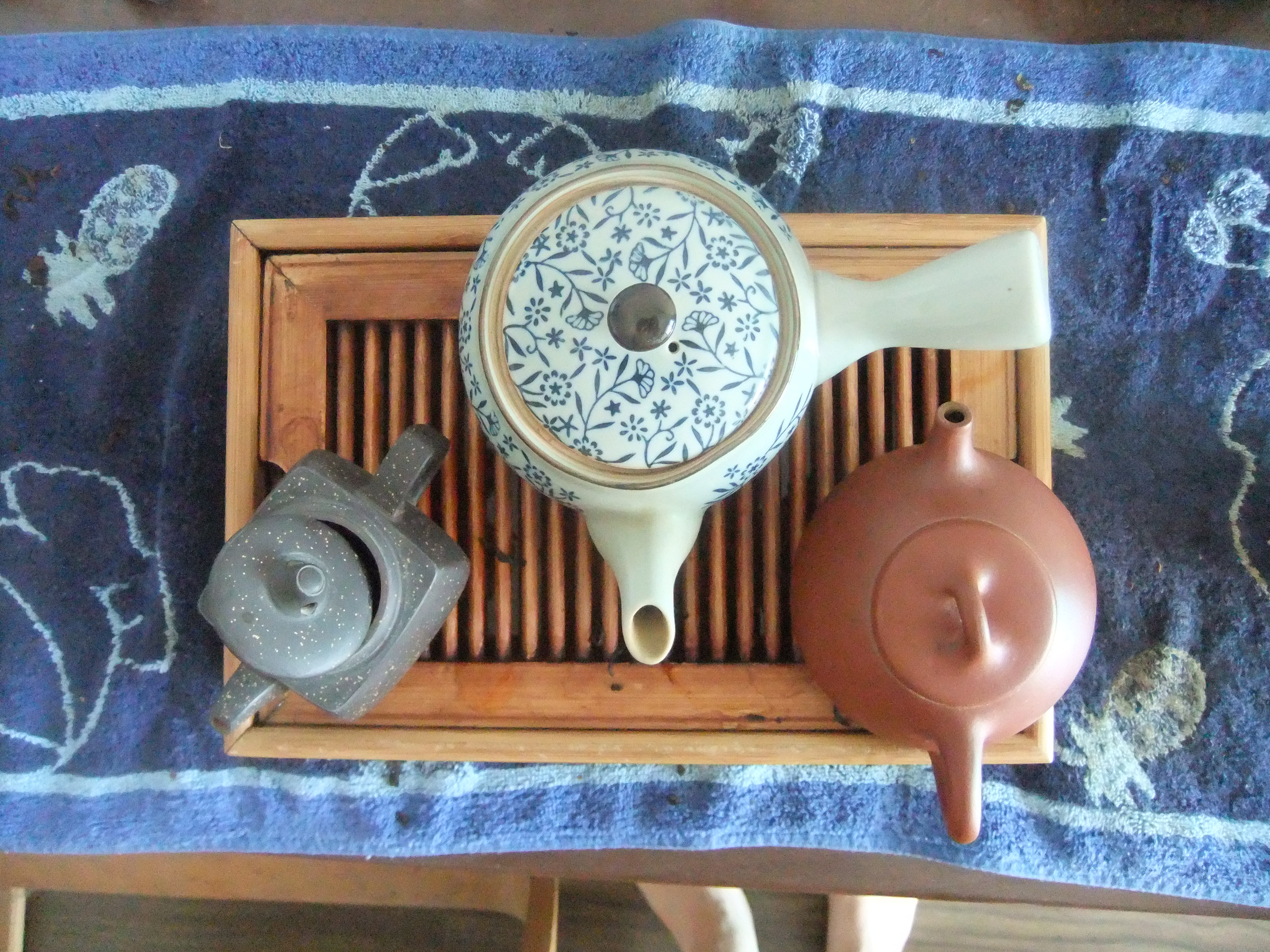
teapot chinese lessons

teapots remain some of my primary texts in learning mandarin. yesterday, for example, yang qian asked me which teapot i wanted to use. i answered, ¨the red one.¨ he laughed. why?

it turns out that the conventional order of description in mandarin would have been: the material the teapot was made of (clay 紫砂的 verses porcelain 瓷的), size (large 大的 versus small 小的), shape (round 圆的 versus square 方的), and only then color (black 黑的, red 红的, and blue 蓝的). so i could have asked for the ¨big clay pot¨ or ¨the round clay pot¨. he pointed out, with other items, such as a table top, texture (smooth 平的 versus 不平的 ) would have been more salient than color.

yang qian then posited that the ancient greeks understood the world through vision, while the chinese understood the world through tactility. consequently, our respective languages (off shoots of languages no longer spoken or even written) organize the world differently. i see color first, where he ¨sees¨ materiality.

in addition to learning to rephrase my requests, i´m not sure where to head with this. metaphors we live by (linguistic anthro 101) has remained one of my favorite books about language acquisition through increasingly abstract processes. default categories are more or less universal (tree, cup, pot) because we can touch them, but more specific and more general categories are shaped by culture (specific tree names and relative familiarity with said trees).

caveat aside, i´m now thinking about the cultural organization of pleasure. i´ve heard various arguments that chinese civilization has been traditionally more hedonistic than western. i have tended to interpret these arguments as projection of the ¨what i want my life to be, but isn´t, so i see that life in country x¨ variety of insight. but, it is interesting to contemplate that pleasures might be focused through different senses. and i find it even more interesting to think about how careful attention to everyday requests and descriptions might map entry into those other worlds.

yes, teapots bring all sorts of joy.

anxious masses: Thinking about Gu Wenda´s Ink Alchemy

Yesterday at the opening for experimental ink artist Gu Wenda, I was struck by the unfolding of scale in his work. His early work could be completed by one person. There were large paintings, like Surreal Horizon (超现实地平线) or images from Lost Empires (遗失的王朝) but nevertheless the actual works themselves conformed to a human-sized world as I have come to know it. I felt myself and the art to be at the same scale. Indeed, often I was larger than the pieces and some, like the Red Heart Series (红心系列) of seals on small, abstract ink paintings, I could hold in my hand. However the later work, such as the Ink Alchemy Series (水墨炼金术系列 – above image) was large scale industrial. As such, these pieces could not be completed by any one person or even by a group of people working with their hands. Instead, the artist became both an industrial designer and an organizer of human labor and machines over time.

Made entirely of died braids of human hair, Gu Wenda’s most recent installation Black Gold (黑金)  fills the entire OCT Art Terminal. In the middle of the cavernous room, a large rectangle of ink powder lies flat beneath a canopy of black braids. To the left and right of the canopy, evenly spaced sections of died braids hang from ceiling to floor in fine, delicate loops. The installation is deceptively simple – blocks of color shimmering neatly beneath gallery lights. However, Black Gold took three years (2008-2010) to complete and thinking about what would be necessary to complete such a project left me feeling both frightened and exhilarated. Frightened because I imaged thousands of woman, who had given several years of their lives to grow their hair, scalped to make an epic statement. Exhilarated because the level of coordinated precision needed to execute Black Gold spoke to me of how one might go about representing Chinese society – massive blocks that from a distance seem a well-organized whole, but which upon closer inspection dissolve into idiosyncratic anonymity.

Neatness or tidiness (整齐) of large groups or objects is one of the mass aesthetic values that I have had difficulty appreciating. Not that I don´t enjoy watching several thousands of people making the same motion at precisely the same time, but when I think about the level of work that is necessary to achieve such precision, I feel the same anxiety that I felt upon seeing Black Gold. Several examples of mass coordination come to mind: military marching, classrooms full of Chinese students taking tests over and over and over again to prepare for the gaokao, highways full of cars, miles of grazing pasture in the American West and wheat fields in the Mid. Massive, national bureaucracies. Each of these instances of mass coordination exemplifies the human potential to submit to external hierarchies that take sameness and repetition to be the signs of unity and belonging.

And here´s the rub: one what?

Military marching and mass test-taking provide living metonyms for the modern, industrial state. Nevertheless, these mass exercises also remind me of feudal traditions, in which being born into oneś place enabled large societies to hold their form for generations. In other words, for many to become one, for each to find her ¨place¨ takes a lifetime of practice. This taking one´s place in a larger order is natural insofar as to be human is to belong to various groups of various sizes. Indeed, as far as I can tell, this is the whole point of education – helping young people figure out how to inhabit diverse sets of coordinated relationships.

The anxiety I feel when thinking about Black Gold, specifically and mass coordination, more generally has to do with the means and goals of mass practices. Military marching, mass test-taking, driving on the highway, planting acres of wheat: each of these practices takes an abstract idea of what it means to be human and imposes it on the diversity of the world, creating conditions of idiosyncratic anonymity. Moreover, these practices aren´t particularly healthy. Armies go to war, Chinese students become test-taking machines, carbon monoxide kills as do the pesticides necessary to maintain wheat fields.

In contrast, if there is such a ¨one¨ out there, I’m Buddhist enough to believe that the point is to create conditions of mutual recognition. Creative collaboration rather than mass coordination, so to speak. I’m not sure what this means in terms of reorganizing nations or highway systems or college entrance requirements. Yet I trust the process. When I take the time to understand each of my students, something happens between us. And that state of sharing between – elusive, delicate, and quite beautiful – could transform mass culture in unexpected and wonderful ways.

Gu Wendaś Ink Alchemy retrospective is currently up at the He Xiangning Museum of Art and the OCT Contemporary Art Terminal. Worth a visit.

what is a self introduction?

I want to talk about the cultural work of self introductions, a topic one would think I had actually given some thought to, but alas, no. However, yesterday, insight. And yes, long story short, I’ve been all too American in how I introduce myself for way too long…

This past weekend, I was in Meilin at the Art de Vivre Art Space (圆筒艺术空间) to participate in the workshop stage of the second Coaster Raid, a series of events organized to promote creative exploration of Shenzhen. During the workshop weekend, nine creative groups or individuals met to explore Meilin and come up with artistic interpretations of the space literally at Deng Xiaoping’s back. On October 31 at 19:00, we will reconvene to show our work to the public. The showing is free and open to the public and the riptide team  hope to encourage reflection on and debate about the city. They are particularly interested in generating fresh approaches to seeing, representing, and talking about Shenzhen.

Yesterday, to conclude the workshop weekend, we had a more or less formal presentation of our ideas, so that the discussion could be recorded. The format was simple: riptide organizers, Michael and Gigi asked participants four questions and participants responded. The first question was: Why did you come to the event?

The Chinese participants all indicated they had been invited by Feng Yu, the Meilin organizer of this Coaster Raid. Some even indicated that they had accepted precisely because they knew Feng Yu to be an interesting person and that anything he was involved in was bound to be interesting.   I said that I had come because I had been exploring Shenzhen for 15 years and was thrilled to have the chance to explore with a new group of friends.

As the introductions went on, it became clear (to me) that the Chinese participants were taking self introduction as a chance to delineate the relationships that had brought them to this moment and only then did they begin to describe their projects. Indeed, as far as identifying themselves within the group, I had a strong sense that for the Chinese participants the relationships that had brought them together were more important than their work. In this sense, the common thread that they had come “to play (玩)” makes perfect sense. In contrast, I assumed that I had been invited because of my work and accordingly, an introduction to my work was the point of the self introduction.

I’m wondering if the difference in emphasis, Chinese participants on relationship, American moi on work works to creates misunderstanding even before conversations begin. To my English speaking heart, the Chinese introductions sounded vague and somehow off the point. Similarly, I wonder how arrogant or self-absorbed my self introduction sounded to Mandarin speaking hearts. I asked, but was reassured that, “Your Chinese is excellent.” And me thinking, “Yeah, but my social skills. What about my social skills?”

So now, I’m thinking that it might be useful to listen attentively to self introductions because they elucidate how my interlocutor perceive the purpose and direction of our interactions and, more specifically, collaboration in Meilin. I’m wondering to what extent my Chinese colleagues understand their work to be a means of exploring and strengthening, sometimes testing our various relationships. Indeed, this way of thinking points to the idea that how well and hard someone works becomes an expression of care or respect. It also allows for the possibility that any meeting may blossom into long term and deep friendships and yes, most Chinese self introductions include a variation on the phrase “I hope we can all become friends.”

In contrast, I know that I’m a good collaborator because I come for the work, whether or not it leads to stronger relationships. Thus, at first Chinese glance, I must appear to be committed to relationships, friendly, and conscientious. However, I know that my relationships may come to appear instrumental because once a project is finished, its easy for me to move on to the next work organized set of relationships.

Hopefully, as I wander through Meilin alone and with companion participants, I will learn to balance my impulse to work for the work with an attention to the work of friendship.

size 36 C and counting

I have been thinking about the purpose of human human adaptability. To what ends and how should we craft human lives? The context for my speculation has been the constant construction and reconstruction of Shenzhen, where I have watched the landscape constantly morph and mutate as if it were an organism with a life of its own and not a collaborative human project; all that is solid melts into air. Today, I am wondering: what kind of bodies are co-evolutionarily suited to this landscape?

Lately, in Shenzhen, human bodies, especially female bodies  have been changing even faster than the skyline. Discussions about women’s breasts reveal the range of  emotions and level of bodily change out there. Anxious discussions about milk powders and early sexual maturation (“precocious puberty”) frequently appear in newspapers. The most startling was the claim that milk powder caused 4-month baby girls to grow breasts, even as celebratory discussions of Gong Li’s voluptuous figure have been ongoing for years. In between these two extremes fall hospitals like Sunshine (阳光医院 in downtown Shenzhen) that specialize in cosmetic surgery to provide any woman with  the perfect 360 figure and debates about the perversions there of.

The diversity of these breasts have me wondering to what extent our ability to manipulate the world and our bodies has distracted us from the real work of figuring out who and where we are (pun truly unintended! I only caught on rereading post). If women only needed to interact with sexual partners and  hungry infants, I could understand how “water drop (水滴)” shaped breasts might enable us to become fully human. However, the crafting of an individual’s purpose occurs over an entire life through interactions with many different people. Thus, whatever the immediate benefits of cleavage (or six packs or firm buttocks…), it seems short-sighted and limited to confuse sporting / touching a set of 36 C breasts with human development.

The construction and reconstructions of Shenzhen suggest not only that human minds can imagine and build a world, but the forms themselves indicate how deeply we share a yearning for transcendence. Each building stretches deeper into the heavens, the roads connect more and more places, boundaries burst with new activities. Each human being is attempting to become more beautiful.

My musing about these new bodies the has been in terms of an ethical telos. Being human means that we are completed – perfected, if you will – through maturation toward a distinctly human purpose. This development constitutes human transcendence and must be embodied. Thus, I am not making an argument against the pleasures of the flesh, but seriously asking if we have confused what we can do with what we ought.