WoWorldly desires

Window of the World opened in 1984, on the auspicious day of 6.18 (June 18). Yesterday, I visited WoW with Constant Dullaart, one of the residents in this years OCT Art Residency. The featured image for this post is a snap of us in front of Niagara Falls.

This is the first time I’ve visited WoW since 1997, and was impressed by two of the new installations — a plane ride trip through the United States (installed 2004) and a toy train ride through mountainous Europe (June this year). The plane ride uses IMAX technology and moving seats to give the impression of flying coast to coast on a double wing plane. At each landmark, white Americans wave to visitors, yelling, “Welcome to the United States”; in watery areas, visitors are lightly spritzed with water. The toy train is less high-tech, but more popular with young children. According to one of the friendly staff members, these rides are part of plans to shift WoW entertainment from viewing miniature landscapes to interactive rides and activities; I’m thinking WoW goes Epcott.

I was struck not only by the yearning for elsewhere manifest in the WoW installations, but also by the continuing nostalgia for a particular kind of elite life. Tourism as an activity of early 20th century elites continues to shape built forms of this yearning. (Or perhaps we experience nostalgia in search of an object?) This neo-liberal appropriation of colonial forms of pleasure was also been reproduced at Shekou’s Seaworld, circa 1984, where the plaza houses western consumption in quaint buildings and the landlocked Shining Pearl.

Seaworld was one of the first efforts to materialize Chinese yearnings for the better (relentlessly global) life. Nevertheless, by the early 1990s, when WoW was built and developers put up European style estates (with appropriate tributes to Versailles excess), Shenzhen grappled to implement neo-liberal economic policies without neo-liberal political changes. The political-economy of both early Shekou and 1990s Shenzhen were reminiscent of early 20th century capitalism, when all sorts of material wealth began to appear, but only a few people were positioned to enjoy it. Or more to the point, perhaps, only a few elites had both the leisure and resources to enjoy it, including romantic alpine train rides and virtual plane rides on double wing planes a la the Wright brothers.

The fantasy life infusing representations of the early 20th century high life — the fashionable world — were a fixture of 1990s Shenzhen architecture. Seaworld and WoW, for example, were conceived and built in the post Tian’anmen era, when “European-style” housing estates were also popular, including OCTs upscale Portofino. In fact, throughout Shenzhen, but especially along Shennan Center Road, the mini-fascades that wrap WoW and Seaworld dreams have been enlarged in themed real estate developments, where many of Shenzhen’s solidly middling middle class still live and to which many migrants aspire.

Yesterday morning while waiting for Constant, I stood at the subway exit that is located beneath the Jiang Zemin inscribed glass pyramid and watched ticket scalpers approach tourists. The tourists spoke accented Mandarin, and had organized themselves into small groups of carefully dressed visitors. They examined the pamphlets, considered their options, and then opened their umbrellas to embark a rainy day of exploration. Those I later saw again within the park seemed to be enjoying themselves; I certainly enjoyed the toy train and virtual plane rides.

In recent years, of course, Shenzhen’s vision of the world has gone SciFi glassy — steeled if you will — against the imaginary onslaught of encounters with alien lives. However, that kind of elite consumption does not resonate with the same visceral pleasure of early 20th century elites enjoying both their traditional privileges and the mass produced delights of a new era. I’m trying to figure out why. Guess du jour: we want elite agency, but we want it as pleasure,in the play of tourism and leisurely meals, for example, rather than as the high stress, overwhelmed and overwhelming agency that seems to characterize elite life on the ninety-first story of a 21st century glass tower.

Postcards from my Alpine excursion, below:

This slideshow requires JavaScript.

the u.s. election and the 18th npc

I have recently hooked into “we chat (微信)”, Tencent’s latest social networking app. Point du jour is simple: Tencent regularly bleeps me news updates, so I can follow world headlines at a glance. These past few days, the juxtaposition of the US election and the 18th National People’s Congress has offered lessons in misreading and irony.

For example: On the eve of the US election, I received the following three headlines:

  1. Today’s topic: does the election divide or unite Americans? to be followed by
  2. The 38 delegations arrived for the 18th NPC and first in line were the farmer-workers (meaning farmers who are migrant workers) delegation, and then, just so you don’t forget that the US and China are not two sides of the same coin
  3. Microsoft will use Skype instead of MSN everywhere but the Mainland.

Now, I’m not sure how direct the comparison between the US election and the 18th NPC were to be. Clearly, while both are domestic rituals, they will impact people through out the world. After all, international chains of production and consumption (of say computers and software) have made the US and PRC not only important trade partners, but also jointly influential over the global distribution of production and consumption in disturbing ways. However, that direction of thought was not picked up by the news editors at Tencent. Instead, the implicit comparison was between the “divisiveness” of the US election system and the “harmony” of the NPC.

Here’s the telling moment: this series of headlines could as easily fit into a Fox Network summary as an explicit (and self-congratulatory) comparison between the “democratic” structure of American politics in contrast to the “homogenized” politics of China.

As any structural anthropologist could tell you, when symbolic systems are this easily converted, there’s a good chance we’re talking about moieties, a form of unilineal descent that involves the occurrence of descent groups in linked pairs which assume complementary positions and functions. In more traditional moieties, marriage is exogamous and involves women and men marrying exclusively from the matching group. However, moieties also engage in trade and other activities, providing the larger social context of extra- and intra-moiety relations.

This is me thinking about the growing interdependence, not simply material, but also ideological between the US and PRC. Our co-dependence is deep and worrisome because we’ve yet to see any evidence that we do anything but reinforce our own and each other’s blind spots.

Sigh.

the back side of the eye

It is one of the ironies of a human life that we experience history not chronologically, but through the cultural present. This is especially true in the arts, where although painting had historically preceded photography, nevertheless most of us saw and took photographs before having seen a painting, whether oil or ink.

Moreover, with the increasing availability of digital images, there is now a generation who has probably first encountered photographic images on a cellphone or computer screen, before contemplating an actual, printed photograph, let alone having viewed a painting. Irrespective of the fact that in point of fact ink painting preceded oil painting, which in turn arose before the invention of photography, in my personal experience, the history of the image has been: photograph, oil painting, ink painting, and then digital image. Other experiential histories are also possible: digital image, photograph, ink painting, and then oil painting.

The Back Side of the Eye, a creative collaboration between photographer Martin Zeller and painter Vai Keng Sou (苏惠琼) reproduces and challenges our experiential history and culture of the image. On the one hand, the production of the images for the series reproduces experiential history, moving from the most recent image technologies toward increasingly distant (and thus increasingly shocking) techniques. Zeller’s digital photographs of Berlin winter landscapes were first viewed on a small camera screen and manipulated on a computer before being printed on rice paper; only then Sou added interpretive brushstrokes. Thus, their creative process itself formulates a question for the era: how do we bring cultural tradition into dialogue with industrial modernity?

On the other hand, viewing the images requires that the photographic and ink elements be engaged concurrently, as elements of a given whole, such that the object itself holds in tension two different aesthetics, which in turn, point to the ways in which human consciousness fabricates past and present out of experience. Indeed, the simultaneous presentation of a past created through digital photography and a past created through ink painting interrupts our appreciation of the image as an example of photography or ink painting. Consequently the result of Sou and Zeller’s collaboration reframes the question of productive process into one of receptive consumption, allowing us to ask: how might bringing cultural tradition into dialogue with industrial modernity enable viewer’s to otherwise engage what-has-been?

Consider, for example, the image “Uncertain Extension”. The underlying photograph is of a swathe of snow-covered trees and, in the background, a line of boxy housing, which evokes the streamlined precision of Cold War modernism. On top of this bleak stillness, Sou has overlaid a clouded spirit, muffled ink smear and trapped purple cloud. The image forces us to engage two past moments simultaneously, the hyper detailed what-has-been of the photograph and the ephemeral what-has-been of Chinese ink painting.

The enigma of a photograph is that a past moment – ‘captured’ on film, we say – is a product of a technological intervention, but is treated as a replica of what-has-been. In fact, no human eye sees the world with the same precision as revealed in a photograph, where details retrospectively emerge to be seen and having-been-seen, to be contemplated. Thus, in “Uncertain Extension”, as viewers note the pattern formed through the delicate wrap of snow on every branch and the rigid precision of housing blocks, we become increasingly sensitive to the atomized materiality of a winter’s day. At the same time, however, Sou’s boneless brushstrokes blur and activate the immobility imposed by photographic accuracy, enabling us to reconsider the psychological what-has-been of winter, not as snow white austerity, but rather as a time of dark sedimentation, of thick ink absorbed by paper already reshaped by printing.

Walter Benjamin asserts that the dialectical value of images, especially photographic images is that they create an analytic space in which to reconsider what has happened, “For while the relation of the present to the past is a purely temporal, continuous one, the relation of what-has-been to the now is dialectical: is not progression but image, suddenly emergent.” In contrast, Zhang Daqian scholar, Pai Tsung Jen (白宗仁) defines the yixiang (意象) of an ink painting outside of history, in terms of the intersection between interior and exterior realities, “創作者主觀意識(意),與外在客觀物象(象)”. In other words, the photographic what-has-been intentionally distances the viewer from the past, while the ink what-has-been purposefully sutures the viewer to the past.

Within their respective traditions, both photography and ink painting denote a particular moment in space and time. However, they emphasize different aspects of that moment. Photography makes the what-has-been relentlessly material, flattened into surfaces that can be endlessly reconsidered. In contrast, ink painting creates yixiang (意象), a sense of being in the world that is shared by both the artist and the viewer. Consequently, the juxtaposition of artistic techniques destabilizes the viewer’s culturally intuitive sense of the nature of what-has-been. Is what-has-been as meticulously concrete as represented in Zeller’s photography? Or is what-has-been as fluidly transient as realized through Sou’s brushstrokes?

The Sou and Zeller collaboration reminds us that although the dialectical contours of the what-has-been may be created and experienced through techniques such as photography and ink painting, nevertheless we use these techniques to make value judgments about what it means to contemplate the past. This is important because how we create the past and its relationship to the present defines who we are as historically and culturally situated people. For Benjamin, photographic pasts were deployed to critique an unjust present. For the ancient literati, ink brushed pasts recorded continuities between external and internal worlds, past and present.

Unlike Benjamin or Pai Tsung Ren, however, we live in an era where although digital images have gone global, nevertheless aesthetic conventions for understanding the relationship between the what-has-been and the present are radically different between  historical generations, let alone different cultures. We need different ways of thinking about the past in order to create a common present. The images brought together in The Back of the Eye beautifully hold the contradictory tension between pasts we create through modern technology and the pasts we create through more ancient forms of human creativity, offering one model for using art to bridge our different approaches to the past.

Their most recent collaboration New Gardens will be exhibited at the Goethe Institut Hong Kong, November 13 through December 18, 2012.

the new face of shenzhen homelessness?

Yesterday evening, I walked from the Peninsula housing estate along Wanghai Road, which winds around the back of Shekou Mountain through a new section of reclaimed land. I passed the walled off and abandoned construction site in the bit of land that belongs to the military policy (武警) and paused to look at the remaining  fishing boats and tangled nets that hug the remaining bit of coast, before making a left onto Houhai Road. After 8 p.m., small trucks are permitted on Houhai Road, and a line of pick up trucks backed up from the new coastline all the way to Old Shekou Road at the Shekou Oil Depot. Dirt filled the open backs and floated into the air, as the trucks trundled into a new reclamation area. I also saw a family living in a van. The lettering on the outer body of the van announced small repairs, however, the sliding side door was opened to reveal a makeshift bed, a mother rocking a child, and a man fixing an appliance of some kind. It’s not uncommon for neidi wives and children to join working husbands on construction sites, however, this was the first time that I have seen the interior of a service car remodeled for family life. So it seems that Shenzhen’s homeless are paradoxically richer because they have a car and tools for making a living and yet more isolated because the more “traditional” — if I can use the term — Shenzhen homeless families squatted in tent settlements under lychee trees, or more recently have occupied the edges of the reclamation projects, which of course, is where my walk began.

the contempt factor

The other day, while showing a group of visitors the Goodbye, Urban Villages (再见,城中村) exhibition, one asked, “Well what will they do about it?” meaning what will the residents do to prevent the forced evictions?

He, from Western Europe, was grappling with the question of democracy (or not) in China. She, from Hong Kong answered saying, “They don’t do anything because they can’t. That’s what it’s like here.”

Our visitors seemed to have settled on a variant of the local intellectual script, A Hong Kong Resident Explains Shenzhen to a Westerner, so I found relief speaking with someone from Beijing.

He commented, “The artists in Shenzhen seem really pure.” I laughed and answered, “That’s because there’s no market for art in Shenzhen; it has to be a hobby (爱好) [literally something done from love].” He smiled, “All we have in Beijing are markets because everything’s for sale.”

As a group, we then moved on to the Kojève exhibition, which is a bit too pure art for my taste, but nevertheless provided enough common ground that the conversation turned to light and pleasant topics.

In retrospect, I have realized that what irritated me about the visitors’ response to Goodbye, Urban Villages was that it had been a variation on a constant theme — contempt for Shenzhen and by extension for those of us who live here.

Intellectual Westerners, who dabble in romance languages, but have never heard of Shenzhen will ask me, “Will you live here, forever?” the unsubtle emphasis underscoring the fact that migrants and their displaced families will not stop the united forces of government and state-owned real estate developers from razing the handshake homesteads, low end eateries, and improvised bicycle repair shops that flourish on the sidewalk. I understand that elsewhere these might appear as insurmountable contradictions, but… and here I pause rather than answer a question that has set me up either to defend what I clearly oppose or to agree with the unspoken contempt in the question. Instead, I point out that no one lives forever.

Likewise, young Hong Kong students who do not cross the border except to purchase books and older aunties who come for sauna and massage will ask me, “How can you live there, is it safe?” and then advise me to move to Hong Kong. Yet others lecture me on the truth about Shenzhen — it is dirty and corrupt and teeming with mafia types who cannot be arrested because they’re in cahoots with governments — this they have learned in Hong Kong newspapers and from their Hong Kong relatives. I understand that many of their foreign friends may have just recently heard of Shenzhen, but… and here I pause rather than answer a question that has set me up either to play the innocent foreigner abroad or to instruct Hong Kong Chinese on what it means to be Mainland Chinese. Instead, I point out that I am still alive.

And there’s the rub: These pauses are difficult to cultivate. On bad days, find myself skeptical of good intentions so poorly phrased that the tone of my response may range from biting to sarcastic, amplifying the contempt with my own. On good days, I treat these questions as possible moments of mutual enlightenment, taking this speech at face value: they do not know and want to learn. Most days, however, I turn pedantic and finish my sentences, trying to make my interlocutor see — not just the political mess and entrenched despair, but also to observe the efforts some are making, and the care that some have brought to what is a vast and tumultuous and often unimaginable transformation.

time zoned urbanization

The walk from Central Walk Mall to the Civic Center by way of Central Park suggests the contradictory temporalities of Shenzhen speed, which was set when Guomao went up — one story every three days. Shenzhen Speed is time zoned urbanization, where architecture appears as a function of place X project-time subdivided by GDP expectations and the inevitable algorithm of actual buildings + entropy gains momentum in the absence of mindful inhabitation. Impressions from yesterday’s walk:

This slideshow requires JavaScript.

after whose history?

As an anthropologist, I understand the question “what is history” to be empirical; history and its concomitant social value is what a group makes of it. I ask simple questions, such as – how does a group teach its history? Through songs? On game shows? In detective novels set in the Victorian age? As a museum exhibition or perhaps through national curriculum and standardized tests?

After I have a sense of the range of historical genres, I do close readings of a few exemplars, comparing and contrasting respective content. Based on what remains constant throughout the different texts, I come up with a working definition of core history for a particular group. In the US, for example, the Revolution is an unquestioned element of the history that makes us Americans; after all the Tories and their ilk ran off to Canada in order to remain British subjects. Indeed, 1776 as the defining moment of being American not only appears in classrooms and textbooks, but also in musical theatre, commentary during baseball games, and automobile commercials. Similarly, based on what varies in these same texts, I get a sense of ongoing debates how this history is interpreted, and by extension, how we should be using it to create particular kinds of Americans. Thus, the Civil War looms in American consciousness, precisely because we still grapple with the contradiction between the self-evident truth (to us as heirs to the Revolution) of all men being created equal and the historic facts of slavery and the disenfranchisement of women, not to mention contemporary debates over the status of First Nations and immigrants.

I contextualize all this analysis with respect to the relative status of sites where these texts are produced, disseminated, read, and sometimes debated. In the United States, universities have higher status but are less a feature of everyday life than are supermarkets. Consequently, I know that Americans recognize the texts used in university history classes to be more accurate, but not as accessible as the historical fictions sold in supermarkets. I know this because Americans read and enjoy pulp fiction – Abraham Lincoln vampire slayer, for contemporary example – more often than we struggle to make sense of Alexis de Tocqueville’s Democracy in America. Likewise, I also know that accessibility is often confused with democratic practice, so that reading Louis Lamour’s western adventures can be considered as valuable as reading Frederick Jackson Turner’s The Frontier in American History.

I mention my intellectual predilections and cultural heritage because yesterday I attended the opening of OCAT’s exhibition After History: Alexandre Kojève as a Photographer, which struck me as quintessentially European in its preoccupation with the philosophical status of history. Moreover, it raised questions about how this preoccupation might inform understanding history in and of and for Shenzhen, where the point of reform and opening has been to launch China into the future.

As curated by Boris Groys, the exhibit highlights the philosophical continuities and contradictions within and between Kojève’s public and private lives. On the one hand, as a philosopher, Kojève followed Hegel in understanding the desire for equal and universal recognition as being the motor of history. This was explicitly a political project that was realized through the French Revolution. On Kojève’s reading, our lives are post-historical precisely because once the French Revolution brought to consciousness the understanding that the role of the State is to facilitate the realization of universal desire, history as such ended. In turn, it is the task of those of us living in post-historical societies to perfect our States, so that forms of political recognition are increasingly equitable and just, allowing for individuals to achieve their desires. This understanding of history shaped Kojève’s public life in two ways. First, as a philosophy professor in Paris, he maintained that he was not teaching anything new, but rather transmitting Hegel’s thought to a new generation of students. Second, at the end of WWII, Kojève abandoned philosophy altogether and became a diplomat, working to establish the European Union.

On the other hand, as a private citizen, Kojève remained fascinated by history, even as his methodology remained Hegalian. At the same time that he began his diplomatic career, Kojève began collecting postcards of historical important buildings and monuments. These postcards were post historical in that they ignored the present in favor of commemorating that which the French Revolution had already made obsolete. Importantly, these postcards became the template for Kojève’s photography, which, on Groys’ interpretation, aimed to bring the philosopher’s idiosyncratic vision of the world in line with that of the dominant vision of the era. Indeed, Kojève’s photographic practice manifested the Hegelian values of “objectivity” and “neutrality” as defined by the dominant trends of an era. Altogether, Kojève collected over 10,000 postcards and took over 5,000 photographs, none of which he displayed to the public. Instead, he filed the postcards and one slide of each image by location and time, creating a massive – but unknown – private visual archive that complimented and contextualized his public work.

At OCAT, Kojève’s importance as a philosopher of history is not evident from the displays themselves. Perhaps at the original installation at BAK-Utrecht (May 20 – July 15, 2012), visitors might have found Kojève’s private obsession to be intuitively interesting. After all Utrecht is just down the road from Haag (the Hague) and debates about the European Union must resonate in the Netherlands in ways that they cannot in China or the United States. Indeed, in a place where Kojève’s work in creating a new political public had concrete effects, I can also imagine a certain fascination with his private life, a desire to examine individualizing obsessions against the background of Hegelian neutrality. Moreover, Kojève’s itineraries began and ended in European cities. Consequently, visitors to the BAK exhibit could imagine themselves as departing from Ultrect and then on to Hong Kong, Calcutta and Madras before returning to Paris by way of Rome.

In contrast to my imagined BAK exhibition, at OCAT, Kojève’s appeal requires contextualization before it begins to make sense, let alone stimulate conversations about what history is and might be. His postcard collection has been represented on nine printed tablecloths and the photographic slides have been digitally reproduced and projected on concrete walls, but what to make of them? We might, for example, specify the question in terms of European history: how have Europeans conceptualized and deployed history such that it became a matter of philosophical debate, rather than say (as in Confucian societies) a matter of ordering the moral society? Moreover, in Shenzhen, we are aware that international journeys begin with the visas that may or may not be granted to Chinese nationals so the question is also practical and not merely academic. Even those with Shenzhen hukou, for example, need a travel pass to visit Hong Kong. In additin, political class and economic status also determine access to an education in western philosophy because international schools can only accept holders of foreign passports, while Chinese schools continue to prepare students for the gaokao, which emphasizes mathematics, science, Chinese, and English to the exclusion of all other subjects.

There are, of course, other challenges to bringing European concerns to a Chinese public. An important one is mutual recognition as an element of international politics. Crudely, the desire for political recognition within China was not the only motive for the Chinese Revolution. Instead, one of the motivations of Chinese revolutionaries was achieving national recognition within the capitalist world system. From this perspective, the establishment of Shenzhen marked the beginning of history in the area and thus Shenzhen’s futurism becomes legible not only as an effort to move beyond Chinese history, but also as making that history legible to those outside China.

It is not my intention to rehearse an argument of Chinese exceptionalism, but rather to elucidate the challenges inherent to any cross-cultural conversation, whether it takes place linguistically or visually or musically. Many have argued that contemporary art accommodates cross-cultural dialogue more easily than language does because languages constrict possible enunciations, while anyone with eyes can understand works of art. And that’s my point. When we think of cross-cultural discourse as a linguistic practice, we are forced to come to terms with the work it takes to learn our native languages, let alone a foreign language. In contrast, when viewing contemporary art, we often forget that just as we learn grammar in order to understand what we hear, we also learn conventions for understanding and evaluating what see. In other words, for a postcard to become a philosophical statement and an exhibition of touristic slides to become a political act, gallery visitors need more than two eyes; we also need history lessons.

This weekend, OCAT has organized lectures to help contextualize the Kojève exhibition. All involved have worked to make the exhibit more accessible to the public, allowing the gallery to become a site of philosophical re-consideration of the meaning and practice of history. However, I suspect that making this history part of the exhibition itself – in addition to holding a series of lectures – might have been a more practical solution to the challenge of making the end of European history relevant to Shenzhen audiences, where we’ve launched into the future.

anthropologizing

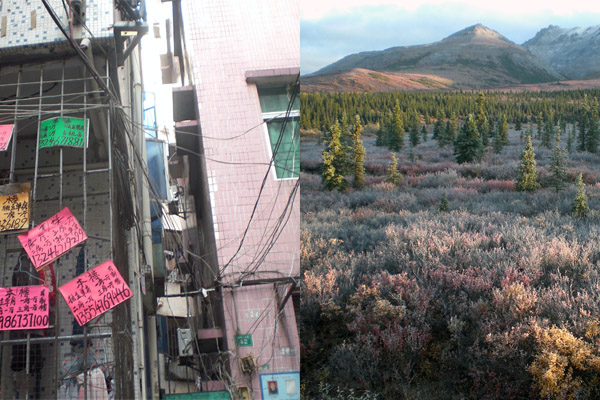
So, a juxtaposition of Baishizhou and Denali, which may be achieved through visual flattening, but as lived required movement through time and space — from Shekou to Hong Kong international by way of Shenzhen Bay checkpoint to SeaTac and then on to Anchorage and passage on the Alaskan Railroad.

I look at snapshots taken here and there, searching for commonalities, for what we might call human universals, which Donald Brown has defined as “those features of culture, society, language, behavior, and mind that, so far as the record has been examined, are found among all peoples known to ethnography and history.”

There is, of course, the eye of the beholder — mine — which seems drawn (here, at least) to pink, but all this does is raise the question of whether or not what I experience in each of these places is what other people also experience. In Chinese poetics, this common — unquestionably and recognizably human — response would be called yijing (意境), which literally means “idea scape” and denotes the moment of union between interior and exterior states of being.  意, for example, is composed of characters meaning “sound (音) and heart (心)”, while 境 is composed of characters for “earth as soil or land (土)” and “final or complete (竟)”, which here functions as a sound marker for jìng.

What are the respective yijing‘s of Baishizhou and Denali? And can we confidently generalize our responses to say, “Just so and how could it be otherwise?”

These questions matter because both Baishizhou and Denali are the focus of conservation efforts, albeit of a different ilk. Both discussions assume a common response to a particular environment. Moreover, in both discussions, one’s response to the environment is taken as an expression of one’s humanity and there, of course, is where the debate rages.

At Baishizhou, the current discussion of how to raze and rebuild an urban village focuses on the experience of mass urbanization and the need for access to housing, food, and transit networks. The debate has two assumes. First, the debate assumes that inequality is a defining feature of human life and that the purpose of social life is to ascertain that level and take measures to insure that people do not live in inhuman conditions. In turn, the content of the debate is over where to draw the line between human, subhuman, and inhuman living conditions. Second, the debate also assumes that urban living is a desirable form of life because it results in access to cultural goods, such as medical care and education by way of intentionally crafted environments, such as hospitals, schools, restaurants, and entertainment districts. As debated, these two assumptions are hierarchically ranked into the Maslovian categories of “basic needs” and “higher needs”. Thus, as one debates, one is not simply drawing lines between this life and that, but also and more importantly, revealing one’s humanity as a function of social responsibility.

Likewise, at Denali a general assumption and its implementation shape debate, but here over the nature and value of wilderness. On the one hand, the debate assumes that the experience of wilderness reveals and cultivates the wild, untamed spirituality that makes us human and that the purpose of social life is to maintain and create spaces where people can realize this spirituality. In turn, one’s love of wilderness functions in this debate as a marker of one’s spirituality. On the other hand, the debate also assumes that wilderness occurs in the absence of human settlements, such that in order to build human settlements one must transform wilderness. As debated, these two assumptions are also ranked hierarchically in terms of what is essentially human (nature) and acceptable transformations of wilderness (culture). Thus, as one debates, one is not simply drawing lines between this life and that, but also and more importantly, revealing one’s humanity as a function of wild spirituality.

It is possible to note the Chineseness of the Baishizhou debate (all that Confucianism going down), just as it is easy to remark on how much Emerson and Muir continue to shape American understandings of our place in the world. And therein lies the challenge of cross-cultural debates about what it means to be human in a world where Baishizhou and Denali cross paths, so to speak. The question is not so much either / or — which is a more accurate definition of what it means to be human: social being or wild spirituality, but rather the question seems to be: what might the Baishizhou debate teach us about the cultural place of wilderness, and what might Denali remind us about the limits to human settlements?

cultural tendencies: how do we teach stupidity?

As we live it, one of the most important functions of an education system is to cull genius. However, given that genius — like stupidity — exists only to the extent that others recognize it, this means the educational system does not simply cull genius, but must also produce it. And one of the easiest and certainly most effective ways of culling genius is to cultivate stupidity.

In the US, for example, math classes provide a key site for the production of stupidity. Our math pedagogy consistently churns out students who have difficulty with mental math, are intimidated by word problems and conceptual reasoning, and regularly underachieve. This remarkably low level of math skills — even after ten years of math classes — is considered “normal”. Those who survive the lack of drills, out-dated curriculum, and their teachers’ ever lower expectations are designated geniuses.

Similarly, in China, English classes manufacture stupidity. The Chinese EFL curriculum relentlessly produces students who have difficulty participating in simple conversations, are intimidated by novels and poetic meaning, and regularly underachieve. This lamentable low level of English skills — even after ten years of daily English lessons — is considered “normal”. Those who survive the lack reading exercises, test driven curriculum, and their teachers’ ever lower expectations are designated geniuses.

However, when we turn our gaze away from our respective home fronts, it is obvious that elsewhere in the world it is possible to teach English (or in the US a foreign language) well. Likewise, Asian and Indian programs cultivate excellent general math skills. More tellingly, US American math and Chinese EFL teachers share the belief that a particular form of knowledge (math or English, respectively) cannot be taught. Also, in both the US and China, the social effects of low math or English scores are disproportionately high with respect to the actual knowledge obtained. In US schools, for example, low math scores mean that a student may be kept out of higher level science classes, while in China, English scores are a graduation requirement. Indeed, the US situation is even less extreme than the Chinese, where English tests also determine graduate school admission and job opportunities.

All this to make a simple point du jour. Both US American and Chinese students learn when we provide adequate training, interesting curriculum, and challenging standards. The question, of course, is not so much — can we teach math or English? — but rather, what social purposes do horrific pedagogy serve?

getting things done in shenzhen

This past year, I have increasingly collaborated with foreign artists, filmmakers, and scholars to create projects in Shenzhen. Often at stake in these projects is the form and breadth of necessary support. For example, to do any kind of project in a public site (performance, filming, showing an art film), you do and do not need papers to show guards. What does this mean?

If the project looks like a group of friends just talking or filming, or if you’re performing / filming in a private house or shop, no one will ask questions. Hence, the proliferation of coffee shop and bar events with sympathetic owners. However, if you set up a large set, have many people involved, and a crowd gathers to watch, then any local guard can stop you and ask to see your papers. And every building has employed guards, so you will encounter them. In urban villages, where there might not be building guards, there are neighborhood civil police, who will know you are in the area within about five minutes and show up (or at least that was Fat Bird’s experience when we did guerilla performances in Huangbeiling and Dongmen 1 and 2).

If you don’t produce performance permits, the guards will send you away. Sometimes, even when you have papers, if the area has a special event going on, the guards will work to send you away. This happened several times during the 6 > 60 bus film screenings, when guards who knew us and were used to our project became nervous because a leader was visiting that day and thus asked us to leave as a favor to them. This indicates how seriously onsite guards take enforcement because 6 > 60 was part of the Biennale and therefore a municipal level project. Nevertheless, guards took the attitude “one less concern is better than one more  (多一事不如少一事)”. Likewise, at a recent Shenzhen University event, a dormitory guard tried to shut down an approved project because approval had only taken the form of spoken agreement. When the project organizer went to confront the approving official, he denied that he had ever heard of the project.

When organizing a project in China, it bears remembering that upper level officials may agree to help (and often support a project in principle), but if they do not write a letter of support, sign papers or issue permits, their support is practically useless because enforcement takes place onsite. Moreover, in most cases the leaders that can approve a project and the offices that issue permits are separate. This means, of course, that what needs to happen is project directors need to work with leaders who are willing to call the people who do issue permits on their behalf.

The whole question of corruption happens at this overlap between needing political support to obtain permits and the fact that enforcement happens elsewhere. After all, why should an official make a phone call or pursue permit issuing officials for you? What’s in it for them? Likewise, permit issuing officials sometimes become a third site of obstruction, depending on the relative status of the caller — immediate leaders are very helpful in pushing permits through, but their office is usually not high enough to approve a project.

And so point du jour: getting things done in Shenzhen means being able to network as many levels as possible to get the permits necessary to make an onsite intervention. That done, you need to then work with or against onsite guards. One time events can usually be accomplished by arguing with guards, however long term projects require onsite negotiations with guards, and often their leaders, who are responsible to a different chain-of-command than the one that pushed through the permits, which in turn requires another round of explaining and securing agreement.

That said, sometimes bravado will get the same or better results, but it’s a gamble.