in the aftermath of housing reform (房改)

Much of what I know about Shenzhen, I know through hearsay. How much might be confirmed through other sources — people, reports, maps, or books, for example — is a methodological question. Sometimes I can track down confirmation, other times I can’t. What I do know, however, is that most folks are willing to talk about other people’s affairs, even when not willing to disclose anything about themselves. The other day, I heard a story about the Baoping Community compound and here’s how it goes:

Built in the area around the train station and then moving north parallel to the train tracks, the earliest residences for Shenzhen cadres were small, danwei compounds. In 1980ish, the Xili Industry and Trade Enterprise bought land rights from Caiwuwei Village and built a small compound along what became Heping Road, just east of the railway. Xili went out of business and Shenzhen Travel took over the compound. However, Shenzhen began privatizing danwei houses in 1988, a full ten years before the rest of the country. Thus, China Travel employees who had housing in the residential area were able to purchase their benefit housing (福利房) at cost.

Sometime after privatization, the residential compound was renamed, Baoping. Old and small, the residential compound is no longer upscale housing. Instead, most of the homes are shared rentals (合租), in which each bedroom is rented out and then the kitchen, bathroom, and living spaces are shared. Continue reading

hubei old village, dusk

Thursday last, I walked Old Hubei Village with Chen Ting, an architectural graduate student with an interest in the landscape of Shenzhen’s state-owned industries. A walk around the train station and then through the Dongmen pedestrian street brought us across the Dongmen pedestrian overpass to the complex neighborhood where Hubei Villages Old and New abut the Luohu Culture Park, crumbling 80s factories, and 90s high-rises and one of the oldest Shenzhen food-streets eased into dusk. Impressions below:

This slideshow requires JavaScript.

The Cost of Business in Shenzhen

A translation of a 天涯深圳网 post, this time about a woman boss who set herself on fire to protest having her rental property revoked (罗湖文锦广场物管收回物业女老板自焚).

A Woman Boss sets herself on fire after the luohu wenjin plaza Property Management revokes her property by Nanfang Reporter, Feng Lei (南都记者丰雷 — 南方都市报)

Yesterday afternoon (January 12, 2012), Ms. Zou of Eastern Fengming Children’s Training, which is located on the 4th Floor, Building A of Luohu Wenjin Plaza set herself on fire to protest that the Plaza’s Property Management Firm had suddenly ended her rental contract, leaving her with over 2 million investment that cannot be recovered. At the moment of crisis, the Tianbei Fire Department and Plaza Management Firm came. According to the Management Firm, the contract stated that when the property owner needed to reclaim the property, then the renter would have to leave. According to Ms. Zou, the Property Management Firm was not the property owner and therefore has no right to evict her from the premiss. Continue reading

a facelift is only skin deep: dongmen

Universiade facelifts continue and, along certain paths in the city – the global, neoliberal, middle class paths – one walks through rubble under tarps and past construction sites. Nevertheless, several steps off those intended tracks, life continues undisturbed by visions of what Shenzhen leaders think foreigners / outsiders should see. The effect of this selective construction is to further isolate pockets of working class ordinariness and transform it into unsightly poverty. In fact, one of the reasons urban villages are as such is because the city grew up around them, closing them in, and distorting their relationship to greater landscape. Thirty odd years ago, a village was a tight cluster of single story story houses and narrow paths in the midst of rice paddies, streams, orchards, and small docks that opened to either the Pearl River or the South China Sea; today an urban village is a tight cluster of three to eight story rentals that hum in the shadows of thirty story apartment complexes and postmodern skyscrapers even as the sea recedes.

Below, a walk through Dongmen, Hubei New Village, and Old Luohu work unit neighborhoods, begging the question: if what we see is what we get, why aren’t we learning to look more deeply?

This slideshow requires JavaScript.

street life

From a walk through one of Shenzhen’s older areas, Hubei New Village and slightly north of Dongmen.

This slideshow requires JavaScript.


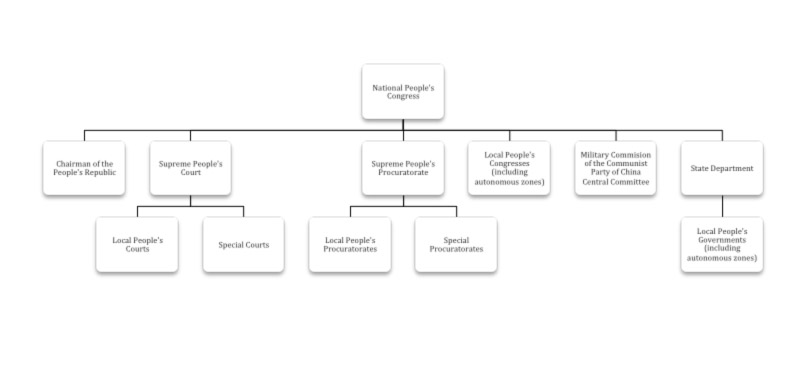
shenzhen administrative structure

I’ve been making charts to organize my thinking. Below is an organizational chart of Shenzhen, circa 2010.

Also, a simplified version of the organizational relationship between the Central government and local governments. Guangdong is the provincial local; Shenzhen is a sub-provincial city, however, as an SEZ, Shenzhen has all sorts of legal privileges that provinces and direct cities do not.

rubble

Gregory Bateson helped me learn to think about how human beings engage in (ultimately) self-destructive forms of competitive growth; Wendall Berry continues to inspire how I think about rural urbanization under capitalism.

Bateson provided a theory of schismogenesis or “vicious circle,” in which our behavior provokes a reaction in another, whose reaction, in turn, stimulates us to intensify our response. According to Bateson, schismogenesis comes in two flavors: symmetrical and complementary. Symmetrical relationships are those in which the two parties are equals, competitors, such as in sports. Complementary relationships feature an unequal balance, such as dominance-submission (parent-child), or exhibitionism-spectatorship (performer-audience). The point, of course, is that unless there is an agreed upon limit to the development of provocation and response, the relationship just keeps going until it hits a natural limit – collapse of the relationship because neither side can continue to meet and exceed the other’s call.

Berry teaches that one of the more deadly tendencies in capitalist urbanization in the United States is to turn all of us, eventually, into Native Americans. On Berry’s reading, the basic structure of American life was to eradicate the people and lifeways of Native Americans and then to replace those people and lifeways with settler capitalism. Importantly, this model of a settled community being replaced by the next, more intensive form of capitalist production both established the rhythm of American development and has become a powerful symbol of how generations of Americans have justified our destruction of people and lifeways in favor of more efficient and valuable forms of life. Importantly, efficient and valuable are defined in terms of profit. Thus, industrial, mass agriculture replace the settlers that had replaced the Native Americans; smart technologies and production are offered as the solution to problems of rustbelt withering.

How have Bateson and Berry shaped my understanding of Shenzhen?

Shenzhen all too clearly grows through an amazing range and diverse levels of complementary schismogenesis. Within Shenzhen, villages, neighborhoods, districts, and municipal ministries all engage in compete for competitive advantage; at the same time, Shenzhen as a city competes with all other cities in the PRD as well as internationally.  In this system, the function of urban planning is contradictory. On the one hand, the Municipal government needs to stimulate competition so that the city can respond to development in Guangdong, China, and the world. On the other hand, the Municipal government also needs to set limits – usually in the form of social goods, such as parks, schools, and hospitals – on how far development can encroach on the people’s quality of life.

Moreover, as Berry noted, the pattern of the first razing and replacement sets the rhythm and symbolic lexicon for understanding capitalist schismogenesis. The problem in Shenzhen is that eventually, we all become locals, our homes and lifeways replaced by more capitalist intensive forms of consumption (increasingly high maintenance housing) and production (higher value added production).

The result has been the ongoing production of rubble. Villages go. 80s housing goes. 90s residences are going. And as in the United States, postmodern nostalgia has become one of the forms that middle class resignation to this fate takes. The poor occupy the rubble until they are moved elsewhere. Images below.

This slideshow requires JavaScript.

futures – yuanling 2


jijian kindergarten

Originally uploaded by maryannodonnell

even as yuanling’s factories are upgraded to retail storefronts, the old neighborhoods – especially the old courtyard residential areas – are being razed to make way for highrise developments.

watching the chickens feed in the courtyard of new yuanling village remind us (1) that shenzhen was imagined and built in a very different social economy and (2) that value is not simply a matter of upgrades, but nevertheless remains tied to how we imagine the future.

new yuanling village is not an actual village, but an example of the first generation of work unit courtyard residences in shenzhen. in the early 80s, homes here appear in some of the first corruption scandals as early cadres scrambled for homes, which they used as investments and rewards (in turn).

housing in yuanling is still some of the most expensive in the city because with each home comes one elementary and one middle school seat (学位). this is important because yuanling schools are ranked first provincial (省一级), a ranking that suggests students from yuanling do well in the national college entrance exam (高考).

although much of the old housing is rented out, those school seats are coveted and circulate not only with the sale of the house, but part of rental negotiations. not unexpectedly, many have bought in yuanling, but live elsewhere, simply so their children can go to school there.

in addition, the area has been approved for redevelopment, which means that within the next two years, all this will be razed and new housing built. homeowners in yuanling will be compensated with replacement housing (based on square footage conversions, but i’m not sure what precisely the terms are.)

housing and education are two of the great goods in shenzhen. indeed, many women will not marry unless they have a home; many parents spend time, energy, and money trying to provide for their child’s education. consequently, it is useful to think about what new yuanling village signified to early shenzhen residents because housing and education are sites where we actively and vigorously create the future.

yuanling looks battered and worn, but the shenzhen dreams of a house and providing for one’s only child still resonate. moreover, the importance of this future to shenzhen identity explains how corruption may have been built into the city. it is hard to imagine how communist cadres may have been reduced to scrambling for moldy bits of concrete and in retrospect, the object of their scrambling appears ridiculous. however, it is more than easy to understand how private hopes and dreams for their families’ future might have gotten entangled in what those cadres saw when they drew up blueprints, laid foundations, and built a post-mao, post cold war future at yuanling.

when i asked if there were any other benefits to buying a house in yuanling, the salesman looked at me somewhat confused – after all, is there anything more important than a new house (even if many years down the road) and a child’s education? – and offered lamely, “you could open a ground floor store.”

i like yuanling in its current incarnation. the streets are narrow, quiet, and clean, the buildings shaded by banyan trees, and the occasional palm tree straggles into the sky above working class residents. pictures, here.

5 minutes in luohu (蔡屋围)


1 alley

Originally uploaded by maryannodonnell

luohu seethes contradictions, especially in the area surrounding the train station and railroad tracks, which connect shenzhen to hong kong (in the south) and guangzhou by way of buji and dongguan (in the north). in fact, the area immediately surrounding the railway station is frequently (and distastefully) referred to as “chaotic (乱).”

this part of the city was originally part of caiwuwei (蔡屋围), location of the previous administrative headquarters of bao’an county (once it was moved from nantou in 1953). consequently, it was one of the first areas occupied by national work units that built shenzhen. in fact, this area is one of the few in shenzhen where there are work unit residential compounds.

although shenzhen’s explosion has repeatedly transformed caiwuwei, the area’s historic importance has meant that past buildings and dreams accumulate in the shadows of upgraded versions.

i have uploaded a five minute walk through two blocks of caiwuwei. it begins in the alley next to the the ministry of shipping compound (航运大院), scuttles through the driveway entrance to the chengshi tiandi plaza, crosses bao’an south road and moves through the newer section of the mix-c mall to park lane manor.

the point of this walk is not simply to draw attention to the contradictions that structure everyday life in shenzhen, but also to emphasize that critical irony is built into the physical environment. benjamin reminds us that when innovations appear in modern life they do so by calling attention to the past. and not merely any past. but collective dreams and fantasies for completion and wholeness that have not yet been satisfied.

pay attention. the the mix-c’s name in chinese is 万象城 – “city of every phenomenon”, evoking the dao de jing, where “the way gives rise to one, the one to two, the two to three, the three to every phenomenon (道生一,一生二,二生三,三生万物). ask yourself. if the way is not capitalism (with or without chinese characteristics), what is it?

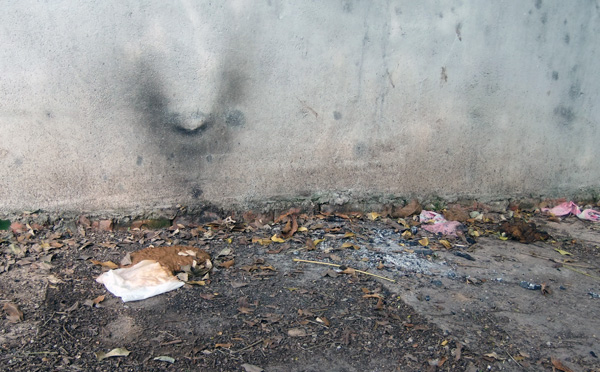
shit


shit

As I have wandered the edges of Shenzhen and as those edges have shrunk to the narrow spaces between the city’s elegant tree-lined boulevards and some kind of wall, I have noticed how easy it is to stumble into impromptu latrines.

Lines that redefine the territory: The road, a sidewalk, and a dirt footpath, which followed the river behind the row of bushes and trees that shaded the sidewalk. This particular latrine is located at the Sungang Bridge over the Buji River.

Once upon a time, maybe as many as ten years ago, this walk was part of Shenzhen’s official greenspace. Indeed, old tile walkways still connect the river path to the sidewalk. Consequently, I also stumbled upon chipped bits of walking path and several benches that provided a view of the Buji River.

The speed at which Shenzhen changes is the city’s identity. A popular saying has it that “To see thirty years of Chinese history, visit Shenzhen; to see one hundred years of Chinese history, visit Shanghai; to see 1,000 years of Chinese history, visit Beijing; to see 2,000 years of Chinese history, visit Xi’an (想看三十年的中国,到深圳;想看一百年的中国,去上海;想看一千年的中国,去北京;想看两千年的中国,去西安).”

A friend recently mentioned a twist on this theme, “Shenzhen took ten years to construct a new city; twenty years to construct an old city; and thirty years to construct a garbage city (深圳以十年建立一座新城市;以二十年建立一座旧城市;以三十年建立一座垃圾城市).”

Sigh.