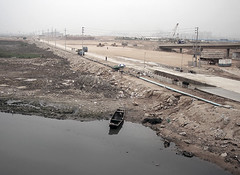
historic houhai

July 1, 2007. ten year anniversary of the Handover of Hong Kong to Chinese sovereignty. Unlike ten years ago, when the city buzzed with anticipatory dreams of what two systems might mean for ordinary people, this year Shenzhen has been relatively unconcerned with commemorating the other of Deng Xiaoping’s two accomplishments. When an American friend asked a Shenzhen friend what they were doing for “July 1st,” my Shenzhen friend looked at both Yang Qian and me, trying to figure out what holiday it was.

May 1st is International Labor Day. June 1st is International Children’s Day. July 1st is the birthday of the Chinese Communist Party, although its an internal holiday, so nobody celebrates it. As we counted, everyone got into the “first” spirit. August 1st is the birthday of the People’s Liberation Army. September 1st is the first day of school. October 1st is National Day. November 1st is All Saint’s Day. December 1st? Nothing. January 1st is New Year’s Day. February 1st? Nothing, but February 2nd is Ground Hog’s Day, which might count in a more generous world. March 1st? Again nothing, but International Women’s Day falls exactly one week later on March 8th. April 1st is All Fool’s Day. We turned to our guest. July 1st?

Tenth Anniversary, she said.

Ahh. We knew that, but it hadn’t registrared. Clearly.

Not that Shenzhen hasn’t prepared a major engineering feat to commemorate the Handover. This morning at around 10 a.m., the Western Corridor Bridge (lit up)officially opened, as did the Shenzhen Bay Border Checkpoint. At 6 a.m,. this morning I made my cursory “in the spirit of documenting history” appearance at the site. I walked down the old Nanyou street. At the intersection between the road and the new Houhai Ocean Front Road, police had set themselves up to prevent cars from going in. Presumably, they were also keeping people off the sidewalk. However, about 10 steps away it was possible to walk through the park that had just been put in (also for the opening ceremony). Walking this way it was possible to go around the police and head toward the new Customs Checkpoint and get a closeup of the Bridge.


heading south the banners read: one country two systems, together build a harmonious society; one land, two checkpoints, achieve scientific development

I came back to the house and told Yang Qian that I felt for the police. Not because I think they should be barricading people away from the checkpoint. Not even because they had to stand in weather that alternated between excruciating sun and thunderstorms. But because they were called on to do a job they couldn’t actually do. Anyone who wanted to walk toward the checkpoint and look at the fuss could and did. There were just too many open spaces from which to access the site. All this reminded me of when I tried to get on the Houhai land reclamation site at Number 8 Industrial Street and ended up walking around to Number 7 Industrial Street. And the funny thing is, once on the site, nobody questioned my right to be there. Likewise, once wandering around the new coastline, noone stopped me. This perhaps an important point about cultural assupmptions about belonging. Difficult access, but once in/on a site noone bothers you. How different from the US, where its not enough to get past the guards, but you also have to remain out of sight. Different forms of regulation. Or assumptions about what regulating means.


heading north the banners read: one bridge connects north and south, shenzhen and hong kong add another connecting passage; enthusiastically celebrate the official opening of the shenzhen bay border checkpoint

Once at the new coastline, much about the topography that the land reclamation project has produced fell into to place for me and I could see a whole, where previously I had only seen partial edges. Those already obsolete pictures, took when looking out toward unbounded space have something immence about them. In contrast, from the perspective of the new coastline, the area still looks big, but now seems managable, within the scope of a retrospectively visible and relentlessly mastering plan. As if we knew what we were doing all along. Or somebody did. So, pictures of historic houhai and a sense of just how banal human effort can suddenly seem.

for it is thou


for it is thou

before boarding a plane back to north carolina, shirley and i enjoyed a sunday afternoon with the dead in st. michael’s catholic cemetery, happy valley, hong kong. shirley memntioned that local graves have been moved for building projects; we speculated on how safe the cemetary was from developers. but mostly we walked in restful silence. shenzhen now has commercial cemetaries that cater to hong kong and taiwanese families seeking resting ground. for a price, of course. what’s more, most chinese people don’t spend sunday afternoons with dead strangers, preferring to visit relatives and friends on specific days. quite obviously, cemetaries are for the living and the living have different relationships to the dead. and yet. i begin to think that the point might be otherwise, or rather think that the point cannot be reduced to cross cultural ethnology, although such analysis helps and is more often than not fascinating, but rather the point is to ask what death teaches each of us, here, today. r.i.p.

南油文化广场:urban facelife, rural fairs


nanyou cultural plaza

the nanyou cultural plaza, like most shenzhen cultural centers was built to promote high culture. however nanyou, like most shenzhen governments doesn’t actually budget all that much money for cultural production, instead requiring that center or plaza administrators capitalize on the space to keep it running. most cultural centers have achieved this by showing movies and renting space for cultural consumption (weiqi clubs, dance lessons, and martial arts instruction, for example).

the success of a cultural center depends on access–in all senses of the word–to the center. many village level cultural centers are in fact quite active because they not only target their cultural production to villagers and migrant workers, who (as rural people) share similar cultural tastes, but also are located within walking distance of most of their patrons. in contrast, street level centers, like nanyou, have to mediate between rural and urban tastes, which don’t really overlap, making it difficult to build a cultural community. consequently, these centers depend upon public transportation and private cars to bring their patrons to them.

the construction of the western corridor bridge has compounded nanyou’s economic difficulties because the street in front of the plaza has been under construction for over two years now. although the nanyou cultural plaza continues to screen movies, the entire space has been rented out to mom and pop vendors, who have transformed the space into a market for the many migrant workers who live nearby.

about five years ago, the area around nanyou was a thriving restaurant district that catered to urban white-collar workers. most of those restaurants (including macdonald’s) have moved out, replaced by small eateries and street level grills. five years ago, there were also villas and upscale residential complexes in this area. these are now being rebuilt, in anticipation of the opening of the western corridor bridge, when nanyou will again and perhaps as suddenly change character, becoming prime real estate for those commuting from western shenzhen to hong kong.

for a sense of how migrant workers occupy shenzhen spaces, please visit nanyou.

hong kong surfaces


self-portrait

this morning, as i walked from my friend’s cityplaza condominium to quarry bay park, i once again found myself refracted accross hong kong’s glitering surfaces. disorienting after the practical tiles of wangniudun.

九街:an ethnographic post-script


remnant gateway to the xin’an fairy town walking museum

one of the earliest articles i published was “becoming hong kong, razing baoan, preserving xin’an: an ethnographic account of urbanization in the shenzhen special economic zone” (cultural studies 15(3/4), 2001, 419-43). i argued that hong kong appeared in shenzhen urban planning as both the origin and telos of modernization. as origin, hong kong capital, know-how, and connections jump-started manufacturing in shenzhen. as telos, hong kong’s glossy skyline provided a model for urbanization. at the same time, contemporary hong kongers were integrated into guangdong society through narratives of hometown and tradition; according to this story, everyone in shenzhen and hong kong were all descendants of xin’an county natives. in this way, hong kong was inscribed into the history of the prc and hong kongers into local history.

hong kong was originally part of xin’an county, and this fact shows up in hong kong histories. however, xin’an county ceased to exist as an administrative unit of guangdong province in 1913, when the nationalist government renamed it baoan county. consequently, histories of shenzhen identify baoan as the city’s rural predecessor. thus, various levels of shenzhen government have found it necessary to stress the common spatial origin of the two cities precisely because hong kong and shenzhen have distinct temporal origins.

at the time i was writing up those earlier fieldnotes, the slippery twists of socialist nostalgia fascinated me. a shared origin – xin’an county – structured this nostalgia, where hong kong’s postwar history (1950-1979) became the past that shenzhen (rural baoan) would have had, if not for cold war politics that isolated the county from global markets. indeed, locals offered hong kong’s prosperity as evidence that socialism had delayed modernization in shenzhen. in order to prove that xin’an county was the origin of both shenzhen and hong kong, it was necessary to engage in acts of historic preservation – at the tianhou temple in chiwan, the pengcheng fortress at daya bay, and old nantou city.

in anticipation of the return of hong kong to chinese sovereignty in 1997, the nanshan district government collaborated with an overseas chinese investor to restore some buildings in “nine streets”, creating a walking museum. nine streets is the contemporary name for nantou, a market town that had been the xin’an county yamen. nantou was the yamen where, after the conclusion of the first opium war in 1842, representatives from the qing and british empires met to sign the papers that made hong kong island a crown colony. indeed, nantou was the xin’an county seat for roughly 600 years, from the ming dynasty until 1953, when the communist government moved the county seat to shenzhen market, which would in turn give its name to the new special economic zone in 1980.

the idea behind the walking museum was to demonstrate the historic links between shenzhen and hong kong. thus, for example, the nanshan district government designated nine streets the nantou old city (南头古城) historic area, which was the actual name of the market town. in contrast, the museum was called xin’an fairy town (新安故城). ironically, the gateway for the museum still looms in front of the nantou city wall.

from the museum’s opening, few people came to explore the restored pawnshop, opium den, brothel, gaol, and yamen. instead, most went to the restored temple to guandi (关帝), the god of wealth to burn incense and pray. at first, the temple was explicitly used as the gateway to the museum, and visitors could purchase tickets there; museum staff tolerated but did not encourage supplicants. however, nine street residents soon dominated temple and, during my latest trip to nantou, the museum had closed and the temple had a resident monk who was reading fortunes in the god’s shadow. rooms that had once held exhibitions about shenzhen and hong kong’s common history had been transformed into alcoves for new gods.

another historic transformation: when i was doing the research for that long-ago paper, i had been unable to gain entrance to an old orphanage, which had built by italian missionaries at the turn of the 20th century and was located in jiujie. however, on this trip, it was possible to visit because it had become the center of the patriotic catholic church of shenzhen. the deacon lamented that the church had been razed and they were now using the orphanage instead. i was struck by the building’s similarities to macao’s churches.

i invite you to take a walk through nine streets, once upon a time the yamen of xin’an county. note that the temple was moved outside the city wall in order to attract visitors. museum designers also intended to make the old ming-era gate the first element of the walking tour.

玩: Hong Kong Disneyland and Ocean Park

玩(wan)means to play, to goof around, sometimes just to hang out. Wan is allied to 放松(to relax)and opposed to 工作(to work). Children are said to crave wan (贪玩), which is not a good thing, but nevertheless natural. Youngsters who can overcome (克服) their impulse to wan have reached the age of understanding (懂事). In contrast, adults who crave wan are childish (幼稚) and unreliable (不可靠); rumor has it these party animals make lame (赖) spouses.

Most importantly wan connects people to each other; playing, goofing around, and hanging out are not solitary activities, but group events, which often require planning and time in order to bring everybody together. Here, wan becomes an important element of friendship. People think about activities that others might enjoy and invite them along. They also invite others along on activities that they want to do. Be warned, however. Playing together sometimes slips into forms of 陪 (pei), where the pleasure of one person becomes the point of the entire trip. I believe this to be true not only of business outings, but also family vactions. What’s more, there are moments when nobody is having a good time, but everyone thinks everyone else is, and so everyone plays until they exhaust themselves (玩累自己).

This summer, friends invited me to join them in a trip to wan Hong Kong Disneyland and Ocean Park. And I went. There were about 20 of us, from seven different families. In the morning, we all met at the restaurant, took pictures with Mickey and Pluto, and then went to the Magic Kingdom, where we broke up into smaller groups based on the age of the children.

Hong Kong Disneyland is small. Indeed you can walk around it in a day. It does, however, offer four fantasies: shopping (on Main Street, USA), romance and shopping (in Fantasyland), exploration and shopping (in Adventureland), and science fiction and shopping (in Tommorowland). There are also many famous characters walking around for photo-ops.

Given the crowds, we spent our time waiting to get into rides or attractions, and then meeting up with the group for lunch.

I returned to Shenzhen and spent the next few days doing yoga and sleeping, necessary antidotes to too much of a good thing.

Cruel/Loving Bodies

This weekend (July 8 and 9), I had the pleasure of participating in a roundtable discussion of Cruel/Loving Bodies 2 project, which is on display at the Hong Kong Arts Centre from July 8 through July 28. The Pao Gallery on the fifth floor and the Goethe Gallery on the fourteenth floor are co-presenting the exhibition. Cruel/Loving Bodies 1 was exhibited at Shanghai’s Duolun Museum of Modern Art (June 2004) and Beijing’s 798 Space (July 2004).

This was the first time I have contributed to an art discussion and, not unsurprisingly, approached it as if it were an anthropology meeting, understanding my role to be that of discussant. I came to play a familiar head game, reading textualized bodies against themselves, against each other, and if time permitted, against other texts. My jaw clenched at the responsibilities that my imaginary job description intimated; what would I say if asked, “What influences do you see in the work of Mayling TO? (杜美玲)” However, the experiences of viewing “Here We Are” with artist Lesley SANDERSON, sucking an ice pop with HE Chengyao (何成瑶), and dubbing Deep Throat as part of ZHENG Bo’s (郑波)“Watch porn, learn English” movement jolted, if only momentarily, corporeal habits. And I expectedly found myself remembering to play hide and seek.

When playing hide and seek, children want to be found. If you don’t find them within what they think is a reasonable amount of time, they will call out to you. In turn, if they can’t find you, they become frustrated, expecting a return call. After all, the point is to find and be found; the seeking is simply a means of enhancing the pleasure, not an end in itself. I think this commonplace observation points to a practical understanding of the fine line between love and cruelty. In hide and seek, love is the effort to find the person, cruelty the refusal.

Most of the time, I don’t play. Instead, my shoulders tighten, my eyes squint, and my heart makes judgments about my interlocutor based on superficial signs—skin color, hair texture, body height and mass, the smell of sweat and light perfume, the drape of a skirt, the polish of leather shoes. Together, these signs suggest how the woman if front of me has treated herself and been treated by others; I too treat her like a lady should be treated. Grimy cheeks, missing teeth, crooked fingers, swollen ankles, rheumy eyes, and sweat-stained clothing also reveal past interactions; unthinkingly, I treat the old peasant like a beggar should be treated.

In presenting bodies in unexpected ways, however, the artists of the Cruel/Loving Bodies project pre-empt habitual interactions. How does one treat, for example, the virtuous women of BAI Chongmin (白崇民) and WU Weihe (吴玮和)? The form echoes that of the Terra-cotta soldiers, but unlike the first Qin Emperor’s guard, these figures have no clear features, except for a number, which corresponds to examples taken from LIU Xiang’s 烈女传. This difference invites the reader to seek: What history brought these signs together in this particular way? Or consider, susan pui san LOK’s (骆佩珊) “Notes on Return”, which skitters across the uneven, indeed flimsy, surface of plastic strips: How can a world become so unstable?

I assume that I know how to treat a lady or a beggar because I assume that their bodies reveal the history that made them who they are. In contrast, the Cruel/Loving bodies compel the viewer to reconsider how these bodies came to be; we don’t know how to treat them because we don’t recognize the processes that formed them. That moment jolts us out of habit as we lurch toward the child’s call: come and find me. Our lady and beggar abruptly seem otherwise as well: what if I have been misrecognizing the signs all along? What if this misrecognition has been a refusal to play? And what if an ability to read the signs has merely enabled me to be cruel?

If in Hong Kong this month, please visit the Cruel/Loving Bodies 2 exhibition at the Hong Kong Arts Centre. The curious can visit the artists’ sites: Leungpo 梁宝山, Zheng Bo, Conroy and Sanderson, susan pui san LOK, and Mayling TO. I have also uploaded some images of the opening weekend.

i am the role

front row (left to right): judi moriarty, yang qian, and shi xiaomei. i am in the back.

yesterday, judi, yang qian, and i went to hong kong to see the mabou mimes’ production of a dollhouse. because none of us had ever been there before, we met with a friend for afternoon tea at the penninsula hotel. it turns out that tian qinxin’s godmother, shi xiaomei was also in hong kong as an advisor on a production of 挑滑车. she joined us in the early afternoon.

talking about the beauty of kunqu, shi xiaomei said, “it doesn’t matter how old i am or what’s underneath. when i paint my face, i am only the role.”

shi xiaomei then laughed and said she was always stealing scenes, but that she couldn’t help it. she knows how to breathe in such a way that the audience only followed her movements. judi, who studied acting at nyu and then went to the north carolina school of the arts, commented that scene-stealing was the sign of a natural performer. judi joked that she couldn’t steal scenes from shi xiaomei, who laughed happily.

i was struck by the strength of her personality. even in a cotton golf shirt, she controled the conversation at tea. shi xiaomei specializes in male roles:

Integrating the Pearl River Delta

Sunday afternoon, I walked east along the Houhai coast, from Houhai to Sand River (沙河). This is a strip of land that was formerly designated to be part of the Nanshan District Binhai green zone, which connects up with the Shenzhen Natural Mangrove Reserve in Futian District. My interest in the area grows with the audacity of land reclamation in Shenzhen. This area marks a second rezoning of the coastline. The first was part of the effort to build the Binhai Expressway, which connects Nanshan to Futian and Luohu Districts. This second stage was districted later and remnants of that now-obsolete coastline litter the new construction site.

(The curious can check out the Shenzhen’s overall urban plan (1996-2010) maps, while the even more adventurous can go to the Nanshan District overall urban plan. On those maps, I walked along the strip of coast facing Hong Kong. Offline, if your library has any of the Shenzhen yearbooks from the 1980s, there are interesting comparisons to be made. Published in the early 1990s, the last Baoan County Gazetteer is also fun, but harder to find.)

On my walk, I stumbled upon guardhouses that were never staffed by border guards and the chain-link fence that separates pedestrians from Houhai. The entire area had been filled with earth and pumps were busy squeezing out the last of the ocean. Dump trucks rumbled past and people carrying nets biked out to the new coastline. I learned there was a two-week window to catch newborn crabs before they swam out into what remained of the ocean. These baby crabs would be used to stock fisheries in Baoan District. The crabbers carried the crabs in plastic soda bottles that hung around their necks. Eventually, I arrived at Sand River, I came across one of the construction sites for the Shenzhen Western Corridor Bridge, which set me to thinking about the various infrastructures which integrate Shenzhen and Hong Kong. What follows is a longish outline of Shenzhen history as mapped by Shenzhen-Hong Kong checkpoints. You can skip the discussion and go straight to the Western Corridor land reclamation pictures, or you can indulge my sudden urge to document comprehensively the transformation of Shenzhen.

(I’ve just realized that I only use Mandarin and Shenzhen place names in this blog. I promise to start documenting the different names for the sites. I may even talk about what these differences in talk might mean…)

Anyway, the fourth land connection between Shenzhen and Hong Kong, the Shenzhen Western Corridor Bridge was completed in January 2006. The corridor itself should be finished later this year. It is a 3.8 km long dual-carriageway 3-lane bridge connecting Nanshan District to Hong Kong at Ngau Hom Shek. The construction is being overseen by OPAC, a San Francisco based engineering firm. Trying to figure out the actual cost of the corridor is somewhat difficult. According to the China Daily, the bridge cost $US 111 million to build. On their webpage, OPAC estimated that the cost of the Western Corridor Bridge would be $US 400 million. The Nickel Institute website quotes the Hong Kong Highway Authority as putting the estimated cost at $US 2.7 billion. Perhaps the China Daily quote refers just to the cost of the bridge, the OPAC quote to the cost of the entire corridor, and the Hong Kong Highway Authority quote to related infrastructure in Hong Kong. What can be concluded is that the corridor is expensive and somebody is making a lot of money from it.

And making money seems to be the point. The Western Corridor Bridge is part of a larger effort to transform the Pearl River Delta into one of the most vibrant economic regions in the world. On August 28, 2003, at the Foundation-stone Laying Ceremony for the Hong Kong-Shenzhen Western Corridor in Shenzhen, Hong Kong Chief Executive, Mr Tung Chee Hwa said, “Hong Kong and Shenzhen are a key nexus in land transport to the Mainland…The three existing land boundary crossings between Shenzhen and Hong Kong are nearing the saturation point, such that both administrations have agreed to build the Hong Kong-Shenzhen Western Corridor as the fourth land crossing to accommodate growth. Traffic flows at the three existing boundary crossings have increased greatly over the past five years. The average total daily vehicular traffic at boundary crossings is expected to reach 65,000 vehicles in 2006, far beyond the daily capacity of 42,000 vehicles, which the three existing crossings offer now. Upon its completion, the Western Corridor will provide additional daily traffic capacity of 80,000 vehicles, raising the overall daily traffic capacity to 122,000 vehicles, thereby easing the current congestion. And yet, even four land crossings are considered inadequate to meet the future demand arising from further development. A working group drawn from among officials of the Hong Kong, Guangdong and Macao administrations will convene its first meeting tomorrow to press on with the advance preparations for construction of the Hong Kong-Zhuhai-Macao Bridge…”

The figures for vehicular land crossings do not include statistics for all border checkpoints (in order of numbers of passenger crossings)—Luohu, Huanggang, Shekou, Shenzhen airport, Wenjindu, and Shatoujiao. Official Shenzhen customs figures showed entry and exit passengers at the city’s six checkpoints reached 137 million in 2004. Crossings surge during Chinese holidays, especially Chinese New Years, when an estimated 5-6 million people (over a period of two weeks) cross at Luohu alone. During the holiday season, all checkpoints extend hours and increase staff handling document inspection. Each of these crossings has a distinct, but interconnected history that illuminates different aspects of the Shenzhen-Hong Kong nexus as part of globalization. A crude synopsis of the six sites follows and provides a very, very, very rough outline of Shenzhen’s deep history.

(I try to problematize the idea of history with respect to Shenzhen most entries. However, this is the first time in this site that I’m trying to locate Shenzhen with respect to larger currents. I’ve learned how to think about this history from Giovanni Arrighi in his wonderful book The Long Twentieth Century. Helen Siu and David Faure have turned an anthropological lens on this process in Down to Earth: The Territorial Bond in South China. I’ve picked up some online sources that may be helpful and embedded in the following notes. I assume it’s all as reliable as statistics about Western Corridor Bridge finances are.)

In a certain sense, the Luohu checkpoint has been in existence since the leasing of the Hong Kong New Terriories in 1898, when the Sino-Anglo border moved to the Shenzhen River. Previously, the Qing Dynasty had ceded Hong Kong Island and the area south of the Kowloon Mountains to Great Britain in 1842 (end of the first Opium War) and 1860 (end of the second Opium War), respectively. Luohu (Lo Wu in Cantonese) was the first stop on the Chinese side of the Hong Kong-Guangzhou railway, which was built in 1913 and more effectively integrated south-eastern China into the British Empire. So thinking about Luohu leads to thoughts about British imperialism, the transition to the Cold War, and the postsocialist realignment of international political-economies with a focus on East Asia. Suddenly, Shenzhen is neither hinterland nor no man’s land, but vying for the center of global trade. In a recent defense of building the Hong Kong-Zhuhai-Macao Bridge and associated costs, the Executive Director of the Travel Industry Council of Hong Kong, Joseph Tung, has said that the Luowu checkpoint is one of the busiest land crossings in the world, with more than 90 million people passing through it every year.

The Huanggang Checkpoint opened for 24-hour border crossings Jan. 27, 2003, at which point crossing figures surged from 50,000 to 110,000 per day. Buses to and from the Huanggang Checkpoint, connect Shenzhen to six Hong Kong destinations, including the Hong Kong airport. Since 1995, Huanggang has been the primary conduit between Shenzhen and Hong Kong Disneyland. Until the construction of the Western Corridor Bridge, Huanggang was the newest of the land crossings. It is interesting because it was part of a geographic shift in Shenzhen from “Downtown” referring to Luo Hu to the new “City Business Center” in Futian. The shift began in 1996, when the Shenzhen Municipal Government accepted plans for the new CBD. Michael Gallagher gave a talk about the Shenzhen CBD in 2002. But for a sense of the scale of this transformation and the debate about it, google 深圳CBD and check out all the different sites. Thus, the shift from Luohu to Futian allows for specifying the differences between a Hong Kong centered development in the early 80s to a more diffuse integration of the region, and therefore a more Mainland-centered pattern of economic development.

The most expensive connection between Shenzhen and Hong Kong, the Shekou ferry makes 13 round trip voyages a day, except during Chinese New Year, when the number of trips increases to accommodate the numbers of visitors. An additional 8 daily voyages connect Shekou to the Hong Kong airport. Most frequent passengers on the ferry are Shekou-based foreigners. The Shekou Ferry is interesting for a number of reasons, most related to the role that China Merchants has played (by way of Shekou) in the development of Shenzhen. The role of China Merchants then leads back to Luohu and questions of national development first raised during the later years of the Qing Dynasty. As of 2004, China Merchants has posted its own historical archive online, which highlights the role that commerce and international relations have played in modern Chinese history.

Along with Hong Kong, Guangzhou, Zhuhai, and Macau, the Shenzhen Airport is one of five international airports in the Pearl River Delta. In terms of passengers served, it ranks behind Hong Kong and Guangzhou. The five international airports have been built within a radius of 25 km. illustrating the level of competition and inter-city rivalry that has characterized development in the Pearl River Delta, rather than regional cooperation and planning. Moreover, the redundant infrastructure in the Delta has led to serious environmental problems, according to a report by K. C. Ho and C. S. Man.

Wenjindu is primarily a crossing for goods between Shenzhen and Hong Kong. It was opened in 1950, as part of the new Mainland government’s strategy to bring hard currency into the country. Throughout the Mao-era, agricultural products flowed from the Mainland into Hong Kong, a development strategy that has been more fully exploited since Shenzhen’s establishment. So thinking about Wenjindu allows one to question commonly held understandings about China’s so-called isolation during the Mao era outside of the obvious connections with the former Soviet Union and other socialist and third world countries. In the era of Avian flu, Wenjindu regularly appears in Hong Kong news reports as the site where chickens and other poultry cross the border. With suspicious regularity, indeed with an almost ritualized compulsion, Hong Kong public health officials regularly express astonishment on conditions north of the border.

So a rough outline of Shenzhen’s history with respect to the construction, use, and re-appropriation of Shenzhen-Hong Kong border checkpoint infrastructure. It touches upon British imperialism, the Cold War, the East Asian economic miracle, the rise of China as a global player, international epidemics, and the concomitant transformation of the environment. This is how we make our world, one reclaimed special zone at a time.