Jiujie / Nantou / Xin’an Old Town

Years ago, I published becoming hong kong, razing baoan, preserving xin’an, an academic paper on urbanization as the ideology informing the construction of the Shenzhen SEZ. Part of that paper included an analysis of Nanshan District’s decision to create a walking museum at Nantou, the County Seat of Xin’an from the Ming Dynasty until the CCP moved it to Caiwuwei, in Shenzhen Market. The museum didn’t survive into 1998 and Nantou settled back into urban village life – migrant workers renting space in handshake buildings, small scale manufacturing taking place both at home and in low tech factories, and bustling streets of vendors, shops, and open air markets.

Yesterday, I walked Nantou and discovered Universiade traces. The roads that connected the buildings in the walking museum had been paved with grey bricks and the buildings abutting those streets (well all two of them) had been given “traditional” facelifts – a faux grey brick facade and eves. Moreover, the museum buildings have been reopened to the public! So the universiade upgrade of Nantou included Shenzhen’s ongoing push to open small museums in the urban villages.

Here’s the rub: Houses and streets beyond the scope of the museum remain as they were. Also, the gate god, which used to inhabit the old Ming gate to the city has been removed. All that remains of that living tradition are two holes on either side of the gate, where incense has been stuffed in. And yes, that’s an upgraded pedestrian overpass at the entrance to what remains of the walled city. Impressions of revamped and still unvamped Nantou, below.

This slideshow requires JavaScript.

千里求缘 – desperate fates

Text of a personal add that I discovered stuck on a building wall outside the second line:

Seeking Shared Destiny

158 XXXX XXXX

The [principals in this] advertisement are represented by a lawyer’s office, they have already notarized [documents], the lady has already deposited 1.3 million rmb in escrow. This information is true, reliable, and guaranteed by a lawyer.

Commercial registration number: 08778955     Document number: 09121206

JIANG Xiaoyan, 28 years old, 1.65 meters, white skin, married to a wealthy Hong Kong businessman. Due to her husband’s infertility, she is unable to conceive a child. Worried that there is no one to inherit her extensive property and in order to avoid disputes, she is using the pretext of visiting relatives [in the Mainland] to find a caring, healthy, and upright young man to impregnate her. If she and the man reach an agreement during a phone negotiation, she will transfer a 300,000 rmb deposit [to your account], arrange a meeting with you, and then send 1 million rmb to you upon having a positive pregnancy test. This will not adversely influence your family, and lawyers will be responsible for maintaining secrecy. (You must call yourself, text messages will not be answered, don’t bother replying if you’re not sincere).

158 XXXX XXXX

Early Forms of Shen Kong

These past few days, I have been thinking about new forms of Shen Kong integration. Shen Kong (深港) is an abbreviation of Shenzhen-Hong Kong, which is frequently used as an adjective, but may also refer to the two city area.In fact, these past few years, Shen Kong collaborations have included: a 24-7 border crossing, linking the subway systems of the two cities, loosening the travel restrictions on Shenzhen residents for visiting Hong Kong, the architecture biennial, and planning the Qianhai Cooperation Zone and the Lok Ma Chau Loop. In this post, I give a brief contextualization of Shen Kong history in order to explore how power balances have been shifting in the Pearl River Delta since 1980. Continue reading

The Lok Ma Chau Loop

In addition to the Qianhai Cooperation Zone, Shenzhen and Hong Kong have recently approved the Lok Ma Chau Loop, which will deepen integration of the two cities as well as displacing one of the few remaining nesting places for Black Face Spoonbills (黑面琵鹭) in the area. Also like Qianhai, the Loop was proposed a few years back, but only reached fruition as part of Shenzhen’s Thirtieth Year Anniversay. Three points. Continue reading

earthly abstractions

Coming into Shenzhen on the Tianjin-Shenzhen train, I heard a broadcast about the City’s historic importance and sites of touristic interest. Nothing out of the ordinary, until the broadcast introduced the Daya Bay Nature Conservation Park. I tend to think of Daya Bay in terms of nuclear power and French technologies thereof, rather than in terms of conservation. Today, the unexpected juxtaposition of nuclear power and nature preserves has me thinking about paradoxes in urban planning.

Continue reading

eddies of difference

each time i visit shangshui (admittedly not all that often), i am caught off guard (again) by how much i like it precisely because the area forms an eddy of difference within hong kong. yesterday, for example, i trundled across the border to shangshui to meet with friends robin and venus who had directed me to meet them at an old style cafe, 广成冰室 in 石湖墟, a short walk from the shangshui metro. the cafe itself teemed with people eating set lunches of macaroni and beef soup, an egg sandwich, and milk coffee or tea. there were also red bean ices, pineapple rolls, and various other foods that had a definite greasy chopstick appeal. indeed, i´m thinking that in the american context, this kind of old style cafe might be more accurately translated as ¨hong kong style diner¨.

when i visit shangshui, i appreciate the low-riding buildings and narrow streets, and sidewalks occupied by fruit vendors. i enjoy the slower jostle of people window-shopping and the mom and pop scale of business. that said, i´m not sure how much shangshui´s appeal lies in it´s being relatively isolated from the glass and steel and tall looming buildings of central and admiralty. in other words, i´m not sure how much of shangshui´s appeal to me is in what it is not, rather than what it is. thus, my pleasure seemed derived from how shangshui contradicted stereotypical notions of what hong kong is.

the distinctly ¨non-urban¨ feeling i had in shangshui also made me aware of how different shangshui is from shenzhen´s urban villages, which are shenzhen´s ¨non urban¨ spaces. admittedly, ¨non urban¨ is not the same as ¨rural¨, nevertheless, shangshui, like shenzhen´s urban villages had me thinking countryside and not metropolis. and this is a difference that seems important. in shangshui, i felt the non urban to signify relative impoverishment – a form of ruralization, if not in actuality, at least ideologically. in contrast, in shenzhen, even though the urban villages actualize relative impoverishment, they also enable a transformation of rural identities and economies into something more recognizably ¨urban¨ and so the feeling is one rural urbanization.

the eddies of difference that shangshui and shenzhen´s urban villages actualize are valuable because they remind us that not only are there many ways of being human,  but also that lived difference is created through human interaction.  moreover, these eddies also constitute a warning; our urban environment testifies to the extent to which we unequally value rural and urban lives, despite our need for clean water and air and sources of food.

spherical tabby

poet steven schoeder inspires me because he creates conversations across continents, cultures, and genres. moreover, his work successfully models an alternative form of globalization – attentively collaborative and wide as space.

visit his latest project with poet and artist kit kelen, this is the speech of my hands. for more prd cultural collaborations, visit the virtual publishing site, spherical tabby and read one of my favorite collaborations, in a human hand, a dialogue between steve and macau poet and painter, debby sou vai keng.

unexpected encounters with tradition…

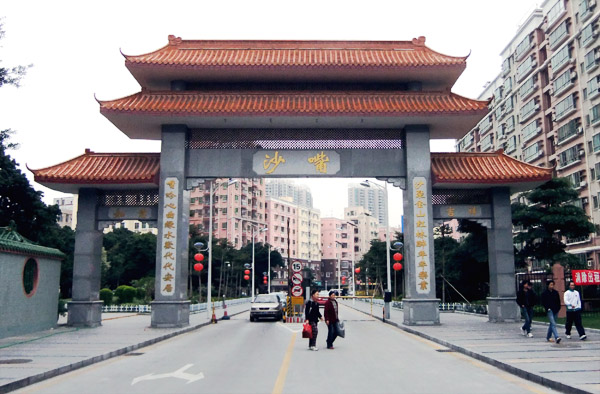
Entry gate to Shazui

Shenzhen villages are places of unexpected encounters with tradition, living and reworked. Indeed, these encounters are reason enough to meander through the villages. Just to the left of the entry gate to Shazui, for example, is a temple to Hongsheng (沙嘴洪圣宫), which is kept by an older Shazui couple. I asked about Hongsheng and they invited me to sit and chat.

Historically, Shazui villagers made their living fishing in the northern section of the South China Sea, beyond the mouth of the Pearl River Delta. Hongsheng, as his name “Flood Victory” suggests is a god who protects fishermen of the South Seas. Hongsheng is also sometimes thought to be 祝融 (Zhurong the god of fire) and THE god of the South Seas, suggesting that Hongsheng is either a local manifestation of a more general god, or was a specific god that was absorbed into a larger tradition.

From a decidely brief net surf, I have gathered that Hongsheng is very local. Most of the temples I came across were located in Hong Kong and this temple is the only one that I (thus far) know about in Shenzhen. Indeed, the Ou Family Association from Hong Kong (沙嘴[香港]欧氏宗亲会) had provided the computor printout with information about Hongsheng, which again suggests how local this god is. I’m wondering if this is because Hongsheng protects ocean fishermen? That said, throughout Nantou, most temples are dedicated to Tianhou (天后) with the largest temple at Chiwan.

So a post that begs more questions than it answers. Why Hongsheng and not Tianhou? Why only in Shazui? How important is the Hong Kong connection to the temple’s maintenance?  And why is the temple located at the gate? Questions, questions. More to follow as I stumble across answers…

Tianmian: East West South North

About a year ago, I had the privilege of participating in Vexed Urbanism: A Symposium on Design and the Social at The New School. I contributed Tianmian: East West South North an image poem that mapped four of Shenzhen’s formative ideologies along east-west and north-south axes.  In this piece, I aim to show – quite literally – how landscape is never simply place, but also and always a symbolically organized world, a cosmos. Thus, Tianmianillustrates how it is possible to read not only Shenzhen’s history, but also the values that have informed the city’s construction in the lay of the land, the placement of a building, and movements in and out of an urban village.

East West South North

fat bird in hong kong!

On January 10-11, 2009 Fat Bird will perform “FBI: 2009 Shennong Plan” at the Fringe Club City Festival 2009. FBI is, of course, the acronym for Fat Bird Institution.

FBI: 2009 Shennong Project is organized as a series of public announcements, propaganda events, and onstage performances that are adapted to local audience concerns.

Organization of Public Announcement. During a pre-show press conference, FBI Chair Yang Qian explains how recent Chinese food crises are in fact signs that human evolution is entering a new stage. Specifically, toxic food allows the earth to weed out food dependent people, revealing the new human as the ones who directly ingest elements. All human beings are welcome to join FBI’s pursuit of a new and glorious future humanity.

Organization of Propaganda Events. At each of the onstage performance, FBI sets up an information table, where an FBI believer challenges passersby and audience members with the questions: “Are you afraid of China food?” and “If so, would you consider joining FBI?”

Organization of Onstage Scenes (for Hong Kong performance, January 10-11, 2009; time 30 minutes; 7 participants). Each scene is comprised of: multi-media and performance. FBI handouts and propaganda materials will also be available at each performance.

Images of the first FBI handouts from the December 4, 2008 press conference in Hong Kong:


fat bird red and blue

English translation of the handout:

FBI Report to Hong Kong Citizens: The Chinese Food Problem and a New Stage in Human Evolution

People of Hong Kong:

Greetings! Recently, under the pressure of population, environmental, rapid urbanization, and globalization, the quality of Chinese food has become increasingly questionable. Chemical residues in food and chemical additives with no nutritional value are now common. In addition, there are constant reports of industrially processed foods. This year, the “Three Deer Milk Powder Incident” transformed the question of food safety into a focus of social concern. “Three Deer” milk products carried the prestigious “No National Food Inspection” label because in previous years their products had all passed inspection. The contamination of Three Deer” milk products resulted in the collapse of confidence in national food safety regulation. This crisis and the high level of distrust of all food was the background for the appearance of a new illness—comephobia. Comephobics display high levels of anxiety, suffer from hallucinations, and are frequently aggressive. There is a danger of comephobic outbreaks in the richest of China’s eating regions. According to our information, health departments throughout the country are as yet unable to cure or control this disease.

However, the crisis in Chinese food safety is actually a signal that humanity has entered a new stage in evolution. Accordingly, FBI has a special announcement: the results of our research show that there is a special class of human being that does not depend on ordinary food in order to live. They are among us. We call the “elementals” because they are able to secure nutrition from other sources. Elementals are uniquely adapted to the current environment and do not suffer from comephobia. Given ongoing environmental degradation, they embody the hope of human survival and evolution.

FBI is the acronym of Fat Bird Institution, the department of the Global New Life Diversification Federation that is responsible for researching and optimizing the opportunities for human evolution caused by the pressure of the Chinese food environment. We have been secretly tracking the existence of elementals for a long time. However, we were unable to develop an easy method for distinguishing elementals from the rest of the population. The Three Deer Milk Powder Incident enabled a breakthrough in FBI’s work on identifying elementals. Our research shows that children who drink melamine contaminated milk powder and develop kidney stones are in fact elementals. When this research was extended to the adult population, our identifications were 99.46% accurate. FBI decided to announce our presence and research to offer an invitation to all people. Come to an FBI identification station and take the melamine milk test and determine your true nature. The mass distinguishing of human natures is the second core mission of the “2009 Shennong Plan”.

During the January 2009 Hong Kong Fringe Festival, FBI will set up an identification station in the basement of the Fringe Club. We welcome every Hong Kong citizen to begin self-identification. We will also provide entertainment.