greek with chinese characteristics – yuanling 1

this weekend, i walked yuanling (园岭), one of the first industrial and residential areas to be developed when shenzhen was officially special.

printing factories still operate in the shrinking industrial area park, however, those that have not been razed for upscale housing development have been and/or are being upgraded to storefront for warehouse like stores for ornate furniture and luxury bathrooms.

it sobers me to think that only ten years ago, this area was a vibrant industrial park, the realization of a particular understanding of modernization, when production and manufacturing were the at the core of shenzhen’s economic development strategy. suddenly and abruptly, individualized consumption has been enshrined as economic productivity in the (literal) wreckage of those past ambitions.

when i first came, shenzhen speed was defined in terms of accelerating 100 years of western modernization into a few decades. but all this instant upgrading has me wondering just how fast is an economic cycle anyway? and what comes next? restructuring and economic depression? pics of upgrades, here.

5 minutes in luohu (蔡屋围)


1 alley

Originally uploaded by maryannodonnell

luohu seethes contradictions, especially in the area surrounding the train station and railroad tracks, which connect shenzhen to hong kong (in the south) and guangzhou by way of buji and dongguan (in the north). in fact, the area immediately surrounding the railway station is frequently (and distastefully) referred to as “chaotic (乱).”

this part of the city was originally part of caiwuwei (蔡屋围), location of the previous administrative headquarters of bao’an county (once it was moved from nantou in 1953). consequently, it was one of the first areas occupied by national work units that built shenzhen. in fact, this area is one of the few in shenzhen where there are work unit residential compounds.

although shenzhen’s explosion has repeatedly transformed caiwuwei, the area’s historic importance has meant that past buildings and dreams accumulate in the shadows of upgraded versions.

i have uploaded a five minute walk through two blocks of caiwuwei. it begins in the alley next to the the ministry of shipping compound (航运大院), scuttles through the driveway entrance to the chengshi tiandi plaza, crosses bao’an south road and moves through the newer section of the mix-c mall to park lane manor.

the point of this walk is not simply to draw attention to the contradictions that structure everyday life in shenzhen, but also to emphasize that critical irony is built into the physical environment. benjamin reminds us that when innovations appear in modern life they do so by calling attention to the past. and not merely any past. but collective dreams and fantasies for completion and wholeness that have not yet been satisfied.

pay attention. the the mix-c’s name in chinese is 万象城 – “city of every phenomenon”, evoking the dao de jing, where “the way gives rise to one, the one to two, the two to three, the three to every phenomenon (道生一,一生二,二生三,三生万物). ask yourself. if the way is not capitalism (with or without chinese characteristics), what is it?

unexpected encounters with tradition…

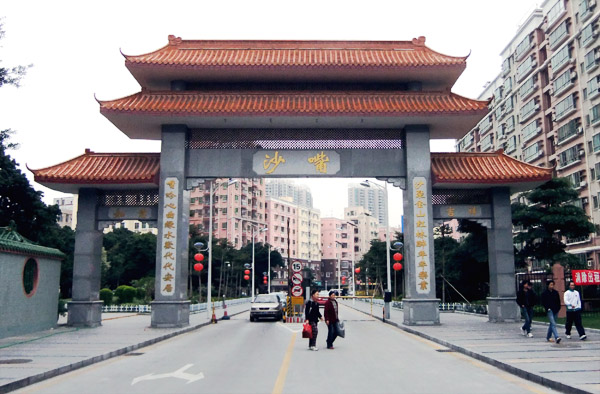
Entry gate to Shazui

Shenzhen villages are places of unexpected encounters with tradition, living and reworked. Indeed, these encounters are reason enough to meander through the villages. Just to the left of the entry gate to Shazui, for example, is a temple to Hongsheng (沙嘴洪圣宫), which is kept by an older Shazui couple. I asked about Hongsheng and they invited me to sit and chat.

Historically, Shazui villagers made their living fishing in the northern section of the South China Sea, beyond the mouth of the Pearl River Delta. Hongsheng, as his name “Flood Victory” suggests is a god who protects fishermen of the South Seas. Hongsheng is also sometimes thought to be 祝融 (Zhurong the god of fire) and THE god of the South Seas, suggesting that Hongsheng is either a local manifestation of a more general god, or was a specific god that was absorbed into a larger tradition.

From a decidely brief net surf, I have gathered that Hongsheng is very local. Most of the temples I came across were located in Hong Kong and this temple is the only one that I (thus far) know about in Shenzhen. Indeed, the Ou Family Association from Hong Kong (沙嘴[香港]欧氏宗亲会) had provided the computor printout with information about Hongsheng, which again suggests how local this god is. I’m wondering if this is because Hongsheng protects ocean fishermen? That said, throughout Nantou, most temples are dedicated to Tianhou (天后) with the largest temple at Chiwan.

So a post that begs more questions than it answers. Why Hongsheng and not Tianhou? Why only in Shazui? How important is the Hong Kong connection to the temple’s maintenance?  And why is the temple located at the gate? Questions, questions. More to follow as I stumble across answers…

thinking food: images from the houhai overpass, 2002-2010

this post is a brief contextualiztion of  china lab’s  landgrab city exhibition for the shenzhen-hong kong biennale 2009. the exhibit draws attention to the the ways that cities are imagined without reference to the countryside and food production. it also usefully brings china into international conversations about urbanization.

The countryside is a vital but frequently overlooked category in the contemporary discourse around spatial policy, and its role with respect to the future of urbanism is more often than not neglected. Landgrab City is an attempt to visually represent the broader spatial identity of the 21st century metropolis; it proposes a new spatial definition of the city and thereby a more complex understanding of urbanism, one that no longer considers city limits as the boundary of its remit, but instead looks beyond – even across international borders – to the spatial, social, economic and political implications of the planet’s rapid urbanization.

i support efforts to think about food – its production, distribution, unequal consumption – are all critical to how shenzhen is imagined, experienced, and reproduced. nevertheless, this exhibition disturbs me because it discusses shenzhen as if the city were one wealthy enclave, rather than an amalgamation of enclaves -rich, poor, and destitute, which abut and constantly disrupt one another.

shenzhen has sold itself and reform in precisely the terms that china lab uses to describe the city’s “reality”. unfortunately, by taking shenzhen’s self-promotion as fact, rather than promotional fantasy, china lab overlooks  how rural migrants inhabit and  transform shenzhen. this silence distresses me because the spatial, social, economic, and political consequences of shenzhen’s modernization are not implied; they are facts of life for many migrants.

so a very simple point:

In reality, of course, these agricultural territories are not actually clustered around Shenzhen, as in the installation, but scattered across China and contiguous regions.

counter point: a five minute walk from the land grab project, agrarian squatters have persistantly grabbed, evacuated, and reoccupied  a portion of the houhai land reclamation area to grow food, which they eat and sell. the differences between overpass then and now are now are instructive because they illustrate both the persistance of shenzhen’s rural poor as well as their increasing destitution.

the map below locates the land grab project with respect to several generations of agricultural squatters at the houhai overpass.  pictures of the squatters and their gardens, here.

the houhai overpass is located at the intersection of houhai and binhai roads. in the map, the squatter areas are located in the southeast quadrant of the intersection, coastal city in the southwest, and the land grab in the northwest. these areas are roughly a five minute walk from each other. in the map, the blue areas used to be underwater; the brown areas were not.

chiwan 2009


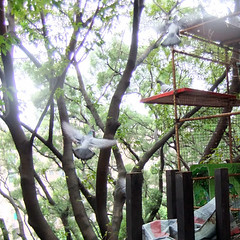
pigeons

Originally uploaded by maryannodonnell

today was the 15th of the 10 month of the lunar calendar, so i did what all good girls do – went temple hopping. chiwan is one of the natural harbors that constitute the port of shenzhen. before reform, chiwan could only be reached by way of a boat launched from shekou, heading north up the pearl river. today, chiwan is easily accessible by the 226 or 355, but still retains something of a backwater feel. indeed, chiwan has the scruffy feel of a potentially hip artist colony, except for the lack of artists and the vanishing coastline.

that said, chiwan is fun because it also boasts some of the oldest sites in shenzhen – the tianhou temple (technically the oldest in the area. zheng he reputedly stopped here, and emperors from the ming and qing gifted stele to commemorate upgrades and rennovations (!) to the temple). chiwan is also site of the grave of the last song emperor – a child who was drown with and by a loyal follower so he would not be dishonored by the yuan. the little emperor’s tomb is maintained by the zhao family.

hop, hop.

History as Farce

As part of our book club discussion (see previous entry), Liu Jingwen handed out copies of a recent blog entry by Yang Hengjun (杨恒均) entitled “Ten Years of Cultural Revolution and Ten Years of the Internet: Where Do We Go From Here? (十年文革与十年互联网:我们向何处去?)” In the rest of this entry, I will translate some of the more interesting passages from Yang’s (much longer) essay. I hope this synopsis + citations will contribute to understanding about historic continuities between Maoism and what followed.

Yang Hengjun is interested in comparing the first thirty years (1949-1979) and second thirty years (1979-2009) of the People’s Republic because he believes there are startling similarities between these two eras. He is particularly interested in the comparing the ten years of the Cultural Revolution with the ten years of the internet in China.

十年文革是建国六十年甚至是中国历史上少有的几个“大鸣大放”、“大民主”的时期,当时是以青年学生(甚至很多高中生)为主,知识分子中大部分已经从1957年的反右中吸取了教训,少部分没有吸取教训的从一开始就被打倒在地了。

互 联网十年里,也是以清一色的青年人为主,在虚拟的空间进行独立思考和自由言说。这时期的知识分子们一边从文革和上个世纪八十年代末的事件中吸取了教训,打 骨子里认同了沉默是金的理念;一边从改革开放中收获真金白银,忙于改善自己的生活,从物质和精神上都向官员靠拢。结果,青年人主导思考和言论成为十年文革和十年互联网最大的共同之处,同时也彰显了我们民族的困境:急需知识分子们启蒙和引导青年的时候,思考国家前途和民族命运的担子竟然落在了涉世未深的青年人的肩膀上。

The ten years of the Cultural Revolution was a rare period of “free airing of views” and “democracy” in the 60 year history of the People’s Republic, indeed in the entire history of China. The key players were young people (even high school students) as a majority of intellectuals had already learned their lesson from the 1957 anti-rightism movement and the majority who hadn’t learned their lesson were beaten early on.

Young people again have been the key players during the ten years of the internet, conducting independent thought and free speech in virtual space. On the one hand, this era’s intellectuals have learned their lesson from the Cultural Revolution and the events of the late 80s, and believe in their bones that silence is golden. On the other hand, they have gotten rich during reform, keep busy improving their lives, and their material and spiritual interests overlap with those of officials. Thus, the primary importance of young people in leading thinking and debate is the greatest similarity between the ten years of the Cultural Revolution and the ten years of the internet. This also shows our people’s predicament: at the time when young people desperately need the enlightment and direction of intellectuals,  the responsibility for contemplating the country’s future and the people’s fate has been unexpectly thrust onto their inexperienced shoulders. Continue reading

Book Club Blues

On December 26, Mao’s birthday, our book club gathered to discuss a recent translation of Wang Shaoguang’s The Failure of Charisma: The Cultural Revolution in Wuhan (1995 Hong Kong University Press; translated in 2009: 王绍光 超凡领袖的挫败–文化大革命在武汉 the 80’s.). We were of several generations – the late 1950’s, 60’s, a couple from the 70’s, and a few from the 80’s.Liu Jingwen, member of the 80’s cohort led and organized the discussion.

What was striking about the conversation was the extent to which generational experience continued to dominate the conversation not just because 50’s and 60’s participants could claim personal experience of the Cultural Revolution, but also because of the relative value of political ideology amongst the different cohorts. Crudely speaking, the older the participant, the stronger was the conviction that collective politics is a pressing matter. Likewise, the younger the participant, the more likely s/he was to express surprise/ interest in/ confusion about the  older generation’s valuation of politics.

How and why the Cultural Revolution continues to matter in Shenzhen are pressing questions because Shenzhen was (arguable) the last of the great social experiments from the first thirty years of the People’s Republic. Deng Xiaoping mobilized intellectuals, cadres, and the engineering corps to leave their cities and “cut open a road of blood (杀出一条血路)” or “feel your way across the river (莫这石头渡河),” depending on the relative militarism of one’s ideological commitments – and yes, Deng was militaristic, but it was also a society saturated by martial metaphors. [Deng Xiaoping’s road of blood inevitably makes me wonder, ‘whose blood’ and ‘how much is needed’?]

Importantly, both the road of blood and the river crossed convey the idea of movement – road to where? Crossing which river? Of course in Shenzhen circa 1978, these questions have concrete answers – roads to Hong Kong at Wenjindu and Luohu and a ferry to Hong Kong at Shekou, respectively. But the also entailed hope and an orientation to the future – a new kind of modernity and xiaokang for every Chinese citizen. In other words, the values that infused the establishment of Shenzhen were the values espoused by many during the Cultural Revolution. This connection is even clearer when we take into account the extent to which freedom and proceedural justice were fundamental to the establishment and prominance of Shekou during the 1980s.

What came out of our conversation was how much history has been disappeared not only in terms of relative knowledge, but also in terms of the scope of the debate. Throughout the discussion,  I was struck by the similarity of the debate to American debates about Vietnam. Most of us don’t know enough to do more than debate the relative value of soundbites, rather than analyze and evaluate events and consequences. Moreover, instead of figuring out shared principals on which to base our analyses and evaluations, we end up comparing levels of personal experience – an important part of historical recovery and recognition of ignored lives, but insufficient to the task of building bridges if (and when) experience (or its lack) become the terms for inclusion in the discussion.

I came to two conclusions after three hours of debate: (1) we need an education that will enable us to transform ourselves and future generations into people who can contribute intelligently AND compassionately to social debate and action and (2) we need to get beyond complacent acceptance of business as usual, let alone celebrating Shenzhen’s successful establishment of hypercapitalism. As we left the coffee shop, one of the 50’s participants said to me, “And we still haven’t done anything in Shenzhen (深圳还没动手!)” Perpetual revolution, indeed.

the wizard of sz

Participants in the Shenzhen-Hong Kong Biennial will

Explore the possibility of large-scale effective social mobilization in a time that lacks centralized force, spiritual solidarity and practical organization – Ou Ning, Biennial Curator.

In the context of Shenzhen’s thirty year history, the word “mobilization” resonates ironically. In 1966, Mao Zedong began the Cultural Revolution by mobilizing Chinese youth to prevent the restoration of capitalism through ongoing class struggle. In 1978, Deng Xiaoping initiated Reform and Opening by mobilizing the national engineering corps, architects, and reform-mind cadres to plan and build a Special Economic Zone, where elements of capitalism would be deployed to finance modernization projects throughout China. In other words, the construction of Shenzhen was a countermeasure to large-scale social mobilization during the Cultural Revolution and the city itself is the product of effective social mobilization under the auspices of modernization. Juxtaposed with the stated aims of the Biennial, Shenzhen’s history thus begs the question, “Why mobilization? Why now?”

Continue reading

中国观澜版画基地: What is a cultural resource?

Yesterday, Wenzi and I visited her classmate, Zhao Jiachun who works at the Guanlan Woodblock Print Base (中国观澜版画基地). Jiachun generously showed us the Base and briefly introduced its history.

Guanlan interests me for three reasons (in addition to the beautiful setting, pictures here):

Guanlan is, at the moment, a purely municipal government funded project. This points to the growing ideological importance of culture in Shenzhen’s identity – both domestic and international.

Guanlan is part of the movement to recuperate elements of Shenzhen’s pre-reform history as a cultural resource. What’s interesting is that this recuperation is happening village by village. Consequently, what emerges is a loose network of sites, rather than an overall “history” of the city. In this case, Guanlan is the third Hakka site incorporated into the municipal cultural apparatus. The first was Dapeng Suocheng (大鹏所城), a military installation in the eastern part of the city. The second was Crane Lake Compound, which is now the Hakka Folk Custom Museum (深圳客家民俗博物馆鹤湖新居) in Luoruihe Village, Longgang (罗瑞合村).

Guanlan is an example of using pre-modern architecture to incorporate international art production into local identity. More specifically, the experience of architectural difference (such as living in a Hakka compound) bridges even as it creates cultural difference. Thus, the Base invites foreign and Chinese artists for residencies. These residencies allow foreign artists to “understand” China / Shenzhen and incorporate these new experiences into their art. At the same time, these exchanges also refigure a local art form (woodblock printmaking) as international cultural heritage. Importantly, this kind of “experience” of the local past as a cultural bridge seems a global trend. In Switzerland, we visited Romainmotier, which also offers artist residencies in a beautiful, restored, pre-modern setting.

This has me wondering about the ideological relationship between past and present urban settlements: Is “history” now the location of “culture”, while the “present” is all about one’s location on a scale of relative modernity? In other words, do Shenzhen and NYC participate in the same “culture”, their real differences explained away as “levels of modernity”? While their cultural “difference” must be found by excavating the past?

Continue reading

计划赶超变化–a new era in Shenzhen development

赶 is often translated as “to overtake”, but can also mean “to drive away”. It first appeared in Chinese political discourse in 1957 when Mao Zedong responded to Nikita Khrushchev’s statement that “the Soviet Union would overtake the United States in 15 years” by saying that “In 15 years the PRC would overtake England”.  In 1958, Liu Shaoqi supported the Great Leap Forward with the idea of “Surpassing England and overtaking the United States (超英赶美)”. Indeed, in Shenzhen’s previous incarnation as Baoan County, there once were two communes named Surpass England and an Overtake America, respectively.

In many of the online interpretations of 赶英超美 (here and here, for example) Reform and Opening (改革开放) is offered as the correct policy for achieving surpassing and overtaking. This scenario is one way of understanding both the importance of Shenzhen (first and largest experiement in reforming and opening the planned economy) and why it is often experienced as “not Chinese”. Indeed, residents have often asked me how similar the United States and Shenzhen are.

赶 reappears in Shenzhen popular discourse in the late 80s and early 90s in the expression “plans can’t keep up with change (计划赶不上变化)”, which comments sarcastically on the governments inability to implement its urban plans. In Shenzhen, for example, the overall plans have been done in 15 year bursts. This has meant that what is planned isn’t built for years. More often than not, village developers and others have taken advantage of this situation to errect their own buildings. Thus, in the 90s, I frequently heard the expression “计划赶不上变化” to explain this situation.

During the 80s and 90s, de facto independence from government plans in Shenzhen resulted in a kind of pioneering exuberence that was often called “the Shenzhen spirit (深圳精神)”, but also found expression in slogans such as “little government, big society (小政府,大社会)” that moved with Shenzhen mayor Liang Xiang to Hainan in 1986 and which continues to inspire debates about changing the relationship between the government and the people (here, here, and here).

However, in conjunction with urban village renovation [administratively located in “Urban village (old village) renovation offices (城中村(旧村)改造办公室)],the government has  recently begun razing buildings that were erected on these unused sites, justifying their actions (with or without compensation depending on various) with respect to the plan. This means that Shenzhen may have entered a period of that could be called “plans overtake change (计划赶超变化)”, whereby neighborhoods of several years are being razed to make way for roads and other public infrastructure (the subway) that have been planned for years.

I am interested in how “plans overtake change” because it describes several of the important contradictions that over time have taken root and flourished in Shenzhen.

Continue reading