of floods and politics, or how the beijing disaster helps wang yang

The official death tole for the Beijing floods is 77 people. Weibo reports however, that in Fangshan District (房山区) alone over 800,000 people have been affected. In response, Mayor Guo Jinlong resigned yesterday, acknowledging his failure to be responsible for the people’s well-being. Today, Beijing Party Secretary Guo Jinlong went to Fangshan to show solidarity with those suffering. Yes, that is correct. In one of the more off the wall moments of Chinese politics, Guo Jinlong was both the Mayor and as of a month ago, also the Party Secretary of Beijing. Even in Chongqing, Bo Xilai was only able to act as Party Secretary, while the Mayorship was held by Huang Qifan.

Here’s the beauty of Guo Jinlong’s gesture. As a government functionary, Guo Jinlong could legally resign. However, as the holder of a Party appointment, Guo Jinlong can only loose his position as Party Secretary if the Party leadership decides to remove him from office — hee!

Now, Guo Jinlong is of interest to those of us in Guangdong who are following Guangdong Party Secretary Wang Yang’s career because like Bo Xilai, Guo was one of Wang Yang’s key rivals to become either Secretary General of the Chinese Communist Party or President of the Country. To be appointed to one of the top two positions in China, Wang Yang must first be appointed to the Standing Committee of the Political Bureau, CPC Central Committee during the 18th NPC. These nine hopefuls will be chosen from provincial level appointees, which includes the Secretary Generals and Mayors of the four independent cities (Beijing, Shanghai, Tianjin, and Chongqing) as well as provincial secretary generals and governors.

In January this year, Wang Yang’s top rivals for one of the nine positions in the Standing Committee were Chongqing Party Secretary Bo Xilai and Beijing Mayor Guo Jinlong. Whatever one thinks of Wang Yang’s “three attacks and two establishes” campaign, notwithstanding, as a recent text message reveals, the Beijing floods may have given Wang Yang the push he needs to get one step closer the highest positions in Chinese politics. So the country may flip neo-liberal even faster than expected, not because privatization works, but simply because recently several political high-fliers are crashing and with them, alternative models of development.

Insights from the Beijing Floods (北京水灾几点启示):

1。The water in Beijing is deep;2。In Beijing, having a house and car is nothing, you also need to have a boat;3。All Beijing subway stations have the same name — Drainage Pool (a pun on the actual station 积水潭);4。Car owners finally understands the government’s great efforts to collect “car and boat taxes” from private citizens;5。The South to North Water Diversion Project (南水北调工程) is finally seeing results (this massive engineering project will be completed in 2013, connecting northern provinces to the Yangtze River);6。The Northern Drifters finally have a correct footnote (artists who go to Beijing to make a career are known as “northern drifters (北漂)”;7。As soon as Wang Yang enters the capitol he will have a job (because both characters in Wang Yang’s name have the water radical: Wang (汪) is a surname that means an expanse of water and Yang (洋), his given name, means ocean).
entitled: the demise of comrade and ritualization of inequality

The other evening northern friends of a certain age lamented the demise of “comrade (同志)” as a form of address. They weren’t so much distressed by the Cantonese queering of the term, as they were by the fact that Chinese forms of address no longer assumed (or aspired to) equality between comrades. Instead, etiquette now demanded that social fields be charted and hierarchical relations marked. Officials, for example, are called by their bureaucratic position. Not surprising in the case of higher ranking officials — the City Party Secretary and Mayor, for example — but somewhat excessive in the case of neighborhood heads.

Even if they chafe at the ritual acknowledgement of political hierarchy and concomitant social inequality, nevertheless, they also remarked that official status does simplify the question of how to address someone. In contrast, they noted that the real awkwardness lay in deciding how to address someone without either a clear social role or a defined relationship to the self. They addressed professionals by their job (Lawyer Chen, Teacher Dong, Doctor An, Theatre Director Yang, and Engineer Liang come to mind), but often blanched at calling rich acquaintances “boss (老板)” or the more refined “executive (总)”. Friends were addressed by nicknames and fictive kin terms, while new friends could be called “Mr. (先生)” or “Ms. (小姐)”, but workers, including waitstaff and other service workers posed a problem because they could also be hailed as fictive kin or just young people. Moreover, gender and age play an important role, and in conversation my friends often call working men “craft master (师傅)” or “boy (小伙子)” and working women “auntie (阿姨)” or “younger sister (小妹)”.

In anticipation of the 18th National People’s Congress and to give a sense of just how complicated is the system of Chinese bureaucracy and relevant titles, I have translated the fifteen official levels of government from a Baidu entry. Positions are listed in order of ranking within a category. Hence, the General Secretary ranks higher than the President, who in turn ranks higher than the Chair of the Military Commission. When making introductions, most people will qualify a title with the appropriate administrative status, as in City Level Vice Mayor, after which however, they will use the full title “Mayor” unless the actual Mayor is around. These rankings also matter because they map the bureaucratic journey that ambitious functionaries must make. Shenzhen is a sub-provincial level city, for example, and so its Mayor cannot be directly considered for a national post, but must first obtain a provincial or ministerial position. In contrast, a the same position in an independent city, like Beijing or a full provincial ranking, would be a rank higher, placing the office holder in contention for national assignments.

Should your eyes not glaze as you read the list, you’ll get the hang of assigning rank and how using titles has ritualized inequality by reiterating the Chinese bureaucratic system from the General Secretary all the way down to a functionary in a community or village office.

First level, national level (国家一级):General Secretary, President, Chair of the Military Commission, Chair of the National People’s Congress, State Council Premier, Vice General Secretary, Standing Member of the Political Bureau of the CPC Central Committee.

Second and third level, national government (国家二至三级):Member of the Political Bureau of the CPC Central Committee, Alternative Member of the Political Bureau of the CPC Central Committee, Secretary for the Central Disciplinary Commission, Vice Chair of the NPC Standing Committee, Vice Premier of the State Council, State Council Member, President of the Supreme People’s Court, Vice Chair of the CPPCC National Committee.

Third and fourth level, national ministries and provincial government (部级正职、省级正职三至四级): Provincial governor, Vice Secretary for the Central Disciplinary Commission, Standing Member NPC, Secretary of State, all sub-national administrative chiefs and enterprise heads (including Party organizations), leaders of all People’s organizations (including Party organizations) at the provincial, autonomous region, independent city level. These organizations include Party Committees, People’s Congresses, Government, and Chinese People’s Political Consultative Conference. Exceptions can be made to give provincial rank to leaders of sub-provincial organizations;

Fourth and fifth level, vice ministries and sub-provincial government (部级副职、省级副职四至五级): Vice Governor, Members of the Central Disciplinary Commission, all sub-provincial administrative chiefs and enterprise heads (including Party organizations), leaders of all People’s organizations (including Party organizations) at the sub-provincialand sub-autonomous region. These organizations include Party Committees, People’s Congresses, Government, and Chinese People’s Political Consultative Conference. Exceptions can be made to give sub-provincial rank to leaders of Office of the Council or Regional organizations [Shenzhen Municipality];

Fifth through seventh level, Council Heads, Regional Chiefs and Counsels (司级正职、厅级正职、巡视员五至七级);

Sixth through eighth level, Vice Council Heads, Sub-regional Offices and Assistant Counsels (司级副职、厅级副职、助理巡视员六至八级) [Shenzhen Districts];

Seventh through tenth level, Department Heads, County Commissioner and  Investigators (处级正职、县级正职、调研员七至十级);

Eighth through eleventh level, Vice Department Heads, Vice County Commissioners, and Assistant Investigators (处级副职、县级副职、助理调研员八至十一级) [Shenzhen Precincts];

Ninth through twelvth level, Section Heads, Xiang Heads and Chief of Staff (科级正职、乡级正职、主任科员九至十二级);

Ninth through thirteenth level, Vice Section Heads, Vice Xiang Heads, and Vice Chief of Staff (科级副职、乡级副职、副主任科员九至十三级) [Shenzhen Communities/Neighborhoods];

Ninth through fourteenth level, Staff Members (科员:九至十四级);

Tenth through fifteenth level, Office Workers (办事员:十至十五级).

可怜天下父母心: generation 80 and 90 go abroad

I tend to think that middle class Chinese parents have it good. Grandparents take care of young children, elementary school children go to school and can generally be pressured into doing several hours of homework a night, and older children hang out with their parents, not only out of respect, but also because they acknowledge that being with children makes parents happy. In fact, a visit to any park or mall, or even an ordinary bus commute suggests how well behaved Chinese infants are. One or two fuss, but most sit calmly on their grandparents’ laps or play with a water bottle. School age children get themselves to and from campus, attend cram sessions, and organize their homework.

Even after graduating from college, middle class children take care of their parents’ well-being. I know more than one member of Generation 80, for example, who returns home for weekly meals. Working Chinese children also arrange for their parents and parental-in laws to live with or near them in order to attend to parental needs. So common is the assumption of parental care that throughout Shenzhen, hospitals and shopping malls market themselves as places where children can express care for parents — arranging a mother’s dental appointment or family dinner, for example. Certainly, facilitating migrant remittances from Shenzhen to neidi and family network phone plans are huge sections of the financial and service industries. In other words, my experience has shown me the extent to which middle class Chinese children — even members of Generation 80 and 90 —  remain remarkably filial. Or certainly seem so when compared with their age cohorts in the United States.

I realize that mine is a minority position. Commentators in both China and the West have focused on how China’s middle-class parents work exceedingly hard to provide the material conditions for their only child to live well. These parents sacrifice all sorts of ambitions and desires so that their child can go a famous university. They also point out that since promulgation in 1980, China’s one-child policy has produced not a few “little Emperors (小皇帝)”, who in common English are simply “spoilt brats”. Now it may be that when two sets of grandparents and often a nanny orbit the lone descendent, some children become unreasonable. But not all. And certainly not the majority, who study hours as long or longer than their parents work to achieve academic results that will make their elders proud. Indeed, I am still impressed by the number of young Chinese people who make their parents’ dreams (rather than their own) their lodestar.

As I have begun to gather stories about generations 80 and 90 abroad, however, my perspective has shifted. I am beginning to realize the extent to which their parents have made these young people their life’s purpose. It is not simply that middle class parents bask in the glory of their child’s accomplishments, but also and more importantly, that they have crafted lives out of raising this child. These parents often confuse high grades with success and low grades with failure, or interpret independent thinking as “rebellion” and “intransigence”. Nevertheless, once their child successfully matriculates in an overseas high school or college, these parents suffer acute ” empty nest” syndrome, as we call it in the States not only because they realize that they will no longer be able to direct their children’s development, but also because they finally understand, no matter what and how they dream for their child, ultimately they cannot give their child a smooth and carefree life.

Yesterday, I helped a mother read and understand US insurance documents. Her daughter is in California and was in a car accident. The other party has filed for damages, and the daughter’s insurance company has begun to negotiate with the claimant’s lawyer. Ironically, the mother sold her own car so that the daughter could purchase a car, which she explained, “is more necessary in California than Shenzhen.” The daughter whose English is fine, but not strong enough to feel confident about her understanding of documents in legal English sent her mother digital copies, asking for guidance. The mother does not read English and used half a day to find a connection to me to make an appointment. After I explained the content to her, we came up with a plan of action and contacted the daughter, who is no doubt figuring out what needs to be done and doing it. Her mother, however, is in Shenzhen managing the anxiety of helplessness; she deeply wants to help her daughter, but cannot.

All this to say that I am hearing the expression “take pity on the hearts of the world’s parents (可怜天下父母心)” differently, and perhaps more accurately. I used to hear it as spoilt parent moaning about a child’s attempt to establish a bit of independence. Today, I am better able to pity parents, not because their child received poor grades or has a stubborn streak, but rather because they would do anything to make their child’s life smooth and happy. Of course, that is precisely what they cannot do, and so they suffer.

Interesting cultural postscript: in Chinese, empty nests refer to lonely grandparents and the phrase “empty nester” is translated as 孤寡老人. Thus, when their children go and remain abroad, Chinese parents not only become empty nesters in the US sense of “children have moved out”, but also potentially in the Chinese sense of “old person without a grandchild”.

reforming rhetoric 1: 摸论

“Feeling stones to cross the river” is one of the more famous sayings of early reform. Western pundits often interpret this phrase as a straight forward description of the uncertainties inherent in reforming the Maoist system and concomitant trepidation about moving toward – what? – xiaokang with capitalist features? However, this expression belongs to a rhetorical form called 歇后语 or two-part analogy, in which the first part is spoken and the speaker’s intended – and often critical – meaning is left unspoken. Paying attention to the unspoken response highlights how conflict and disagreement was handled within Party debate over the direction and scope of reform.

Chen Yun first raised “Feel theory (摸论)” as it became known during a Central Working Conference in December 1980. Importantly, Chen Yun used the two-part analogy to conclude an opinion on how to reform the Maoist apparatus, “…[I]n other words, we need to ‘Feel stones to cross the river’ (也就是要‘摸着石头过河《陈云文选》第3卷第279页)”. In conventional Mandarin, the unspoken critique in this analogy is “tread carefully (步步稳当)”. Later during the Conference, although Deng Xiaoping agreed with Chen’s unvoiced but present call for a more conservative approach to reform and opening, nevertheless, he shifted the discussion by emphasizing pragmatic action.

With “Cat theory (猫论)” and “Don’t debate theory (不争论)”, “Feel theory” became one of the three main principles guiding early reform.

more confucian business ethics: collect the bags!

Roughly twenty years ago, he, his wife, and their son immigrated from China to Southern California. They came to Shenzhen last year to do business with successful college classmates and brought a daughter and a younger son. The older son remained in California. The man was 40 something years of age, and he told me that his wife and son met a friend and business associate at LAX. When the three went to pick up the visitor’s luggage, his wife went to collect the bags. However, because she is a woman, the visitor stopped her and collected the bags instead. The man didn’t say, but I’m assuming the wife and friend engaged in some who-can-hold-onto-the-bags shuffle, with the result that the visitor ended up carrying his own bags. The son waited for the ritual to end and then led his mother and his father’s friend to the car. The son drove them home.

The man told me this story because he wanted to know what I thought; how had the son behaved?

“Based on what I know of American or Chinese cultural norms?” I hedged, thinking that any young man who drove his mother to the airport to pickup a guest was an accommodating son, and that if his parents and their friends wanted to engage in who’s-the-most-polite shuffles, then that really was their business and why not wait for the storm to end. In fact, personally, I sympathized with the son’s position because I am frequently nonplussed when confronted by demonstrations of Chinese courtesy that are also not-so-sutble assertions of dominance.

He explained that afterward his friend had approached him to talk about the matter. The friend worried that the son did “did not understand things (不懂事),” an expression with meanings that range from ‘immature’ through ‘is insensible to the feelings of others’ to ‘has no concept of proper behavior’. The friend had acted out of concern because he worried for his friend’s son future prospects. To declare a college graduate “does not understand things” means that those in positions of power “cannot use him (不能用人)” and thus will not place him in positions of responsibility, thereby foreclosing opportunities for advancement.

At the time, the father had replied that he thought skill (能力) was the most important criteria for promotions. However, when he discussed the issue with another friend, this time the CEO of a small company, he realized that from the point of view of makers and shakers in China, his son in fact “could not be used”. The CEO explained that he had two employees, A and B, who went everywhere with him. The CEO did not have a driver and so A and B took turns driving. When A drove, he made sure to open the CEO’s door for him before getting into the car. When B drove, he immediately sat in the driver’s seat and A, again, opened the CEO’s door before settling himself in the car.

“Now, who should I promote?” the CEO rhetorically asked the man. “Obviously, A is more meticulous/ attentive (更细心) than B. Consequently, he can be trusted, whereas B doesn’t see the big picture.”

The big picture included hierarchy and etiquette, or understanding one’s relationship with another and each time A opened the CEO’s door, he demonstrated his understanding. In contrast, B did his job. On the CEO’s interpretation, it didn’t matter how talented B was. The real problem was that B couldn’t be trusted to treat guests and by extension business colleagues and clients, properly. A could.

I’m told there are serious differences between etiquette in state-owned industries, where bureaucratic privilege trumps skill and the private sector, where talented people are more valued than sycophants. Also, it seems that things “are different” in the IT sector, but again, people quickly remind me, that techies are young and often westernized. Westernized, perhaps, but as in Western business culture, Chinese business culture distinguishes between those who give good face and those who do their jobs well; rare is the individual who can both manage people and complete tasks.

Interestingly, although the characters for the Chinese words for CEO (董事长) and “understand things” are different, nevertheless they are homophones, which alerts us to the moral of today’s story. At an airport, there are several rules that apply when greeting Chinese guests:

1. If the guest is older than you — collect the luggage to show your respect;

2. If the guest has a higher rank than you — collect the luggage to show your respect;

3. If the guest is a friend — collect the luggage in order to demonstrate your good will.

There are three possible exceptions to the “collect the luggage” rule for greeting Chinese guests, gender, age, and White ethnicity. A friend would neither expect a friend’s wife to collect luggage, nor would that friend expect an elementary school child to collect luggage. Although if the child grabbed a bag, be sure to laugh happily, muss her hair, and exclaim, “Wow, she really understands things!” And yes, white Americans are forgiven for all sorts of social faux pas that Chinese-Americans are not so that when we go for the bags, we suddenly appear “Chinese”.

But to return to the father’s story. What do we say to a Chinese man, who clearly wants his American son to succeed, knowing that amongst globe-trotting Chinese he will be judged by ancestral values and not those of his hometown, Los Angeles?

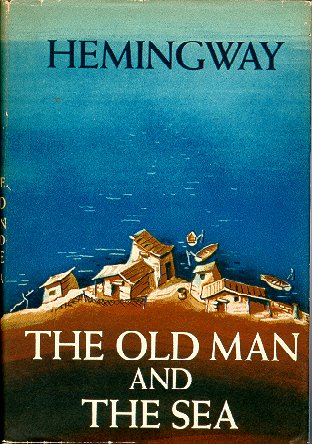
reading the old man and the sea (in shenzhen)

I am currently reading The Old Man and the Sea with two 16 year old Chinese high school sophomores. They are cousins. One is a “good” student, strong and sly in the self-protective way of students who know how to work the system, but do not reach the upper echelon of test results. The other is delicate and shy, a “top” student, who is being groomed to test into Beijing University, producing results (出成绩) for her school and family. The good student knows that unless she goes abroad, she will no doubt end up at Shenzhen University, no matter how much harder she works at school; fortunately, her parents can afford to send her anywhere and so she is not too sly, and her eagerness to model good student answers quickly gives way to assertive self-confidence. The top student already struggles with contradictory desires and ambitions. She yearns to study abroad, but her homeroom teacher has already begun pressuring her to stop studying for the TOEFL and to use her extra time more productively — taking practice gaokao tests or studying the junior year high school curriculum. What’s more, the child of divorce she knows that her mother can’t afford Chinese tuitions, let alone foreign and thus she must secure a scholarship  wherever she attends university.

We sit around a square table, tracking the relationship between the old man and the marlin. Santiago believes that his fish is out there, and his quest begins when he sights the purposeful circling of a man-of-war bird. His faith is rewarded and the contest engaged. As the fish pulls the man further out to sea, away from from the lights of Havana and known landmarks, the old man endures, charts his progress against the stars and his suffering, and the fish becomes more than a fish — first a friend, then a brother, more noble, but less intelligent, a brother who must be convinced that he is less than he who came to kill. It is a grand battle that does not end in glory, but the realization of hubris, “I shouldn’t have gone out so far, fish,” the old man says to the marlin’s corpse, which has been strapped to the skiff and is being inexorably eaten by sharks. When the old man finally drifts ashore, all that remains is an 18 foot skeleton and the certainty of death.

I chose The Old Man and the Sea because, well misgivings about Hemingway notwithstanding, he knew his craft. His language is deceptively simple. Any sentence taken out of context seems ordinary, common even, but together his words sculpt moral landscapes that make exquisitely salient the brute masculinity and ultimately tragic consequences of lives lived against nature.

“Americans aren’t very peace-loving,” the good student concludes.

“Did the old man have faith in luck or faith in the sea?” the top student asks.

Thus, yesterday’s lesson transformed from a discussion about human limits into a conversation about how being human is culturally defined and experienced. The old man is not their old man, his fish is not their fish, and the sea that relentlessly pulls us out of our depth, that tests our forbearance and ultimately claims our soul, that sea does not figure their dreams. It may be a generational difference. But perhaps not. Certainly the new US passport is replete with pictures of men taking on nature — cowboys and seamen ruggedly occupying the western plains and Pacific waves, respectively. And that’s the point: the girls read with me because the good student’s mother is a friend and she has entrusted her daughter to me (and yes those words were used “交给你”) for old-fashioned Chinese purpose: edification rather than simple instruction. The goal of our bi-weekly meetings is not to improve English test scores or practice oral English, but rather close reading of novels, essays and poetry, to help the teenagers learn to navigate literary nuance elsewhere, which it turns out is also learning to simultaneously recognize oneself and one’s Other despite and across epic difference, which isn’t quite what Hemingway had in mind when he figured Man through his engagement with the Fish, but nevertheless where yesterday’s lesson ended.

怀疑: A Cross Cultural Parable

This and next weekend, the teachers of the Shenzhen University Department of Acting are performing a Chinese adaptation of Doubt: A Parable by John Patrick Shanley, or 怀疑 as it is translated. After the show, several friends approached me and asked me what I thought of the acting. I said that I had enjoyed the performance. They looked at me strangely and pressed, “No, really, what did you think?” Evidently, they didn’t like it so I asked what they thought. Answers included, “I keep hoping that they’ll make me get nervous with the anticipation of waiting to see the show.”

“And you don’t feel that way?”

Flat out, “No.”

Another mentioned that he thought the actors were doing the best they could. But. But?

“They just don’t get the story. I mean, I don’t feel it with them.”

“What about the story?” I started asking, “Is the question of Doubt/ 怀疑 important to you?”

A considering look and then, “The actors are supposed to make me care about the topic. That’s their job.”

As the title suggests, Doubt is a teaching story, figuring the incessant problematic of faith in rigidly dogmatic Sister Aloysius’s certainty that the personable Father Flynn sexually abused Donald Muller, the school’s first black student. The story is set in the Bronx, during the fall of 1964 and the historical background matters because the characters also function allegorically for larger social shifts and ruptures. In 1962, Vatican II opened, but would not close until 1965, when the Council famously challenged the relationship between the Catholic Church and the modern world, acknowledging that truth could exist outside the community and declaring that the mass could be given in vernacular languages instead of Latin. Sister Aloysius embodies these past certainties and the Church’s previously unquestioned authority in all things moral, which tended to be, well everything; she suspected children of harming themselves to play hooky and saw sexual abuse in slight gestures. In contrast, Father Flynn represents the newer, hipper face of the Church; he plays basketball, wants to sing secular Christmas carols, and likes his tea sweet, perhaps even, too sweet, hmm?

Similarly, even though Donald Muller never appears onstage, his shadowy presence signals that like the Catholic Church, New York society was also changing and nowhere more than the Bronx. In 1963, Robert Moses’ Cross Bronx Expressway was completed. The bridge displaced families and businesses, was a constant source of noise and air pollution, and catalyzed the decline of the South Bronx from a district of family neighborhoods and businesses to the poorest district in the United States, despite its proximity to Manhattan. In fact, the South Bronx erupted into American national consciousness in 1977, when during a baseball broadcast, Howard Cosell exclaimed, “Ladies and Gentlemen, the Bronx is burning!” Sister James and Mrs. Muller are left to deal with the spiritual and practical aftermath, respectively. Sister James agonizes over the meaning of faith when innocence has been shatter and Mrs. Muller begs to protect her child despite his “differences”. Donald is black and may or may not be “that way” — his father and former classmates regularly beat him because they suspect he is — although Stonewall was only five years in the future, 1969.

Contemporary history also shapes reception. In 2002, the Boston Globe broke the story of sexual abuse in the Boston Archdiocese. Shanley first staged Doubt and won the Pulitzer in 2005. Soon, productions had been mounted in Australia, Singapore, the Philippines, and New Zealand. Roman Polanski directed the play in Paris; it was also staged in Venezuela and London. In 2008, Meryl Streep and Philip Seymour Hoffmann performed the antagonists, Sister Aloysius and Father Flynn. Clearly, Shanley’s nuanced exploration of moral ambiguity resonated with English-speaking audiences precisely because it resonated at so many levels — historically, spiritually, and personally. Or as an older Catholic friend summed up his response to the play, “Of course he did it and yes, she’s a bitch. But still, none of that changes the truth…” And implicit in this statement, reverberating through our souls is the desire to believe, to have faith. And yet, we doubt. As Shanley elegantly described our situation, “For those so afflicted, only God knows their pain. Their secret. The secret of their alienating sorrow. And when such a person, as they must, howls to the sky, to God: ‘Help me!’ What if no answer comes?”

And therein lies our cross-cultural rub. For my Chinese friends there was no story except as conveyed by the actors. 怀疑 means doubt and suspect, and is often used to describe situations when someone may or may not be lying, as in, “I suspect she’s actually dating him,” or “I suspect he’s hiding something.” In the final scene, when Sister Aloysius cried, “我怀疑!” the audience seemed confused, unmoved by the Sister’s predicament. Maybe had cried, “无地自容” the audience may have understood that the foundation of her life had shifted, and she would never again act from life-affirming conviction. Perhaps not. Nevertheless, for those of us raised Irish-American Catholic, a profound chasm separates religious doubt from secular suspicions. We are taught, after all, to render unto Caesar, but in the last instance, when forced to choose, to vote our conscious, so to speak, we move within and against the heart’s fragile certainties; we yearn to be one with God and he is silent, but we must act as if he had answered our call. Thus, in the final scene, when doubt brings Sister Aloysius to despair, I understand. I am with her regardless of the quality of the acting. The acting was sufficient to move me because, as Stanley reminds us, “Doubt can be as powerful a bond and sustaining as certainty,” which I amend with the cross cultural caveat, “especially amongst former Catholics…”

three class theory: speculating on the scale and possibility of reforming china

A while back I heard a princeling turned Shenzhen nouveau riche (and they do surface every now and again, entrepreneurs in their late 50s and 60s, who came to the SEZ to live well below the national political radar, but nevertheless take advantage of their status to reap economic benefits in the city that launched Reform) half-mockingly challenge a lunch table of intellectuals, saying:

China has three classes — high ranking officials (高干), national intellectuals (高知), and peasants (农民). Officials need help governing and are good to those who help them, but that’s not the important issue. The real question is: do you really want to share power with peasants?

That smug question provoked self-conscious chortles because most at the table were low-level national intellectuals, not peasants, no, but certainly ecclesiastes, who Gramsci defined as the category of intellectuals “who for a long time…held a monopoly of a number of important services: religious ideology, that is the philosophy and science of the age, together with schools, education, morality, justice, charity, good works, etc. The category of ecclesiastes can be considered the category of intellectuals organically bound to the landed aristocracy.”

The a-ha moment in “three class theory” is the emphasis on political, rather than economic power. Take a look at Chinese society and what becomes obvious is that high-ranking officials are, by and large, China’s property-owning class and national intellectuals are, by and large, members of the bourgeoisie. Within each of these classes, of course, exist various opportunities to confirm and strengthen social status, as well as opportunities to transfer and exchange socially valued goods, including money, but also including housing, medical care, and other social benefits. In contrast, peasants are those organically tied to the land, with all that the status has historically entailed: providing quota grain under Maoist collectivism to fund socialist urbanization, and presently being excluded from China’s urban boom except as members of the proletariat. The point, of course, is that in Chinese society economic opportunity is a function of political and social status, rather than the reverse.

The status of peasants and their ties to land are at the center of Shenzhen’s development.On the one hand, as rural areas urbanize, the question of land comes to the fore and in it we see how officials and intellectuals cooperate to expropriate land and justify its expropriation. In this scenario, the class struggle is over the terms of proletarianization and the creation of what are called “peasant workers (农民工)”. On the other hand, to the extent that villages retain control of their land and pursue capitalist projects, we see the stability of the three class system as local systems reproduce this hierarchy, producing “local emperors (土皇帝)”.  In this parallel scenario, the struggle is over the extent to which local emperors and local intellectuals might launch themselves into national politics. Obviously, although both historical trajectories transform individual lives, it is also clear that these changes are not bringing about a more just society, but rather using previous injustices to make and legitimate power grabs and the concomitant distribution of the spoils.

As China enters its fourth decade of reform, Gramsci’s call for intellectuals to theorize and provide alternatives to the present situation still haunts us. The fact that US and Chinese leaders continue to cosy up to one another and that US and Chinese intellectuals find so much in common makes salient the compatibility of US neoliberal ideologies and Chinese ideologies of socialist exceptionalism. However, this ideological compatibility has blinded many of us to a simple truth; the quality of life for Chinese nongmin remains the standard for evaluating the scale, possibility, and social forms of Reform and Opening, not the cross-cultural comfort level of high-ranking officials and national intellectuals, whatever their passport status may be.

the tale of hotpot waters…

For a brief moment, the following bit of satire circulated on the Chinese web:

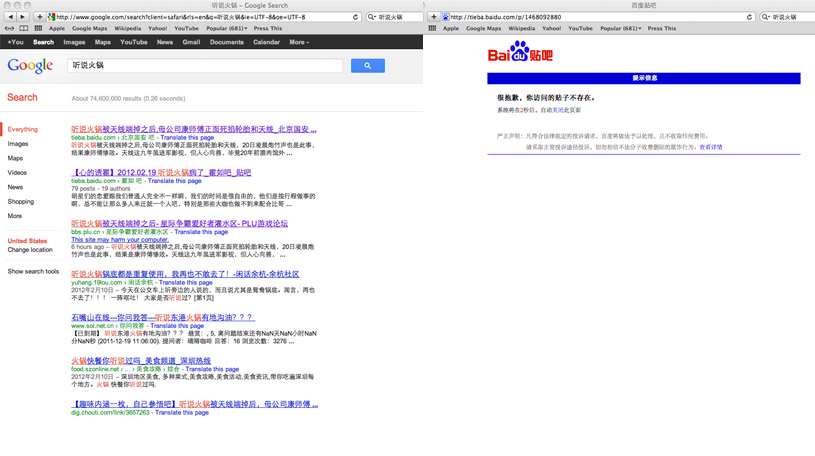
Rumor has it that after Hotpot was swept away by the Direct Line to Heaven, Noodle Master Kang of the Mother Company was openly fighting with Tire and Heaven Direct. The morning fireworks on the 20th were also part of this fight, with the result that the Noodle Master Kang took a serious hit. Even though these past nine years Heaven Direct has charged his way into the silver screen, nevertheless he’s well intentioned. After all, twenty years ago just outside the preserved ham shop, he was the man who stood behind Yangzhou Fried Rice. If y’all sing and eat hotpot again, his nine years of blood and sweat will be as nothing. Thus, it’s a good thing that Tire has the camouflage firmly in hand and soundly thrashed those instant noodles. [original: 听说火锅被天线端掉之后,母公司康师傅正面死掐轮胎和天线,20日凌晨炮竹声也是此事,结果是康师傅惨败。天线这九年虽进军影视,但人心向善,毕竟20年前腊肉馆外他是站在扬州炒饭背后的男人,你们再唱歌吃火锅,人家九年心血全没了,所以幸亏轮胎紧握迷彩涂装不放,才狠摔方便面。]

Traces of the passage remain in google cache but can no longer be accessed on Baidu (image below).

Why was the spoof so quickly removed from Baidu? Continue reading

Textual Logic: life as gerund

For me calligraphy has been one of the real pleasures of learning Chinese. Indeed, even when I can’t read what I’m seeing, I enjoy trying to following the line and figure out the character. Yesterday morning as part of the Textual Logic (书与法) exhibition at the OCAT Contemporary Art Terminal there was a calligraphy performance by Qiu Zhenzhong (邱振中) and Wang Dongling (王冬龄). So I was kind of “wow, calligraphy onstage. Fun.” However, it turned out that I had approached the event naively; calligraphers may or may not be fun, but the event felt like a cross between a movie star press conference and an art seminar.

The audience for the calligraphy performance was not OCAT’s typical audience who tend to have western aesthetics and a passion for conceptual art. Instead, the audience (not including the calligraphers’ respective entourages) was made up of calligraphers and folks who might be classified as calli-groupies, whose comments ranged from how the room had been set up through how the ink was mixed to how difficult it was or was not to write at this scale for so long. Indeed, it was a happy, almost fair-like event with pauses for watching and then commenting. Needless to say, the audience also complained that photographers and videographers had been given front row positions and could follow the calligrapher.

This slideshow requires JavaScript.

The level of audience participation in the exhibition struck me wonderful.  Continue reading