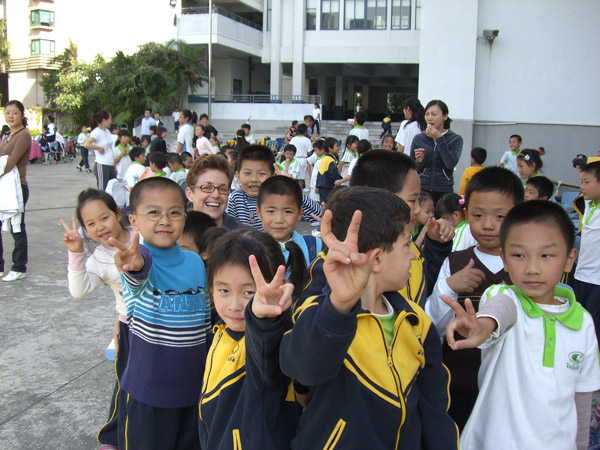
The Violence of Childhood

In talking with people about sociocratic principles, I find myself reminicing about my time as a vice-principal or college councelor and am once again reminded of the violence of childhood and how that violence shapes our understanding of governance because governance is, ultimately, about figuring out how to live together.

I have a clear memory of a first-grader who didn’t like math. Not hard to understand from my US American perspective perhaps, but unacceptable from the perspective of his parents, teachers, and other Chinese adults in his life. The reasoning was both psychological and pragmatic: to excel in math, self-confidence was important and the best way to develop self-confidence was through high test scores. Moreover, the logic continued, elementary math tests were simple and so there wasn’t any reason, except perhaps laziness or stubbornness for a child not to do well in math.

The boy’s first grade math scores were low by local standards; he was averaging between 88 and 93ish on tests, but his classmates were all forging ahead with perfect scores plus extra credit and, a friend helpfully reminded me, in elementary school most students received over 95 on math tests. Clearly the boy had a problem. Nevertheless, his parents were progressive in that they believed that if a student liked a class, he would do better in it and so it became imperative to talk their son into liking math. They thought that if he liked math then he would (1) stop being lazy and work harder and (2) stop resisting their efforts to make him do extra math problems and cooperate with his tutor.

So the parents talked to him. His grandparents talked to him. His teachers talked to him. Several months into this process, they scheduled a meeting with me so that I too could talk him. Nobody actually listened to him.

At the time, I spoke directly to the parents suggesting that the boy had a responsibility as a student to work hard in class and finish assignments, but had no corresponding obligation to like math or spend time each week with a private tutor preparing for Olympic maths, I was told that (1) I was too idealistic and (2) I was American and didn’t understand Chinese children. What didn’t I understand? The importance of elementary school math test scores? They aren’t actually important. And thus, our conversation came to ignoble cross purposes and the boy continued to dislike math and do relatively poorly at it. Over the next few years, parental and teacher conversations escalated into scolding and punishments, although to my knowledge the boy was never beaten for his math scores.

In retrospect, I think the boy’s parents were trying to tell me that I hadn’t assuaged their fears for their son’s future. I’m not sure I could have because for them math tests symbolized future potential to navigate the “real world”. What would happen, the analogy goes when a child went out in the real world, where life tests weren’t simple and failure meant… although this is actually where the logic stumbles because no one knows how low math scores might ultimately destroy a human life. The immediate source of parental fear seemed to be that if the boy didn’t excel in elementary math, he would do poorly on the Shenzhen high school entrance exam, subsequently do poorly on the gaokao, and then end up in a vocational school or worse, laboring as a construction or sanitation worker. Although here again, the logic blurs, because in Shenzhen rural boys who fail to get scholarships to high school end up working on construction sites and although these same rural boys also collect garbage, cleaning jobs go to rural girls who fail to get high school scholarships. In contrast, the boy’s parents were actually worried that the boy couldn’t do better than getting into a foreign university equivalent of Shenzhen University.

I regret that I didn’t actively listen to either the boy or his parents. Its possible that with more practiced skills I might have helped the boy come to terms with the inevitability of classes we don’t like and how to deal with contradictions between our feelings and our responsibilities. I might also have helped his parents have more reasonable expectations for their son’s test scores and a more respectful attitude toward his likes and dislikes; not their job to tell him how he feels.

When we don’t actively listen to children, we teach them that their desires and fears and joys and accomplishments aren’t important. What matters is that they fit into our graded boxes. Clearly the boy’s parents didn’t care if he actually liked math, they simply wanted to find a way of achieving better test scores. They disagreed with traditions of forcing a child to something he didn’t want to do, and so the solution seemed to be forcing him to like it, so that he would then become a pro-active math student. Equally clearly, I didn’t care about the parents’ fears, I just wanted them to stop wasting my time lamenting a first grader’s math scores. I disagreed with their valuation of exams and didn’t see any way of convincing them that disliking math is okay and thus the solution seemed to be getting them out of my office as quickly as possible.

And there’s the rub: I’m starting to understand the violence of childhood as the lack of respect we have for children’s abilities and desires. And this lack of respect blossoms into grown-up inabilities to actually resolve problems in ways that nourish each other’s lives. His parents left my office more deeply convinced that a huge cultural gap separates Chinese and US American people. I remained in my office anxious that another set of parents would schedule a meeting to talk their daughter into liking a difficult subject, like English. But what seems to have actually occurred was another instance of childhood violence in which none of us adults had the wherewithal to help a six year old learn simple concepts of addition and subtraction.


reading the old man and the sea (in shenzhen)

I am currently reading The Old Man and the Sea with two 16 year old Chinese high school sophomores. They are cousins. One is a “good” student, strong and sly in the self-protective way of students who know how to work the system, but do not reach the upper echelon of test results. The other is delicate and shy, a “top” student, who is being groomed to test into Beijing University, producing results (出成绩) for her school and family. The good student knows that unless she goes abroad, she will no doubt end up at Shenzhen University, no matter how much harder she works at school; fortunately, her parents can afford to send her anywhere and so she is not too sly, and her eagerness to model good student answers quickly gives way to assertive self-confidence. The top student already struggles with contradictory desires and ambitions. She yearns to study abroad, but her homeroom teacher has already begun pressuring her to stop studying for the TOEFL and to use her extra time more productively — taking practice gaokao tests or studying the junior year high school curriculum. What’s more, the child of divorce she knows that her mother can’t afford Chinese tuitions, let alone foreign and thus she must secure a scholarship  wherever she attends university.

We sit around a square table, tracking the relationship between the old man and the marlin. Santiago believes that his fish is out there, and his quest begins when he sights the purposeful circling of a man-of-war bird. His faith is rewarded and the contest engaged. As the fish pulls the man further out to sea, away from from the lights of Havana and known landmarks, the old man endures, charts his progress against the stars and his suffering, and the fish becomes more than a fish — first a friend, then a brother, more noble, but less intelligent, a brother who must be convinced that he is less than he who came to kill. It is a grand battle that does not end in glory, but the realization of hubris, “I shouldn’t have gone out so far, fish,” the old man says to the marlin’s corpse, which has been strapped to the skiff and is being inexorably eaten by sharks. When the old man finally drifts ashore, all that remains is an 18 foot skeleton and the certainty of death.

I chose The Old Man and the Sea because, well misgivings about Hemingway notwithstanding, he knew his craft. His language is deceptively simple. Any sentence taken out of context seems ordinary, common even, but together his words sculpt moral landscapes that make exquisitely salient the brute masculinity and ultimately tragic consequences of lives lived against nature.

“Americans aren’t very peace-loving,” the good student concludes.

“Did the old man have faith in luck or faith in the sea?” the top student asks.

Thus, yesterday’s lesson transformed from a discussion about human limits into a conversation about how being human is culturally defined and experienced. The old man is not their old man, his fish is not their fish, and the sea that relentlessly pulls us out of our depth, that tests our forbearance and ultimately claims our soul, that sea does not figure their dreams. It may be a generational difference. But perhaps not. Certainly the new US passport is replete with pictures of men taking on nature — cowboys and seamen ruggedly occupying the western plains and Pacific waves, respectively. And that’s the point: the girls read with me because the good student’s mother is a friend and she has entrusted her daughter to me (and yes those words were used “交给你”) for old-fashioned Chinese purpose: edification rather than simple instruction. The goal of our bi-weekly meetings is not to improve English test scores or practice oral English, but rather close reading of novels, essays and poetry, to help the teenagers learn to navigate literary nuance elsewhere, which it turns out is also learning to simultaneously recognize oneself and one’s Other despite and across epic difference, which isn’t quite what Hemingway had in mind when he figured Man through his engagement with the Fish, but nevertheless where yesterday’s lesson ended.

power and authority in a chinese high school

Last night I heard a fifteen year old girl ask the rhetorical question, “Why are some suited to be a leader and others aren’t?” She had been comparing a teacher and a vice principal, both from her school. Apparently, the teacher had treated her badly and the vice principal had treated her well. Her disparaging remark neatly summarized a common understanding of power — people who treat others well deserve to be leaders. Implicit, of course, was the assumption that those who don’t treat others well don’t deserve to be leaders.

The question vexed me. On the one hand, she was correct to note the difference between authority and power as styles of leadership. The vice principal had helped her, which confirmed the legitimacy or the authority of his position. In contrast, the teacher had coerced her to do something she didn’t want to do. Coercion falls pretty unambiguously into the deployment of power category. On the other hand, these were not isolated events. They took place within a fraught social network in which the reason she had sought out her teacher and the vice principal came into play. At this level, both the teacher’s and the vice principal’s actions make sense. Continue reading

lament of generation 80

Opportunity in the post-Mao era — like all opportunity — has been a question of being in the right place at the right time. Below, I have translated a blog post, lamenting the fact that even if Shenzhen is the right place, it is no longer the right time; the opportunities are going, going, gone and if what remains are wage labor and education, even they are not enough for the poor.

Of note, the author uses the expression “poor second generation (穷二代)”, the direct opposite of the “rich second generation (富二代)”. More interestingly, he refers to “second generation farmers (农二代)”, as if the transition from farmer to urban resident was a natural progression. However, there have been generations of Chinese farmers — in fact, this is one definition of traditional Chinese culture. What then, we might wonder, is it about Shenzhen that gives rise to the expectation that each generation must do economically better than the last?

Shenzhen: Unfortunate Generation 80, Unhappy Workers, and the Hopeless Poor Second Generation

First of all, let me explain that my title refers to me. Perhaps you, who are reading this heading are one of the lucky Generation 80, the happy office workers. Or, maybe you’re one of the poor second generation or a second generation farmer but aren’t hopeless. If so, congratulations. My opinion isn’t going to be yours, its only representative of my thoughts.

Why is Generation 80 unfortunate? Continue reading

龙年元旦: Thoughts on why not to hate [Dashan or Chinese students]

I’ve been thinking about the three poisons (ignorance, attachment, and aversion), but especially about aversion because we frequently cite aversion as a reasonable response to the world as we find it. When we look to explain aversion, we shift attention from whether or not aversion itself is a problem to the question: is our aversion justified or not?

Consider, for example, the quora question, “Why do so many Chinese learners seem to hate Dashan (Mark Rowswell)?” Mark Roswell provided a succinct analysis of why westerners feel aversion toward Dashan:

“In short, the reasons seem to be as follows:

1) Overuse – people are sick and tired of hearing the name Dashan;

2) Resentment (Part A) – Dashan’s not the only Westerner who speaks Chinese fluently;

3) Resentment (Part B) – Being a foreign resident in China is not easy and Dashan gets all the breaks;

4) Political/Cultural – People wish Dashan had more of an edge;

5) Stereotyping – The assumption that Dashan is a performing monkey.

Yes, yes, and yes. But. If we’re giving our time and energy to figuring out why we hate Dashan, then we’re not giving or time and energy to (1) finding ways of politely acknowledging a conversational gambit and then adroitly changing the topic to one of common interest; (2) working through our own ego investments in speaking Chinese well: ‘Why,’ we wonder, ‘aren’t the Chinese complimenting moi?’; (3) being happy for someone else’s good fortune; (4) being the critical change we want to see in the world in general and China in particular, and; (5) becoming more proactive in our own lives. Continue reading

poor but honest farmers? that’s the buzz…

乡下人三句话培养好孩子:1。孩子,爸妈没本事,你要靠自己;2。孩子,做事先做人,一定不能做伤害别人的事;3。孩子,撒开手闯吧,实在不行,回家还有饭吃。

城里人三句话害孩子:1。宝贝,好好学习就行,其他爸爸妈妈来办;2。宝贝,记住不能吃亏;3。我告诉你,再不好好学习,长大没饭吃!

Country people raise their children on three sentences: 1. kid, your parents are useless, you’ll have to depend on yourself; 2. kid, to accomplish anything, first you have to be a good person, never do anything that would harm anyone else; 3. kid, let go and give it your best shot, in the worst case, if you come home there’ll still be food to eat.

City people harm their children with three sentences: 1. darling, all you have to do is study, daddy and mommy will take care of the rest; 2. darling, always remember you can’t loose out to anyone else; 3. I’m telling you, if you don’t sit down and study, when you grow up you grow up, you’ll have nothing to eat!

’nuff said.

Education and the production of educated masses

This is a speculative post from yesterday’s walk through Shenzhen University. What struck me in the rubble and organization of public spaces was how much was dedicated to creating mass audiences. Not just not enough for people to be present to observe and thereby constitute political hierarchies, but also that knowledge mediates the rituals of inclusion. Moreover, collectively watching sporting events seems to (1) create massive masses and (2) reminds us that we learn more through the body than we do through eyes and ears when they are pinned uncomfortably in plastic seats. And yes, all these bikes collectively used and then forgotten over summer vacation. For the over 40 crowd like moi, these images tell how extensively China’s political-economy has been restructured from cities of cyclists on their way to work units to cities of recreational biking and cars.  Impressions of technologies for creating educated masses, below:

This slideshow requires JavaScript.

educational experimentation in shenzhen

For many years, I have noted the extent to which education has been closed off from the forms of social experimentation that characterize other aspects of Shenzhen society. Shenzhen was first to reform the danwei system, housing allocation, and even hukou laws. However, education has rigidly conformed to national standards — curriculum, methods, and goals, all have reflected national values and goals. When there has been experimentation, it has taken the form of international education — importing extant curriculums, such as the A-levels or American programs, rather than re-inventing Chinese schools. Even University Town (深圳大学城), which provides graduate education and research facilities has developed within a more standard academic model.

Yesterday, the opening ceremony of Southern Institute of Technology (南方科技大学) indicated a willingness on the part of both the national and municipal governments to invest in the search for new pedagogies. Differences with traditional colleges include: (1) size: SIT will offer small scale undergraduate education. The first class has only 45 students; next year, SIT will take in a class of 150, building until a cap of 400 students per class year. (2) recruitment: SIT recruits students through individual application rather than through the gaokao. (3) evaluation and graduation requirements: SIT has hired top academics to design classes and determine what course content should be. Moreover, at the level of specialization, students will be given the opportunity to design their own major. This is significantly different from the national standard, where undergraduate programs still reflect national standards. Moreover, there is little opportunity for students to study outside their major, let alone design their own. (4) residential dorms with house parents / teachers. SIT hopes to encourage a more familial atmosphere in its dorms and to provide life counseling for students as they adapt to academic life. Indeed, to my American eyes, SIT seems more like a liberal arts college than it does a university — Harvey Mudd, rather than a tradition technological institute like Qinghua or Cal Tech.

Four years to see what happens, at which point, presumably more cities and colleges will be given the opportunity to reform Chinese higher education.

China Talk

Today, I visited my niece’s third grade class to talk about China and had a practical answer to the question, “how do we teach across experience?”

First, show and tell. I brought in money, a kite, mini-terracotta warriors, a teapot and pu’er tea, and a map (and yes, like elementary students in China, these third graders saw how closely China’s borders resemble the silhouette of a chicken.)

Second, play. We looked at the money and compared it to dollars. Several students taught me how to make sweet tea and then I showed them how to use the teapot (and yes, teapots travel.) We also played go fish (去钓鱼!) in Chinese to learn about tones.

Third, detailed story-telling. The students loved the story of the Qin Emperor (秦始皇), wanting to know how many kingdoms he conquered, how many soldiers were buried with him, and what kind clothes he wore.

It seems self evident, but: why isn’t education always this fun?

more thoughts on education

Having published on the zhongkao and with Hu Jintao’s visit to the US, my father and I have been discussing education. Here is an excerpt from the dialogue.

Dad: China is in the news as Hu Jintao bops around the states. Since China is our banker, he is being received with open arms. Send more money please Mr. Banker! The news has also been focusing on education, and naturally we (US) suck in comparison. We are now 17th in the world and falling. South East Asia is leading the pack and putting distance between themselves and the US. Due to failing state budgets, (we are in tough economic times), we will be laying off at least 25% of our teachers! Unlike the federal govt., states are required to balance their budgets. In Moore County this means 600 teachers. No school district in the state [North Carolina] is hiring. Who would have thunk?

MA: As for education, I’m not sure we can talk about ahead and behind when both systems reproduce conditions of inequality. Both systems need not only to produce underpaid workers, but also “acceptable” reasons to legitimate inequality. Clearly, the US system is getting really good at it; can’t do math go into service. China is also very good at it, when you keep in mind that they have five times our population; can’t pass the zhongkao go to a factory; can’t pass the gaokao be an underpaid clerk. Consequently, in China the cream that is rising is proportionately much, much smaller than in the US. So maybe what’s actually happening is that China is setting what Marx would have called “acceptable living wage” for the world. Importantly, the acceptable living wage in China is much lower than in the US, so our wages are shrinking because we need to lower our national acceptable living wage in order to compete globally. I think at Harvard business, the unsinkable call this “economic adjustment” and then go out for a Michelin starred meal.

Please join the conversation. How we educate is the expression of why we teach children; clearly, all of us everywhere need fresh inspiration.