Why does the West misread Shenzhen?

Here’s a quote introducing the SEZ’s investment environment. I lifted it directly from the English website of the Shenzhen Municipal Government. I like it because it makes explicit the different ways that the Chinese government and neoliberal Western think tanks evaluate Shenzhen:

Economic Power

Shenzhen is fourth on the Chinese mainland in terms of economic power and one of the cities that has generated the biggest economic returns.

Shenzhen was second in an economic performance listing by the Brookings Institute and the LSE Cities. The Global Metro Monitor report published in November 2010, which examined data on economic output and employment in 150 of the world’s largest metropolitan economies, showed that Shenzhen’s economic performance was second in the world and first in China.

And that’s the point. In China, Shenzhen is fourth, behind Beijing, Shanghai, and Guangzhou. China ranks its cities not only in terms of economy, but also political clout. So yes, Shenzhen’s economic success has launched it ahead of other Chinese cities, such as Tianjin, which under Mao was city number three, but no matter what the SEZ’s international economic ranking, politically, Guangzhou is the highest ranking city in Guangdong Province. Full Stop. Continue reading

Qingming

Yesterday, went to Hongfa Temple for Qingming, or grave sweeping day. The traditional day to celebrate was the 15th day from the Spring Equinox, which usually falls around April 4, 5, or 6. Ever curious, I asked friends why a traditional Chinese holiday was celebrated according to the solar calendar. It turns out their were two explanations. First, Qingming was a lunar festival, usually celebrated on the third day of the third month. Second, Qingming was one of the 24 solar periods (二十四节气), when people came out to see the sun after winter. It could have been instituted as a shifting day holiday like the Spring or Mid-Autumn Festivals. Why it was not, I still don’t know. I do know, however, that when the Mainland reinstated Qingming as a public holiday in 2008, it was immediately associated with venerating national heroes and martyrs. Pictures from Hongfa Temple, the first temple built in China in the Post-Mao era. Yes, Reform-era public support for religious practice was also a Shenzhen “first”.

This slideshow requires JavaScript.

Bill Aichison in and around Xiamen

Friend Bill Aichison is preparing “The Customer is Always Wrong,” a performance piece based on his exploration of things Chinese in Xiamen. Teaser video and project blog worth a look.

viewpoints

Just saw Ajax at the American Repertory Theater, Boston and am thinking about reasons we go to war or refuse to bury a fallen enemy; the imperative to honor the dead precisely because once we have fallen what else remains but acknowledgement of a fundamental something that could not otherwise be named? So while I wait on a friend, I sit in a bar listening to people scream at each other, but they aren’t angry, it’s just that their voices raise when their interlocutor disagrees, as if persuasion might make it — whatever it is — true.

Sometimes, when thinking about cultural difference, I forget that it is painfully difficult within cultural similarity to accept incommensurable ways of being. In Shenzhen, I often suffer from a fundamental disconnection, floating lightly. But here, home, suddenly this homegrown feeling tricks me into feeling that the world is as I think; a mistake I rarely make in Shenzhen because I still have difficulty controlling my tones, let alone a tight philosophical argument in Chinese.

generations

Lately I have been writing about Generations 80 and 90 because much of what they do and think mark interesting sites of departure from older generations. Today, a brief comment about my experience watching Beijing Opera with an 80 year-old friend.

Continue reading

why text messages?

As the Christmas decorations have been quickly swept away, Shenzhen has entered Chinese New Year mode. Rabbits are popping up everywhere and every type of text message from year in review to greetings are already circulating. On this blog, I have translated text messages because they provide insight into what my Chinese friends feel is worthwhile (funny, insightful, urgent) commentary on society. Indeed, text message culture (短信文化) has been an important factor in many recent social movements (2006, 2007, 2008, and 2009). Indeed, many speculated that the 2010 crackdown on text-porn was a not-so-subtle attempt to tighten censorship controls.

However, simply describing the effects of texting in Chinese cities overlooks an important question: why is texting so popular? Walk down a Shenzhen street and look into hair salons and dress shops, restaurants and convenience stores, any beautician, salesgirl, waiter, and clerk who is not serving a customer is reading or sending a text. On buses and the subway, in cars and yes, in classrooms and business meetings, movie theaters and restrooms, people are texting. Every Chinese New Year the country sets another world record for texts sent for a holiday.

I don’t understand the allure of texting. In part it’s generational; in high school, our thing were three-hour telephone calls. I still enjoy telephone conversations and really enjoy watching the antics of my nieces and nephews when we skype. In part, it’s skill; I do talk faster then I type in English or Chinese. But that’s not all of it. Chinese friends my age have readily adopted texting and regularly send me all sorts of messages. Indeed, setting up a date may involve a series of texts, rather than a phone call. And although part of the allure may be cost – it’s cheap cheap cheap to text – price doesn’t explain why many Chinese not only text, but also purchase services that allow them to text internationally. In other words, folks in Shenzhen are choosing to text more frequently and regularly than I would; indeed, they text in situations that I would either phone, or, frankly not bother. Indeed, in situations where I find texting intrusive, my friends cheerfully read and respond to a text.

And so here’s some cross-cultural speculation du jour: texting has enabled Chinese people to intensify a cultural preference to be in contact with people they care about and it is that moment of contact that is the true message. This desire to be together explains why it is socially necessary to apologize for not seeing a text message and responding immediately. Moreover, I suspect that text messages can grow into social movements precisely because they carry this underlying desire to be [stand] together. In this sense, text messages function as a constant assurance that a relationship is important. Chinese texters confirm this highly desired and desirable sense of solidarity by responding properly to a message. Sometimes that response is texting a smile, sometimes it is going to the restaurant, sometimes it is taking to the street to protest.

As with all speculation about how technology makes, unmakes, and restructures social relationships, the next question is how much quality time is necessary to keep the emotive message of texts resonant. What happens when relationships dissolve into nothing more than text messages? And how much text message-span really is enough to prompt some kind of counter apps? In the meantime, I’m reviewing lists of possible New Year’s messages to choose my contribution to the deluge.

新春佳节不送礼,发条短信祝福你,健康快乐常伴你,好运和你不分离,财神已经跟随你,财源滚滚进袋里,好处全都送给你!(I’m not sending a gift for Spring Festival, I’m sending a text to bless you. May you be healthy and happy. May luck stay with you. May the God of Wealth already accompany you and wealth roll into your pockets. May all good things be given to you!)

“Eye” is a hit!

“Eye” was a success, so successful in fact that people (with tickets) were turned away at the door. How could this happen?

The New Black Box Theater at Shenzhen University seats roughly 150 people, with space for folks to sit on the floor and aisles, and to stand in the back. So maybe 200 people can see a show. Most Fat Bird productions don’t fill the house, even when (as with “Eye”) it is a joint production with Shenzhen University and therefore the show is free and open to the public. Thus, in order to encourage people to come, we call our families, friends, and acquaintances and encourage them to come. We ask, “How many will come?” And then to encourage us, our families, friends, and acquaintances say, “five” or “six” or “fourteen”. On the day of the show, maybe two or three or nine actually come. Sometimes a few unexpected guests drift in, but because Fat Bird / SZU productions are advertised by word of mouth, generally everyone expects 1/3 of of the promised audience not to come.

So, for “Eye” folks gave tickets in the spirit of “1/3 of the promised audience won’t come”. Opening night, this strategy worked and all who came got in. However, by day three of the performance, people were being turned away at the door; on day four, SZU students were not allowed in so that guests could see the show and still about 100 people (including students) were turned away; and on day five, new special tickets that operated as tickets (and not as airline overbookings) were issued. On day five, I actually had to call several friends and uninvite them to the show. It seems that the audience began to spread the word that “Eye” is a great show and consequently, those with tickets not only came (expecting to get in), but also brought additional guests (who didn’t have tickets).

“Eye” exceeded all expectations. Of those who got into the house, most had seen Chinese opera and some had seen translations (or not) of American musicals, but for many in the audience it was the first Chinese musical they had seen. And they loved it. Yes, musical theater may be one of the great popular art forms because it’s hard not to enjoy singing and dancing even when we don’t understand the lyrics, but when we do, and the story connects with our lives – fun, fun, fun.

The concept is seriously absurd – human beings are killing all the pigs to prevent the spread of “swine flu”. The dog in charge of insuring animal cooperation with human demands, has to track down the last pig couple on earth in order to exterminate them. A space experiment gone wrong, Fat Bird has been placed under house arrest by the dog, but is recruited to help in find the missing pigs because he speaks human and animal languages. Indeed, the animals mistake Fat Bird – a cross between a human, pig, and bird embryo – as the angel who will save them from humanity because he is the new human. And as the pigs and dogs and bats and rats and frogs and cockroaches sing about life under human domination, the point is clear: we will only save ourselves when we understand that to be fully human is not to dominate other life forms, but to learn to live (and dance and sing) in harmony.

Thanks to all who helped produce the show and thanks to all who came and made it at hit.

thoughts on the culture of commerce

information about the shenzhen bay fringe festival is now online. the dates are december 4-12, 2010. there will be events everyday at the nanshan culture center, which is in fact the string of malls that run from baoli in the east through coastal city over houhai road to nanshan book city. and yes, the conflation of “culture” with “commerce” is both strategic and unfortunate. strategic because commerce is the way shenzhen artists step around politically sensitive questions. unfortunate because most shenzhen residents do not see interesting frissions between commerce and culture.

the hopeful aspect of commerce as culture is that what starts out as a strategy to introduce shenzhen residents to a wider variety of cultural forms may pry open an alternative space within the relentless commercialism of the area. the more distressing aspect, of course, is that the commercialism is relentless and, for many, an unquestioned good precisely because of its alliance with culture, especially, education. after all, commercialized shenzhen art remains primarily a means of earning additional gaokao points, even when a student actually enjoys music or painting or the ballet. for adults, art is a hobby.

the shenzhen conflation of commerce and culture is not unlike the american confusion of freedom to purchase with human emancipation. we buy sniper dolls for our daughters and do not question the principles organizing our toy stores (why dolls? why plastic bullets? why do we differentiate between children based on what their parents can and cannot afford?) and yes, this confusion annoys me; on bad days, i end up snapping at mothers who have done nothing more than ask if their daughters can earn alot of money if they go to the right colleges. (i haven’t recently taken out my frustration on americans because i left the country. next trip home i’m sure i’ll be snapping with the best of the turtles. sigh.)

come anyway. be the fissure that cracks open our hearts.

Discover Meilin

Halloween 2010 (yes, tomorrow Sunday Oct 31), from 7 to 10 pm, the nine Meilin coaster raiders will present their work at the Art De Viver Sculpture Academy No.8 Zhongkang Road, Shangmeilin / 福田区 上梅林中康路八号 雕塑家园圆筒. The event is bi-lingual and will include opportunities to discuss and think about what it means and how it feels to inhabit Shenzhen.

I will present, ¨If this is where we are, it must be how things are done¨ (detail above, introduction to other raiders, here.

Please join us.

teapot chinese lessons

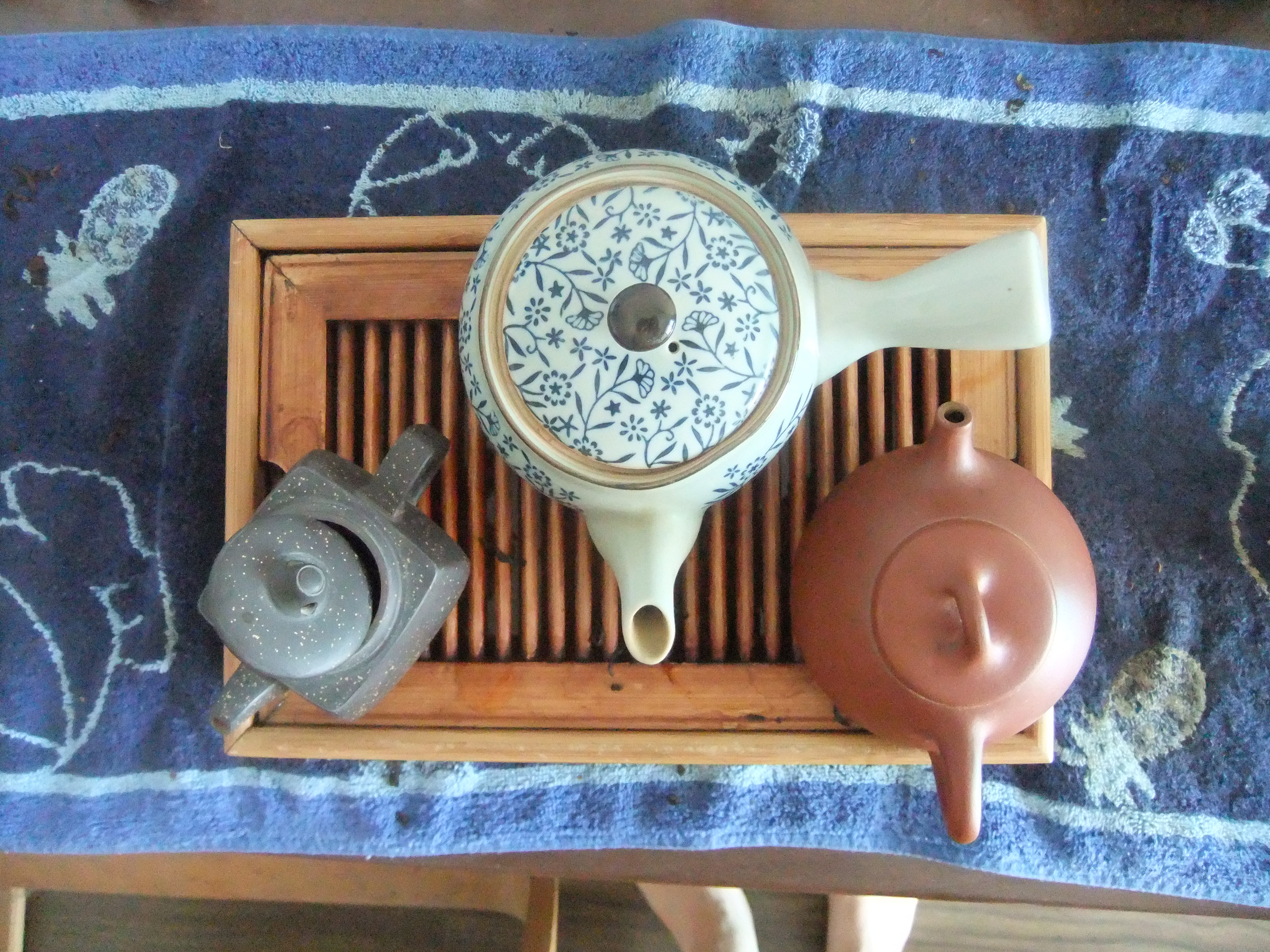
teapots remain some of my primary texts in learning mandarin. yesterday, for example, yang qian asked me which teapot i wanted to use. i answered, ¨the red one.¨ he laughed. why?

it turns out that the conventional order of description in mandarin would have been: the material the teapot was made of (clay 紫砂的 verses porcelain 瓷的), size (large 大的 versus small 小的), shape (round 圆的 versus square 方的), and only then color (black 黑的, red 红的, and blue 蓝的). so i could have asked for the ¨big clay pot¨ or ¨the round clay pot¨. he pointed out, with other items, such as a table top, texture (smooth 平的 versus 不平的 ) would have been more salient than color.

yang qian then posited that the ancient greeks understood the world through vision, while the chinese understood the world through tactility. consequently, our respective languages (off shoots of languages no longer spoken or even written) organize the world differently. i see color first, where he ¨sees¨ materiality.

in addition to learning to rephrase my requests, i´m not sure where to head with this. metaphors we live by (linguistic anthro 101) has remained one of my favorite books about language acquisition through increasingly abstract processes. default categories are more or less universal (tree, cup, pot) because we can touch them, but more specific and more general categories are shaped by culture (specific tree names and relative familiarity with said trees).

caveat aside, i´m now thinking about the cultural organization of pleasure. i´ve heard various arguments that chinese civilization has been traditionally more hedonistic than western. i have tended to interpret these arguments as projection of the ¨what i want my life to be, but isn´t, so i see that life in country x¨ variety of insight. but, it is interesting to contemplate that pleasures might be focused through different senses. and i find it even more interesting to think about how careful attention to everyday requests and descriptions might map entry into those other worlds.

yes, teapots bring all sorts of joy.